Clarifying words from Brian Zahnd

There are theologian-writers out there who consistently challenge me, inspire and compel me to prayerful change. Brian Zahnd is one of those. Although I’m including his entire post here, first written in October of 2025, I encourage you to support his ministry and click on his original here.

As Jesus came near and saw the city, he wept over it, saying, “If you, even you, only recognized on this day the things that make for peace! But now they are hidden from your eyes.”

–Jesus (Luke 19:41)

_________________________________________________________________________________________________________

Whether or not slavery was the direct cause for the first shots fired upon Fort Sumter in April of 1861 is a matter of scholarly debate. What is undeniable is that the fuel that caused the American Civil War to ignite into a conflagration that resulted in 750,000 deaths was two-and-a-half centuries of slavery. From its Jamestown beginnings, the American colonies—and later the United States—practiced one of the most brutal forms of slavery the world has ever known. The preservation of an institution that systematically dehumanized millions of people for the sake of economic gain was not a thing that made for peace! Inevitably that kind of cruel exploitation would overflow its cup and unleash death and hell, bringing everything that is the opposite of peace. During the horror of the American Civil War, the land of the free became a burning Gehenna. Thirty percent of Southern men of fighting age were slain on battlefields that saw the birth of modern warfare. From then on, war would be totalized and mechanized. The four horseman of the Apocalypse galloped across America leaving a wake of war, disease, famine, and death.

But in tragic irony the spiritual revival of the Second Great Awakening had swept through America during the decade before the Civil War. Americans flocked to churches and evangelistic meetings. This was especially true in the more religious South, where Christianity was embraced with greater fervency than in the less zealous North. Across the country revival was on, churches grew, conversions multiplied. People got saved, praised Jesus, and talked about heaven. Then they went to hell. Or at least the same kind of hell Jesus had warned Jerusalem about during his final days. Despite a great revival, a nation of Christians was thrust into a hell of cannonballs, Gatling guns, field hospitals, and amputation saws. Great cities were set aflame and fields were littered with thousands of rotting corpses. The fires were not quenched and the maggots did not die. What had gone wrong? Millions had accepted Jesus and shouted hosanna, but they did not know the things that make for peace. They prayed a sinner’s prayer, “got right with God,” and kept their slaves. They had a faith that would justify the slave owner while bringing no justice to the slave. They had faith that gave them a ticket to heaven and a highway to hell. The religious fervor in the conservative churches of the South only served to convince them that they were blessed by heaven. They were quite certain God smiled upon their deep devotion to their southern-fried Jesus. If they had to go to war to preserve their freedom, so be it—God was on their side. They were sure of it. But there would be hell to pay.

To help you comprehend how wrong the conservative churches of the Antebellum South were despite flaunting their faith in Jesus and clutching their well-worn Bibles, I’m going to enlist the help of someone who was there and saw it all—Mark Twain. In the chapter entitled “You Can’t Pray a Lie” in Twain’s beloved novel Adventures of Huckleberry Finn, Huck Finn has helped hide Miss Watson’s runaway slave, Jim. But Huck thought he was committing a sin in helping a runaway slave. Huck had learned in Sunday school “that people that acts as I’d been acting goes to everlasting fire.” So in an act of repentance in order to save his soul, Huck wrote a note to Miss Watson and told her where she could find her runaway slave. Now Huck was ready to pray his “sinner’s prayer” and “get saved.”

I felt good and all washed clean of sin for the first time I had ever felt so in my life, and I knowed I could pray now. But I didn’t do it straight off but laid the paper down and set there thinking—thinking how good it was all this happened so, and how near I come to being lost and going to hell. And went on thinking. And got to thinking over our trip down the river; and I see Jim before me all the time: in the day and in the night-time, sometimes moonlight, sometimes storms, and we a-floating along, talking and singing and laughing. But somehow I couldn’t seem to strike no places to harden me against him, but only the other kind. I’d see him standing my watch on top of his’n, ‘stead of calling me, so I could go on sleeping; and see how glad he was when I come back out of the fog; and when I come to him again in the swamp, up there where the feud was; and such-like times; and would always call me honey and pet me and do everything he could think of for me, and how good he always was; and at last I struck the time I saved him by telling the men we had smallpox aboard, and he was so grateful, and said I was the best friend old Jim ever had in the world and the only he’s got now; and then I happened to look around and see the paper. It was a close place. I took it up, and held it in my hand. I was a-trembling, because I’d got to decide, forever, betwixt two things, and I knowed it. I studied a minute, sort of holding my breath, and then says to myself: “All right, then, I’ll go to hell”—and tore it up. It was awful thoughts and awful words but they was said. And I let them stay said; and never thought no more about reforming.

Huck Finn had been shaped by the Christianity he’d found in his Missouri Sunday school—a Christianity focused on heaven in the afterlife while preserving the status quo of the here and now. Huck thought that helping Jim escape from slavery was a sin, because that’s what he had been taught. He knew he couldn’t ask God to forgive him until he was ready to “repent” and betray Jim. Huck didn’t want to go to hell; he wanted to be saved. But Huck loved his friend more, so he was willing to go to hell in order to save his friend from slavery.

Twain did a masterful job of showing us how wrongheaded Christians can be about what constitutes salvation. For Huck to act according to justice, he had to think he was committing a great sin. For Huck to act Christlike, he had to think he was forsaking Christianity. For Huck to love his neighbor as himself, he had to think he was condemning his soul to hell. Think about that a while!

Mark Twain used his skillful pen to skewer the conservative Christianity of the American South. Though Mark Twain wasn’t a believing Christian (and he wasn’t)—he was a prophet to the prevailing Christianity of his day. This was a compromised Christianity in desperate need of a prophetic voice. In seeking to preserve an economy dependent upon slave labor, Southern churches had embraced a fatally distorted faith. Probably without even knowing what they were doing, these Christians had quite effectively used Jesus and the Bible to validate their racist assumptions and protect their vested interests. They went to church on Sunday. They got saved. They loved Jesus. They waved their palms and shouted hosanna on Palm Sunday. But like the crowd in Jerusalem eighteen centuries earlier, they didn’t know the things that made for peace. And Jesus wept over an America headed to hell. The churches were full and slavery continued—until the Civil War, that is. Then 750,000 people died for the sins of America.

This is more than a recitation of history; there’s a lesson to learn here. When we don’t know the things that make for peace, we can barrel down the highway to hell, all the while singing about how much we love Jesus and how wonderful it is to be saved. This should disturb us. How can it be that generations of religiously observant people can say all the right things about Jesus and still be on the wrong road? How can we know the things that make for a good church service but not know the things that make for peace?

Jesus said that something has hidden the peaceful way from our eyes . . . and more often than not, it’s a flag. If patriotism simply means the pride of place that inspires civic responsibility, so be it. But if patriotism means “my country right or wrong,” it’s a kind of groupthink blindness that hides the things that make for peace. Unfurled flags of nationalism have a long history of hiding the things of Christ that make for peace. Whether they are Roman, Byzantine, Spanish, French, English, German, Russian, or American flags, when they hide the things that make for peace, they are no longer the innocent banners of a benign patriotism.

So what are the things that make for peace? What is it we need to perceive if we are to avoid the bloody boomerang of a self-inflicted hell? Jesus told us when he said:

In everything do to others as you would have them do to you; for this is the law and the prophets. Enter through the narrow gate; for the gate is wide and the road is easy that leads to destruction, and there are many who take it. For the gate is narrow and the road is hard that leads to life, and there are few who find it. –Matthew 7:12-14

The things that make for peace are the two great commandments: love of God and love of neighbor, but especially the second command. (Love of God is only validated by a cosuffering love of neighbor.) The “golden rule” of evaluating our actions through the eyes of our neighbor is the narrow and difficult road that leads to life and peace. The golden rule is the narrow gate. The narrow gate is not a sinner’s prayer; the narrow gate is the practice of the Jesus way. The narrow gate is fulfilling the law and the prophets by empathetic love of neighbor in imitation of Jesus. When we hate and vilify others for ideological reasons, when we demonize and dehumanize others for nationalistic reasons, when we use and exploit others for economic reasons, we are on the highway to hell—we have chosen the well-worn road that leads to war and destruction. The deeply disconcerting thing is that it is entirely possible to cruise down the broad road of impending doom while singing songs of praise to Jesus. It happened on the first Palm Sunday. It happened a hundred and fifty years ago in America. It continues to happen today. If we think Jesus shares and endorses our disdain and enmity for our enemies, we don’t know the things that make for peace, and we are headed for an inevitable destruction, even if it takes a generation or two to arrive at our horrible destination. If we console ourselves with the promise of heaven in the afterlife while creating hell in this present life, we have embraced the tawdry religion of the crusader and forsaken the true faith of our Savior.

The road of nonviolent peacemaking is not an easy road, it’s not a popular road, and it’s certainly not a road for cowards. The road of “God is on our side, and he shall surely smite our enemies” is a wide road. A lot of parades have gone down that road. It doesn’t take much courage to travel that road; just fall in step and follow the crowd. A marching band is usually playing. But it’s also the road that leads to burned villages, bombed cities, and solemn processions of flag-draped coffins. Until the self-professed followers of Jesus are willing to forsake the wide road for the narrow way, the popular sentiment for the unpopular conviction, the easy assumptions for the hard alternatives—Jesus will continue to weep while his disciples shout hosanna.

I won’t pretend I have perfected the art of following Jesus on the narrow way that leads to life and peace instead of traipsing down the broad way that leads to death and war. Far from it. I’m a newcomer to the steep and narrow path of peacemaking. If I’m not careful, I can find myself trying to climb the path of peacemaking in a far too unpeaceable way. Which means I am falling on my face—or even tumbling back down the steep path. But still I know it’s the right path. I would not have found, much less chosen to travel, this hard and demanding path unless Jesus had led me on to it. I wasn’t going to be led onto the path of peacemaking by Gandhi or Rumi—as admirable as those men were. If today I’m trying to walk the narrow path of nonviolent peacemaking, its only because its where I find the footsteps of Jesus. It’s an uncrowded path, perhaps at times a lonely path. But it’s worth traveling, because I keep catching glimpses of Jesus farther up the road.

BZ

P.S. I wrote this thirteen years ago. This is an excerpt from A Farewell to Mars.

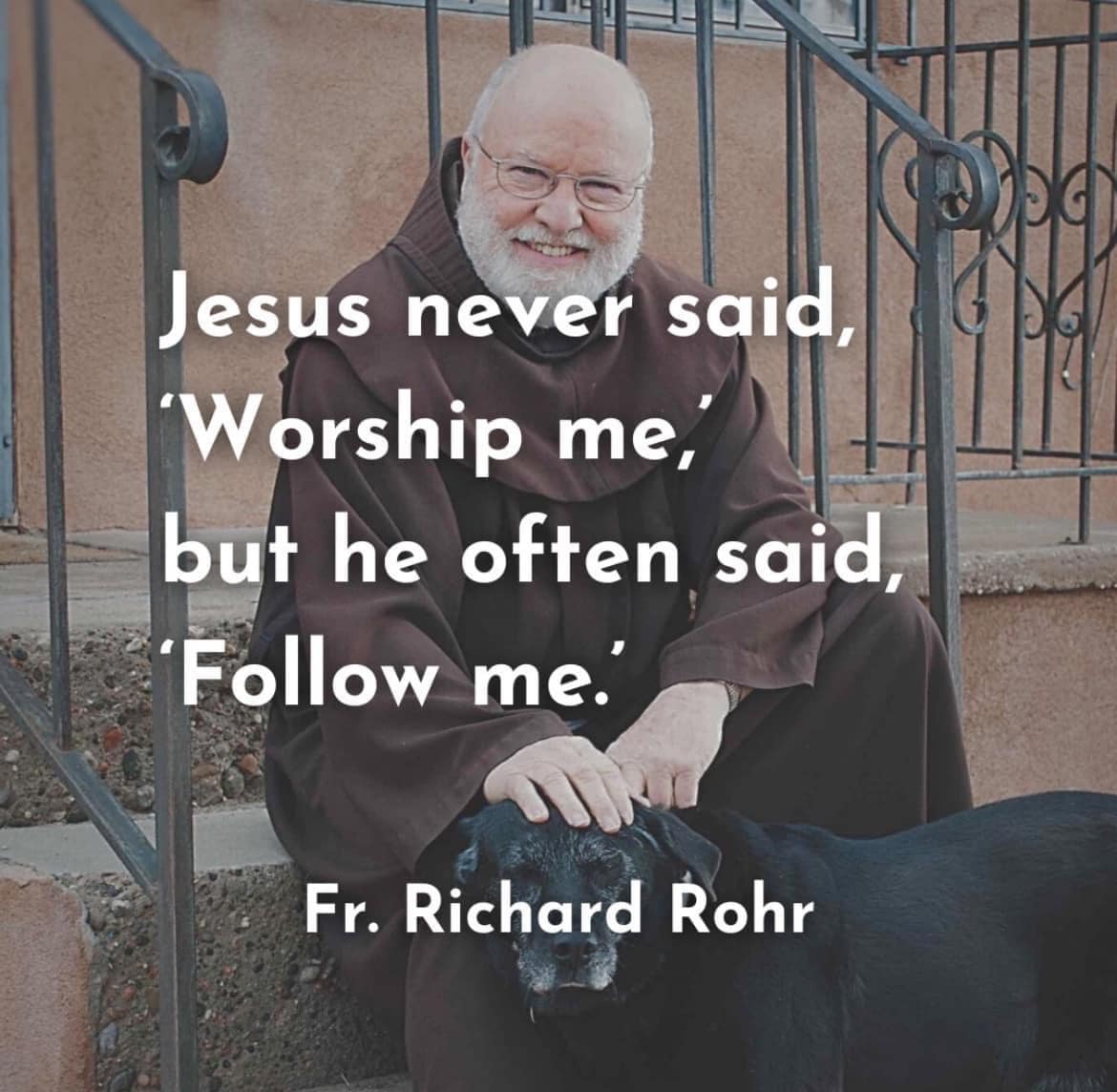
Notable Quotables – Richard Rohr

Doors

“A picture is worth a thousand words,” once proclaimed advertising executive, Fred R. Barnard.

Like so many of you, I love picture. Metaphor. Symbol. Illustrations as it were of the lives we lead that, themselves, mirror the confluence of flesh and fire, body and spirit, life and eternity. Occasionally, I post something that is a tip of the hat to such metaphors.

Door is a favourite such metaphor. They are something we must open ourselves but which, at times, are opened for us. Often, I open doors just for me, but most doors are communal, allowing others to go through with me, before me, instead of me, or even in spite of me. Once open, we’re faced with a decision: stand and gaze, or walk through and take an existential risk of faith mixed with trust. Once through, we gain the elation of having taken that risk and our view opens to be exponentially more expansive than it was before.

Speaking about prayer, Jesus made a remarkable promise to his disciples, “Knock, and the door will be opened for you.” He also said, “I am the door. If anyone enters through me, he will be saved, and will come in and go out, and find pasture.”

Such a profound, but mysterious, invitation!

Whatever the circumstance, in Christ, all such doors lead inward to friendship with God and outward to the riches of a universe being restored, renewed in God’s image. All of it an act of grace.

Come, let’s dare to walk through together.

Once upon a time – becoming the story

Sunday, September 5, 2021. Rosebud Church, Rosebud, Alberta.

Begin with Prayer

What follows is excerpted and morphed from a sermon I delivered recently on Prayer as the foundation for Evangelism.

________________________________

The time has never been greater for Christians to live as Christ Ones. Our world, our neighbourhoods, our families all need a freshly invigorated, Spirit-filled kiss from God through lives made whole and real in the Gospel.

As with everything else, Jesus is our example, our inspiration, and our guide. Because the topic of prayer is so vast, I’m paring it down to three episodes in the life of Jesus in order to see how he goes about this business of prayer.

Episode I – Jesus Prays for Enlightenment

Luke 6:12-13

12 Now during those days he went out to the mountain to pray; and he spent the night in prayer to God. 13And when day came, he called his disciples and chose twelve of them, whom he also named apostles:

Jesus prays for Enlightenment, for help in decision-making. At a key moment early in his ministry, Jesus prays all night to hone his spiritual spidey-senses to hear clearly from his Father. The time had come for him to choose his team. His apprentices. Those who would represent the Kingdom of God. We know them of course as the Apostles.

He didn’t consult his notes, or do background checks, or call references. He didn’t consult his Purpose Driven Life book or call up Joel Osteen. He didn’t check his horoscope.

He prayed.

He stopped everything he was doing, turned off his cell phone, and talked to God all night. And, upon his return, chooses twelve of the most influential people in human history.

As we live the Christian Way among our neighbours, we will need a spiritual sensitivity, honed and heightened by prayer. “Lord, where are those most hungry for a touch from you today? Lord, how do I know to whom you may be calling me to offer a word of hope? To help share a burden? To be a willing listener?”

The same way Jesus did. By prayer. In prayer we learn to trust the “holy hunch.”

Rae and I learned this lesson again a few weeks ago while on our way back from Seattle. We’d stopped to eat at Salty’s Restaurant on Alki Beach, a favourite haunt of ours. Our waitress was a young, intelligent, and gregarious young woman. She was quite chatty really. A Psychology student who is trying to make it in real estate. 

Before long we found ourselves buried in conversation with her. Then, the conversation moved very naturally into discussing matters of soul. She is feeling distanced from the faith of her parents who worshipped in a fundamentalist fashion. Her relationship with her parents was a bit strained to say the least.

In fact, she asked if she could stay after her shift was over. She longed to speak with us longer about her distant faith and of her disillusionment with the present state of Christianity in this country. She stayed for two hours! We enjoyed a very intense and moving conversation that was wonderfully beneficial to all of us.

We’re now good friends with her and her fiancée, a young man from Yakima, actually. And last weekend we were in Seattle again and ended up with an extra ticket to see Ed Sheeran in concert. We took him with us.

Why do we Begin with Prayer? Because we cannot see the way forward to just the right conversations with just the right people at just the right time in any other way.

Episode II – Jesus Prays for Empowerment

Mark 1:35-39 In the morning, while it was still very dark, he got up and went out to a deserted place, and there he prayed. 36And Simon and his companions hunted for him. 37When they found him, they said to him, ‘Everyone is searching for you.’ 38He answered, ‘Let us go on to the neighbouring towns, so that I may proclaim the message there also; for that is what I came out to do.’ 39And he went throughout Galilee, proclaiming the message in their synagogues and casting out demons.

Prior to this Jesus had been engaging in a flurry of teaching engagements, healing and helping and listening and dealing with the religious leaders. Apparently, healing people, casting out demons, raising people from the dead, losing friends, gaining enemies, and engaging in constant conflict with the religious brass was exhausting. Who knew?

The life to which we are called is a demanding one. Not just because of our own survival. But, because there will always be those around us who need God’s love. There will always be one more child to adopt. One more disease to cure. One more demon to cast out. One more lonely person to befriend. One more lost soul who needs the companionship of Jesus.

Kingdom work tired Jesus. It will tire us, too.  Prayer is to the soul what sleep is to the body; what sex is to a relationship. It nourishes and restores and sustains. Jesus needed prayer. So will we.

Why do we Begin with Prayer? Because relationships are beautiful but tiring.

Episode III – Jesus Prays for Encouragement

Matthew 26:36-44 Then Jesus went with them to a place called Gethsemane; and he said to his disciples, ‘Sit here while I go over there and pray.’ 37He took with him Peter and the two sons of Zebedee and began to be grieved and agitated. 38Then he said to them, ‘I am deeply grieved, even to death; remain here, and stay awake with me.’ 39And going a little farther, he threw himself on the ground and prayed, ‘My Father, if it is possible, let this cup pass from me; yet not what I want but what you want.’ 40Then he came to the disciples and found them sleeping; and he said to Peter, ‘So, could you not stay awake with me one hour? 41Stay awake and pray that you may not come into the time of trial; the spirit indeed is willing, but the flesh is weak.’ 42Again he went away for the second time and prayed, ‘My Father, if this cannot pass unless I drink it, your will be done.’ 43Again he came and found them sleeping, for their eyes were heavy. 44So leaving them again, he went away and prayed for the third time, saying the same words.

Life at times puts the squeeze on us. All of us at some point must carry the burden of the cross. We will confront fear, disappointment, pain, doubt, failure. We will face our own fox-hole faith moment when all our waning energies rally to a single point of bursting emotion: “Father, if it is possible, let this cup pass from me…”

Life lived as Good News is challenging. It will ask of us everything. Our time, our trust, our energy, our finances, our faith, our doubts…all of it. We will often be taxed well beyond what we can manage on our own.

Prayer is the place we are given enlightenment – seeing what we most need to see. Prayer wakes us up to what’s happening all around us.

Prayer is where we are empowered to do the work set before us. It is the oatmeal of our faith journey – where we are enlivened and sustained in Kingdom work.

And, prayer is where we will find encouragement to persist when all around seems bleak and impossible.

Why do we begin with prayer? Because Jesus did. And he’s the reason we’re doing any of this anyway.

___________________

Thanks to www.holyart.com for sponsoring this post

On Writing a Memoir, Part I

poets-pen.jpegSo, dear friends, I need your help. I’ve had a book percolating in me for some time now. But I need your help in pulling it out and getting it down. I’m inviting you, my dear readers, to help guide me on this journey.

Many of you have faithfully followed along with my often random, esoteric ramblings, with grace and dedication. I am utterly gratified to be in this with you. Truly.

Of the pieces you’ve read, what has struck you most? Deepest? What are the bits and bobs that have most touched you, made you laugh, or cry, or angry? I mean, the kinds of bits you’d read more of were they to find themselves between covers? So, this is an open invitation to you, my beloved readers, to walk with me toward some as yet undetermined goal of a memoir.

I appreciate you all so much. Your input is invaluable in the discernment process for this little project. Whaddya say? Can ya help a guy out?”


Love, Shackled by Unbelief

As a church music director I occasionally get opportunities to preach sermons. That should cause some of you to rejoice that the artsies have a pulpit voice, too. The rest of you will shudder at the idea that we’re allowed anywhere near one.

Ah well, what follows is my sermon from this morning, Sunday, August 5th. It’s been amended a bit to this audience who would tend not to react as negatively to more “spicy” language and approach.

I hope it lodges somewhere good, or at least, hungry.

Mark 6:1-13

6He left that place and came to his home town, and his disciples followed him. 2On the sabbath he began to teach in the synagogue, and many who heard him were astounded. They said, ‘Where did this man get all this? What is this wisdom that has been given to him? What deeds of power are being done by his hands! 3Is not this the carpenter, the son of Mary and brother of James and Joses and Judas and Simon, and are not his sisters here with us?’ And they took offence at him. 4Then Jesus said to them, ‘Prophets are not without honour, except in their home town, and among their own kin, and in their own house.’ 5And he could do no deed of power there, except that he laid his hands on a few sick people and cured them. 6And he was amazed at their unbelief. 

Then he went about among the villages teaching. 7He called the twelve and began to send them out two by two and gave them authority over the unclean spirits. 8He ordered them to take nothing for their journey except a staff; no bread, no bag, no money in their belts; 9but to wear sandals and not to put on two tunics. 10He said to them, ‘Wherever you enter a house, stay there until you leave the place. 11If any place will not welcome you and they refuse to hear you, as you leave, shake off the dust that is on your feet as a testimony against them.’ 12So they went out and proclaimed that all should repent. 13They cast out many demons and anointed with oil many who were sick and cured them.

Even a cursory jaunt through the Gospel of Mark gives us a picture of Jesus who doesn’t fit well into pre-existing categories. He is different than the conventional and, as such, is often viewed suspiciously, or as we shall see, even contemptuously.

This sermon takes place among a series entitled “Defiance – Challenging the Norm.” ‘Defiance’ here is intended as a general term meant to convey the prophetic, counter-cultural way in which Jesus lived, taught and related to others. He defied easy categorization.

He was then and shall ever be, a glorious enigma.

Jesus has begun a ministry of healing and teaching, confronting people with a new way of thinking, of being in the world. He’s been busy making waves, making sick people well, hopeless people hopeful, lost people found, demonized people free, the government nervous, and religious people pissed off.

So, with all that success and street cred in tow, Jesus comes now to his hometown. But he comes not on a social call. He arrives bringing with him the kingdom message and is prepared to fulfill the exact same purpose for which he has come. He returns to Nazareth to reveal this new way of looking at God.

And how does he go about doing such a thing? Exactly. He teaches in the synagogue to those who already “know God” (by the way, in the same way doctors make terrible patients, we religious folks can make the worst disciples!). He’s met quickly with disdain and rejection.

“Wait a minute. We know this guy. That’s a lotta book learnin’ coming from that weird kid who grew up down the street from Bob and Lydia’s place. Who the hell does he think he is?!”

In fact, this was what they said, “Where did this man get all this?” They can’t be bothered to use his name! “Is not this the carpenter, the son of Mary…?” They basically remind him of his status as an illegitimate bastard by referring to him as “the son of Mary.”

Jesus had likely dealt with whispers and sneers his whole life. The self-righteous do-goodery of small town gossips has ripened well. And old grudges die hard.

Their assumptions about Jesus and, by extension what a prophet is “supposed to be” have been challenged. “This is no prophet, this is that snot-nosed carpenter’s kid. And, certainly no Messiah, either.” They make themselves unreceptive to the saving power of grace.

How many of us, having gone out into the world and made something of ourselves have returned to our places of origin only to be met with suspicion, or even derision? This kind of thing happens all the time. There’s something about challenging the status quo that makes people uncomfortable.

Jesus, the small-town lad, returns home. But no longer is he Joseph’s boy who spent many an afternoon fashioning cedar china cabinets and coffee tables. He returns home to Nazareth, a Palestinian redneck town, flashing the equivalent of a Ph.D. and a big city car. And they don’t take kindly to him shoving all this in their faces.

There is an acceptable, well-established role for anyone calling themselves prophet. Do not move outside those lines. In their eyes, miracles of healing, however impressive, may well have been reduced to cheap parlour tricks from someone just showing off. And a salvation message, however profound, met with stony ears unprepared for it.

Love gets shackled by unbelief.  

To call him a prophet would have called into question all the ways they already saw the world and their place in it. It would have been to question their own hearts. And come on, that’s hard for most of us, isn’t it?

Poet John Donne once penned these words:

No man is an island,
Entire of itself,
Every man is a piece of the continent,
A part of the main.

We all have a collective grid of preconceptions, shared expectations, and accepted protocols through which we see out to the world and through which the world comes to us. If you don’t believe me, just try changing the rules to a game played for decades at the local social club. I dare you.

Because we have constructs for everything, we will have difficulty seeing Jesus when he challenges our comfortable assumptions. Jesus looks too much like us. We’ve coopted him, repackaged him, made him comfortable, usable, for us. Then, we lose the ability to see him in our daily activities, hear him speaking to us.

Theologian John Dominic Crossan once said, “beware of finding a Jesus entirely congenial to you.” We don’t want a Saviour who is constantly poking around at our idolatries. Our bigotries. How annoying! And to reject the Jesus who welcomes others, is automatically to reject God.

Let’s be honest, sometimes we’re either afraid or ashamed to be challenged because it’s just easier to rest in a Gospel re-envisioned to suit us. No outsiders allowed. Gather with those who look and think like us because it’s safer and more controllable.

This is something hard to see because those we think of as “other” are unique to every time and place. And, whenever we corral some particular group into the “unwanted” or “sinful” category, that’s precisely the place we will find Jesus.

We see this writ large in the ridiculous debacle of contemporary American politics. With ample posing, bluster, and incompetence enough for everyone with leftovers, we’ve decided it a great idea to crystalize our fears by bowing down to a self-proclaimed White House king. We say we want Jesus but really, we want Barabbas. And he means to neanderthalize what once was a cultural mecca for progressive (small ‘p’) values and diversity. Rather than seek to understand one another and enjoy the delightful surprises of acceptance, we vilify and demonize and divide. Indeed, our wrath spilleth over. 

Who here remembers Isaac Asimov? He was a professor of biochemistry at Boston University and a prolific author. He once said, “your assumptions are your window on the world. Scrub them off sometimes or the light won’t come in.”

Jesus is not in the business of satisfying what we already believe to be true. Jesus wants us to follow him who IS true.

You want to find Jesus? Don’t look for him on the courthouse lawn. Find him in the prisons.

Don’t look for him in the backyard suburbia. Find him in tent villages under bridges.

Don’t look for him in the Constitution. Find him in between the lines of graffiti or suicide notes.

Don’t look for him in the hallways of power and priviledge. Find him in the faces of caged children and in the mentally challenged.

See his face staring back through the black eyes and broken nose of the abused housewife.

Find him in the cyber-bullied student or pregnant teen.

See him looking back at you in the eyes of your Republican neighbour, your Democrat sister, your drug-addict brother, your senile grandma.

See him in your enemy.

It is as true now as it was then, Jesus is often the least welcome among those who claim to know him best. We can be slow to accept anything that challenges our deeply embedded assumptions. Over familiarity with what we’re convinced is true about Jesus can keep us on the outside of experiencing the love he offers.

And, at the very heart of the Gospel is love. It is God intruding into our lives, shattering our pre-existing ideas about everything. Not to be a bully. But to help us clean off our windows enough to let in some light.

Let us not be those whose cast iron opinions (of which, obviously, I’m equally guilty) disallow the in-breaking of God’s love into our lives. Let us instead be those who are always willing to be surprised by Jesus. Let us not allow our knowledge about Jesus stand in the way of our love for him.

Who knows, perhaps he’ll be welcome enough in our hearts to perform mighty deeds of power? Lord, in your mercy, may it be so. Amen.


Defiance: Introducing Mark’s Jesus

What follows is a “bloggified” version of my sermon from last Sunday, June 3rd.

* * * * *

Today we begin our summer sermon series entitled “Defiance: Challenging the Norm.” We will focus on Jesus’ radical, counter-cultural life and the ways he defied social norms, religious traditions, and theological expectations. We’ll be using for this exploration the gospel of Mark.

Mark will reveal to us a Jesus offering hope for the abundant life, convincing people that he was the promised Messiah, spending time with disreputable people, challenging the social conventions of his day, healing, teaching, eating and drinking, praying, and teaching his disciples to do the same.

 So, when we hear the word “defiance,” what comes to mind?

The stubborn two-year-old who sits pouting, arms folded, at the kitchen table because he didn’t get his way?

The angry teenager who shouts, “I hate you!” just before slamming shut her bedroom door?

That guy who insists on his right to walk through the shopping mall, teaming with families, with an open carry pistol?

Or, conversely, the PC police, social justice warrior who shouts down a speaker at a university campus because she disagrees with the message?

All of the above? None of the above?

Maybe this is what we think?Defiance 1 (boot).jpgPeople rising up against their oppressors. Jesus did that, although in subtle, subversive ways. And, he starts from the inside out. His weapons of choice? Love and his own life.

Or perhaps this?Defiance 7 (truth behind the lies).jpgPealing back lies to reveal truth. Jesus did that. “You have heard it said, but I tell you…” “I Am the way, the truth, and the life…”

Or maybe this?Defiance 8 (truth to power).jpgAlone, or together, having the courage to speak truth to power? Jesus did that, too. “Woe to you blind guides…” “You brood of vipers…” You know, the kind of things you say to your grandparents at family dinner.

How about this?Defiance 5 (overturning tables).jpgHere we see Jesus turning over the tables of the money-changers. This is Jesus, in defiance of the business of faith: T-shirt, bumper-sticker religion.

The image we decided on for at least the first part of the series is this one.Defiance 2 (little girl).jpgA little girl stands courageously against a raging bull. We see here the weak against the strong. The vulnerable against the bull-y (no extra charge for that one).

The dictionary defines “defiance” as follows:Slide 1-Defiance (definition).jpgLet’s explore how this might apply to Jesus.

All four Gospels are unique. They are four unique authors speaking from unique perspectives saying unique things about the unique, but complex person of Jesus.

Matthew wrote primarily to the Jews. Matthew’s Jesus is the fulfillment of God’s covenant promise to Abraham and of all the Law and Prophets.

Luke, a doctor, presents us with Jesus, the son of Man, lover of the poor and downtrodden, the hated prodigals now welcomed into the presence of God through him.

John was the mystic. He was the closest friend of Jesus and had heard his very heartbeat. It has this scent of tender familiarity. John’s Jesus takes us deep into the loving heart of God.

And then there’s Mark.

In the space of fifteen verses we get:

  1. The proclamation of a wild man – John the Baptist.
  2. The baptism of Jesus in the Jordan.
  3. A voice from heaven (freaky at the best of times).
  4. The temptation of Jesus, who Mark says was “driven” into the wilderness.
  5. The arrest of John. You know, the guy mentioned a couple sentences earlier!
  6. And, the beginning of Jesus’ Galilean ministry!

Mark’s gospel reads like a Hollywood blockbuster that opens with a car chase. It’s the biblical equivalent of the Fast and Furious! He’s so excited to tell us about Jesus that he spares no time. He. Is. Focused. Let’s just git ‘r done!

My wife and I are both lit-geeks. But Rae is really more the story-teller. She says that, in any study of story, the question of pacing is incredibly important. Too fast and it can lack the heart, depth, and staying power of great storytelling.          T    o    o     s    l    o    w    and    y   o   u    r   i   s   k     l   o   s   i   n   g     y  o  u  r    audience.

Hence, even Mark’s very pacing teaches us. Something has happened that radically changes the way we look at and experience the world, and he can’t wait to tell us about it. There is no more waiting. It’s happening right here, right now, in real time. It is decisive, dramatic and begs a response.

But how does Mark’s Jesus illustrate defiance?

We can do that in a single verse. Mark 1:1 says,

The beginning of the good news of Jesus Christ, the Son of God.”

How is this defiant, exactly? Well, this is a significant statement for many reasons.

What do we know of ancient Rome? It was a military occupation possessing a particular skill in “crowd control.” It was marked by its efficiency, technology, discipline, and finely-honed bureaucracy.

Rome was intimidating and ruled by means of the well-known adage – “the beatings shall continue until morale improves.” The Jews were all huddled up under the great shadow of Rome, longing for the promised Messiah to come and kick some Roman ass.

But what kind of Messiah did they get? Mark’s point is to convince them that Jesus is indeed the Messiah, just not in the sense they wanted him to be.

Let’s read that statement again:

The beginning of the good news of Jesus Christ, the Son of God.”

You may recall that Herod considered Jesus such a threat that he slaughtered an entire generation of Hebrew children. What was he so afraid of?

A child, rumoured to be king of the Jews, would have posed no small threat to a bumbling narcissist like Herod (sound familiar?).

Many Roman Caesars believed themselves to be God incarnate, a notion they were only too happy to enforce. For anyone other than Caesar to make such a claim would have been foolhardy in the extreme. To the Romans, for Jesus to be described as “the Son of God” was not a theological matter. It was a political threat.

And, guess what form of death was designed specifically for political dissidents?

Crucifixion.

Mark’s opening statement therefore is already a dangerously defiant one!

This Messiah does not set out to conquer. He sets out to suffer that the notion of conquering might come to an end. He doesn’t conquer Rome. He conquers death at Rome’s hands, forgiving them the whole time.

A defiant bait ‘n switch if ever there was one! His non-violent love defied – said ‘no’ – to blind hate and aggression and, through death, led ultimately to the freedom of all.

Jesus defied hatred with love.

He defied exclusion with invitation.

He defied the misguided hope for military salvation (take note America) and brought instead, freedom from sin and death.

He defied the kingdom of Caesar with the kingdom of God.

He defied everyone’s expectations, trading pride for humility.

Jesus should have baptized others. Instead, he allowed John to baptize him.

Jesus, Lord of the wilderness is, himself, driven there to starve and face down the archetypal temptations we all face. Why? That he might truly be one of us, in every way.

Jesus could have ruled a heavenly army. Instead, he says “the time is fulfilled, and the kingdom of God has come near; repent, and believe in the good news.”

Let’s ask Mark to take us on a journey, shall we? A journey into the heart of God, a God who does not look like what we’d expect.

He looks like Good News.

Amen.

“Do you want to be healed?”

“Do you want to be healed?”

For the longest time I had attributed it to the insistent paradigm of the poet’s logic, the lover’s unrequited dreams, the shifting clouds of the philosopher’s quest – all searching for something – a reality as numinous and perfect as it is deceptively secret and stubbornly resistant to conquest.

An ever-present sense of melancholy, a numbing ache, an unnameable yearning – desolation even – has draped my consciousness for many years. It seems I am a walking advertisement for mood enhancing substances and the pharmaceutical drug trade (or, maybe just self-pity?)

Sometimes, and inexplicably, my soul is shot through with little darts of light – suggestions of heaven, of how things truly are. They come unbidden mostly as ghostly sojourners, inhabitants of a more perfect realm come to slake my wheezing soul with wine, bread, and perhaps a song or two.

In recent days, this ubiquitous, verbose Demon of Grey Souls has gnawed at me for so long that it seems, by virtue of that fact, to have overplayed its hand. The hide ‘n seek after contentment, so long now the haunt of my days, has been smoldering behind its best hiding places under new rays of sun. I had willingly become a pawn in a cat and mouse game and my overseer has grown too fat to hide well.

New light, still diffuse and weak, but less coy or troublesome, is asking me a question; the ironic question Jesus once posed to some poor bugger by the Jerusalem Sheep Gate: do you want to be healed?

On the surface it’s a question as ridiculous as asking two young lovers, separated by time and circumstance, whether they’d like to make love. Upon reflection however, it reveals shear genius and a profound knowledge of the human psyche. In asking such a question, Jesus becomes more than just miracle-worker, more than a first-century doctor. He becomes psychologist and spiritual director.

He gazes beyond the obvious malady to which this fellow is chained and sees something else. His question is aimed at the man’s fear, not of remaining ill, but of the unknown world that might just open to him in the face of his healing. To be healed is to rejoin society. It is to refuse the Hogwart’s sorting hat from placing you once again into the House of Sufferin’. It is to relinquish the comfortable role of pitied and pitiful, dependent on the succoring cries of others, and take up one’s place responsibly as contributor and co-builder of a just and compassionate world.

The Spirit of God is revealing to me just how long I have sat beside my own Beth-zatha (see Jn. 5:2ff) with the expectation of healing but full of excuses for why it shouldn’t have or hasn’t yet happened. The brooding and mysterious artist persona, complete with philosopher-poet mystique and generous helping of eyes-down, hood-up melancholy is no longer a big enough hiding place for the overwhelming presence of this question, posed by Jehovah-Rapha (God, our healer).

Perhaps it’s about timing, we must wait until our own “fullness of time” (Gal. 4:4)? Perhaps God is content, as in the case of Job, to let us sit in our sackcloth and ashes long enough to remove all doubt that we’re so buried that only another can save us? Perhaps it’s just “our turn?”

Says Marilyn Gardiner, “We sit, often for years, with our paralysis. It may not be physical paralysis, but it is just as debilitating and defeating as physical paralysis. It prevents us from truly living, from being who we are called to be.”*

Whatever the case, I am ready to answer ‘yes’ to the question of Jesus. I am ready to shed one skin, now old and overused, and don a better one.  I am ready to see what has always existed just below the surface of my murky water. 

I think I’m ready to say ‘yes.’

I’m ready to say ‘yes.’

I say, ‘yes.’

Yes.

Will you?

_________

*Excerpted from Marilyn R. Gardiner’s wonderful blog, Communicating Across Boundaries

Words – A Good Friday Meditation

The first word: “Father, forgive them; for they do not know what they are doing.” (Luke 23:34)

Father, forgive them

As people, we assign significance to many things, deserving or not. But, if there is anything to which we assign particularly deep significance, it is to the words spoken to us by others we hold dear. A jaunty “good morning” from a work associate could never hold the same weight as if the words are spoken by that special someone whose attentions we’d been trying to attract. The regard we give to words spoken to us is directly proportionate to the one from whom and the context in which they are spoken.

For example, if we’re honest, how many of us would admit to twinges of discouragement, disappointment, or even anger at statements on social media that seem dismissive, flippant or maybe even abusive? They may never have been intended that way. But, devoid of a significant person’s voice and presence, and accompanying body language, we’re left to interpret from one-dimensional communication a multi-dimensional message.

We may read on our Facebook wall: “so, you’re happy with that, then?” Pretty benign really, isn’t it? Or is it? We don’t know. Those same words feel quite different when heard directly from the mouth of our best friend standing in front of us with a quirky grin on his or her face…”so, you’re happy with that, then?” We don’t have to “fill in the blanks.” We “get it.”

The generally agreed upon “7 last words of Jesus” from the cross have the deepest significance when understood in the broader context in which and by whom they were spoken.

To a group of men called out of their settled lives into the nomadic, unsettled life of Rabbinic apprentices, Jesus’ words already had weight. They may not always have understood. But they respected the source and therefore the words. But, remember that, by this point, they were busy licking their emotional wounds from having dismissed, betrayed, denied, disowned and finally abandoned him when he needed them most. They were literally swimming in grief and shame.

Therefore, it was significant that the first words from Jesus’ mouth were not of condemnation as one might reasonably expect. No, they were of forgiveness. They are also of particular importance given the shady circumstances surrounding his death.

Jesus had been handed over to be killed, not as a religious heretic or prophetic martyr, but as a political revolutionary. Jesus’ ignominious death was never really about blasphemy, or heresy as the religious leaders were fond of contending. Those were surface issues that made it easier to get rid of him. They were the straw man that became the elephant in the living room. Since we can’t seem to deal with this guy by theological means, let’s play the political card. Let’s throw him at Caesar and see what happens. Let’s appeal to the mass hysteria induced by authority figures telling people what they should be thinking about something. It was about a threat to power and control. He represented a genuine threat to the religious establishment.

The cross tells us many, many things. It tells us firstly, that Jesus didn’t give up, either on his mission or on the first recipients of that mission. He saw it through to the end. Not just any end, but an ignominious end at the hands of his own people willingly handing him over as nothing more than troublemaker to the Roman powers-that-be. It also tells us that his own people distanced themselves from him spiritually by insisting on crucifixion as the means of his death; a form of torture reserved for enemies of the state, not the nation of Israel.

That’s the context. “Father, forgive them, for they do not know what they are doing.” Under such shameful circumstances, no other words could possibly hold more powerful meaning.

Before Jesus says, “It is finished” he says, “Father, forgive them.” We are drawn to faith not in the hope of forgiveness but in the reality of forgiveness. We rush into the arms of a God not waiting to forgive, but a God who has already forgiven. The first words from the cross frame all the rest. We do not have to assign any other significance to them because God himself is the one who has answered the cry of Jesus.

Friends, forgiveness isn’t the end game of the cross. It’s the starting point. It isn’t the result. It’s the means of revealing a result. Our journey with God doesn’t come to a point of forgiveness. It begins there. Relationship doesn’t happen once forgiveness is offered. It can happen precisely BECAUSE forgiveness has been offered.

Amen.

Image found here