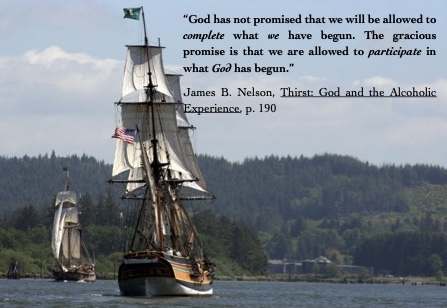
“Hi, I’m Rob, and I’m an alcoholic.” I say these words regularly. At this point they’re practically a mantra. Starting with this post, I will be sharing every episode of my new podcast venture: The Creative Recovery Initiative.
And so, it begins…

“Hi, I’m Rob, and I’m an alcoholic.” I say these words regularly. At this point they’re practically a mantra. Starting with this post, I will be sharing every episode of my new podcast venture: The Creative Recovery Initiative.
And so, it begins…
As a recovering alcoholic whose life and ministry revolves around working among others like me, how could I not be inspired by this amazing post by Bradley Jersak? I have this very conversation consistently, constantly, insistently, relentlessly.
The genius of Alcoholics Anonymous lay in its huge welcome mat. It introduces us to God but refuses to quickly define God. For those desperate for sobriety and community but without the trappings of “church” which might be far too triggering, this gentle introduction is perfect.
Please read and I trust you’ll be as compelled as I to learn still more about A.A. and your own “Higher Power.” Be sure to check out Brad’s Substack: “Christianity Without the Religion.”

While I was on a holiday with Eden, I had time to post what I think was an important article I wrote a while back about the God(s) of 12-step recovery.
* NOTE: This resource is not officially approved by any fellowship. These are observations of an individual member.
Introduction: The only prerequisite for joining any 12-Step recovery program is a desire to be free of our addictive behavior. While the program uses the terms “God” and “higher power,” it is also explicit about not imposing any religion, creed or dogma. In this way, anyone can participate regardless of their belief system. The founders of AA were committed to making the program accessible, not only to Christians, but to people of other faiths or no faith at all.
That said, the program does lead people on a journey of surrender to one’s “higher power,” including practices such as prayer and meditation, even if only “as if” God exists. These practices are meant to improve the addict’s conscious contact with their higher power, trusting that this will also deepen and heal their understanding of God.
In that context, I see two notions of God at work within the program: 1. the God of the addict’s understanding and 2. a God whose nature and attributes are described in the program.
Whether one comes from a dogmatic religious background or has no faith at all, when we speak of “God,” we admit that our ideas of God are incomplete and biased, formed by our culture, family and experiences. These ideas form “our understanding of God,” however immature, broken or twisted. Some of the most distorted images of God arise from early childhood trauma or overdeveloped fundamentalist training. Some addicts may be unable to entertain any idea of a God, so they may begin by thinking of their higher power as the principles of the program or embodied by the fellowship they attend. And fair enough.
The point is that however limited or misshapen, the “God of our understanding” is always enough for God to work with. Even if they pray to “the Unknown God”—God Anonymous, if you will—we believe God (as God truly is) sees the addict’s plight and hears the addict’s cry for help. That God will respond to every broken and willing heart. The path toward freedom has begun. The program teaches that this path will include growth and healing in our understanding of God. While 12-Step recovery resists forays into theology, it does in fact attribute at least five important character traits to God that we believe every addict will discover through the program.
The five traits of God revealed through the program are as follows:
A. God is loving: Addicts need to be reassured again and again that regardless of what their shame tells them, God is not angry with them. He is not a punitive judge, scowling at them in condemnation. Many addicts have fashioned a vindictive God out of the dust of their own shame—a God that they feel must hate them and is punishing them for their failings. But 12-Step recovery says, “No! God doesn’t hate you. You need not run or hide from God. God is not a gavel-heavy judge who treats your addiction as a moral failing. Instead, God is a Great Physician who sees your addiction as a disease. And his medicine is the love you’ll experience in the program.” But what does this love look like in practice?
B. God is caring: The love of God is experienced as care. God is not distant, absent or silent. God’s care is real, experienced in a variety of beautiful ways. For example, God’s care is known through the belonging and acceptance of the fellowship. God’s care is felt through the welcome of addicts just like us who listen without judgment—and especially through the care of a sponsor. This sense of care grows as the addict finds their prayers being answered, they know not how, and realize that God’s providential hand is at work for their good. Most of all, God’s care comes as the obsessions and cravings begin to lift, through moments of clarity and growing clean time.
C. God is forgiving: Addicts begin to learn that God is forgiving when they find their higher power already waiting for them at “rock bottom.” No matter how far we sink or how badly we’ve blown up our lives, the truth is that there is nothing God can’t forgive. While we proclaim this regularly in our meetings, we come to know it directly as we work steps 4 and 5 with our sponsor. Our sponsor embodies forgiveness as we share our “fearless moral inventory.” It’s also essential we know God has forgiven us before we make our amends. The reason for this is that God’s love is not conditional on the response of those we’ve harmed. Some may never be able to forgive us, and we mustn’t try to manipulate forgiveness from them. No, it is God who must and will and has forgiven us.
D. God is responsive: 12-Step literature tells us that we’ll gradually learn that God is responsive. A practice as simple as the Serenity Prayer comes with a growing expectancy that when we pray, God does and will grant us serenity, courage and wisdom beyond our temperament. As we work the steps, we discover that God truly does answer unselfish prayer. The step-3 prayer says, “God, I offer myself to you – to build with me and to do with me as you will. Relieve me of the bondage of self, that I may better do your will. Take away my difficulties, that victory over them may bear witness to those I would help of your Power, your Love, and your Way of Life.” As we practice daily gratitude for how these prayers manifest in our lives, we come to believe God is responsive and thus, personal.
E. God is personal: Many of us began as agnostics or even as atheists, and could not associate our higher power with a personal God. But by working the steps in earnest and even just praying “as if” faithfully, we came to believe that the “power greater than ourselves” is more than a projection. Words such as loving, caring, forgiving and responsive become lived realities, regardless of the name we chose for our higher power. We were no longer simply personifying the program—we were relating daily to something, or rather, Someone, who was personal—who never abandoned or condemned us, who would never leave us or give up on us.
Through Step 11, our spiritual awakening now included conscious contact with “the God of our understanding.” And that understanding now became a conviction: this God was loving, caring, forgiving, responsive and personal. This God humbly came to us, even anonymously, to guide us from shame to grace, and into the freedom of recovery.
Christians in 12-Step programs around the world have noted that making Jesus Christ their higher power has been beneficial to them personally. Certainly, the God who Jesus proclaimed as “Our Father” is loving, caring, forgiving, responsive and personal. However, some Christians have felt discomfort with speaking about God generically or “reducing” God to a “higher power.” They believe it might be “watering down the gospel” and reason that the program itself needs to upgrade its higher power to Jesus for it to truly be effective. Some groups, such as Overcomers Outreach and Celebrate Recovery, believe they have successfully transposed 12-Step recovery into a fruitful Christ-centered option suitable for their churches and ministries. That may be. I’ve heard some good reports.
However, it was not without reason or wisdom that Alcoholics Anonymous and its affiliates began as they did, despite their Christian foundations. Nor is Christianizing the program without its own perils.
First, the founders of AA understood some important truths that are compromised when we Christianize the program:
While any member is welcome to name Christ as their higher power, the peril of creating a fellowship where that confession is required (a) creates an exclusive “outer court” of conditional grace, and (b) gives the impression that until an addict believes what Christians believe, lasting recovery is not possible. This just isn’t so. God’s healing grace for addicts is not conditional on using the right name.
Conversely, while one might believe that naming Christ as one’s higher power is an obvious upgrade to our idea of God, the very opposite can and does happen! How so? Namely, in the name of Christ, certain fundamentalist aberrations concerning the nature of God are smuggled in. These include, for example, (a) shame, (b) punishment, and (c) moralism. These elements have no place in the program. Some Christian traditions would add that they have no place in Christianity either—and yet they have frequently infected the gospel with a fear-based message of an ugly and angry God.
The unspoken scandal is that the God of Christian religion has tended to be far less Christlike than the God of AA et al! Christian members of AA, NA, SAA, etc. ought to be encouraged to see their open fellowships, not as a watered-down gospel, but as a place for Christ himself to move anonymously, a hospital not for those who believe they’re righteous, but for those who know they need a doctor.
“The Difference a Year Makes, part 2: So, what now?”
The Creative Recovery Initiative is a labour of love I’ve developed over the past couple years living with my wife in Edinburgh, Scotland as global personnel with Serve Globally, our denomination‘s mission wing. I don’t pretend to be a professional vlogger, influencer, or documentarian. I don’t even own fancy equipment. What I have however is an iPhone, a story, a Saviour, and a desire to tell that story to as many who might benefit from hearing it.
Perhaps you’ll find yourself here in some way? Perhaps someone you know might find hope from the stories I tell here? Either way, I invite you into this space to join me in the telling. In so doing, we’ll find healing and build community, together.
Peace to you all…R
Life as an addict/alcoholic, whether in recovery or not, is treacherous. Fraught with sandbars, rocky shoals, and gale-force winds forever obstructing any forward motion. Shore could be in sight, hopes elevated, and one’s ship gets dashed against the rocks of the unexpected, uninvited, and unwelcome. Sadly, many do not survive. This is the story of one such soul.
We shall miss you, Elle.

There are those among us upon whose shoulders we stand when looking for ways out of the claws of darkness. Women and men who have peace and glory in equal measure tattooed upon their souls, waiting to help others across the finish line of pain to peace, chaos to glory. They are often unassuming and hard to spot in a crowd, their humility hiding their heroism. Bill W. (William Wilson (1895 – 1971), Dr. Bob (Robert Holbrook Smith 1879 – 1950), and Rev. Samuel Moor Shoemaker III (1893 – 1963), collectively, the architects of Alcoholics Anonymous. Says Bill of Rev. Shoemaker, “early AA got its ideas of self-examination, acknowledgement of character defects, restitution for harm done, and working with others straight from the Oxford Group and directly from Sam Shoemaker.”*
I Stand at the Door
by Rev. Sam Shoemaker of The Oxford Group
I stand by the door.
I neither go to far in, nor stay to far out.
The door is the most important door in the world –
It is the door through which men walk when they find God.
There is no use my going way inside and staying there,
When so many are still outside and they, as much as I,
Crave to know where the door is.
And all that so many ever find
Is only the wall where the door ought to be.
They creep along the wall like blind men,
With outstretched, groping hands,
Feeling for a door, knowing there must be a door,
Yet they never find it.
So I stand by the door.
The most tremendous thing in the world
Is for men to find that door – the door to God.
The most important thing that any man can do
Is to take hold of one of those blind, groping hands
And put it on the latch – the latch that only clicks
And opens to the man’s own touch.
Men die outside the door, as starving beggars die
On cold nights in cruel cities in the dead of winter.
Die for want of what is within their grasp.
They live on the other side of it – live because they have not found it.
Nothing else matters compared to helping them find it,
And open it, and walk in, and find Him.
So I stand by the door.
Go in great saints; go all the way in –
Go way down into the cavernous cellars,
And way up into the spacious attics.
It is a vast, roomy house, this house where God is.
Go into the deepest of hidden casements,
Of withdrawal, of silence, of sainthood.
Some must inhabit those inner rooms
And know the depths and heights of God,
And call outside to the rest of us how wonderful it is.
Sometimes I take a deeper look in.
Sometimes venture in a little farther,
But my place seems closer to the opening.
So I stand by the door.
There is another reason why I stand there.
Some people get part way in and become afraid
Lest God and the zeal of His house devour them;
For God is so very great and asks all of us.
And these people feel a cosmic claustrophobia
And want to get out. ‘Let me out!’ they cry.
And the people way inside only terrify them more.
Somebody must be by the door to tell them that they are spoiled.
For the old life, they have seen too much:
One taste of God and nothing but God will do any more.
Somebody must be watching for the frightened
Who seek to sneak out just where they came in,
To tell them how much better it is inside.
The people too far in do not see how near these are
To leaving – preoccupied with the wonder of it all.
Somebody must watch for those who have entered the door
But would like to run away. So for them too,
I stand by the door.
I admire the people who go way in.
But I wish they would not forget how it was
Before they got in. Then they would be able to help
The people who have not yet even found the door.
Or the people who want to run away again from God.
You can go in too deeply and stay in too long
And forget the people outside the door.
As for me, I shall take my old accustomed place,
Near enough to God to hear Him and know He is there,
But not so far from men as not to hear them,
And remember they are there too.
Where? Outside the door –
Thousands of them. Millions of them.
But – more important for me –
One of them, two of them, ten of them.
Whose hands I am intended to put on the latch.
So I shall stand by the door and wait
For those who seek it.
‘I had rather be a door-keeper
So I stand by the door.
So then, Mr. Wilson, Dr. Bob, and Rev. Sam, this recovering alcoholic thanks you.
See Wikipedia
I’ve been quite open about my struggle with alcoholism and subsequent recovery. Perhaps it is because, through my association with the program and community of A.A. I’ve rediscovered the loving, trustworthy God I once knew. That God somehow got lost along the way, despite my practices of faith, my role as a “professional Christian,” and a radical conversion experience at eighteen.
These days, my faith is simpler. It is not so cliché-ridden, expectation-laden, preconceived notions-driven. It is one of basics: learning humility, self-love, and the practices necessary to maintain and nourish the same. Along the way, I read everything I can get my hands on to assist in that journey. This is a short excerpt from my Seeds of Grace: A Nun’s Reflections on the Spirituality of Alcoholics Anonymous by Sister Molly Monahan (pseudonym).

If we are made in God’s image and God sings, then we should be singing, too.
Ancient Wisdom for Modern Seekers
Spiritual Direction for Integrated Living
From liquid courage to Sober Courage
an anamcara exploring those close encounters of the liminal kind
Collaborating with the Muses to inspire, create, and illuminate
...in such kind ways...
"That I may publish with the voice of thanksgiving, and tell of all thy wondrous works." Psalm 26:7
Blog for poet and singer-songwriter Malcolm Guite
…in the thick of things
REFLECTIONS & REVIEWS
Seeking that which is life giving.
… hope is oxygen
Homepage of Seymour Jacklin: Writer - Narrator - Facilitator
If we are made in God’s image and God sings, then we should be singing, too.
Ancient Wisdom for Modern Seekers
Spiritual Direction for Integrated Living
From liquid courage to Sober Courage
an anamcara exploring those close encounters of the liminal kind
Collaborating with the Muses to inspire, create, and illuminate
...in such kind ways...
"That I may publish with the voice of thanksgiving, and tell of all thy wondrous works." Psalm 26:7
Blog for poet and singer-songwriter Malcolm Guite
…in the thick of things
REFLECTIONS & REVIEWS
Seeking that which is life giving.
… hope is oxygen
Homepage of Seymour Jacklin: Writer - Narrator - Facilitator