We are living in a strange day, and with no way of really knowing what direction the wind will blow next. As a writer, poet, musician, and pastor, it is my job and my joy to speak truth to falsehood, love to hate, light to darkness.
So, in our current Coronahaze, rather than load up the Internet with more data, as helpful as it is, I thought I’d leave you with a daily dose of hope, some of it backdoor, some overt.
Today’s is brought to you from the queen of quirky gospel truisms, Nadia Bolz-Weber. Our responses to fear are not always our best selves. Trust me, as a recovering alcoholic, I know of which I speak. Let’s begin from via negativa and see what light may come before long, shall we?
In my last post I shared a gorgeous prayer poem written by Richard Carter. It is one of many in a deeply satisfying spiritual treatise written by the same. My lovely wife bought it for me when last we were at St. Martin-in-the-Fields in London’s Trafalgar Square just last November. This is the book in question: What follows is from the penultimate section of the book entitled “Staying with,” in which he outlines the Rule of Life for the recently established Nazareth Community. I found it especially poignant give our current situation in which we find ourselves – in much that is unknown.
Exhilarating, yes. Motivating, to be sure. But…uncertain. I find this little segment encouraging to say the least. It is, in a word, inspiring.
I’m sure you’ll love it as much as I did! Enjoy (then, buy the book!).
Negative capability
“The phrase was first used by the poet John Keats to characterize the human potential to pursue a vision of beauty even when it leads through intellectual confusion or uncertainty: ‘when a man is capable of being in uncertainties, mysteries, doubts, without any irritable reaching after fact and reason’. In fact, the sense of unknowing becomes the catalyst or the very thing that focuses, intensifies and enhances the search for a greater truth. There is an importance in staying with the discomfort of the unknown, fear and the unresolved, because it is in that place that we reach the borders of what we are and discover what we could become. Thus this uncomfortable place, or place of trepidation where there are no quick fixes or easy answers, can become the place of transformation. It is often the very things we fear and our own lack of certainty that help us to break through all pride and discover the truth of living at ground zero. Perhaps it is here that we will learn what it means to live by faith and by love. It is in this hard place that the face of the unknown can reveal to us the face of the beloved.”
I’ve been reading a wonderful book, “The City Is My Monastery: A Contemporary Rule of Life” by Richard Carter. My wife bought it for me when we last visited St. Martin in the Fields in London last year. It outlines the Nazareth Community established by Richard Curtis, a place where all may come, whether rich or poor, whatever their background, to participate in the common life of Jesus. Curtis, on staff at St. Martin’s and a former monk, reveals his personal journey of discovering community, contemplation, and peace in the heart of London.
What follows is just one of many gorgeous prayer poems found in its pages. A highly recommended read.
From friend and fellow seeker, Justin Coutts, comes a short but timely exposé on our favourite New Year’s Eve song tradition. A happy and prosperous 2020 to all of you. “Should auld acquaintance be forgot…”
Every year, on New Year’s Eve, people all around the world sing a few lines in Scots which most people don’t understand. Those lines are:
“Should auld acquaintance be forgot, and never brought tae mind. Should auld acquaintance be forgot, and the days of auld lang syne.”
I bet you always wondered what that even means. Well, I’m about to tell you.
The phrase Auld Lang Syne is in Scots. Now, Scots is a language which is very similar to English but is different enough to confuse people who aren’t familiar with it. It evolved at the same time as English did and was the main language of the Scottish lowlands for a long time. It is still spoken there today.
Many people think that Scots is just a weird accent that makes English hard to understand, but it is actually a language in its own right with similar…
I love when my wife brings the Prayers of the People in our liturgy. They are prayers that live in that uncomfortable space between pastoral nurture and prophetic nudging. This was her prayer from our service this morning, Sunday, December 29, 2019.
* * * *
Preamble
The first time I stepped into a Covenant Church in December 2003, I was struck by how it felt both evangelical and liturgical, like a Baptist Oreo cookie with a Lutheran Center. Afterwards, a man explained that one of the denominational distinctives is the reality of freedom in Christ. Essentially, what that means is that, on many issues we can agree to disagree agreeably. Our new Brazilian friend, Fabio, on the Serve Globally Europe team, calls the Covenant, ‘the Dog with the least fleas.’
This morning, instead of the Lord’s prayer, we’ll close with lyrics written by U2. Bono, the lead singer grew up in Dublin in the Catholic south of Ireland the product of a scandalous marriage during the height of IRA terrorism. His father, Catholic. His mother Protestant.
From our side of the pond, we can see the fighting has little do with Christianity, and everything to do with religious tribalism. Because he’s seen the human cost of not seeking peace, his background uniquely shaped him to write songs about it.
“One” was written at a time when the band were fighting over their direction. The core lyric, ‘we’re one, but we’re not the same, we get to carry each other, carry each other.’ It makes Bono an ideal Covenanter!
Will you join me in prayer?
Carry each other – a prayer
Our beloved Father in heaven,
We’re closer than ever before in history to people all over the world, and yet there are growing divisions and the rise of tribalism where once there was peace. Help your church in the world to answer conflicts and divisions with love and justice. Send workers where needed to bring physical and spiritual healing, and help Christians who live in places with surplus to provide for those who go without. May the smallest pinprick of light we bring swallow much darkness (thanks to my hubby for that line!).
It seems each time it’s my turn to pray, our nation is more divided than the previous time. Across our nation, churches and communities, Lord, we thank you for those who serve graciously and honestly. We pray that where leaders fail to do their tasks well, or uphold the oaths they take, may they be replaced.
Whether we identify as conservative, moderate or liberal, let us each conserve the rule of law, be moderate in our judgement of others and wise of those who seek to use the church for their own political ends. Let us be liberal in our love toward each other, especially those who aren’t part of our tribe.
Lord, in this time of division, let us hold onto hope and not be hijacked by our fears. Let us be wary of those who tell us who is out to get us and who we should blame. Let us remember those who seek to froth up our grievances with a paycheque attached to promoting those views. Help us to remember that conflict sells.
Lord, let us remember our nation is built upon the separation of church and state and that history shows us again and again when the church gets too close to power it is weakened. Therefore, help us to be cautious of Christian leaders who have become intoxicated by the proximity to power.
And we pray for those in our own church across the nation who once attended but have lost their way. Many see the church being committed partisans, blaming others, instead of committed Christians. May we show them, Lord, that our allegiance lies to Christ above all else, and that despite our differences, in you we are one. We are not the same. We get to carry each other, carry each other.

 Thank you, Dina Gregory, for posting this to our Facebook chat room. It’s perfect for all of us right now.
 What follows is from the penultimate section of the book entitled “Staying with,” in which he outlines the Rule of Life for the recently established Nazareth Community. I found it especially poignant give our current situation in which we find ourselves – in much that is unknown.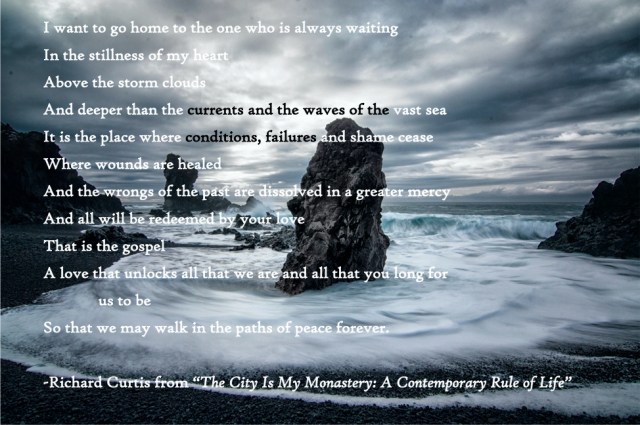



 innerwoven