So, this is part of a fun blogger’s initiative called a “Blog Hop.” Here’s how it works. I was invited by writer/poet friend, Lesley-Anne Evans, to join what amounts to a writer’s pyramid scheme. The rules of the game? Tag three other bloggers, all of whom will answer four questions about writing and the writing process. We post two weeks after the previous crew. Therefore, every two weeks, the number of bloggers posting grows exponentially!
The goal is simple – to connect writers who blog in a tighter community and hopefully, enrich others looking for answers to their own writing questions. Lesley-Anne is a gifted writer and poet who spends much of her time beautifying neighborhoods, cafes, street corners…wherever really, with poetry “installations.” She also does a fun thing called “Pop-up Poetry.” To see her contribution, click here.
My DNA, such as it is, swims in the veins of two amazing young men – my sons, Calum – 23 and Graeme – 18. Each morning, looking back from the bathroom mirror is a reminder that a percentage of my younger self dwells in their lives. To some degree, when they see their own reflections, they are seeing me. As they experience fear, pain, remorse or joy, they do so in ways similar to my own. Their responses, either good or bad, to the involuntary stimuli thrown out from a quivering universe will be reminiscent of my own. Whatever I’ve been able to cobble together as my present ‘self’, God and I struggling together, is what they too must face. It will be their challenge as they overcome in themselves my numerous knotted patterns of being that, sometimes, can strangle or eviscerate. But it is also their gift, implanted in their psyches to help guide them in those mirky moments that will require whatever small intuition was gifted me.
Watching my younger son graduate from high school last Thursday night (6/5/14) was pause enough to sing the praise of both these men. I cannot claim to be half the man I need to be for them. Indeed, I cannot always claim I’ve been a man at all to them. What I can say with a clear conscience and not inconsiderable pride is how much I wish I were more like them. That more of them might be seen in me. My life, my energy, the very blood in my veins, belongs to them.
Their calling now is to find their calling; to find their truest selves; to be their most passionate selves for a very needy world that awaits them, and needs who they are (thanks Mr. Buechner). Precious few would I trust to write what they should most hear. Today, I entrust this sacred task into the hands of the late John O’Donohue…
For the Unknown Self
So much of what delights and troubles you
Happens on a surface
You take for ground.
Your mind thinks your life alone,
Your eyes consider air your nearest neighbor,
Yet it seems that a little below your heart
There houses in you an unknown self
Who prefers the patterns of the dark
And is not persuaded by the eye’s affection
Or caught by the flash of thought.
It is a self that enjoys contemplative patience
With all your unfolding expression,
Is never drawn to break into light
Though you entangle yourself in unworthiness
And misjudge what you do and who you are.
It presides within like an evening freedom
That will often see you enchanted by twilight
Without ever recognizing the falling night,
It resembles the under-earth of your visible life:
It was a sweltering summer day. I wiped perspiration from my face while I made my way to the church. The topic I was about to address was hot, too, as in controversial. I had begun preaching a series entitled “Men, Women and God” in a congregation in the Ohio River Valley, a region with unusually high rates of violence against women.[1] My goal in the sermon series was to introduce the congregation to deeper levels of the healing and liberating power of the gospel. I also hoped to give voice to the suffering of many who experienced sexual abuse and domestic violence in our city. This is tricky in any church, introducing a tough topic like this in a way that opens people’s hearts and minds, challenges the status quo, and yet doesn’t alienate everyone.
So it was that on this Lord’s day, several weeks into the series in which I had already established a biblical foundation for gender equality, I talked about sexual abuse. I named its presence among Christians, its relationship to patriarchy and how the church that could help to prevent and heal this form of violence instead often perpetuates it.
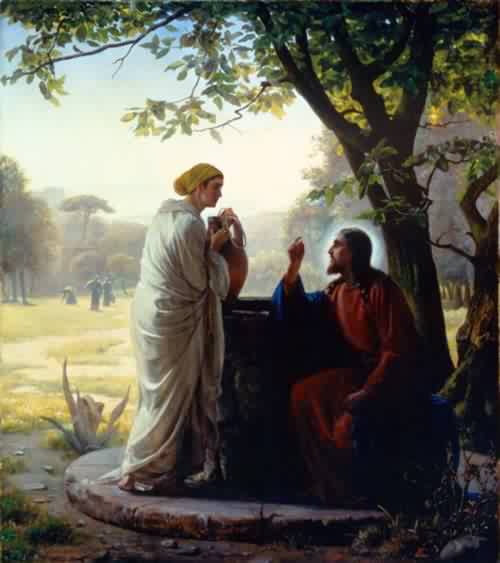
My biblical text was the story of the woman at the well in John 4. I have heard this woman described by preachers in many pulpits over the years, almost always with mild contempt. They referred to her multiple broken marriages as her problem, her issue, and something she instigated. She was tainted. Impure. Unclean. A joke. They treated her like a Samaritan Hollywood celebrity, ditching her latest conquest for someone younger. Today would be my chance to offer a very different view.
The congregation was unusually quiet, listening intently as I described the woman’s worth in God’s eyes. Jesus asked to drink from her cup, breaking cultural taboos on many levels, I said. She was a despised Samaritan, a woman who, because she might be on her monthly cycle, was automatically unclean and untouchable. She was alone at the well at noon, meaning she was an outcast from all the other women of the village who went to the well in the cool of early morning. She was everything that bigots in Jesus’ culture and her own people loved to hate. Yet, neither sexualized nor objectified her. He asked to drink from her cup, an unspeakable transgression of cultural norms.
Her series of rejections as an adult could very well have been the outcome of the wounds of childhood sexual abuse, I suggested. There were aspects of her adult life, I said, that are often found in survivors. She lived a narrative of broken boundaries that kept moving from bad to worse. In her culture men, not women, initiated divorce. Women couldn’t even bear witness in a court of law. Every time this woman experienced another divorce, another loss of home at the hands of a husband she became an easier target for predators. By the time Jesus met her she had reached the bottom. Now, she just lived with someone without the protection of marriage. In Jewish culture at the time this was crime, punishable by death. Here was a woman with deep wounds, living as an outcast.
So, instead of looking at her story as just one more example of an immoral woman, I said to a congregation that was absolutely silent and listening, what if we thought about the kind of childhood experiences that can move a person toward this much chaos as an adult. This familiar story from the gospels was a way to ease into a very difficult subject as we considered some of the consequences of childhood sexual abuse for adult survivors. As I spoke of the struggle with perfectionism and anxiety and other consequences of sexual abuse I noticed several people had tears in their eyes.
Bringing the message to a close, I reiterated the systemic layers of oppression that burdened this woman, isolating her from her own people and religious community, linking the sin of childhood sexual abuse to the larger systemic issue of patriarchy. The good news, I concluded, the wondrous truth, is that this woman became the first evangelist in the gospel of John. Because of her words, the entire town came to listen to and trust in Jesus and what he taught. This happened without her saying “I am a sinner, please forgive me,” or Jesus saying anything at all about sin. He did not say to her, “Go, and sin no more.” He did mention that she had had many husbands and was now living with someone. He was, as they say, naming the elephant in the room (or at the well) as to why she was outcast. I imagine him laughing and waving to her as she ran off mid-sentence to tell all the people who loved to hate her, about Jesus.
Here’s the thing. She had always wondered about God, but who could she talk to about such things? So, Jesus talked to her at length. Not about sex or her checkered past, but about the nature of God; the problem of thinking we can lock God into a religious box, and the meaning of authentic worship. This was a conversation Jesus had not had with anyone else. He spoke to the woman—an outsider on every level—as he would speak to one of his disciples—insiders. Jesus trusted her, wanted to drink from her cup, was willing to be seen with her. This woman was not her living situation. She was not her history of rejection. If indeed she was a survivor of childhood sexual abuse, she was not her abuse, either. She was a human being made in the image of God, someone for whom Jesus was happy to break lots of cultural rules. That is how she found her own voice, and with it led others to the one who set her free.
After the service I stood as usual, shaking hands at the door of the church. An older woman*, tall and dignified, thanked me for my sermon. It was the first sermon she had ever understood, she said. And she’d been a church person her entire life. Leaning close she said to me quietly, “I was raped when I was a child. I never told anyone before.” That day was the beginning of her healing.
Over many years as a pastor and theologian what I have learned is that the church and the world are full of people who need to hear the Bible interpreted by survivors of sexual abuse—those who are healing well and like the woman at the well, are doing our theological homework. We bring a different perspective. We get it about shame, how it destroys every aspect of life. We see through patriarchy in the name of religion, because it’s obvious to us that it is a road to hell. We know that straight doesn’t mean good and gay doesn’t mean bad. We think of sexual sin more in terms of violence. We also know how evil it is to be treated as a sex object because we bear in our bodies, memories, and stories the scars of that abuse. So, we are unwilling to victimize people because of their sexuality.
Today, I honor the woman at the well for her chutzpah, and Jesus for his transgression of cultural norms. Together they beckon all of us to look at our brokenness and our neighbor’s dysfunction through a different lens.
*Her identity has been obscured in the interest of privacy.
Adapted from We Were the Least of These: Reading the Bible with Survivors of Sexual Abuse (Grand Rapids: Brazos, 2011).
[1] The statistics for abuse for both genders are staggering. While both men and women are victims of sexual abuse and domestic violence, 95 percent of domestic violence is against women. Twice as many girls as boys are victimized by sexual abuse, with one out of three girls and one out of six boys experiencing sexual abuse before the age of 18. “Q&A” Faith Trust Institute, http://www.faithtrustinstitute.org/. Rape Victim Advocacy Program, “Myths and Facts—Child Sexual Abuse,” http://www.rvap.org/pages/myths_and_facts_about_child_sexual_abuse . “Domestic Violence in the Workplace Statistics,” American Institute on Domestic Violence, http://www.aidv-usa.com/Statistics.htm; “Domestic Violence Facts,” National Coalition Against Domestic Violence, http://www.ncadv.org/files/domesticviolencefacts.pdf.
Painting: “The Woman at the Well” by Carl Heinrich Bloch found here
Elaine A. Heath is the McCreless Professor of Evangelism at Perkins School of Theology, and is an ordained Elder in the United Methodist Church. She is the co-founder of the Missional Wisdom Foundation (www.missionalwisdom.com), which administers New Day, the Epworth Project, and The Academy for Missional Wisdom, an experimental network of missional, new monastic faith communities in historic mainline traditions. Elaine has provided retreat and seminar leadership in spiritual formation, leadership development for clergy, and the missional church for many years and is a highly sought after preacher, teacher and lecturer. Among her research interests are the new monasticism, emergence and the church, spirituality and evangelism, and gender and evangelism.
Missional.Monastic.Mainline. co-authored with Larry Duggins (Eugene: Cascade, 2013). We Were the Least of These: Reading the Bible with Survivors of Sexual Abuse (Grand Rapids: Brazos, 2011); The Gospel According to Twilight: Women, Sex, and God (Louisville: Westminster/John Knox, 2011); Longing for Spring: A New Vision for Wesleyan Community, co-authored with Scott Kisker, (Eugene, OR: Cascade, 2010); Naked Faith: The Mystical Theology of Phoebe Palmer, Princeton Theological Monograph Series(Eugene, OR: Pickwick Publications, 2009); The Mystic Way of Evangelism: A Contemplative Vision for Christian Outreach (Grand Rapids: Baker Academic, 2008); and More Light on the Path (Grand Rapids: Baker Book House, 1998), co-authored with David W. Baker.
Elaine holds a BA in English from Oakland University, an MDiv from Ashland Theological Seminary, and a PhD in theology from Duquesne University. She and her husband Randall live in Garland, Texas and are the parents of two adult daughters. Favorite activities include hiking, camping, bicycling, canoeing, exploring small towns, music and watching movies.
Like, Rev. Parker, I too am weary of the constant “exchange” among Evangelicalism and the Mainline. Now, as a post-Evangelical-non-Evangelical, but still needing the voice it brings to my own experience, I can sit back with a bit more objectivity and…listen.
These days, Evangelicalism makes me feel old. And tired.
The week that Phil Robertson was suspended, I was preparing for the funeral of a 16-month old girl killed in a car crash. The week he was re-instated, I was preparing for a funeral of man who took his own life, leaving 3 young children behind.
The Feast of the Epiphany, which celebrates the arrival of the three wise men at the manger in Bethlehem has a special mystery and joy to it. Until now the story of the coming Messiah has been confined to Israel, the covenant people, but here suddenly, mysteriously, are three Gentiles who have intuited that his birth is good new for them too. Here is an Epiphany, a revelation, that the birth of Christ is not one small step for a local religion but a great leap for all mankind. I love the way that traditionally the three wise men (or kings) are shown as representing the different races and cultures and languages of the world. I love the combination in their character of diligence and joy. They ‘seek diligently’, but they ‘rejoice with exceeding great joy’! I love the way they loved and followed a star, but didn’t stop at…
This is fun. Thanks to all you wonderful people who keep showing up here and making life so much more fun. Thank you. Thank you. Thank you. Love you all…R
Here’s an excerpt:
A New York City subway train holds 1,200 people. This blog was viewed about 5,600 times in 2013. If it were a NYC subway train, it would take about 5 trips to carry that many people.


 Light…



 innerwoven