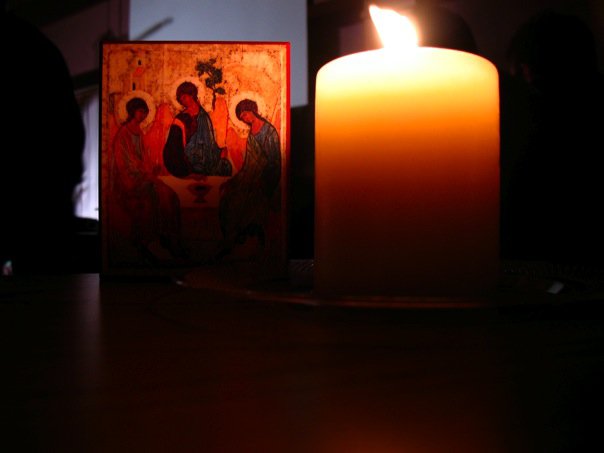
Glimpses, part II – the spirituality of place.

Where a person is can be as important to one’s spiritual development as what they believe. Long have spiritual masters proclaimed the benefits of sacred places. The Hebrew scriptures are replete with God’s directions to Israel to mark out territories prescribed by God that would both demonstrate God’s faithfulness and Israel’s special role in God’s redemptive economy. From the irrigated, verdant hills dotting the landscape around his hometown of Galilee, Jesus would spend countless hours with his Father. From such wilderness haunts he would find nurture, tenacity, strength, succor, and, frankly…answers.

So much of who we are and what we are becoming is directly attributable to the places that have graced us (rhyme subliminal but entirely intentional). In the comparative spiritual laissez faire of Constantine’s newly Christianized Rome, Abba Antony of Egypt started a mass exodus into the deserts of Egypt, those who would become known as the Desert Fathers and Mothers. The barrenness and desperation of the desert mimicked a similar cry deep within the hearts of these enigmatic souls. What is the obvious lesson? When there isn’t anything to titillate the senses, one might as well deal with the soul!

As a result of their foray into geographical nothingness, they became everything. They became the fullness that lies beneath the surface of what one misses when only seeing the desert sand.

The Celts, well known for their keen kinship with their environment, made much of this desire. Not unlike the Native populations of the US and Canada, not a feather of wing-ed bird, nor bark of tree, nor single trickle of rainwater escaped their notice. All carried within it some morsel of meaning for them.  Because everything received notice, nothing got wasted and this outer kinship found expression through inner resolve and great spiritual creativity.

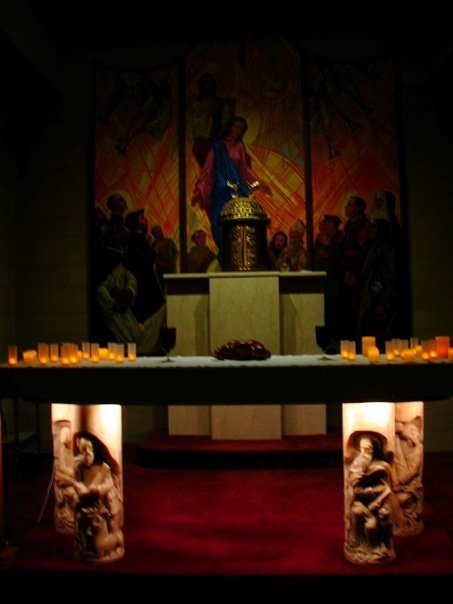
My own holy places, the cairns of my wanderings, are generally old, rather solid, often drafty and poorly insulated, but full of the memory of stones that have long cried out to their Maker. Long have I had an historical and spiritual affinity for those stuffy, rarely air-conditioned chapels that never cease to draw me elsewhere…to the great Other. Let me share just a few.

St. Saviour’s Anglican Church sanctuary in Nelson, British Columbia where for a number of years I taught at a Highland Bagpiping School (a place where other strange souls like myself learn to tame a five-legged creature designed to rouse neighbors and destined to arouse suspicions). Connections in the community opened the door figuratively and, in this case, literally, to spend as much time as I wanted in the church sanctuary after everyone else had gone home. I was given a key and carte blanche run of the place.

Most evenings after a long day of bagpipe students, some whiny, some lazy, all of them noisy, I would retire to the sanctuary with my pipes. For an hour or so I would simply play, enjoying the epic reverberance of the sound bouncing off the hard stone walls, and finding no sonic respite from the hardwood floor. It was, for me, the closest I had yet been to what I might have then described as heaven. At times it was 2:00 am before finally getting back to my room.

The hospital chapel in the same city was another such place. I was falling apart after a recent break-up with a girl to whom I had been engaged. My shattered interior was gradually reintegrated in that little chapel where I would weep and pray for hours, listening to John Michael Talbot, or the Monks of the Weston Priory sing beautifully doleful refrains. It was for me, through gallons of heart-crushing tears, the perfect requiem to my stubbornly elusive peace of mind. It would become the Introit to a new place of healing and restoration, albeit gradually.

Tintern Abbey in Wales, the place I believe could be boasted by angels as heaven’s waiting room, the lobby to eternity. My first experience of this roofless wreck of holiness was following a six month sojourn as a missionary to youth in Edinburgh’s rough Pilton district with my new wife of a year. We were tired and needed time to traipse about the land of our ancestors (and her relatives) before returning to Canada, unsure of what awaited us there. The warm, lazy day infused with the angular light of Fall caressed the ancient stone walls easily visible from almost anywhere. The pointed gables of apse and nave bespoke a darker but simpler time. All we could do was sit and pray.
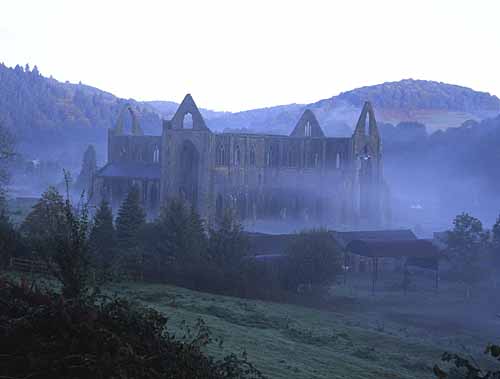
Less than two years later a picture of Tintern Abbey would help pull her through a terrible first pregnancy with our son, Calum. The same photo performed this function five years later as our second son, Graeme, reluctantly succumbed to womb-ed pressure and left his humble abode to make his premier. However, it is difficult to compete with William Wordsworth whose words best complete this picture:

While with an eye made quiet by the power

Of harmony, and the deep power of joy,

We see into the life of things…

And somewhat of a sad perplexity,

The picture of the mind revives again:

While here I stand, not only with the sense

Of present pleasure, but with pleasing thoughts

That in this moment there is life and food

For future years. And so I dare to hope…(Wordsworth on Tintern, 1798)

Everyone can point to at least one place where something important, even seminal occurred and they sense something is different. There it is that our life has been forever changed, perhaps only incrementally, but transformed just the same.

I believe it is God’s way of playing spatial peek-a-boo.

Think deeply of a place or two that have been places of rest and reconstruction. Picture that place in your mind. Now let that picture juggle your heart.

As you do so, re-member the pieces of you that may have been broken or lost in that place. Quietly give thanks to the God who loves to find us where we’re least looking or at least looking the other way.

My wife always tells me where to go

For guys like me who suffer from severe, chronic directional retardation, Diana Ross contributes the quintessential song, “Do You Know Where You’re Going To?” It is an appropriate question for me since, as previously mentioned, I get lost easily. There’s an even more embarrassing reality here…

My wife is a professional cartographer.

She makes maps.

I know! How crazy is that, right? I like to kid her that, not only does she tell people where to go, but then gives them detailed directions as well. In my unredeemed moments when I’m tempted to tell some self-congratulatory stuffed shirt to go to hell, I know where to go for tips on the quickest way there. My wife is an expert in helping people get from A to B and back again. In this way she is a kind of geographical shepherdess, guiding the unwary soul away from the rocks of potential disaster to the still harbor front where rest and Daiquiris await (or tonic and lime in my case).

I’ve been a “professional” church music director for many years. Anyone who does what I do will likely share a similar scenario. When introducing oneself at parties or potlucks, the customary question aimed at one’s spouse is always the same, “and what instruments do you play?” The assumptions here are many, not the least of which is the very 1950s idea that to hire a man for ministry is to hire his wife and family as well. I’m the main guy, she the piano-playing-kid’s-choir-directing-always-polite-and-fashionable-dutiful-wife sidekick; a role for which she is rarely recognized and never paid. Once, while at a party with friends, a certain insistent lady kept pushing for more information on her singing abilities since “that’s what music minister’s wives do.” True to form, Rae replied with the astute comment, “is that the same for you since your husband is a carpenter?”

Well played, my dear. Well played.

She used to be bothered by this presumption. Thankfully, the perception of a thinly-veiled evaluation has worn even more thin over the years. Now we simply chuckle about it.

People have often asked me, why didn’t you marry another musician? I recognize that to be the accepted pattern. In actual fact, she knows a great deal about music and is a passable pianist and organist. We both share a widely eclectic musical palette; everything from Bach and The Chieftains to Sara Bareilles and Death Cab for Cutie. Tellingly however, our younger son, Graeme, once told her she had the singing voice of a goat and that even auto-tune is out of its league here. Dude…nice.

One must understand that musicians, or at least I, swim in a veritable sea of self-referentialism. Ironically, it’s what makes us good at what we do. Artists are generally brooding, too self-aware and then, pushy about it. I’m at the head of that parade. Don’t get me wrong, I love my artsy kindred spirits but, seriously, you really don’t want more than a handful in the same room at any given time, trust me. It’s simply too much Bohemian smug for most church potlucks to accommodate.

No, I’m quite pleased to have met someone who, instead, shares other deep passions of mine – history, geography, old languages, and rain. My undergraduate degree is a B.A. in Music with a major in Vocal/Choral Performance. Hers is a B.A. in History with a minor in Geography. In this curious mix, at least in our better moments, we have seen a much fuller, rounder, doubly satisfying concoction of passions and traits. It means that I can be the king of music, she the queen of history under the same roof. Instead of vying for attention, as artists are wont to do, we have the choice of being each other’s biggest fan.

Granted, this sounds great in theory. It doesn’t always work in reality. But, the lesson is clear. In our darker moments, a poem, joke or song from me can bring hope and cheer to an otherwise bleak situation. She reminds me that men and women have struggled with such darknesses for centuries and that safer shores were never that far away.

Now, when asked why I didn’t marry a musician I can simply say that I needed someone who would tell me where to go, how to get there and, in so doing, help this lost soul be found again.

I know of Someone else who does such things.

Jars of Clay – A Prayer

Lord, you have exalted your name above the heavens.

Your name means grace and peace and wonder to all who speak it in faith and love.  You have chosen to use weak and broken vessels to be your eyes and hands and feet in this world.  It seems, Lord, that you love to pour out your glory through

the ordinary, the fragile, the imperfect.

In this, Lord, we are honored – but humbled.

You ask us to mirror grace, love and faithfulness to the world – the very grace, love and faithfulness so eloquently portrayed in Jesus Christ.  Through him, you promise to give us all we need to live rich and holy lives in our communities, our families and in this world.

Mysterious God, so great a salvation!

We sinned, you forgave.

We turned away, you gave chase.

We rebelled, you paid for it.

We forgot, you remembered.

We are often faithless, you are ever faithful.

We complain, you are patient!

Lord, do not allow us to make excuses for ourselves, hiding as we do in the limits of our humanness.  Although we are perfectly aware of how inadequate we are to the task, help us to see ourselves as you do, as reconcilers, as peacemakers, as redeemed kingdom builders.  If we are dull, make us shine.

Lord, take these imperfect jars of clay and make them holy cups of pure grace, forged in your desires for us.

May it be so, Lord.

May it be so.

Parking lot lost and found

I get lost easily. It’s funny to those who know me best, annoying and perplexing to me. Many is the time I’ve lost my way in the Safeway parking lot, often in an ungodly fog of non-Sunday-school language. After calming down from my diatribe on poor parking lot engineering I begin the pathetic process of self-flagellation that includes the obligatory inner harpy: “if you can’t even find your way out of the parking lot, how do you expect to find your way in the big, bad world with, like…roads ‘n stuff!?”

A case in point: last summer I was hurriedly making plans after a long and complicated week to drive to Cannon Beach, Oregon for a choral directors workshop. As I am wont to do, I left well before I really needed to since that’s what uptight, anal guys like me do. I was particularly proud of my packing prowess having narrowed down my weekly possessions to a single midsize suitcase…well, and my guitar of course…oh, and a bunch of books in a separate bag (not counting snacks, naturally). Being more concerned about early arrival than any other point of preparation I happily hit the road two hours ahead of schedule with the air condition blasting and the tunes blasting even more.

I crested the final hill from Yakima to Ellensberg from which the windmill and horse ranch dotted valley below spoke loudly of itself in multi-colored hue. I sailed past Ellensberg and was impressed with the reasonably well-flowing traffic on the ever-busy I-90 corridor to Seattle. Then, a few miles past the small mountain cowboy town of Cle Elum I hit the intestinal traffic jam with no hope of quick relief to the constipated bumper-to-bumper traffic.

No problem, I thought, I had left plenty early and was listening to a delightful conversation between Krista Tippet and poet/philosopher, John O’Donohue (listen here). I was enraptured and unhurried. Upon finishing the CD I figured a few cell phone calls might help pass the time. One of those was to my wife Rae, (who ironically, makes maps, more on that in my next post) and confidently boasted my ample progress despite poor traffic just past Cle Elum.

A lengthy pause.

“What the hell are you doing in Cle Elum?” she barked, apparently not as chuffed as I on my progress.

Another lengthy pause…

Then it dawned on me. I was in fact on the wrong road altogether!

My retort?

“Yeah, what the hell am I doing in Cle Elum?”

I am now the proud owner of a cool GPS unit that speaks to me in the smooth vocal tones of Sean Connery (snooty bugger) and, thanks to my wife and boys, seldom get lost anymore (please don’t tell them that I generally don’t know how to use it very well).

Sometimes we need road signs, GPS units, spouses, kids and friends to share the burden of our lostness. And the more I think of my proclivity toward directional retardation the more I am reminded of the spiritual parallels here. It’s no surprise that Jesus loved the lost and found metaphor and used it liberally. To be lost is one thing. To be lost and blissfully unaware of it is quite another. It is more sinister, not in the traditional heaven-hell, saved-damned dichotomies; but in the getting-warmer-getting-colder proximity meter as we seek union with God.

I hate the feeling of being lost or losing my sense of direction. But, to hear Connery’s comforting voice say those words I love to hear, “you have reached your destination, shaken, not stirred”, is the highway equivalent of these still better words…

“This one was lost and, now, is found.”

…and he said to him, “follow me”: a Litany

This litany grew out of a class I took as part of my master’s program….


How good it is whenever we leave all false agendas, desires, plans, schemes, thoughts – selves behind and obediently follow the Master without hesitation.

…and he said to him, “Follow me.”

How good to imagine a world where those without hope are given hope because the community of Jesus follow the leading of their Master and Teacher and bring this hope in all they say and do.

…and he said to him, “Follow me.”

How good, to host the Presence keeping company with sinners, tax collectors, lepers and the outcasts of society.

…and he said to him, “Follow me.”

How good to ever have ears to hear the voice of Jesus calling to us, urging us to follow him wherever he goes participating with him in bringing the new wine of God’s kingdom to light around us.

…and he said to him, “Follow me.”

How good to live before God every moment with godly sorrow for our sin, fully embracing our many and varied brokenness in honesty and authenticity.

…and he said to him, “Follow me.”

How good to celebrate with all whose repentance brings new life and an accompanying deep life change even when such celebration causes raised eyebrows.

…and he said to him, “Follow me.”

How good never to allow ourselves to succumb to religious peer pressure that traps one in the smothering flames of imposed, ungodly parameters of faith life and thereby lessen the gospel message in compliance with it.

…and he said to him, “Follow me.”

How good never to succumb to the same judgmental spirit which produces and perpetuates religious peer pressure. “Father forgive them, for they know not what they do.”

…and he said to him, “Follow me.”

How good to taste the old, complexly rich and fragrant wine of our forebears while working in the vineyard alongside our Master Winemaker.

…and he said to him, “Follow me.”

How good, to “stand in the place where you work” looking left and right to find those of ill repute and the despised with whom to drink new wine.

…and he said to him, “Follow me.”

How good to stand in the place where others are, be the voice of Jesus calling to them, saying “follow me” and teach them how to catch others in the net of grace.

…and he said to him, “Follow me.”

How good to be those who hold the redemptive instruments of grace at the bedsides of the broken together with our great Physician.

…and he said to him, “Follow me.”

How good to bring encouragement to all whose “bridegroom” has been taken from them either by sickness, death or malfeasance.

…and he said to him, “Follow me.”

How good…

How good, indeed.

Praise be to the Lord of all lepers, losers, limpers and lovers!

…and he says to us, “Follow me.”

God is there – a litany

As a contemporary liturgist for some years now it has been my job to help congregations experience their God and express their spiritual journey in corporate worship. Sometimes that has meant developing new ways of saying old things. The following is a short litany I’ve used on many occasions, sometimes as an aid to prayer, sometimes as a call to worship, other times simply for common reflection on the nearness of God. I pray that it is inspiring, or, at least…useful in some way.


When day moves into night and the seasons each stake their four quarter claim,

God is there.

When sadness, death and pain becoming the defining characteristics of our path,

God is there.

When God puts a new song in our mouth, a song of praise to our God,

God is there.

When words no longer come and shutters are drawn on lonely minds,

God is there.

When youthfulness reigns in life and limb and lingers in our days,

God is there.

When communities succumb to individualism and self-talk,

God is there.

When the common grace given us all finds voice among us and I  becomes we,

God is there.

Through all our days, our joys, our pain, our defeats, our triumphs, our lives,

God is there. 


God is here.

Laundry day Jesus

There are curious profundities in insignificant things. We Presbyterians are especially proud of our strong, unassailable logic in all things theological, as if God was easily codified into neatly established linear categories. More often than not, we are working out our salvation with coffee and donuts as much as fear and trembling. Our responses to sermons regularly find their way into coffee pot conversations. They just don’t sound so fancy pants.

For all our strengths, those of the Reformed persuasion too often miss the point in a mad dash to convince everyone of big boy doctrines like the virgin birth or the divinity of Jesus. It seems that it will remain an impossibility to perfectly describe the indescribable. I often wonder if we would do his divinity a big favor by paying more attention to his humanity; the way he did.

Jesus never shied away from recognitions of or statements about his place in the Godhead. It just wasn’t his primary focus. Instead, he spoke endlessly about wheat and lilies, goats and sheep, wine and bread, coins and widows and sand and sea and doubts; the kind of stuff we talk about in our unguarded moments together. Jesus didn’t want to raise our level of conversation with polysyllabic words fit for Scrabble champions. Nor did he really care whether or not we came out of this with a shiny box set of matching, picture perfect doctrines fit for wrapping and placing under the Christmas tree.

He wanted to find himself with us caught up in the load of laundry that contained a red crayon or the fifty-dollar bill Dad had been desperately looking for last week. He desires to find his way into our thoughts when we’re changing the oil in our car or swapping out a toilet in the master bathroom. Will our most private, reckless moments contain bits of light, truth even? Would we speak from the pulpit what we just spoke to our swollen finger, freshly hammer-smashed? Does the name of God find its way to our thoughts as often or as vividly as does the business page of the paper or the latest political wrangling?

These considerations are not to add to our already bursting guilt quotient. But maybe they can help us find our way out of the morass of conversations thick and heavy with theological brain goop in favor of the spiritual tarpaper of mutual sojourn with the Jesus who knows how we do our laundry. Our theology should lead us to the laundry room as readily as the church library.

He knows that we’re often more delicate than the stuff presently in the dryer.

What are some of the out of the way places Jesus might find you today?

If you were to converse with Jesus in the most mundane moments of your day, what would you say? What might he say to you?

Think of the most boring thing asked of you this week. Try picturing Jesus there with you. Remember, Jesus did grunt work, too!

Jet fuel, candle wax, Bilbo Baggins and Pentecost

I posted this originally on the Spring Arbor University MSFL micro-site. I also wanted to share it here. Join me in either place and we’ll talk Tolkien among other stuff…

In a conversation with Gandalf the Grey, Bilbo Baggins, elder statesman of Bag-end in Hobbiton, anxiously complains that he is feeling “thin, like butter spread over too much bread.” Uncharacteristically, Bilbo had been the first hobbit ever to venture outside the safe, recognizable confines of the Shire. There, life was well planned, neatly cropped and decently fitted to those more inclined to an afternoon of tea and scones than giants, goblins and dragons. How distasteful.

“Butter spread over too much bread”, I quite relish cryptic statements like this. There are any number of ways to parse his meaning. Bilbo might just have easily said that he needed less bread upon which to spread his limited butter. It means basically the same thing, doesn’t it?

Maybe.

His original statement suggests that there isn’t enough of Bilbo to accommodate all that life throws at him. He was verbalizing the fact that, under any circumstances, he was always the same person; a hobbit of limited emotional and physical resources (the latter being especially true of Shire folk). For hobbits, adventures are unsightly, unnecessary inconveniences. What had changed were the additional demands his world imposed upon those limitations. Sound familiar?

As we consider Pentecost, this should invite the question, “is the Spirit-empowered life intended to prep us for a world that makes no allowances for the spiritual needs of its inhabitants? In other words, do we, by God’s strength, bend to suit the frenetic nature of the world around us? Conversely, is the Christian life designed to provide us with the tools necessary for us to discern such demands and, in response, live counter-culturally? That is, do we, by that same grace and power, embrace a just-say-no policy to insane living?

Mindy Caliguire, founder of Soul Care, a spiritual formation ministry, (and committed non-hobbit) places we Pentecost people into two broad categories: jet-fuel drinkers and candle lighters. At first glance, I envision those type-A, scale the world with bare hands types to be drawn to the former option. They already tend toward a win-through-perseverance philosophy in most things. Thus, they might be more inclined toward the more is better motif – praying, believing and living in ways that hint at the deeper well from which the Christian may draw. Pentecost to them means that we are given more than adequate resources to meet the challenges imposed by a frenetic culture. More butter to meet the demands of much bread.

The second scenario might be considered more the domain of the candle lighters. They are those who see the inherent dangers to an integrated wholeness within the prevailing culture and risk either apathy or antipathy in their subversive, counter-cultural response to that same milieu. They seek freedom from the imposed insanities rather than power over them. In this ideology, Pentecost provides the inner sensitivity that allows for careful discernment of our crazy predicament. Less bread given our limited butter.

What then is the biblical alternative for he or she who seeks to live as a faithful disciple of Jesus Christ? As I read the scriptures I am forced to concede that the best answer is…both. From the Bible’s earliest pages, one discovers jet-fuel drinkers and candle lighters dwelling together in a veritable stew of divergent sojourners.

Matthew, the greedy, upwardly mobile corporate yes-man intent on being all he needs to be to dominate the system: jet-fuel drinker.

Intimately acquainted with the rhythmic beating of the Savior’s heart and writer of the most mystical Gospel, John: candle lighter.

Gideon, the mealy-mouthed Mama’s boy who ultimately becomes a savage warrior: jet-fuel drinker.

Samson, more aptly named Testicles, a small-minded man whose thoughts are more guided by testosterone than thought: jet-fuel drinker.

Mary, the simple (Martha might suggest, lazy), young lass intent on soaking up the warmth of Jesus’ intoxicating presence without thought of consequence: candle lighter.

Peter, run-at-the-mouth-foot-in-the-mouth-has-a-big-mouth, and yet ever repentant, never enervated follower of Jesus: jet-fuel drinker.

Elijah, self-pitying purveyor of God’s power over pagan parlor tricks: candle lighter in a jet-fuel drinker’s body.

So, what does all of this have to do with Pentecost? My original query was whether or not the promised Spirit sent to those expectant, wondering disciples was primarily for the purpose of preparing ill-equipped weaklings to become stronger than their environments. Or, is the Spirit’s primary purpose to help discerning disciples say no to the soul-killing environment in the first place and build the new society of love envisioned by Jesus?

Jesus enjoyed company with all manner of strangely broken, frustratingly naïve individuals. The hand of God extends to all who are found clinging to the hem of the Savior’s garment. The chill-out, be happy, hippy version of faith together with the git-er-done, live like ya mean it suit ‘n’ tie types.

How does Jesus’ example help us interpret Bilbo’s complaint? Does Jesus, by the Spirit, primarily present the victorious life of the jet-fuel drinker, thereby modeling the ideal spiritual life as the power-to-rise-above? Conversely, is Jesus, by that same Spirit, to be viewed more as the perfect version of Martha’s whimsical sister, whose strength for service came at the feet of her Savior and friend, the candle lighter? Was Jesus drinking jet fuel or hot wax?

Yes. Any questions?

To follow the Pentecost road with Jesus is to live rightly and well. It guarantees that our butter will last and that the constant stream of toast demanding our butter will never be more than our butter can manage. Let us rise to thank Bilbo Baggins for his good, but unintended, spiritual counsel.

I need a sandwich.

An Easter people in a Good Friday world…

This past Sunday, with the coming of the Holy Spirit at Pentecost, we “officially” mark the end of the Lenten-Easter journey. Unofficially however it is only the beginning. With hearts freshly cleansed, minds renewed, paths made straight, souls united to God and eyes made clear, we are now given charge to be the bridge upon which people may walk to find peace…to find God. We become Easter people in a Good Friday world. The following is our manifesto:

An Easter people in a Good Friday world:


Live life when death seems to be winning,

Seek hope when despair seems bigger,

Laugh out loud when to be sullen seems better,

Cry for justice when the weight of wrong smothers,

Call out for peace, when the shrapnel of war still smolders,

Find good where goodness should not be found,

Stand still when chaos and panic seem to rule,

Take the long road of grace instead of the short road of law,

Pursue righteousness, even when unrighteousness is easier,

Sing the praises of God even as darkness appears most ominous,

See Christ in the face of friend, enemy, immigrant and stranger,

Proclaim an empty tomb when the heart of darkness yet gloats…


“He is not here…just as he said.”

Commissioning prayer

I moved with my family from Kelowna, British Columbia to McMinnville, Oregon a month before the infamous events of 9/11. I’m not generally known for great timing! The move was for the purpose of assuming my role as Minister of Worship and Music at First Baptist Church. My short, 3 year tenure there was challenging and exciting and growing for me. A congregant, Densley Palmer, was a wonderful hymn text writer and poet. The following is a commissioning prayer he composed for the occasion of my coming to FBC.

Commissioning

Densley and Joyce Palmer ©October, 2001

For the commissioning of Robert Rife as Minister of Worship and Music

First Baptist Church, McMinnville, Oregon, October 14, 2001


Let all earth dance and sing in the presence of the eternal God.

Let us blend distinct voice and individual song in praise and thanksgiving

to God who makes all things one.

Let us worship God with our voices,

on the organ, and on the pipe and drum.

Be still, and await God’s voice in the pregnant moments of silence.

Calm the erratic cadence of daily life and move to the rhythm of the eternal.

Through worship, glimpse God’s infinite breadth, eternal length,

and encounter the intimate presence of the holy.

Wherever we worship God, let it be with a sense of awe and expectation,

a spirit of joy, and an awareness that,

through worship, we encounter the sacred

and stand barefoot on holy ground.


Let all earth dance and sing in the presence of the living God.