Advent – God’s gift of longing

Undue significance a starving man attaches

To food

Far off; he sighs, and therefore hopeless,

And therefore good.


Partaken, it relieves indeed, but proves us

That spices fly

In the receipt. It was the distance

Was savory.

These words of Emily Dickinson remind us that the longing for someone or something is often an experience even richer than the person or object of that longing. The college-age love affair forced to endure the insufferable distance of educational geography. The retired man or woman lost in a fog of non-identity yearns for earlier times when it was more clear who they were and why they were here. 

My mom used to tell me that as kids we were “full of piss and vinegar” around Christmas time. Although the exact nature of this chemical mixture is unknown to me, I think I get her point. Those of us fortunate enough to have access to Christmas morning consumer delights may recall the unbearable pangs of waiting for it when that certain item we’ve been harping about might just be waiting to greet us.  

Advent is the liturgical equivalent of communal yearning. It is a time when, together, we enter into the much deeper waiting experienced by our forebears in faith for the fulfillment of a promise; a promise made to those long dead and far removed from our present reality.

There really is no better time than Advent to talk about the mystery of waiting. If we are willing, our connection with the Divine throbs most insistently at such times. Waiting can be nothing more than a feat of drudgery, accompanying oneself on the frustrating journey of unsatisfied desire. Or, it can be the mist-heavy pond upon which float, blindly but lightly, our lilies of longing. One leads to fear, hatred, anger, destruction. The other to patience, quiet devotion to duty and persons, to the delicate wonders of the unremarkable that grace our days.

lily-padsAdvent acts as a centuries long foreplay to the main event through which sweet relief is found. In that long foreplay we learn to live, move and have our being while often blind-folded or lost altogether. In it we learn to trust our silent dance partner whose subtleties on the dance floor leave us breathless but a little baffled at times.

Advent forces a kind of slowness to things. As it becomes clear that immediate satisfaction is nowhere on the horizon, we learn the joys of nuanced living; of faith in a person rather than facts and plans and possible outcomes. We learn journey more than destination.

With the advent of Jesus we learn that God remains annoyingly carefree in his use of timelines. They belong to God alone. However, in that same advent we learn just how good it can be to wait with the intentionality of longing – spiritual foreplay – than pacing the floors of our constantly incomplete lives. For, to miss even the tiniest detail of all the manger meant is to miss everything else as well.

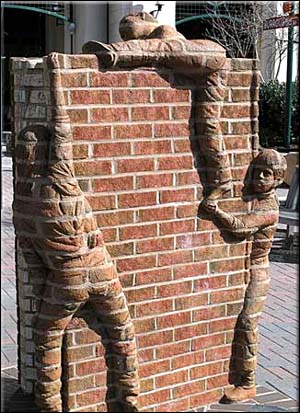
The bricks in our walls, chapter 3

brickwall1

I had never played this game before. I was just fourteen at the time and was apparently comfortable with the fact that I was doing so not just with new friends but also with my older, female cousin. Boys will be boys as they say. To add further daring-do we were playing this dangerous game in their kitchen, mere feet from aunt and uncle’s bedroom. Perhaps it was the adrenal rush of knowing that, to be caught out here in rural Nowheresville, British Columbia, meant no one would hear the screaming.

Strip poker is fun.

Jim played blues and ragtime guitar. I’d never before heard Maple Leaf Rag, The Entertainer or The Heliotrope Bouquet played on a six-string. It was a lunchtime folk club at my high school hosted by a friend, Barry, who also happened to be my guidance counselor. Jim was our guest performer that day. It was an hour of seventeen-year-old musical bliss as we enjoyed the most effortless guitar acrobatics I’d yet encountered. With my natural expertise at charming flattery and acerbic wit, lightly salted with otherworldly humility (translation: bullshit), I sat in his living room as his guitar student less than two weeks later. Only after apprenticing under this demure genius could I say with some level of honesty…

I play guitar.

It tore me apart. It was a toss-up what was worse – the insult of my best friend holding hands with this girl, or the salt-in-the-wound – only days before, she’d been my girlfriend. The sense of injustice was overwhelming. For matters of suitability I’ll refrain from the Old Testament metaphor of freshly plowed fields for another’s enjoyment. But, I digress. My heart couldn’t decide which was worse, the jealousy of seeing him next to her, or the pang of longing self-pity. Is anything more insufferable than such a friend asking relationship advice with the previous participant in that same relationship? Eventually, the melodrama subsided and was replaced with a delicious vindication when, mere weeks later, she was engaged to yet another man with whom she’d been “friendly” right under everyone’s noses.

Relationships are so easy and uncomplicated.

Terry was the extravert in our musical partnership. His effervescent personality, literally brimming with electricity, always overshadowed my quieter, albeit charming, demeanor. We made a great team, both as performing duo, and as life-of-the-party tornadoes. Through Terry I was introduced to what is actually possible as a player of strings. His deft mastery of guitar, mandolin, banjo, and ukulele made my own growing skills seem elementary at best. Hence, I was the singer. More important however was the easy, hospitable faith of a man six years my senior, lived out among the strange, ne’er-do-well ruffians who were our nightly audience. It taught me that those rough-‘n-tumble souls were under our care.

Terry is still my best friend.


Picture found here

the art of wasting perfume

There are smart people out there with books and articles and quotes intimating that the wick of the worship wars flame has burned to a stump. Now, only sticky wax remains out of which we may safely pull something shapely and useful. Whether that is true or not I can’t really say. But, we’ve been sailing post-modern seas long enough to have emerged in a somewhat better place regarding shared worship practices. What interests me most however lies much deeper than mere ritual.

So much of our corporate experience of ecclesiastica these days is about efficiency, effectiveness and euphoria (no extra charge for the cute alliteration). Even big box churches like Saddleback and Willow Creek are recognizing that it’s much easier to draw crowds than deepen congregations. Spend enough money in the right places, position the right people in your dream team staff and learn the angles (this, apparently, means relevance or some such thing) and success is all but guaranteed.

A scourge, not just of contemporary faith and practice, but of early New Testament times as well, is that of pragmatism; visible, quantifiable, “helpful” theology. If some practice of faith doesn’t yield measurable results it is considered suspect, superfluous; even useless. Dead-weight. Dross. The average church building boasts classrooms for every grade, meeting rooms for everything from Ladies’ Teas to A.A. to Family Ministries. Closet space is dedicated to coats, robes, wedding paraphernalia, soup bowls and Christmas decorations. Signs in the Narthex (lobby, foyer) proudly point to these rooms, giving visitors the impression that this is a church on the move. Look at us, we’re not idle. We’re doin’ stuff. Good stuff. Lotsa stuff. It’s exhausting just to consider the dizzying possibilities, let alone dive in.

In our culture, if an idea or practice isn’t immediately and continually beneficial for coffers, volunteers, or givers, it is suspect at best, anathema at worst.

I committed my life to Jesus while driving home to Calgary from a pub gig in Edmonton. A creeping loneliness blending with a troubled psyche was replaced by a lightness of mind and heart I can only describe as…good. Really, really good. I was barely eighteen and living at home. That very evening, my own gratitude and joy spilled over to my Mom, who became the surprised recipient of a fifty-dollar bill for doing my laundry. There is nothing quite like the joy of lavish waste in the name of thanksgiving. Well, and the look of delightful surprise with concerned consternation on someone’s face on the receiving end of such magnanimity.

As I’ve been discovering ever since, such acts are nothing new. Happy hearts become ready harbors for such ships of gratitude, over-laden with desire to be offloaded onto the object of their affection. The Gospel is all about waste and abundance in the name of love; the praise of those who get what it means to be seen. To be known. If you don’t believe me, ask your wife if the time spent making love might not be better spent painting the guest room. I dare say it might be a venture that just prepped your new sleeping quarters. The scriptures are replete with examples of extravagance in the name of love.

I am rather fond of a seedy picture of a woman, obviously swooning in gratitude for the courteous and loving attention of a well-known Rabbi casually saunters over and basically pours her beer on Jesus. Well, actually super expensive perfume. Like, way expensive. A rather sexual act by any standard, it alone deserves volumes for it speaks of much more than simple extravagance. Jesus affixes theological significance to the act. And, of course, the pragmatists in the crowd, thinking themselves in-sensed out of high ideals jump all over it.

Of course, as we can always expect under such lavish displays of unadorned praise offered inappropriately to the wrong person at the wrong time in the wrong way, self-proclaimed keepers of the moral gates then, as now, cry foul. They either spit out their tea or drop their knitting needles. By the way, have you ever wondered where those sneaky bastards always come from? They’re positively creepy in their ubiquity as though finding crevices behind rocks, under the dining room table, or behind the rhododendrons.

The scriptures are replete with such acts of selfless wastefulness. Joseph of Arimathea, one of Jesus’ wealthier followers, became his post-mortem patron in the form a top tier burial plot. Not the magnanimity one would generally prefer, but there it is; another example of a heart needing to express itself in wealthy waste. King David craves water be brought him while facing the brutal Philistines but decides instead to pour out the most valuable currency in the desert back to the desert. He too knew the art of worshipful waste.

Although an overused example, it serves to illustrate my point here; if this woman by her act has openly laid bare her heart, swollen in the ache of gratitude, then she shows us what worship truly is. What it means to adore someone. And her risky act of risqué devotion mirrors God’s own character. Jesus is God’s wasted perfume. Jesus understands her because he understands his own journey into the dark abyss of broken humanity. It is a pilgrimage of pain, not the pain of the cross primarily, but the pain of loss and loneliness.

She mirrors the heart of God who knows only too well the art of wasting perfume.

ALTARWORK dot calm

These are those delightful, though humbling serendipities that add such a glow of grace to life. Please check out this wonderful initiative of which I am honored to be a part…

ALTARWORK is delighted to present a sample of Rob’s poetry – eight poems in all. Rob has a unique voice and style – eclectic, uniquely profound – and is unafraid to stray beyond convention with regards to his subject matter, point of view, and wordplay. Rob is a highly enjoyable read.”

— Jason Ramsey, ALTARWORK Founder/Editor

A Celt in a kilt and the beautiful mundane

This was originally posted as a guest post on a favorite website of mine, Abbey of the Arts (thank you Christine Valters-Paintner!). What a delight to be given opportunity to share one’s life among kindred spirits in the grand dance that is our eternal redemption.

Please, please, please, if you haven’t already done so, be sure to visit Christine and the rest of us Monk-Artists at the Abbey. Come visit/like the Facebook page as well. You’ll be so glad you did. I promise.

__________________________________________________________

A Celt in a Kilt and the Beautiful Mundane

I-You-Holy Ground
By Robert Alan Rife

I am the dusty ground, low and dry
thirsty for the imprint of holy feet.
Despoil with radiant prints, this virgin ground.

You are the rain, falling deftly
upon my brown soil. Now is left
your footprint on this ground.

I am the ashen leaves, curling and broken
awaiting but a whisper. For only then
can I fall on solid ground.

You are the soundless wind, howling, still.
You creep up behind me and
exhale me to the ground.

I am the snow, disembodied worlds of cold
and chance encounters with hand, or tongue,
eye-lash or palm needing ground.

You are the frozen air in which I am held
aloft, drawn slowly down
to meet with others on the frozen ground.

I am the waning autumn death
soon to give way to the long silence-when one Voice
becomes the loudest ground.

You are the Voice that speaks
heard best in dying, power given for
rising from this shivering ground.

I am the distant hours, the midnight passing-
the refusing minutes, trapped in hours,
running from the years of ancient ground.

You are the many, and the one, and all time
and nothing and everything from nothing
where time has no ground.

I am the weeping, the squalid groaning,
the unrequited miseries of misery’s company
laying crippled and diffused in the ground.

You are the end of tears and years, the question
and the answer, the sutured nerve of joy, not suggested
but present, here, on this Holy Ground.

________________________________________

For me, the term ‘monk’ used to mean ‘one safely cloistered away from the cares of normal life in dimly lit, echoing stone hallways where hooded men sing hauntingly beautiful music and basically float just a bit off the ground. A single, piercing glance from their crystalline eyes means healing, they have superpowers, can read your thoughts, never need to eat, and speak once a year whether they need to or not.

Since leaving behind my roots in evangelicalism for headier waters elsewhere I’ve since discovered that monks often have the sauciest senses of humor, the bawdiest stories and, not surprisingly, the deepest delight in the world around them. My kinda fellas. They’re as non-dualistic as they come; a life to which I aspire. Apophatic meditation one moment. Bodily noises the next. Welcome to my world.

I am a dreamer; a philosopher-poet capable of romanticizing even the most mundane banalities. To a guy like me, cutting the grass has the potential to be a portal into the nether regions of the universe, awash in liminality, where mythic faeries ride unicorns on their way to Celtic slumber parties. But, I’ve been known to overstate a little.

Clearly, I’m a favorite among type-A corporate headhunters (tongue super-glued to cheek). Rather, stereotypical songwriters, tree-huggers, poets, unfocused A.D.D. artsy-fartsies, and contemplatives love to love me. They’re my peeps. My homies. They know my psychic address.

These overly romanticized sensibilities haven’t always promised smooth sailing for me. In fact, more often than not they’ve brought more than their fair share of woe and disillusionment. The world has precious little patience for those like me, preferring instead the multi-tasking, power-doers with ambitions larger than the moon upon which they hang their coats (but generally not their egos). It’s a challenge in our super-charged, winner-take-all culture to prove real value in lighting candles and pursuing silence when time is money and money is god and god keeps shrinking or running away.

My earliest recollections of spiritual awareness contained the following simple elements: surprised by joy moments, generally unasked for and seldom expected; a sudden awareness that the world was not really as it seemed – that from God’s perspective all was well. Specifically, I was drawn to all things ancient, mystical and Celtic. As a bagpiper/Irish whistle player who has toured extensively it makes sense that, for me, the world is seen through green colored glasses, smells just a little peaty, telephone poles were meant for tossing, and “ladies” is misspelled on the restroom door (insert look of shock and consternation here).

Although a mystic from a very early age, despite a decided lack of language to articulate such things, my fate was forever sealed when, for the first time I heard the Great Highland Bagpipe. I was seven years old. I was gobsmacked. Mere weeks later, in the basement of St. Andrews Presbyterian Church, I started learning to play the pipes. I have played ever since.

Something else happened however. It christened a liminal journey of my inner mystic and forever sealed my fate as a lover of all things Celtic, monastic and artistic. It also began an almost unassuagable thirst for the monastic realities of thin-place living. Puddles become holy water. All time, whether singing, snoring or snacking, can be wrapped up in a ball of quivering holiness. It is the essence of Celtic spirituality. It is my essence (especially if we had haggis the night before).

Now, a gazillion years and as many prayers later, to be an artist, a mystic and a monastic-wannabe is for me to see myself less as a dreamer and more as a waking dream. Life is to find the holy in the banal; the glorious mundane. The perfect, daily moments of nothing-special that, simply by virtue of noticing them, become possibilities of inherent wonder. The greatest gift I’ve received in the past few years, something particularly attributable to the Celts, is that of awakening to these shimmering possibilities in the blasé and dull. How brightly they shine under the light of the God of order and magnificent delights.

Grief, Observed

Today, August 16, 2014, marks the twenty-eighth anniversary of the death of a woman I never met, my mother-in-law, Nina Barkus. That event, combined with the death of my father almost one year earlier, sparked the meeting, the love affair, and subsequent twenty-six years of marriage (so far) between my wife and I.

This is for her and her mother (mam), Nina Barkus.


Rae and her mom, Nina

Grief changes a person. Grief, along with it’s drinking buddies: pain, shame, anger, betrayal – they have a way of reducing a person to his most elemental place, her lowest common denominator. A human being stripped to that bare minimum of barely surviving/survivable raw material. It can push us to become someone we don’t even recognize.

Like a persistent toothache on steroids comes grief; some unimaginable carnivore of light, a predator of hope. It is no respecter of persons. It makes its entrance like a bull in a china shop, impolitely and destructively unexpected. All one can do is stand by, hide somewhere they think to be safe from the onslaught, and observe the damage unfolding before them.

Grief is shameless. It cares not how it comes, undressed and brazenly free of restraint. Like being forced to watch one’s own daughter perform a pole dance, grief strips itself and its participants to places well beyond their own humanity, well below self-defined limits of propriety. It can haunt our conscience as much as our consciousness.

Grief is the chameleon of human experience. It lays in the center of our lives, taking the shape of its container, the color of its environment, so that it becomes maddeningly insouciant, invisible to either scrutiny or even identification. Once identified it shape-shifts again, leaving us now both to grieve and shrink from the exhausting process it is in the first place. It is the never-ending injury to its own insult.

Unlike hope, which, like water, undergirds our elusive oil refusing to mix with the more delicate undergrowth, grief kneads itself into the dough of our lives, leaving us to bloat and swell but with no vision of what might arise in its place. It is a ruthless bully, intent on bruising the softest places where lasting scars are most likely.

Grief most often accompanies a death: of a loved one, a lover, friendships, self-confidence – the list is long. It offers little other than the ominous sense that someone is watching from the shadows, leaving us unnerved as we fumble for the car keys. Just when it seems we’re safely inside, a hand grabs us from behind, refusing us the safety of ‘elsewhere.’ We do not run from it. It runs to us. We do not hide from grief because we end up hiding right behind it. Grief hears our labored breathing every time and quickly finds us out.

Grief is the Goliath of our inner experience. It stands, boasting and blethering on impudently as we soil ourselves before its not inconsiderable size and bully demeanor. “It has killed others greater than I”, we say, as we look way up to find the faceless monster bearing down in full strength upon our pitiable frame.

One could speak as well of the pitiful awakening to one’s own flawed behaviors; ways of seeing things that hurt others and oneself. Poured on top of this kind of grief is the scalding gravy of shame. It is perhaps the worst grief of all since it is often accompanied by a raking internal self-awareness of the negative kind that is seldom polite and never constructive. In fact, it generally becomes the self-fulfilling prophecy.

Nothing shapes our grief quite like the knowledge that we may have been the cause of it in another. It has a baldness about it, a merciless fait accompli that, if not well discerned and graciously attended to, becomes our very demise. It flattens the soul, kicking the air out of our spiritual gut in ways we never thought possible.

Having lost my father and both in-laws to cancer (among any number of friends and colleagues) I can confidently attest to the groaning maw of emptiness that accompanies such an ignominious demise. ‘Tis true faith indeed to smile into the great oblivion, unfairly bestowed, and sing.

Well, that was dark, one might fairly say. And they’d be correct. Is there any corrective?

Indeed there is. Having one’s heaviest grief tossed into the lap of another, whose measure of personal pain could never be fully known, but whose faith, unflinching; whose love, unwavering, produces the only known antidote: hope. Grief, be gone, for (s)he who has hope, has everything.

And that hope has a name…

The bricks in our walls – chapter 2

brickwall1

Her name was Susan. She was my first “official” girl friend. I was 13. She was tall and shapely and smart with the sexiest braces I’d ever seen. Her reddish brown hair careened off her shoulders like a gentle waterfall. She, like me, was caught in that strange vortex of too-smart-to-be-cool-but-too-cool-to-be-a-nerd. It made her good company. Besides, she was as awkward as I at this whole “going steady” thing. Our conversations were peppered by silences and repeated questions, more silence, then making out. I mean, what better to fill a gaping Junior High School silence? Our romance lasted an epic five weeks.

His name was Rob. That’s where the commonalities ended. He and his family had moved from somewhere in South Dakota to Calgary, into a house a couple blocks from us. He was a rough and tumble kinda guy. I hated how he could always get me to do stuff I wouldn’t normally do. Egg houses. Give wedgies. Terrorize neighborhood pets. Pull out plants and bushes. All manner of man-boy evil. He holds the record for most days missed from any school year at our Junior High. In twelve years of public education, I skipped school, on purpose, twice. I was caught both times. Both times were with Rob. I kind of miss the silly bastard.

It was my first practice with the Beaumont Pipe Band in Calgary. I saw her from across the gymnasium among a crowd of her peers. Her blue-green eyes could have split atoms and her gentle curves, spiky blond hair, and pointy, Joe Jackson shoes (it was 1982) settled that this was a girl to know. I guess I had been staring a little too long and she looked up and saw me. A gleaming smile framed in blood red lipstick against her pale, white skin sealed the deal. I was smitten. We knew then we’d be close. Close enough that, four years later, we were engaged and poised to send out our wedding invitations.

We didn’t. Her name was Vanessa. She died of bone cancer in 1992.

I always thought he had the coolest name. Lazarus Cornelius was East Indian. He was a dapper ladies man and an amazing guitarist. We were friends at College where we sought to study both of the former along with regular classes we stuffed in the cracks of our busy social calendars. He came from numerous generations of pastors from Mussoorie in the northern Indian province of Uttarakhand. Even though he was thoroughly Canadianized (meaning primarily he was a hockey fan, knew the lingo, cared little for politics and bitched about Americans) I thought it cool to have an Indian friend. It made me feel…cosmopolitan and a little chic.

And when you lived in a cow town like Calgary, that was saying something.


Picture found here

The bricks in our walls

brickwall1

1974. I remember Burkandt, my Turkish friend with legs that barely worked. His eyebrows, far too bushy for a kid of ten, swept upward in a wave, not unlike his thick, brown, curly hair. It was as though his facial hair just wanted to point us to God. The accent was only an obstacle if someone wasn’t really interested in talking to him. Despite his physical handicap, he was remarkably fast and shockingly strong. I laugh to myself as I recall the piss poor way he’d stumble through telling jokes. He never did understand that a joke is best told with the punch line at the end. At least he tried. He was fascinating. He was my friend.

Jamie-Lee Andrews (pseudonym) cowered in a smelly corner of the schoolyard. She thought herself safer there from the abuse she suffered at the hands of my schoolmates. An only child, she lived with her parents in a house even tinier than the 900 square foot bungalow we called home. Whenever an unholy hoard would surround her with arrowed words and painful jabs, I’d hide away like a coward so as to protect my “conscience” from involvement. If I hadn’t been so horrified of the potential social fallout, she too could have been my friend. Not a soul seemed to like, let alone befriend, her. I ached for her.

My sister’s First Nations friend, Olive Redfoot (also a pseudonym) lived between worlds, caught on an unenviable tightrope of a predominantly white professional community in which her father was a lawyer, and no life at all on the reservation where the other unmentionables were stowed. It was not uncommon for either natives or non-natives to egg their house, showering them in sticky disapproval. She was a beautiful girl with long double-braided hair that flowed, wild but disciplined, past her derrière. My sister loved her. I kind of did, too.

Saturday mornings were best. It was a time I looked forward to with stomach-rumbling anticipation every week. My parents would drive me the fifteen miles from our home for bagpipe lessons. At the time it was in the town of Midnapore, well beyond the extreme south end of my home town of Calgary, where we lived. Nowadays, the entire journey is one elongated shopping extravaganza with hardly a green space to be found. We would pass at least half a dozen grain elevators, innumerable cattle, and a train station (it used to run within a stone’s throw of our home). From 9:00 a.m. until noon, the smell of elk-hide pipe bags, cobbler’s wax, cane reeds, Mr. Reed’s coffee, and a room full of young boys would map themselves into my nasal memory.

Dana was my best friend. He lived four houses down from me. We used to pretend we were WWF wrestlers, dinosaurs or superheroes, and trade NHL hockey cards. Fights were inevitable given his insistence upon championing the Black Hawks when the Montreal Canadiens were the betting man’s choice. We’d walk to school with my other friend, Darrell, who lived across the street from us, and just be troublesome, generally speaking. One day we were lighting farts behind his house and a flame came out of Dana’s flaming air-trap that burned the paint off the side of his parent’s trailer. We were a classy lot.

I wish these were more than just a random collection of disparate memories in a middle-aged guy’s sketchy recall. Sometimes, they push their way to the front of a crowded reminiscence and I can still touch their faces, like bricks in my wall; walls not meant to guard, but to support and frame.


Picture found here

To thine own self…

Spiritualk-Maturity

My DNA, such as it is, swims in the veins of two amazing young men – my sons, Calum – 23 and Graeme – 18. Each morning, looking back from the bathroom mirror is a reminder that a percentage of my younger self dwells in their lives. To some degree, when they see their own reflections, they are seeing me. As they experience fear, pain, remorse or joy, they do so in ways similar to my own. Their responses, either good or bad, to the involuntary stimuli thrown out from a quivering universe will be reminiscent of my own. Whatever I’ve been able to cobble together as my present ‘self’, God and I struggling together, is what they too must face. It will be their challenge as they overcome in themselves my numerous knotted patterns of being that, sometimes, can strangle or eviscerate. But it is also their gift, implanted in their psyches to help guide them in those mirky moments that will require whatever small intuition was gifted me.

Watching my younger son graduate from high school last Thursday night (6/5/14) was pause enough to sing the praise of both these men. I cannot claim to be half the man I need to be for them. Indeed, I cannot always claim I’ve been a man at all to them. What I can say with a clear conscience and not inconsiderable pride is how much I wish I were more like them. That more of them might be seen in me. My life, my energy, the very blood in my veins, belongs to them.

Their calling now is to find their calling; to find their truest selves; to be their most passionate selves for a very needy world that awaits them, and needs who they are (thanks Mr. Buechner). Precious few would I trust to write what they should most hear. Today, I entrust this sacred task into the hands of the late John O’Donohue…

For the Unknown Self

So much of what delights and troubles you

Happens on a surface

You take for ground.

Your mind thinks your life alone,

Your eyes consider air your nearest neighbor,

Yet it seems that a little below your heart

There houses in you an unknown self

Who prefers the patterns of the dark

And is not persuaded by the eye’s affection

Or caught by the flash of thought.


It is a self that enjoys contemplative patience

With all your unfolding expression,

Is never drawn to break into light

Though you entangle yourself in unworthiness

And misjudge what you do and who you are.


It presides within like an evening freedom

That will often see you enchanted by twilight

Without ever recognizing the falling night,

It resembles the under-earth of your visible life:

All you do and say and think is fostered

Deep in its opaque and prevenient clay.


It dwells in a strange, yet rhythmic ease

That is not ruffled by disappointment;

It presides in a deeper current of time

Free from the force of cause and sequence

That otherwise shapes your life.


Were it to break forth into day,

Its dark light might quench your mind,

For it knows how your primeval heart

Sisters every cell of your life

To all your known mind would avoid,


Thus it knows to dwell in you gently,

Offering you only discrete glimpses

Of how you construct your life.


At times, it will lead you strangely,

Magnetized by some resonance

That ambushes your vigilance.


It works most resolutely at night

As the poet who draws your dreams,

Creating for you many secret doors,

Decorated with pictures of your hunger;


It has the dignity of the angelic

That knows you to your roots,

Always awaiting your deeper befriending

To take you beyond the threshold of want,

Where all your diverse strainings

Can come to wholesome ease.

____________________________

Picture found here

26

May 14. Our Anniversary. This time last year I posted the most popular piece this blog has ever seen. Thank you. This year, it’s my wife’s turn. After all, she’s more the real deal than I’ll ever be, as writer…and human. To wit…


Our epic romantic comedy begins in a High School English Class in 1982, when I (possibly the inspiration for Bridget Jones but with more klutz and better hair) switch high schools in my last semester. The English teacher reads a poem by one of her past students. The best she’s ever had. (A rumour persists that the student and the teacher did indeed ‘have’ each other, but it was unfounded). This former student’s sister sits in front of me in the class. She winces at the mention of her brother for sheRae had endured comparisons throughout her public school career.

The quality of writing in this geo-political poem, something about beavers and eagles, leaves me completely gobsmacked. My 17 year old self thought I had some writing talent, not stellar, but better than average. How could someone my age possess such staggering talent? I dip my toes in the Sea of Self Defeat, a place I would later wade and nearly drown. How many days or weeks it was between the time I hear that poem and then sit with my parents on the sofa, just before graduating from high school, to be informed of my mother’s colon cancer, I can’t recall with accuracy.

Four years later, after a recent break up with one of the many Johns I dated, (the last had a thing for blondes) my Pastor tells me about a student of his in a music class at college, Rob. Not long after, said music student shows up to our church (enter Bridget Jones’ misunderstanding scene): with his fiancée! Who is blonde! Chatting with her, she is pleasant. And, I discover they attend my BFF’s church where BFF’s father is the Vicar.

While away at college, I learn through a letter from BFF that Rob has called off his wedding to blonde fiancée. As BFF and Rob are both much better musicians than me, I ask if she is interested in him. “No,” she says, “He’s a player.” (As it turns out, BFF has confused one girl, different hats). The important point to note is that I hold very firm opinions on country music, camo fabric, animal prints, and players.

One evening, I am out at a mystery supper at BFF’s church. Rob attends. Alone. He, BFF and I carpool between dinner locations. I find him engaging and witty. My mother is weeks away from losing her battle with cancer and I had great need of ‘witty’. I remind myself frequently that he is a player, and his new GF is a student, NON-BLONDE, opera singer. When he learns my mother is dying of cancer, he hands me his phone number with an offer of mutually consoling conversation. “My father recently died of cancer. I understand this. If you ever want to talk….” I am touched, but will never call, because, say it with me, ‘he is a player.’

Rob-singing on Okanagan Lake

We discover our cars are parked beside each other and, what started as a quick goodbye, ends as a thirty-minute conversation about the ‘c’ word. And, we share what it is like to be 22 and watch a parent die. Though all of my friends have tried to be compassionate, he is the first person who actually understands what I feel. A bond was forming. The next day I tell my mother how much fun I had the night before and she is pleased. Two weeks later, at my mother’s funeral, BFF tells me, “one day, I know God is going to bless your socks off and good will come from this.”

I adjust, (not well), to attending University in Calgary, and grief. I develop a few crushes to provide minor distractions from my grief. A snowy November evening, several of us decide to go out for cheesecake. We carpool. (Who knew we were so green in 1986)? Suddenly the car door opens and BFF pushes me onto the icy pavement. “Rob needs someone to carpool with him.” Frankly, at this point, my interest in Rob is strictly platonic. I have two other crushes on the burner. We chat non-stop, and I became more fascinated with him as the evening goes on, especially when he tells me how he ended up in jail after a rock concert. A few years previous, that might have been me. I discover once again, that we both possess a saucy, British sense of humour that plays off each other well. Rob, I later learn, kept thinking, ‘damn, she’s funny, I wish demure, Christian, opera singer girlfriend was more like Rae.”

Painful days ensue in my grief process prior to my first Christmas without Mam. December 28, at my little Baptist church, I‘m surprised to see Rob. I’m even more surprised to learn he is going to be doing a choir practicum over the next several months. Things are looking up.

That evening, a large group of friends diminishes to six. Only Rob and I are left and briefly discuss our experiences with grief. Then, to my utter disbelief, he tells the group how he wishes opera singer GF wasn’t so perfect. “Why can’t she trip, spill, fart, or drop something? Maybe speak stupid words at the wrong time?” No man, and I repeat, no man, has EVER stated these as desirable qualities in a woman!

Fast forward several months. Rob has ended relationship with Opera Singer GF, and we have developed a sweet friendship that has slowly blossomed into a romance. The first time I am at his mother’s house, we are standing in the living room and I see a family picture over a piano. “I know that girl,” I say, unsure of where I have seen his sister. He tells me her name.

“YOU, it was YOU, who wrote the geo-political poem about the beaver and the eagle?!” I am, again, gobsmacked. Five years later, I still remember not just the poem, but how impressed I was with the writing. A year later, at our wedding, we pay tribute to the parents we lost to cancer. When I return to my seat, BFF has tears in her eyes, “I told you God was going to bless your socks off!”

Rae-Wedding Day88

2012. Twenty-four swashbuckling, adventurous years of marriage filled with many epic misunderstandings, juicy secrets, a rinse-repeat of colon cancer, this time with my father, and two handsome, talented sons later, I turn my back on the Sea of Self-Defeat. I remember my love for writing, and I begin writing a novel. Frankly, our romance had waned, and writing a handsome hero is like having an affair, without the mess! But as I rediscover my love for writing, I also rediscover my love for Rob. I have always been in awe of his many talents, but perhaps he needed to hear me say it again. He listens patiently as I read chapters aloud. We start acting out characters and scenes (mmmm), one of which lands me in the hospital with a dislocated kneecap after trying to demonstrate spy ‘gravity grips!’

Today is our 26th Wedding Anniversary. I am still deeply moved by his writing. I am more moved by him. And he is, without doubt, the funniest man I know and the best I’ve ever had. If we’re unavailable, we are probably rehearsing a scene.