Glimpses VI: peering into the abyss

A truth many of us would rather not face is what I will call “lostness.” St. John of the Cross speaks at length of the dark night of the soul in his classic by the same name. But, since I’m not St. John, or perhaps saint anything, and my understanding of such things is limited, allow me to share my own rudimentary gleanings.

I’ve often mused that, if a person can say with confidence they are in a dark night, they’re not yet in a dark night. Nasty and ghoulish perhaps, but not what I mean by lostness. Dark means just that. Light has gone. Dark has come replacing sure steps with foundering ones. A way forward succumbs to guess work or less. Destinations become forgotten in a haze of bumping into walls not of our own choosing and which we cannot see anyway. As such, we lose not only orientation but the reasons for our non-whereabouts. Soon, we lose hope that light will come again and, at its worst, lose the desire and ability to see life as anything but one’s present bleak experience.

I am told that in situations of torture, people will sustain terrible beatings and then are placed in dark cells for weeks at a time. Painful sensory overload is replaced by unspeakable deprivation and loneliness. The non-existence experienced in these holding periods becomes even worse for the victims and they literally yearn to be beaten again. At least something is happening. Besides, even bad company means we’re not alone, the worst of all punishments.

Such is the lost-ness of lostness. Ostensibly, this is where God does God’s best work on the soul. When the senses have vacated their steadying influence and only a hollowed out vacuum remains, we are left with but one choice: believe anyway…or not. The sheer pointlessness of it all needs to sink into our being in order for us to be stripped of our need for pin-point accuracy in all our dealings. God alone rules here for, alone, there is only God. For we do not exist. Or so it seems. It is both the worst and the best thing God ever does in the human soul. A sweet cruelty, the pangs of which remain indelibly etched within.

A particularly poignant biblical picture of how best to weather such places of struggle is the aching repartee of Jesus with his Father in the garden of Gethsemane. The king of the ages, a long way from anything that was home, has just gotten comfortable with this broken, mortal coil. He loves us but is now asked to give it all up. For something even far worse. Perhaps with little idea of what “to be raised on the third day” might actually mean.

What is the intended result? In time, an eternity to us, a wink to God, we become shining trophies of grace. Not shiny like cheap flea market brass trinkets. But the rich, robust pewter and silver serving trays fit for royalty. The fickle fetters of sense and emotional agility that throw us under the bus when we’re not looking have now bowed to a deeper well. Unseen, but oh so quenching.

But not before we do a lot of fist shaking, weeping and finally giving up. That’s when rescue is sweetest.


Prayer of one who is lost

Hello…anyone,

can I call you God? or god? or what?

I am sick. My soul is sick and I am crushed.

Are you there? If you are, are you good?

Are you to be trusted?

Are you the one I should be looking for or do I wait

for someone else? something else? somewhere else?

How much does guilt, shame, blame

fortify this place of thick, impenetrable walls?

Am I wise or even smart to hope when all I see is

blackness; sorrow draped in the sickly posture of dreams forgotten,

of light full shaded?

Do not speak to me of Job like the others.

He is a fairy-tale, a mockery to me,

a dream of dust and ancient woes

far removed from this Halloween of hellish delight.

He does not speak anymore and,

unlike his, my book has an ending yet undecided,

murky, unmoving like a lake long dead.

Perhaps no ending will come at all?

Perhaps there is no book?

Picturesque dreams no longer peek into sleep otherwise uninterrupted.

A mind instead, in broken time, refuses better context,

mocking lost memories of what I once thought was life.

When a heart bitterly refuses whatever comfort felt like,

to what do I cling? Is this to be my rebellion? My condemnation?

Am I headed for hell because of these questions?

Because, frankly,

the questions are hell enough.

For what it’s worth,

help me through one more day, this day,

if indeed there still is such a thing.

* * * * *

Is this you right now? What practices might be helpful as you and God seek to navigate this dark time?

Do you have a support system in place? Others who can be co-sojourners with you?

Share some of your own dark night experiences.

Glimpses V: learning self-love through self-knowledge

“You hypocrite, first take the log out of your own eye, and then you will see clearly to take the speck out of your neighbor’s eye.”

“You shall love your neighbor as yourself.”

-Jesus

* * * * * *

The most genuine love we can show those around us is to nurture self-love. If this sounds narcissistic, hold your judgment and read on.

I’ve been forced lately to consider some rather disconcerting truths about myself. I often feel a little squirmy stopping to glance in the soul-mirror longer than the space between songs on my iPod playlist. But, to crack our spiritual eggs, God has to play hardball before we smell the omelette of his presence wafting through our life’s kitchen. And, let’s be honest, we generally don’t learn any other way.

The twelfth century French abbot, Bernard de Clairvaux, believed self-love for the sake of God to be the highest of all since it is the best revelation of God’s fingerprint in us and guarantees we have no projections toward or pretensions against which we might wrongly see God. My point is this: self-love develops from a basis of self-knowledge. Lately, one tool God has been using in this process is the “Enneagram” as developed in two books on the subject, The Wisdom of the Enneagram by Riso and Hudson and The Enneagram: A Christian Perspective by Richard Rohr and Andreas Ebert.

For years now friends have suggested, either openly or subliminally, that I take a look.

A close look.

It’s alright, we’ll wait…

Isn’t it funny how those we know best actually know us better than we do ourselves? Nosy buggers. Obviously they’ve seen something I have yet to see or just haven’t turned to face yet.

In recent years I’ve adopted a greater willingness for such loving intrusions into my psychic space. Why not? It’s going to get dealt with one way or another, right? Why not do it through the more supportive way of loving community? As Rohr makes clear in his book, how we interact with others will contribute to and be impacted by those incremental movements toward union with God.

Let me try to unpack this a bit. For those unfamiliar with the Enneagram, it is an ancient, pre-Christian tool used by the Desert Fathers, medieval Sufi mystics and a host of others in determining the nine primary “Essences.” In Christian spirituality, it was used to help identify our core sins; those pitfalls in each of us that deny wholeness and integration.

The authors are careful to point out that there are bits of all of these in each of us. The freedom comes however in discovering which number, and its accompanying “capital sin”, that best describes our struggle toward self-awareness and it’s end, self-love.

In my case, not one, but two numbers did a brazen Fosbury Flop off the page and down my throat with hurricane-like insistence. I seem to be both a glittering, off-the-charts FOUR (defined as “the need to be special”, or The Individualist), and a cozy, kumbaya NINE (“the need to avoid pain”, or The Peacemaker). Either way it has forced me to address my overriding need to be everyone’s center of attention but not so much that it messes with my “chi.” Whenever I’m not the dinner table centerpiece I will force my way there or look for better prospects.

The flip side however, or my NINE-ishness, denies me full entrance into that hallowed place since, to be there, means the potential for failure, or worse…success, neither of which I care to deal with. Avoidance is my chosen modus operandi. I am good at it.

Very good.

Want to come live with me? Didn’t think so. I wouldn’t either.

It is particularly challenging for guys like me to be “just a part of the pack” when we crave peaceableness, beauty, balance and blustery goodness everywhere we go. How, then, do I also ensure ample amounts of praise, attention and pats of approval on my needy crown? God forbid that I don’t stand out somehow; that I’m not just a little hipper, a little funnier, a little more talented or good looking or profound than the rest. When that happens I ratchet it up a notch to achieve the desired result, often with disastrous consequences. And, to complicate matters, the peacemaker in me loves to live vicariously through whoever happens to be the most interesting or inspiring person in the room, the very person I’m trying to be! Aah, just the way I like it, a confusing nightmare of complexity!

Thanks to the Enneagram, among other things, I am inching closer toward self-knowledge. The self-love part? Not so easy. People tell me they’re not mutually exclusive. At times I have my doubts however as my eyes open ever wider to my blatant inconsistencies and shameless coverups.

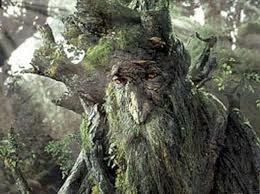
But, there it is, my present journey toward self-love. It is coming with the help of the Enneagram and at the expense of a good spiritual chainsaw. Like the Orcs’ insidious intentions in Fangorn Forest, God and I have together hacked and burned and burned and hacked at the forest in my eyes. It is an unwelcome process however necessary.

As I said at the beginning, I’m slowly understanding what self-love can actually mean; the benefits so to speak. Those with whom we must share this life are best served when we work on our own stuff first. After all, nobody wants to be another’s eye-forest lumberjack.

Glimpses IV: the spirituality of home

With this topic I enter through a small door into a big room. I do so on tip-toes so as not to awaken any sleeping giants. Home, like love is a word deceptively larger than its meager 4 letters suggests. In my 48 years post-womb I have been many people to many people with many people. A social chameleon, I guess I thought it best to live vicariously through anyone other than myself. Their stories were better, more invigorating or inspiring, or more inclined to win female attention or male praise.

As a result, home, both as place and idea, hasn’t always had the centrifugal force it is supposed to have. From time to time, life has felt a bit disjointed, like a balance with an ill-positioned fulcrum. It’s always a little off. Move it enough and one forgets where the center was to begin with.

Most folks enjoy at least a minimal sense of who they are and when their boundaries are breached. Whenever something foreign or unnecessary storms the walls of their identity they have a means of objective detachment whereby to judge their suddenly unfamiliar surroundings. I, apparently, lack this essential characteristic.

Why?

Is it my artistic, non-logical, non-empirical sensibilities? Perhaps the fact that I’m adopted? Could it be my “progressive” sensibilities (think protest songs, Kumbaya group hugs and flannel shirts), my piss poor memory or some unseen psychological malady(s)? Bad gas? It is as baffling and frustrating as it is intriguing.

The result is the fact that home needs redefining for me – renaming even; something broad enough to encompass my complexities (annoyances to those who know me best), focused enough to provide sufficient context for who I am becoming and “Jesusy” enough (thank you, Anne Lamott) to be honest, self-sacrificial and have lasting trajectory with ultimate meaning…oh, and perhaps a hint of compassion.

(The 950 square foot bungalow in Calgary where I grew up)

A recent trip to my home-turf of southern Alberta left me with these thoughts:

Home is not geographical as much as spatial. It involves an awareness, a familiarity as it were; that place “where everybody knows your name.” I know it and it knows me. There is no awkwardness or second guessing. I understand the politics, the inside jokes, the acceptable or unacceptable faux pas. The prevalent bigotries, hip views, “in” restaurants, “now” looks. The shortcuts and back roads to places only I know or care to know.

In other words, home is where we know and are known. It is about who we spend our lives with and why. We are most home when surrounded by those with whom we share life, both good stuff and bad. We are home when someone cares enough to be pissed off at us or play practical jokes on us. Or cry with us.

Here is the challenge however. As good as all that sounds, it’s still an unsure footing for something as untamed and uncertain as the spiritual life. It makes a ton of assumptions, many of which grow from our home-grown, Western world, Waltons mentality. What if I’m blind and cannot see the above gifts? Deaf and cannot hear the words of familial comfort or humor? Comatose and cannot experience them? Mentally incapacitated so as to deny full involvement in it all? Incarcerated or worse? Where, then, do I find “home”?

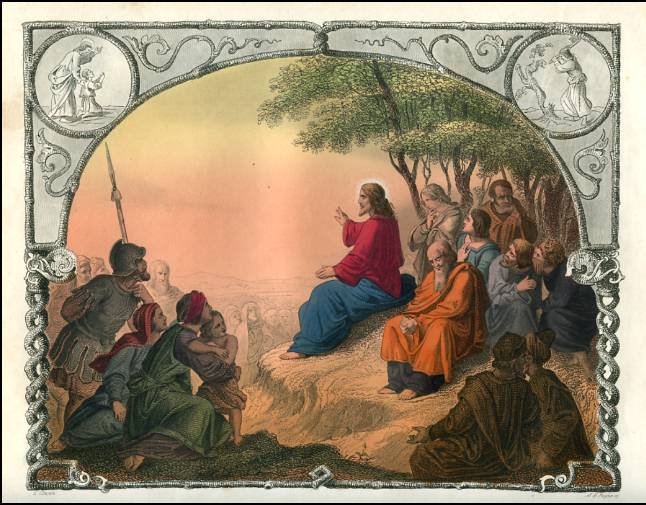
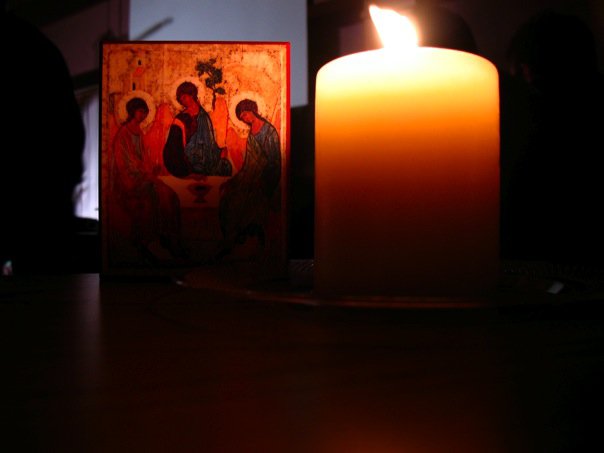
If anyone stood well outside the comfortable, normal or expected, it was Jesus. His was not a simple move across the country or even the globe. The journey he undertook landed him amid the harassed mass of fallen humanity of which he was now a shareholder. Where once he enjoyed the benefits of Trinitarian dwelling and the benefits thereof, he passes through a birth canal into the cold world, created for, through and by him. Jesus’ example and presence makes home possible even in the least likely locations.

Why?

He gave up his “home” in order to give us ours. And that’s good enough for me.

Glimpses, part II – the spirituality of place.

Where a person is can be as important to one’s spiritual development as what they believe. Long have spiritual masters proclaimed the benefits of sacred places. The Hebrew scriptures are replete with God’s directions to Israel to mark out territories prescribed by God that would both demonstrate God’s faithfulness and Israel’s special role in God’s redemptive economy. From the irrigated, verdant hills dotting the landscape around his hometown of Galilee, Jesus would spend countless hours with his Father. From such wilderness haunts he would find nurture, tenacity, strength, succor, and, frankly…answers.

So much of who we are and what we are becoming is directly attributable to the places that have graced us (rhyme subliminal but entirely intentional). In the comparative spiritual laissez faire of Constantine’s newly Christianized Rome, Abba Antony of Egypt started a mass exodus into the deserts of Egypt, those who would become known as the Desert Fathers and Mothers. The barrenness and desperation of the desert mimicked a similar cry deep within the hearts of these enigmatic souls. What is the obvious lesson? When there isn’t anything to titillate the senses, one might as well deal with the soul!

As a result of their foray into geographical nothingness, they became everything. They became the fullness that lies beneath the surface of what one misses when only seeing the desert sand.

The Celts, well known for their keen kinship with their environment, made much of this desire. Not unlike the Native populations of the US and Canada, not a feather of wing-ed bird, nor bark of tree, nor single trickle of rainwater escaped their notice. All carried within it some morsel of meaning for them.  Because everything received notice, nothing got wasted and this outer kinship found expression through inner resolve and great spiritual creativity.

My own holy places, the cairns of my wanderings, are generally old, rather solid, often drafty and poorly insulated, but full of the memory of stones that have long cried out to their Maker. Long have I had an historical and spiritual affinity for those stuffy, rarely air-conditioned chapels that never cease to draw me elsewhere…to the great Other. Let me share just a few.

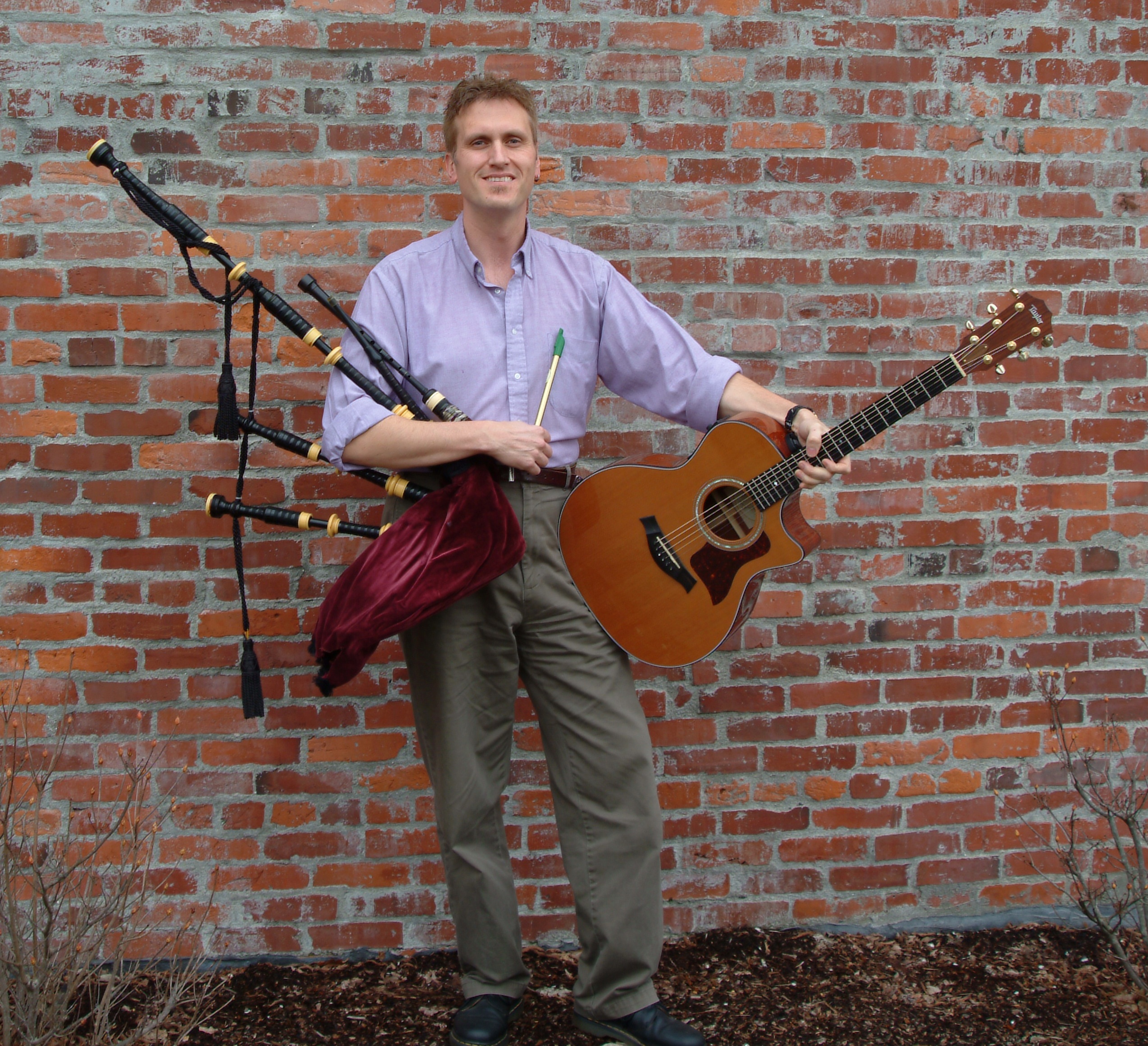
St. Saviour’s Anglican Church sanctuary in Nelson, British Columbia where for a number of years I taught at a Highland Bagpiping School (a place where other strange souls like myself learn to tame a five-legged creature designed to rouse neighbors and destined to arouse suspicions). Connections in the community opened the door figuratively and, in this case, literally, to spend as much time as I wanted in the church sanctuary after everyone else had gone home. I was given a key and carte blanche run of the place.

Most evenings after a long day of bagpipe students, some whiny, some lazy, all of them noisy, I would retire to the sanctuary with my pipes. For an hour or so I would simply play, enjoying the epic reverberance of the sound bouncing off the hard stone walls, and finding no sonic respite from the hardwood floor. It was, for me, the closest I had yet been to what I might have then described as heaven. At times it was 2:00 am before finally getting back to my room.

The hospital chapel in the same city was another such place. I was falling apart after a recent break-up with a girl to whom I had been engaged. My shattered interior was gradually reintegrated in that little chapel where I would weep and pray for hours, listening to John Michael Talbot, or the Monks of the Weston Priory sing beautifully doleful refrains. It was for me, through gallons of heart-crushing tears, the perfect requiem to my stubbornly elusive peace of mind. It would become the Introit to a new place of healing and restoration, albeit gradually.

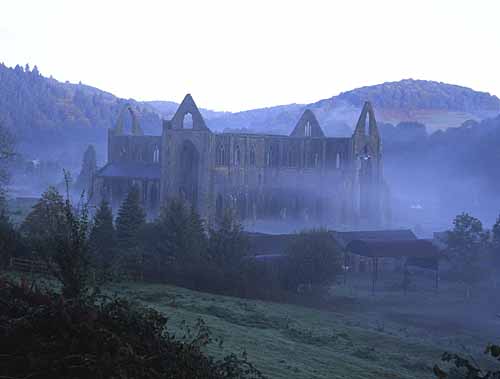
Tintern Abbey in Wales, the place I believe could be boasted by angels as heaven’s waiting room, the lobby to eternity. My first experience of this roofless wreck of holiness was following a six month sojourn as a missionary to youth in Edinburgh’s rough Pilton district with my new wife of a year. We were tired and needed time to traipse about the land of our ancestors (and her relatives) before returning to Canada, unsure of what awaited us there. The warm, lazy day infused with the angular light of Fall caressed the ancient stone walls easily visible from almost anywhere. The pointed gables of apse and nave bespoke a darker but simpler time. All we could do was sit and pray.

Less than two years later a picture of Tintern Abbey would help pull her through a terrible first pregnancy with our son, Calum. The same photo performed this function five years later as our second son, Graeme, reluctantly succumbed to womb-ed pressure and left his humble abode to make his premier. However, it is difficult to compete with William Wordsworth whose words best complete this picture:

While with an eye made quiet by the power

Of harmony, and the deep power of joy,

We see into the life of things…

And somewhat of a sad perplexity,

The picture of the mind revives again:

While here I stand, not only with the sense

Of present pleasure, but with pleasing thoughts

That in this moment there is life and food

For future years. And so I dare to hope…(Wordsworth on Tintern, 1798)

Everyone can point to at least one place where something important, even seminal occurred and they sense something is different. There it is that our life has been forever changed, perhaps only incrementally, but transformed just the same.

I believe it is God’s way of playing spatial peek-a-boo.

Think deeply of a place or two that have been places of rest and reconstruction. Picture that place in your mind. Now let that picture juggle your heart.

As you do so, re-member the pieces of you that may have been broken or lost in that place. Quietly give thanks to the God who loves to find us where we’re least looking or at least looking the other way.

Glimpses, part I: awakening to the indescribable

I want to take a stab at describing what cannot adequately be described. As a contemplative and a musician, I have met, from time to time, with mystical experiences that beggar explanation. I do not have anything close to adequate categories or temporal understanding for such things. In seeking them out, I must simply share and hope for the best.

I will be doing so in a short series of posts under the general heading, “Glimpses.” A little unoriginal I admit. However, I trust that my faltering attempts at self-revelation will prompt your own journeys of inner discovery and that, together, we may find God’s deep reservoir of grace.

At the foundation of Christian spirituality (and others) is the very basic principle of awakening or awareness. It comes in many different packages, under numerous ideologies, representative of a host of approaches, all with practices that lend themselves to one’s emerging spiritual life.

To become aware is to wake from some form of slumber, sleep or sloth. One of the mysteries of spiritual awareness is that one does not awaken naturally. We are prodded awake by the loving work of God upon the sleeping soul. It requires this nudge from God upon our shoulder before any meaningful process of receptivity and relationship can occur. In order for us to embrace this work, basically to ‘awake to our awakening’, we must intuit God’s whisper, speaking grace into the spiritual ear of our understanding.

I do not speak so much of the prophetic proclamation to “arise, shine; for your light has come.” No, before we can be so attuned to the prophet’s voice calling us to faithfulness and righteousness, we must first hear the voice of the Lover calling us to succumb to this wooing for which our only response can be, “I am my beloved’s and my beloved is mine.”

As comforting and romantic as that sounds, however, upon awakening to the first primal strains of the song of God, there comes a dissonance amidst the lilting notes. We awaken to beauty and begin to see that for which we have always yearned but of which we were unaware; blind. This, however, can often be a fearful and groggy experience. Cobwebs invade our minds unaccustomed to such sharpness of color. Ears that have been plugged up suddenly pop as our inner altitude changes. It is as disorienting as it is invigorating.

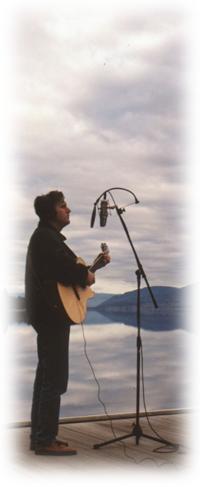
I remember places, glimpses into…something; an awareness that hints at a proximity to the indefinable, numinous presence of God. These are never easy things to describe, but there is a delight in the attempt for, in so doing, I am taken back to some of those places. For me, it was often some old, stone church or monastery; most often at night, alone.

Yet, not alone.

As I have since come to believe, they were, as the Celts called them, thin places where a barely perceptible sheath surrounds the holy otherness of God and where comes a mystical awareness of God so immanent that one feels she can literally smell God’s breath, touch God’s skin. These experiences have often made the hair on the back of my neck stand up.

Ironically, they used to happen often when I was a boy, long before I had any faith lexicon or tidy systematic theology with which to scrub them up and describe them away. I recall one particular time as I lay on our living room floor. I was probably eight or nine years old and, as I did every year, was watching the first snowfall of winter. Enormous frozen flakes dove in random, disciplined lines, dancing past the streetlight that stood outside our home. The glistening goodness provided a panacea against which the world was complete and all was one, if only for a time. In those moments, gilded and encased in childhood wonder, I became curiously aware of a haunting peace that arrested my sensibilities and held me spellbound in what I can only describe as ‘rightness.’ The cosmos and I were one. God, as I now understand God, was lying beside me on the living room floor that night, whispering wordless words to me, convincing me of my place in it all, be it ever so miniscule.

This is a story best left unfinished…

This week, consider quietly and prayerfully, the ways in which you may have heard these awakening whispers of God.

Journal them. How did they occur? Under what circumstances? What, if anything, changed in you as a result?

What are ways you may be invited by God to enter even more deeply into these places of awakening and transformation? Agree, humbly and with resolve, to enter into them with the God of grace to guide you.

Feel free to share what you and God have been up to in your journey together.

My wife always tells me where to go

For guys like me who suffer from severe, chronic directional retardation, Diana Ross contributes the quintessential song, “Do You Know Where You’re Going To?” It is an appropriate question for me since, as previously mentioned, I get lost easily. There’s an even more embarrassing reality here…

My wife is a professional cartographer.

She makes maps.

I know! How crazy is that, right? I like to kid her that, not only does she tell people where to go, but then gives them detailed directions as well. In my unredeemed moments when I’m tempted to tell some self-congratulatory stuffed shirt to go to hell, I know where to go for tips on the quickest way there. My wife is an expert in helping people get from A to B and back again. In this way she is a kind of geographical shepherdess, guiding the unwary soul away from the rocks of potential disaster to the still harbor front where rest and Daiquiris await (or tonic and lime in my case).

I’ve been a “professional” church music director for many years. Anyone who does what I do will likely share a similar scenario. When introducing oneself at parties or potlucks, the customary question aimed at one’s spouse is always the same, “and what instruments do you play?” The assumptions here are many, not the least of which is the very 1950s idea that to hire a man for ministry is to hire his wife and family as well. I’m the main guy, she the piano-playing-kid’s-choir-directing-always-polite-and-fashionable-dutiful-wife sidekick; a role for which she is rarely recognized and never paid. Once, while at a party with friends, a certain insistent lady kept pushing for more information on her singing abilities since “that’s what music minister’s wives do.” True to form, Rae replied with the astute comment, “is that the same for you since your husband is a carpenter?”

Well played, my dear. Well played.

She used to be bothered by this presumption. Thankfully, the perception of a thinly-veiled evaluation has worn even more thin over the years. Now we simply chuckle about it.

People have often asked me, why didn’t you marry another musician? I recognize that to be the accepted pattern. In actual fact, she knows a great deal about music and is a passable pianist and organist. We both share a widely eclectic musical palette; everything from Bach and The Chieftains to Sara Bareilles and Death Cab for Cutie. Tellingly however, our younger son, Graeme, once told her she had the singing voice of a goat and that even auto-tune is out of its league here. Dude…nice.

One must understand that musicians, or at least I, swim in a veritable sea of self-referentialism. Ironically, it’s what makes us good at what we do. Artists are generally brooding, too self-aware and then, pushy about it. I’m at the head of that parade. Don’t get me wrong, I love my artsy kindred spirits but, seriously, you really don’t want more than a handful in the same room at any given time, trust me. It’s simply too much Bohemian smug for most church potlucks to accommodate.

No, I’m quite pleased to have met someone who, instead, shares other deep passions of mine – history, geography, old languages, and rain. My undergraduate degree is a B.A. in Music with a major in Vocal/Choral Performance. Hers is a B.A. in History with a minor in Geography. In this curious mix, at least in our better moments, we have seen a much fuller, rounder, doubly satisfying concoction of passions and traits. It means that I can be the king of music, she the queen of history under the same roof. Instead of vying for attention, as artists are wont to do, we have the choice of being each other’s biggest fan.

Granted, this sounds great in theory. It doesn’t always work in reality. But, the lesson is clear. In our darker moments, a poem, joke or song from me can bring hope and cheer to an otherwise bleak situation. She reminds me that men and women have struggled with such darknesses for centuries and that safer shores were never that far away.

Now, when asked why I didn’t marry a musician I can simply say that I needed someone who would tell me where to go, how to get there and, in so doing, help this lost soul be found again.

I know of Someone else who does such things.

Jars of Clay – A Prayer

Lord, you have exalted your name above the heavens.

Your name means grace and peace and wonder to all who speak it in faith and love.  You have chosen to use weak and broken vessels to be your eyes and hands and feet in this world.  It seems, Lord, that you love to pour out your glory through

the ordinary, the fragile, the imperfect.

In this, Lord, we are honored – but humbled.

You ask us to mirror grace, love and faithfulness to the world – the very grace, love and faithfulness so eloquently portrayed in Jesus Christ.  Through him, you promise to give us all we need to live rich and holy lives in our communities, our families and in this world.

Mysterious God, so great a salvation!

We sinned, you forgave.

We turned away, you gave chase.

We rebelled, you paid for it.

We forgot, you remembered.

We are often faithless, you are ever faithful.

We complain, you are patient!

Lord, do not allow us to make excuses for ourselves, hiding as we do in the limits of our humanness.  Although we are perfectly aware of how inadequate we are to the task, help us to see ourselves as you do, as reconcilers, as peacemakers, as redeemed kingdom builders.  If we are dull, make us shine.

Lord, take these imperfect jars of clay and make them holy cups of pure grace, forged in your desires for us.

May it be so, Lord.

May it be so.

Parking lot lost and found

I get lost easily. It’s funny to those who know me best, annoying and perplexing to me. Many is the time I’ve lost my way in the Safeway parking lot, often in an ungodly fog of non-Sunday-school language. After calming down from my diatribe on poor parking lot engineering I begin the pathetic process of self-flagellation that includes the obligatory inner harpy: “if you can’t even find your way out of the parking lot, how do you expect to find your way in the big, bad world with, like…roads ‘n stuff!?”

A case in point: last summer I was hurriedly making plans after a long and complicated week to drive to Cannon Beach, Oregon for a choral directors workshop. As I am wont to do, I left well before I really needed to since that’s what uptight, anal guys like me do. I was particularly proud of my packing prowess having narrowed down my weekly possessions to a single midsize suitcase…well, and my guitar of course…oh, and a bunch of books in a separate bag (not counting snacks, naturally). Being more concerned about early arrival than any other point of preparation I happily hit the road two hours ahead of schedule with the air condition blasting and the tunes blasting even more.

I crested the final hill from Yakima to Ellensberg from which the windmill and horse ranch dotted valley below spoke loudly of itself in multi-colored hue. I sailed past Ellensberg and was impressed with the reasonably well-flowing traffic on the ever-busy I-90 corridor to Seattle. Then, a few miles past the small mountain cowboy town of Cle Elum I hit the intestinal traffic jam with no hope of quick relief to the constipated bumper-to-bumper traffic.

No problem, I thought, I had left plenty early and was listening to a delightful conversation between Krista Tippet and poet/philosopher, John O’Donohue (listen here). I was enraptured and unhurried. Upon finishing the CD I figured a few cell phone calls might help pass the time. One of those was to my wife Rae, (who ironically, makes maps, more on that in my next post) and confidently boasted my ample progress despite poor traffic just past Cle Elum.

A lengthy pause.

“What the hell are you doing in Cle Elum?” she barked, apparently not as chuffed as I on my progress.

Another lengthy pause…

Then it dawned on me. I was in fact on the wrong road altogether!

My retort?

“Yeah, what the hell am I doing in Cle Elum?”

I am now the proud owner of a cool GPS unit that speaks to me in the smooth vocal tones of Sean Connery (snooty bugger) and, thanks to my wife and boys, seldom get lost anymore (please don’t tell them that I generally don’t know how to use it very well).

Sometimes we need road signs, GPS units, spouses, kids and friends to share the burden of our lostness. And the more I think of my proclivity toward directional retardation the more I am reminded of the spiritual parallels here. It’s no surprise that Jesus loved the lost and found metaphor and used it liberally. To be lost is one thing. To be lost and blissfully unaware of it is quite another. It is more sinister, not in the traditional heaven-hell, saved-damned dichotomies; but in the getting-warmer-getting-colder proximity meter as we seek union with God.

I hate the feeling of being lost or losing my sense of direction. But, to hear Connery’s comforting voice say those words I love to hear, “you have reached your destination, shaken, not stirred”, is the highway equivalent of these still better words…

“This one was lost and, now, is found.”

Leviticus, Lambs and all in All

It is not generally my style to be a theological “shock-jockey” and I have no particular love for sacrificial triumphalism. Nor do I especially value our over indulgence in violent guilt offering atonement theories that merely perpetuate condemnation rather than permeate grace. I am, however, reading through Leviticus and made some profound connections between what the ancient Hebrews might have encountered and what a less ancient Hebrew once encountered to counter the former.

Take it.

Take it all.

Take it all and more, it was never mine to begin with.

All that was my all I sacrifice before the great All.

All that I thought was all I sacrifice before the great All.

My all can never be All unless given up for the all in All.

I flay these guiltless idol-beasts on the bloodstained altar of grace,

where all that is ever All once was.

This blood matches my own, this heart my own;

this pain my own, these eyes and innards my own.

This poor bleating one, shivering and afraid

with eyes askance and yet calm

foreshadows another Lamb

eviscerated for all that I have done-

ensconces all that I will be.

We are one because you have ordained it so.

These cultic rites and offerings weigh heavily upon me;

so labor intensive, so messy, so inconvenient, so…expensive.

Oh, I get it.

…and he said to him, “follow me”: a Litany

This litany grew out of a class I took as part of my master’s program….


How good it is whenever we leave all false agendas, desires, plans, schemes, thoughts – selves behind and obediently follow the Master without hesitation.

…and he said to him, “Follow me.”

How good to imagine a world where those without hope are given hope because the community of Jesus follow the leading of their Master and Teacher and bring this hope in all they say and do.

…and he said to him, “Follow me.”

How good, to host the Presence keeping company with sinners, tax collectors, lepers and the outcasts of society.

…and he said to him, “Follow me.”

How good to ever have ears to hear the voice of Jesus calling to us, urging us to follow him wherever he goes participating with him in bringing the new wine of God’s kingdom to light around us.

…and he said to him, “Follow me.”

How good to live before God every moment with godly sorrow for our sin, fully embracing our many and varied brokenness in honesty and authenticity.

…and he said to him, “Follow me.”

How good to celebrate with all whose repentance brings new life and an accompanying deep life change even when such celebration causes raised eyebrows.

…and he said to him, “Follow me.”

How good never to allow ourselves to succumb to religious peer pressure that traps one in the smothering flames of imposed, ungodly parameters of faith life and thereby lessen the gospel message in compliance with it.

…and he said to him, “Follow me.”

How good never to succumb to the same judgmental spirit which produces and perpetuates religious peer pressure. “Father forgive them, for they know not what they do.”

…and he said to him, “Follow me.”

How good to taste the old, complexly rich and fragrant wine of our forebears while working in the vineyard alongside our Master Winemaker.

…and he said to him, “Follow me.”

How good, to “stand in the place where you work” looking left and right to find those of ill repute and the despised with whom to drink new wine.

…and he said to him, “Follow me.”

How good to stand in the place where others are, be the voice of Jesus calling to them, saying “follow me” and teach them how to catch others in the net of grace.

…and he said to him, “Follow me.”

How good to be those who hold the redemptive instruments of grace at the bedsides of the broken together with our great Physician.

…and he said to him, “Follow me.”

How good to bring encouragement to all whose “bridegroom” has been taken from them either by sickness, death or malfeasance.

…and he said to him, “Follow me.”

How good…

How good, indeed.

Praise be to the Lord of all lepers, losers, limpers and lovers!

…and he says to us, “Follow me.”