25 + 5 =

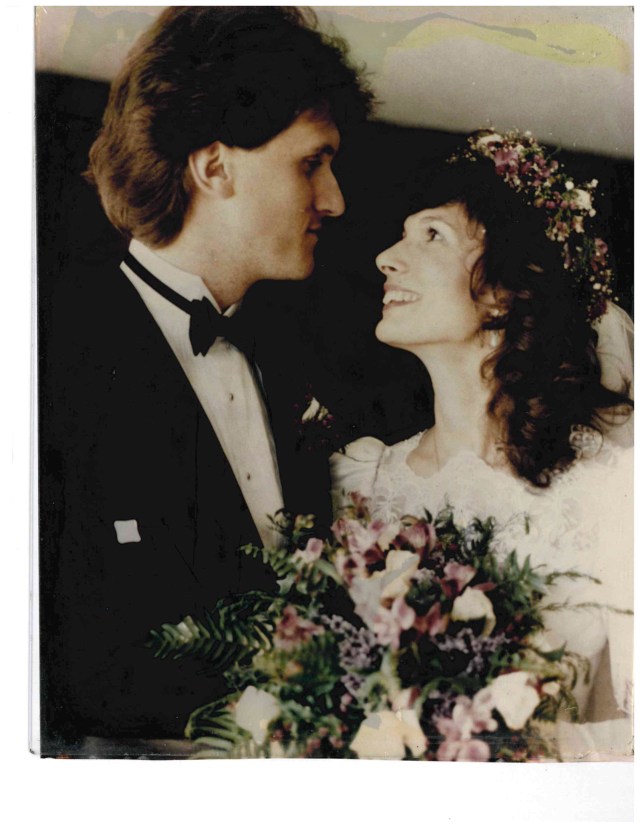
On a windy Calgary day on May 14, 1988, I got married. Rae Kenny-Rife to be exact.  If my math is correct (in these matters it’s best to be accurate), that makes 30 years.

May 14, 1988.jpg
Eyes, the gateway to the soul.
Rob and Rae wedding  copy.jpg
Rae and I posing in her father’s living room (you’ll just have to forgive the mullet)

30 years.

30.

Years.

It feels strange just reading those words. A guy at my level of A.D.D. seldom manages 30 minutes at anything.

Rae-Wedding Day88 copy.jpg
Rae, 30 years ago today (yummy)

That’s 360 months. 131,400 days. 7, 884, 000 minutes – well, you get the idea.

Marriage has been compared to many things.

The slow, arduous climb up a mountain, increasingly steep, and constantly threatened by dodgy weather.

Cool. Lots to see up here.

Wild, adrenaline-pumping, white water rapids.

YOLO.

A crazy carpet ride down an icy hill. Partners in guts and glory. Fellow felons of fun and frolic, as it were, gathering speed, danger, and panicked screams along the way.

Go for it. Whether by fall, splash, crash or slide, it’ll wrap up all too soon –  sometimes with an uncomfortable bump at the bottom.

Besides, you can cry or laugh alongside someone who also pissed themself on the way down.

Rob and Rae, couch copy.jpg
As fashionably 90s as one can be in a kilt.

We love to ask our elders, decades of partnership under their belts, “what’s your secret to success for a long and happy marriage?”

Of course, in the asking, we assume their marriage to be both “successful” and/or “happy,” whatever those ultimately mean.

Therefore, let me humbly suggest we begin with a satisfactory definition of terms. What do we mean by long, happy, and especially, successful? Is it successful only inasmuch as it is long and/or happy? Put another way, can short marriages also be defined as successful if they were happy most of the time? What about those decades-long marriages that, although long, were rarely happy? Are we to view those as successful as well? At the end of the day, is happiness or longevity the litmus test for a successful marriage?

Rob and Rae cruise ship-cropped copy.jpg
On our Hawaiian Islands cruise, 2007

I could wax philosophical and ask whether Shakespearean star-struck gooeyness makes for good lovers (if so, hide the kitchen knives!). After all, who doesn’t love a good love story? That impossible pairing of impossible opposites who, against impossible odds, stumble into bliss together.

Nah.

Back to our aging honeymooners instead. Among the most common answers to the question are as follows:

Communication (including sex).

Laughter.

A sense of shared purpose.

Frugality and discipline.

Hard work and sacrifice.

Children.

Not children.

Regular date nights.

Bourbon…the list goes on.

To those staring at 50, 60 years or more, 30 years seems like a drop in the bucket. So what? They felt the same way as I many years ago.

30 years!

That’s a very long time and I’m proud of it. We’re proud of it. And, were someone to ask us our recipe for “success” I’d likely say, “I have absolutely no f**king idea!”

Communication. Let me land there for a minute or two. In any marriage, communication can mean many things. Lack of it might best be described as unseized potential for understanding. Maybe even happiness. Relationship carpe diem, missed.

At other times communication bubbles over like foam on warm beer.

Then, there are those times of steel-blue silence. Arms folded. Back against back. Eyes squinted and distrustful – what Canadian novelist Hugh MacLellan once called “the two solitudes.”

Rae and I-Caerleon copy 2.jpg
2016, Caerleon, Wales, UK

Communication. In 2012, following an extended period of marriage difficulties, in what could only be described as a blinding hurricane of sexual renaissance, we were reminded about the powerful communication that can happen in the sheets. You can speak in a thousand different ways, but the robust vulnerability of intense bodily contact places trust at a whole new level.

Oddly, it can also be the best form of deception. Merely sharing orgasm doth not a relationship make. (That said, what a great way to find out!)

No harm, no foul, right?

On its own however, it is insufficient. It pales to the much less glamorous task of authenticity and mutual openness. The gristle gained in the grind.

Sex can iron out wrinkles sufficiently to make relational garments fit better. It can oil the squeaky hinges on the door that opens outward to freedom, inward to contentment. It loosens up tongues, long silent, to reinitiate the project of bridge-building.

It can, in the words of Richard Rohr, take us to the temple gates, but only the vastly superior love of God can open those gates and escort us in. Something much greater than a post-coital daze is necessary to sustain a relationship through the long, rigorously demanding years of life.

And those years are often hurled at us like glass in a hurricane rather than gently lowered down in a tidy basket of fruit, smiles, and puppies.

Laugh I’d say. If you don’t know how, bloody well learn. Few things are as life-giving as gut-busting laughter. This we have done in spades. The girl is a walking party. She attracts mischief and  gloriously infantile guffaws like scuffs on new shoes.

Laughter? Yeah, we’re pretty good at that bit.

30 years.

I wrote this on our 25th. Rae wrote this on our 26th. Now, on our 30th I add another 5. And, if someone felt the urge to ask me how we’ve managed this long – “what’s held it together? What’s the secret? How did you do it?” – I’d be hard-pressed to give a decent answer.

Was it the many times I could have more readily throttled her than cuddled her?

Was it the time we told each other to f**k off while losing control of Scottish teens at a church seaside games night?

Or, the screaming match in a church parking lot when I threw the car keys into traffic?

Was it the years we rarely touched each other?

The first or second time we separated?

Was it the nights, sometimes many, I decided to sleep elsewhere – anywhere else?

Was it those times I was so angry I couldn’t see straight or imagine another minute with her?

When the best remedy I could find was booze?

Or, was the nights, huddled under winter blankets, watching BBC together?

Our shared passion for justice, and distaste for ecclesiastical hypocrisy, and political bullshit (in America, those are the same thing)?

The Nirvana of a Welsh rain pouring restlessly over Tintern Abbey stone?

Tintern 4 copy 2.jpg
Tintern Abbey. No wonder it inspired Wordsworth so much.

Mutual lump-in-throat dry mouth, driving B roads in rural Britain?

Welsh countryside 4 copy 2.jpg
Back roads, by way of example.

Our love for all things ancient and wonderfully impractical?

Those liturgical dates at a Taizé prayer service, an Anglican or Catholic Mass?

Antiquarian bookstores?

Well-honed inside jokes?

Favourite Spotify playlists containing everything from ABBA to Gregorian chant?

Writing dates at oceanview cafés?

The embarrassing hilarity of late middle-age sex?

The shared writing of a symphony, Opus 1 (Calum) and Opus 2 (Graeme)?

Yes. All of it and more. It’s been bliss at times, shit at others.

But, it’s our shit. The shit we know. The shit we’ve weathered together.

30 years and I’m still horrified at the sheer level of commitment required. I still blanche at the profundities of this whole deal – the distance there can be between contentment and chaos. How contentment, however spotty, gives perspective to said chaos.

Mostly, how God has managed to help us smell like roses in a sea of self-inflicted shit.

Rae and I, Edinburgh copy.jpg
1989. The Royal Botanic Gardens, Edinburgh. Rae, looking like a 1940s starlet!

If a “successful” marriage, whether long or short, happy or not, is one characterized by awareness of its failures, but possessing a desire to deal with them, we likely fit the bill.

If “happy” simply means more sunlight than shadow, more gratitude than regret, more genuine than shallow, more honest than projected, more lived than protected, we likely fit the bill.

30 years.

25 + 5 = 30.

For me, it equals quiet satisfaction.

Happy Anniversary, babe. Let’s keep adding numbers until we forget we were adding numbers.


To See or Not to See…

To see or not to see....jpg

We’ve all heard the old adage, “one only sees what they want to see.” We easily and quickly make judgements on our perceptions of things, not always on the truth of things. It’s always been that way. I’m guessing it will always be so to some degree.

Some will see only a page full of black dots. Others see the number hidden in the middle (they kinda piss me off!) Some see the brown barrenness of parched desert. Others see the miracle of life which is possible even in austerity. What is to one a beautiful optical illusion is to another a confusing mess of nothing at all. One sees thirst and death. Another sees possibility and survival.

It is a remarkable feature of human nature that, on the basis of perceptions and in the interest of either self-preservation or the pursuit of fulfillment, we succumb to the process of other-worldly fabrications. Given our predisposition to see only selectively, we sometimes live our lives labouring under misapprehensions.

For my part, I have often built an enormous mental-emotional web of shadows and half-truths and desires and make-believe. A construct on whatever I think is true. It is mental, because so much of who I am and how I behave is conceived and constructed in my mind. Emotional, because, just like yours, my head and my heart are inextricably linked.

To think something is true is, correspondingly, to feel something as well. If I think a loved one is still alive after some long absence, it creates hope, expectation. To believe that same person to be dead is to create despair and hopelessness. If we believe the person to whom we’ve been communicating is still on the other end of the phone, we’ll happily blether on until the bleak reality dawns!

Conversely, to experience an inexplicable hope, is to believe all to be well in our little world. In the world at large. If we feel weighted down, we either have a need for companionship, a change of scenery, or mood-altering substances (my preferred M.O.!) Moreover, we will believe it to be so because, in such moments, the universe may appear to us at the time, a toxic and malignant place, unfit for habitation.

Our brains are a complex lump indeed! From the minutiae in our head comes the fodder for our palaces or prisons. All is either benign, malevolent or benevolent on the basis of what we believe to be true or false.

Perhaps the entire goal of grace, and with it, the contemplative enterprise, is constructed to help us monitor, manage, even master the cognitive dissonance we experience – the chasm between what we observe, what we know (or think we know), with what we experience?

It seems that God’s intention in the Gospel is to gift us with a mental-emotional equilibrium in a universe that, to our physical eyes at least, makes little sense. God seems to be trying to get our attention focused away from what we see and onto what we have yet to see. Or, better, what God sees.

For example, if I see endless amounts of unpromising, fruitless work – God sees a garden. If I see endless hours of frustration, ignorant bumbling and non-Sunday school language – God sees the end product of my labour – a new staircase, or a table. If I see fatigue, poverty, and unpredictability – God sees relationships, children, and the warmth of family.

To say then, “I see,” is no longer just a physical act – observations in time and space of what is immediately before me. In the infinitely broader perspective of God, contextualized in the Gospel, “to see” is simultaneously to hope, to rejoice, to weep with joy.

For, to see as God sees, is to inhabit all things at all times at one time. Things are not only as they appear to me now. They are shown to be what they will be then.

It is there, in that place of seeing through God’s kaleidoscopic eyes, that a universe –  sometimes tasteless, flat and hopeless – becomes a sumptuous feast of possibility. Only then do I experience something counter-intuitive to what I “should” under my limited experience. My heart and head agree because God has introduced them to the broad spacious land – the realm of God. My earth and God’s heaven, kiss.

And I am reborn.

Seeing is believing, say the scientists. Believing is seeing, say the theologians. Being is both seeing and believing, say the mystics. Some cannot believe unless they see. Others claim to see and not believe. Still others claim to see what they don’t believe. Others will not believe whether they see or not. Confused yet? Yeah, me too.

God’s deepest reality? All of us belong in some way along the continuum of belief, sight and experience. God journeys with us wherever and whenever that is.

All that to say this: one’s emancipation comes most readily not from a change in circumstances, but in the readiness, and ability, to see. To awaken. I have often said that, behind and beneath and around everything we see with our physical eyes, is a pervasive spirit of glory.

The light and beauty and truth of God subsumes all things into itself. And, from time to time, there come moments of lucidity, of universal benevolence, when one becomes aware of the overwhelming perfection of it all. A built-in beauty not always immediately apparent.

But such moments are frightfully rare. They are gifts, shards of translucence and splendour, reserved for the unasked-for moments of clarity; when the paleness of our present reality, gives way to something else entirely. When it does, simply observe.

Rub your spiritual eyes and let yourself be roused from slumber. Wachet auf (wake up) as Bach might intone! Awaken to God’s tap on your shoulder. Throw off the covers. Stretch. Say nothing. Speak not a word. Just drink. Drink deeply of this stream. Let it do its work. For, once it’s gone, there is no telling if or when it may come again. But its nourishment is ours to keep.

Forever.

____

Amazing image found here


Learning to Live Dis-Labeled

Today, I proudly welcome my wonderful writer wife, Rae (her nom de plum: Wren Kenny) as guest blogger. What follows is a prayer she spent many hours composing to pray during the “Prayers of the People” segment of our liturgy. 
Labels.jpg

These are always tricky, especially in our present environment of toxicity and constantly germinating hatred. But, she wrote it. Prayed it. And the people – well, at least the many who showered their praise – loved it.

So, with that, I give you:

* * * *

The first time I visited a Covenant Church, I adored the blend of liturgy and evangelicalism. A man I spoke with after the service told me, “the Covenant allows for differences of opinion over non-essential theological issues.” He gave the example of baptizing both infants and adults.

This really appealed to my moderate personality, which bristles at extremes in either direction. I fact-checked with Pastor Dean. This denominational principle is called The Reality Of Freedom In Christwhere we focus on what unites us as followers of Jesus instead of what separates us.

It’s with this spirit I bring the prayers of the people this morning. 

_______________

Dear Lord, as we pray for the world, a popular culture phrase resounding through our nation right now is Lordy. And Lordy, what a time we live in!

We might be sitting in the pew next to a leftist, a rightist or an orchardist. The news, the Internet and social media have splintered us into tribes where we seek affirmation to support our own world-views rather than for information or friendships.

Everywhere we turn, there is division and labelling. Our Presidents have been white, black and orange. Our States are red, blue, or purple. Our parties are elephants or donkeys. The elephants have Liberals, and Blue Dogs and Progressive Dogs and people concerned we’re culturally-appropriating-cats-for dogs. The donkeys are divided over conservatism. If you’re not conservative enough you’re a RINO and excluded from a Tea Party. Then there’s the Alt Right suspicious of the Deep State and the newly formed Republicans for the Rule of Law. Amidst all of this we have a growing number of Independents and third parties and people of the just-make-it-all-to-go-away-so-we-can-party party.

Lord, how do we pray for the leadership of our nation, fraught with such divisions? Borrowing words of U2‘s Irish prophet, Bono, we pray: Lord, “Heaven on Earth. We need it now. Jesus can you spare a dime and throw a drowning world a line. Peace on Earth.

Conflicts escalate around the world. Most recently we think of chemical weapons attacks on the people of Syria—and we know that “no one cries like a mother cries when her children are living in the ground.” We turn on the television and the pundits fall everywhere, from ramping up military action, to peaceniks worried about a war because of a tweet sent from a toilet. For the leaders in governments around the world, we pray,

Jesus can you take the time and throw a drowning world a line. Peace on Earth.”

In our National leadership, we have those energized to seek election for the first time and others gearing up or fearing for their re-election campaigns. We have an unprecedented rate of retirements, resignations, firings, and indictments. The news comes at us fast and furious, and it’s spun to fit every ideology.

And it’s exhausting.

The days ahead only guarantee they’ll be filled with more division. For the principalities and powers that govern us we pray,

“Jesus can you spare the time and throw a drowning world a line. Peace on Earth.”

Lord, your word in Galatians 3 tells us: “There is no such thing as Jew and Greek, slave and free, male and female, for we are all one person in Christ Jesus.” But in our nation, we’re fighting over whether black lives, blue lives, or all lives matter. We fight over the rights of the unborn, and the born. We fight over the rights of school children and guns. And then we have gay lives and straight lives and Muslim lives and Christian lives and alternative lives.

“Jesus can you take the time to throw a drowning world a line. Peace on Earth.”

Our sports are divided over standing or kneeling. Our bakeries may or may not serve you a cake. We avoid our friends and relatives if their views don’t align with our brand. Your word tells us to encourage one another and build one another up, to be kind, tender hearted, and to forgive one another in Christ. If we’re honest. We’ve failed.

Bigly. For those estranged from others we pray:

“Jesus can you take the time and throw a drowning world a line. Peace on Earth.”

And we pray for those who once dwelled among us but are struggling in their faith. The divisions around us have affected the church. But today, let each person present think of those people who are no longer seated beside them. They might have been elders, deacons, singers, scripture readers.

Many find their faith shipwrecked by the challenges in our nation. From conversations, we’ve gleaned these words which will sting – the word Evangelical in the public perception has become: evangelical – all those associated with Twitter rants, adult entertainment, and attacking teenagers whose friends are laying in the ground.

The church across the nation is hemorrhaging members. “Evangelical” is not a word with which they want to be branded. Instead, life gets in the way and they give themselves an I-have-better-things-to-do-on-a-Sunday mulligan. 

Help us, Lord, to find ways to address the palpable anxiety, put aside our petty differences and reach out to those we no longer see. Help us embrace the freedom in Christ to be comfortable with differences of opinion.

Please, dear Jesus, throw your drowning church a line and let us remember that the gospel is not fake news. It’s the good news, because your word teaches us that “there is nothing in death or life, in the realm of spirits or superhuman powers in the world as it is, or the world as it shall be, in the forces of the universe, in heights or depths—nothing in all creation that can separate us from the love of God in Christ Jesus our Lord.”

Peace on Earth.
rae.jpg


Rae is presently putting the finished touches on her debut novel, Miss Adventured, published likely this year. Stay tuned!


Mystics Over Machine

I’ve long said something like this. This piece over at Patheos just says it better, that’s all.

Mystics-will-save-Christianity-1.jpgEnjoy!

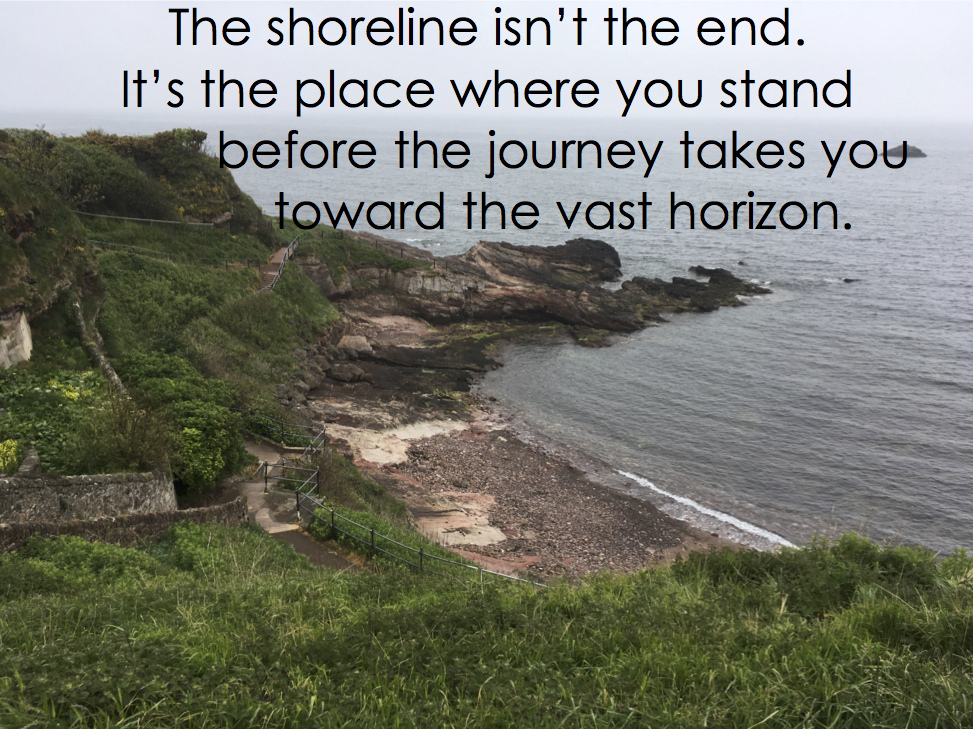
Where the horizon waits

Photo taken by me of Dunbar Harbour, Scotland, 2016

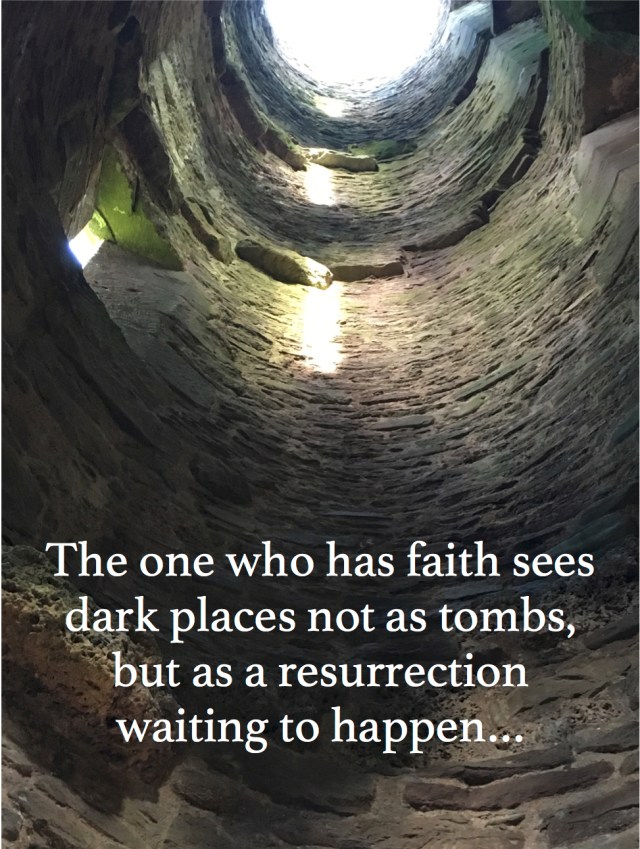
Shard of light

Resurrection waiting to happen

Resurrection
Llanthony Priory, Wales

Photo credit: me (thank you iPhone!)


Rediscovering Wonder

What follows is my sermon from Sunday, March 4th. And, of course, it reads more like a sermon than a blog post. But, you’re a forgiving crowd.

Mark 6:1-6 (NRSV)

He left that place and came to his home town, and his disciples followed him. On the sabbath he began to teach in the synagogue, and many who heard him were astounded. They said, ‘Where did this man get all this? What is this wisdom that has been given to him? What deeds of power are being done by his hands! Is not this the carpenter, the son of Mary and brother of James and Joses and Judas and Simon, and are not his sisters here with us?’ And they took offence at him. Then Jesus said to them, ‘Prophets are not without honour, except in their home town, and among their own kin, and in their own house.’ And he could do no deed of power there, except that he laid his hands on a few sick people and cured them. And he was amazed at their unbelief.

Where the other gospels begin backstage as a whisper and slowly crescendo, Mark’s gospel enters like a Quentin Tarantino movie: graphic, fast-paced with both barrels blazing. There’s a certain breathlessness to Mark’s gospel that heightens urgency. The pace holds our attention. It entertains as it teaches and is all about bold pronouncements, big miracles, immediate actions, and expected responses.giphy.gif

So, here are a few highlights, the prequel as it were, to Mark 6:

Jesus heals and forgives a guy let down from torn out ceiling tile.

Increasingly, teachers and scribes question Jesus’ character and ministry decisions, creating added tension.

He chooses the motley crew, otherwise known as the disciples.

He speaks of a house divided against itself followed by his own family trying to “shush” him by calling him away (he was likely becoming a little embarrassing).

He teaches about sowers and seeds and lamps and bushel baskets; grain and sickles, and mustard seeds.

He stills a storm with a couple words tossed out over the waves.

He sets free a crazed, demon-possessed man at the expense of some poor bugger’s herd of pigs who hurl themselves into the sea. You know, as pigs do.

He raises a synagogue leader’s daughter from the dead, all while indirectly healing a desperate woman’s lifelong hemorrhage.

And that’s only the first 5 chapters. The guy’s just getting warmed up.

But then he shows up in his home town. One would think that a particular type of reception would be forthcoming. What he receives instead is a collective, “who the hell does he think he is?!” And a bone-crushing flurry of amazing feats of heavenly daring-do come to a screeching halt on his own front door.

I’m sure we can all think of times when social gatherings didn’t work out in desirable ways.  For example, high school reunions. They’re always fun.

Right?

After many years, we reassemble, all of us wondering whether we’ll be able to pick up where we left off. We all know the ropes. And, we have a shared language, a certain unspoken understanding of things.

Will Bobby still be a science geek?

Will Audra still be the quiet, awkward girl stigmatized for her weight?

Will Matt still be the annoyingly self-referential football star the girls loved and boys loved to hate?

Will Alistair still be the class clown?

Will Skye still be the hippy girl who was good at writing and photography?

giphy.gif
Romy and Michelle break it down for us

Most importantly, how will I be perceived?

To some degree, how could anyone compete with the likes of Jesus? He’s one of their own, a meagre carpenter no less, claiming equality with God and performing the coolest party tricks ever to substantiate it.

I love stand-up comedy (I know, big surprise). Comedian, Brian Regan, highlights this socio-pathology. In short, party-talk one-upmanship. At every party, there’s at least one loud mouth, self-identified socialite sophisticate whose story is always so much better than anyone else’s.

How many of you have experienced this? Maybe it was you!?

giphy-1.gif

This is mine, not Mr. Regan’s (the lesser quality should be a giveaway).

You: “I climbed Mt. Adams last year.”

Mr. Better-Than-You: “Aw, how sweet. That’s when I was in Africa, climbing Mt. Kilimanjaro.”

You: “Well, I finally did it. I finished my bachelor’s degree.”

Mr. Better-Than-You: “Hey, that’s great. I’m getting a publishing deal for my post-doctoral work.”

You: “After four years of frustration and fertility drugs, we’re finally pregnant!”

Mrs. Better-Than-You: “Congratulations! We decided not to have a fourth and are going to Cambodia to adopt. We may stay for a year or two and work among the poor.”

Regan continues setting up his punch line. While Mr. Big Man in the room is doubling down on his own greatness:

“Last quarter, I managed to bring our company out of its slump and produce the highest quarterly earnings in its history. My wife’s been such a trooper, taking on all the extra responsibility while I taught in Prague. So, I took her and kids to Thailand for a month. Then, on the return trip we rented a Bucatti and drove the Autoban. It. Was. Fabulous.”

giphy.gifAt the other end of the table sitting quietly and without pretense, is an unknown guest, whose response is simple, unadorned and genuine: “I walked on the moon,” says the guest, Neil Armstrong.
All the air leaves the room. No one will ever have a better story.

We resent feeling upstaged. We resent whenever we’re not the most interesting person in a room. But, it’s so much more than just that.

I believe Mark 6 tells us many things. It speaks to the irritation of being confronted by the unexpected, especially if something is demanded of us.

Jesus was a home-boy done good and, had he returned in his nicest Sunday School clothes with Bible under one arm, flag under the other, kissing seniors and babies, and preaching white bread ‘n gramma’s apple pie, he’d have been welcomed with open arms.

“Just look how wonderful Joseph and Mary’s boy has become. You know he made Helen’s china cabinet, right. Yes! He’s making Bob and Edna’s patio furniture. That boy is going places.”

But Jesus returns to his hometown as a prophet. He’s been saying big things that don’t stay within the party line. He’s messing with convention. And, friends, let’s be honest, nothing spoils a party faster than someone who sees our failings, our deepest sins, and our most persistent needs…and can quote them publicly.

I had a radical conversion experience in 1981 while touring as a musician. I’d experienced miracles while on the road, made lots of new and strange friends, started carrying around a big Bible, hung out downtown at the Mustard Seed Street Church, gave away half my clothes, most of my record albums, and gave my Mom $50 just for doing my laundry.

10389430_10152658454597448_5329237185201042898_n.jpg
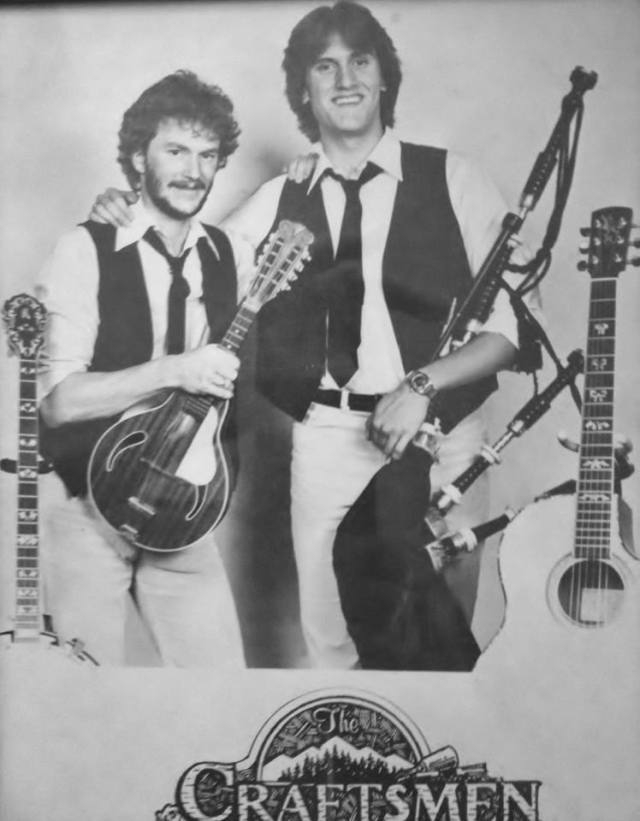
“The Craftsmen” – one iteration of my touring career. I think I was 17 here.

And my family loved me.

Well, in theory. My reentry into my family of origin was anything but easy. What I saw as beautiful, persuasively formative changes in my life often came across as threats and condemnation to them. I recall my sister, in casually caustic manner, telling me to just go away and sell flowers at the airport (that’s actually quite funny). My brother threw a pair of scissors at me and my poor mother just thought I was abandoning her and everything they had taught me as parents.

Frankly, I was new in faith and just being an immature dink. So, perhaps this is not the best analogy. But, it was still deeply disconcerting.

We resent perceived changes to our status quo.

We resent that with which we have easy familiarity. It can in fact breed contempt.

We resent whatever pulls us out of a stream of consciousness flowing comfortably in one direction.

We resent reminders that we are not called to be power-brokers, but prophets.

We resent being told that we’re somehow on the wrong side of history if we think ourselves winning some culture war.

We resent being reminded that the last shall be first and the first, last.

Jesus was too well known in his home town for anyone to actually listen and be moved to repentance and change. They had traded their wonder for revulsion. What many non-Jewish, non-conformist, non-“correct” outsiders were experiencing – forgiveness, healing, emancipation – his own townies found offensive.

I’ve been drawn back to the prophets of late. I once hated reading them. Grumpy buggers, the lot of ’em. With the sorry state of our national life these days, primarily the church, they are offering much encouragement. A number of things become apparent when one honestly reads the OT prophets.

First, those most in need of God are God’s people. Judgement always starts where one would assume kingdom truth to be self-evident. Friends, if there’s anyone who needs to hear the gospel all over again, it’s us, the church; those most familiar with him.

Jesus stands at the door and knocks, trying to get back into his own church; a church too in love with political agenda, and worshiping a fabricated Jesus, rather than following the red-letter Jesus of the New Testament.

Second, God’s people can be surprisingly smug and dismissive about kingdom life as we become overly familiar with it. When it ceases to be a radical way of life and becomes instead our politics and our sub-culture; a “worldview” rather than the missio dei, it has lost its allure.

Third, God is most unwelcome among those who do not want to be reminded of their failings. And, if the scriptures tell us anything, that happens often with insiders. Us.

However, God NEVER gives up. God is a jealous lover who will pound at our door again and again and again until we reawaken to see what has never left us.

jesus-at-the-door-39617-gallery.jpg
Painting by Del Parsons

Friends, when we become too “familiar” with what we think the gospel to be, we can become offended at that which once amazed us. Resentment poisons humility, denies teachability and robs us of childlike wonder.

            When truth begins to hit too close to home, we retreat back to the safety of our shared prejudice rather than face the withering scrutiny of God’s transforming word.

You see, to rediscover Jesus is to rediscover wonder. Gospel as way of life, not just some political platform, the trumpet section for our culture parade. Jesus, the lover of our souls, not the name on our bumper stickers, the picture on our t-shirts, or our regrettable church-sign slogans.

Church, I hear Jesus knocking at our door. Let us allow him back in. Let’s rediscover Jesus, the real Jesus…and let our wonder be rekindled.

Amen.

Learning to Walk in Sobrioteousness

To those dear souls for whom this level of honesty is awkward: grab your inhaler, a pillow or two, and Just. Look. Away. What follows are a few thoughts outlining my slow, daily march of sobriety.

And, never one to mince words, it’s been (insert happy superlative, or expletive, of choice) awesome. Like, so way much more awesomer than usual. I’m choosing to call it a time of sobrioteousness.

giphy.gif

It is an awkward and wonderful marriage of sobriety, riotous joy, and deeper righteousness. The result has been a clearer head. It has scuttled out some pretty confusing stuff and ushered in a season of newness and productive self-reflection.

And, as one who has spent inordinate amounts of time in the swirling eddies of his own head, this would otherwise be dangerous, even inadvisable.

But times they are a’changin’ as someone once said. Thank you, Mr. Dylan.

I am presently experiencing that which those like me most avoid but for which we most long:

wait for it…

a normal life. 

giphy.gif

I know!

Just a few years ago such a prognosis would have struck terror in me. I mean, the very thought that I was anything less than stage-ready remarkable would have been an unthinkable travesty. Like Madonna with no marketing plan. Kanye West, the guy, not the god. Taylor Swift without the whining. Or the Kardashians, at all.

Much of our lives are lived in pursuit of that which we possess already – acceptance and love. It has certainly been the case for me.

Upon honest reflection, my life has often aimed itself at two primary goals: self-knowledge, and the safety found in praise and adulation. It can be hard to know the difference. It has prompted many, including myself, to ask the question, will the real Rob please stand up?

Of course, I don’t think it either right or prudent to simply write off all pursuits as efforts toward attaining acceptance and the praise of others. There will always be those things to which we naturally aspire. 

For example, it would be hard to disattach from me all things Celtic. The skirl of bagpipes, the wild scuttle of Celtic music and the dark, mystical history that weaves it all together. This is the cut of my jib. 

And, words. Long have they held sway over me, sometimes in euphoric, hypnotic ways. To read words placed well, taste them under the tongue, swallowing them raw and whole is genuinely nourishing. Those occasions when I feel I’ve written well leave me breathless. I’m seldom out of breath, but trying all the same.

I’ve always loved laughter and the humour that takes me there. I love whatever is funny and however I can be funny. From distant memory I recall possessing the ability to make people laugh.

That makes me happy.

I love to run. To some degree it has become every bit the addiction alcohol was, although with more respectable results. It too has defined how I see myself. How others see me. How I want to be seen.

All of this and more lines up to take its place in the panoply of influences, pursuits, passions, and proclivities that have come to represent, Rob

Ironically, the older I get, and the deeper I move into the blessing of sobriety, the less interested I am in being unique and remarkable.

giphy-1.gif

I do not spend as much time and energy looking for the wow factor, and that relieves the constant pressure to be unforgettable, memorable. Not dull or without significance or ability in my own right. Just part of something bigger; something beyond myself in which I can play a small part.

My part.

Instead of rejoicing in all the ways I am unique, I now find considerable comfort in all the ways I am just like everyone else. And, to my surprise, I’m no longer lonely.

Go figure.

I’m calling this phase of life, sobrioteous. I’m clean and sober, happily, riotously normal. And all of that may, in some small way, contribute to righteousness or the Bible’s description of “the good life.”

Thanks for listening…

giphy.gif