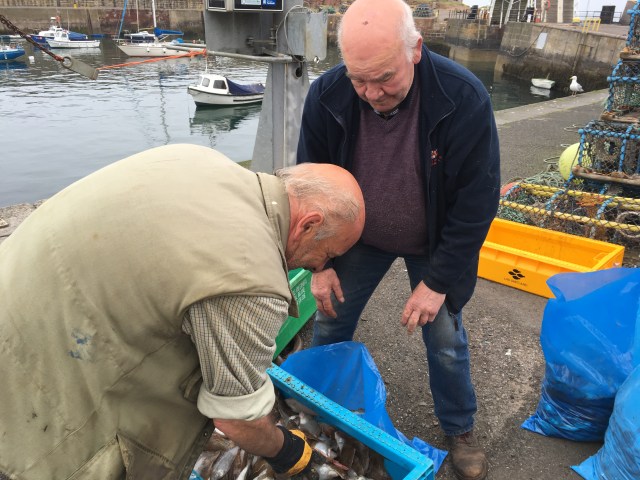
Dunbar Harbour. A tiny nook of land nestled tightly against the North Sea. The horizon shoulders in equal measure a ghostly, white mist and the slowness of morning sea. Waves of amber grey taste the red rocks of Scotland’s southeast shoreline. And the timid shores trade their sins for the secrets of the deep, betrothed in waves of forgiveness. Pink-cheeked seamen toss buckets of fish as bate into lobster traps readying for the day’s catch. There’s a sharpness to this low tide air, the sea’s pungent reminder of her abiding presence.
Fishermen in Dunbar Harbour prepare the lobster traps
A lit-geek to the core, I doffed my book-bag complete with eyeglass cleaner, multiple writing implements, not one but two journals, half a dozen books and of course, my laptop. One always hopes the effort of lugging around an extra twenty-five pounds of geekery will pay off on some seaside park…
French writer and poet, Antoine de Saint-Exupéry, said: ““If you want to build a ship, don’t drum up people to collect wood and assign them tasks…rather, teach them to long for the endless immensity of the sea.”
Anna is on her death bed. She has battled Alzheimer’s disease for almost 10 years. She hasn’t recognized her family for quite some time and this reality has left her terrified, confused. She is often angry. She believes a host of people are trying to trick her. Every unknown day arises again the next with all the same complexity and uncertainty. As her caregiver assists her in preparing for sleep, she hears Anna sing just outside her door: “then sings my soul, my Savior God to thee, how great thou art, how great thou art…”
She has forgotten every sermon she ever heard.
Every bible verse she ever memorized.
Every note she ever took in every bible study.
Every family member’s name.
But she remembers all the verses, word for word, of this great hymn. Why?
A young man in his late twenties battles with a choice. In his circle of friends, he has made the acquaintance of several lovely young women. He dates regularly. These women are delightful, intelligent, captivating. He looks forward to a time when home and family give him better reason to traipse to and from a busy downtown office day after day. A better life picture.
Erin is a Princeton post-doc student. Her dirty blond hair, cheerful demeanour, razor-sharp mind, and engaging repartée have been his regular experience of her. He’s reminded regularly by family and friends just how perfect she is for him. All the “pieces” fit together in a game too big to lose.
Brynne is girl-next-door pretty. Slightly chunky, but still shapely, and full of energy with a quick wit and uproarious sense of humour. Although not as book smart, she is equally intelligent. She is loud, often abrasive but never mean-spirited. She is funny, usually in embarrassingly public ways; opinionated, inadvertently pitting people against one another. She is clumsy and goofy and forgetful and messy and dangerous to his professional reputation.
And he can’t stop thinking about her.
What is happening here? All the facts line up in such a way as to present Erin as the obvious choice for a long-term relationship. Everything “fits.” She fills well the checklist on any relationship course he’s ever taken. Against his better judgment and flying in the face of the facts, Brynne rises to his mind continually. Something about her haunts him, chases him, wants him.
In our current church culture, we usually pose as the primary question of Christian discipleship “what do you believe?” And, pursuant to that question is the presupposition that you need all the facts before you can make an informed decision. I’d like to suggest however that an even more fundamental question is “what do you want?”
James K. A. Smith in his book “You Are What You Love: The Spiritual Power of Habit” suggests that we are what we want. “Our wants and longings and desires are at the core of our identity, the wellspring from which our actions and behavior flow. Our wants reverberate from our heart, the epicenter of the human person…”
What we often generate in our churches is a fill-in-the-blanks doctrinal checklist that amounts to a legal transaction. It is more Descartian: “I think, therefore I am,” than biblical.
Our young man in question will of course do well to know his own heart to navigate whatever his future relationships hold. But in his inexplicable desire for Brynne over Erin, despite appearances to the contrary, we find a key to how God seeks to relate to us.
“Discipleship [then] is more a matter of hungering and thirsting than of knowing and believing.” Even the demons believe and shudder. Knowing facts is easy. Retooling the human heart and its longings is not. But, it is our truest path. That is my call: to work in the Spirit’s process of forming a kingdom people by means of the gathered community in worship.
St. Augustine is quoted as saying, “Love God and do whatever you please: for the soul trained in love to God will do nothing to offend the One who is Beloved.” Our discipleship is less about information than it is transformation.
We don’t instruct people deeper into kingdom life. We inspire them. The heart knows what it loves and that is what forms the foundation of our actions and our habits. Our journey is one of inspiring and shaping our heart’s deepest desires, bending them ever more toward Christ and his kingdom.
Our journey is to discover the beauty and holy peril, oddly comforting, of being adrift with God on the vastness of life’s open sea.
Lord, Saint Augustine once said we’re created by God and our hearts are restless until they find their rest in you. Sometimes the way to you can seem cloudy, or grown over with thistles and weeds. We thank you for our longings. We love because you first loved us. You’ve built it into our DNA. Help us not to be afraid of what most deeply moves us, even if that isn’t lofty or what we typically think of as holy. Instead, grab hold of our hearts and shape them, Lord. Form in us a new and undeniable passion for life with God and others. And that, Lord, will be our truest joy. Amen.
August, 1989. My wife and I were the grateful recipients of Scottish largesse and enjoying a robust, five-course meal at Edinburgh’s George Hotel. The meal was spectacular. The entertainment? Lounge cheese. Nevertheless, down went venison, roast vegetables, fresh salads of varying kinds, nips ‘n tatties, roast beef and, of course, haggis. We were by far the youngest at our table, mere months after celebrating our first anniversary on Culloden Moor. It was pure magic.
I suppose this added a bit to our sense of naïveté and childlike wonder. We had just completed our time at Granton Baptist Church, Edinburgh as youth ministry “missionaries” and were spending some ramble time in the Highlands and England. We were, as a result, the wrong people to hear the travesty of screw-the-world chest-puffing comments that followed.
Seated across the table from us were two of the most arrogant…
Hay, Monmouthshire – the view I’ve been waiting for
I have, for the first time, truly experienced the devastating wonder that is Wales. It is as though God made Britain first and then, everything else from spare parts (not that I can speak from context, or experience, or knowledge of any kind really). From the broad-shouldered Brecon Beacons, to the literary orgasm that is Hay-on-Wye, the city of bookshops.
A bookshop. A café. In Hay-on-Wye. What’s not to love?
From the Cistercian monastery ruins at Tintern Abbey to equally haunting and beautiful Llanthony Priory. From the seaside riches of Harlech and Llanbedr to the rough ‘n tumble Dolgellau.
From a fifteenth century teahouse in Ty Hwnt I’r Bont near Llanwrst to Snowdonia National Park in Beddgelert, Wales is a place of countless treasures.
I’ve been here before, but not this close to the bone. I’ve learned what it means not…
Here, in the lavish, lazy valleys of South Wales one can smell the old, taste the green. To the mystic’s palette it is chateau briand for the soul. The harmonious voices of stocky, Welsh coalminers blend with the buoyant tongue of an ancient language to stoke the most experienced fires.
Too bad they drive like shit. Well, one can’t have everything.
Our brief foray in the UK takes a turn from the sleek, overly preened mien of London to the clumpy, sodden town of Newport, Gwent, South Wales. It is a place as equally devoid of panache as it is pretention. The people are as unremarkable as they are genuine. Note to self: read that line again later.
The muddy banks of the Usk
The River Usk upon which this town is built looks like one long bowel movement running through the center of town…
As endless underground tube stops, countless footsteps to and from every possible sight, packed unimaginably into what amounts to an hourglass on my wife’s schedule I am, of course, café bound. Two very full days of touristing the hell out of London with a view to advancing my wife’s novel descriptors has left me washed out. She’s a veritable whirlwind in a thimble, a human hurricane of never-ending activity and world-wonder.
My wife, the human hurricane
As a self-described artsy, bookish mystic, I’m sure you understand my reasons for writing. Besides, I’m sure she’s glad to be rid of me for a few hours. Who needs a needy poet on their back when there’s a world to conquer?
The morning started with a leisurely walk along the Thames through, first, an industrial district and later, through rows of prim, stately flats. Every time I see the Thames I am instantly…
This time last year my wife and I were frolicking around the UK, reconnecting with our roots. By way of reminiscence and to honour that time together, I’m going to reblog my entries. This was post 1. I hope you enjoy…
The words I’m about to write are the first I’ve written about this. Not because I am ashamed of it. Nor am I trying to hide anything. Quite simply, I’m still trying to understand it all.
I had an emotional breakdown early in the new year. I hit a wall that would have intimidated Goliath. I was wiped out, gutted; truly at the end of my emotional capital. I laid curled up in a ball, weeping uncontrollably on a hotel room floor, a tsunami of thoughts raging in my skull. My soul was in a vice, and my interior life was squeezed beyond recognition.
Quite simply, I had nothing left.
In the middle of that I received a text from a close friend and colleague. Rather cryptically (and not without humor), it said, “what the f**k is up with you? I keep getting woken up to pray for you.”
The more I read the Gospels, the more I am convinced that we would be the first to condemn Jesus and pin him to a cross all over again. That, in spite of two thousand years of knowledge, and canon, and religious conversations, and catacombs, and persecutions, and the dawn of “Christ-ianity.”
To read the Gospels honestly is to place oneself in dangerous places indeed. It is the readiness to identify as a sheep or a goat; as a disciple or a Pharisee or a religious teacher or a widow or wheat or weeds. We have so objectified the good news into our neat, neo-Platonic categories that we’ve rendered ourselves incapable of being seekers; the very posture required by Jesus to see – God, others, even oneself.
If the Gospels tell us anything they tell us how easy it is to build an impenetrable club of pretense and walls of preconception around our faith. The Pharisees did it and Jesus was forever pissed off with them. The biggest challenge to conversion is the belief that one is already converted and without any further need. It becomes poisonous to the very humility that would otherwise find us deeper in grace and living more abundantly.
It is the great proclamation of the convinced.
Richard Rohr calls this what it is: idolatry. It is the worship and protection of the means to an end rather than the journey toward the beginning. He tells us, “religions should be understood as only the fingers that point to the moon, not the moon itself” (Everything Belongs, p. 51). He believes, and has built a career upon, the notion that all true spirituality is about seeing and letting go in order to see still more.
I have found that it is often to my benefit that I am both A.D.D. and a mystic. That way, when I begin to ramble (a common occurrence!) and someone tells me to “just get to the bottom line,” I can retort with the same refusal Jesus used in such instances. He cared little for such things and besides, it is the misguided idol of a success-driven culture built on information and accumulation rather than instruction and awareness.
I’m aware how much this frustrates my type A friends. For naysayers however, more often than not, they don’t ask again!
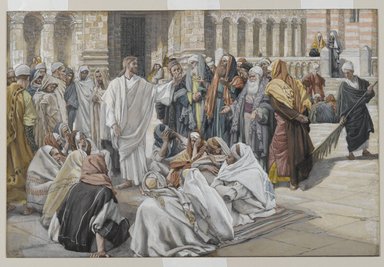
Says Rohr, “preoccupation with exchange value and market value tends to blind us almost totally to inherent value…Everything becomes priceless if it is sacred. And everything is sacred if the world is a temple” (Ibid, p. 56). To expect life to produce some kind of “bottom line” is the demand for Jesus to offer a sign. Like the Pharisees, we insist, “just get to the point” and do so in a way that impresses me, asks nothing of me, gives me answers rather than better questions, perpetuates my misguided presuppositions, assures me I’m in and you’re not, and never invites me to step out and journey. Moreover, it promises more darkness and blindness and no actual change. I will still see what and how I want complete with all my preexisting opinions and skepticism.
The Pharisees Question Jesus – James Tissot (1836-1902)
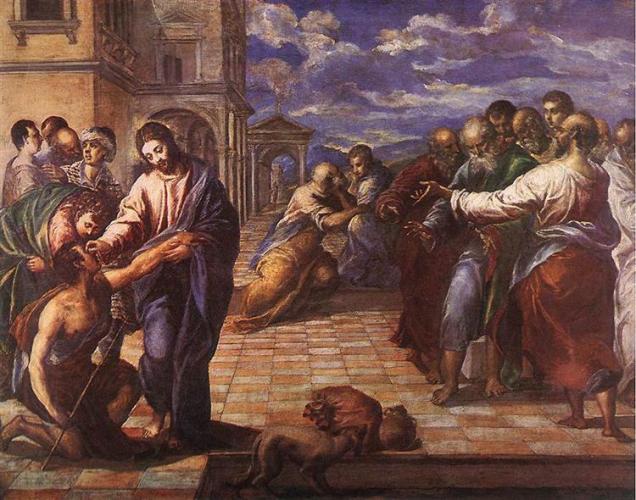
To see is the one great gift of all true spirituality. Jesus spent a lot of time healing blind people and a lot of time blinding self-proclaimed seers. When all we crave are answers, solutions, and the pragmatics of control, then it is we who stand in need of a raised voice from Jesus. We become the gatekeepers. We become those who, alone, claim to know the Way, the Truth, the Life. We are those possessing the Words of life but in restrictive, mechanical ways upheld in our own Sanhedrins.
Christ healing the blind man – El Greco, 1560
And that is what makes us the most ready to feel we need nothing more. We, the converted, stand most in need of conversion. Jesus spent a lot of time in an already protracted ministry window healing blindness. This I believe was no accident. He was particularly drawn to this because of it’s wonderfully metaphorical teaching platform. And I’m sure that someone healed of their blindness would be most deeply grateful; most readily loving.
To see therefore, is to love. And to love is the heart of the Gospel message. Until we love as Jesus loved, we may yet stand in need of conversion. To say otherwise reveals a spiritual smugness, a theological self-satisfaction bent more on winning arguments than whispering prayers.
These days, I rest secure in the knowledge that the same grace offered to the pimps, whores, and swindlers is offered to the converted and the righteous. Jesus spent more time arguing with one and partying with the other.
As I’ve shared elsewhere, I have a “star-crossed lovers” relationship with the written word. A young Capulet and Montague stare with longing at one another from across the room, and wonder what the next step is. We’ve always managed to work things out, but not without long and moody periods of dust and dearth. It’s always advisable, and spiritually healthy, to change up our routines from time to time if only to shake off the cobwebs of inactivity or apathy. But, my relationship with holy writ often stands in contradistinction to their typical handling.
Throughout all ages, the most common topic which has occupied singers, philosophers, poets, and people in general has been…love, of course. The sheer ubiquity of love songs, poetry, painting, sculpture, and pining readily attests to its centrality in our human experience. If you can easily describe your first kiss, the appearance of your first child, the terror of a dead spouse, or pride at the accomplishments of your spawn, you have yet to truly experience love.
Similarly, if you can easily and with absolute confidence ascribe hermeneutical perfection and interpretational clarity to a collection of writings such as the Bible, you are either deluded, or you’ve been reading something else. It is a library with which to contend because, in it, are found treasures worth the battle. The Covenant Community Bible Experience has, for me at least, drawn me to the scriptures in some new and alluring ways; ways that have helped reinvigorate my intention to let them find me and turn me up once more like clotted soil.
We lost as much at the Reformation as we gained. The bible as story is one of those. Against Luther’s best intentions, we ended up with a bible widely available (eventually) but indistinguishable from any other field of inquiry. Bible in the brain, rather than Christ in the soul. The forces set in motion even before the Reformation poured ideological gasoline over centuries of Christian reflection and practice.
To many in contemporary evangelicalism today the church started not at Pentecost, but at the Reformation. Hence, we are given the unfortunate impression that God was somehow completely lost and confused for fifteen hundred years. Suffice it to say, the corrections that needed to be made in the existing church occurred, but in ways impossible to foresee or worse, control. The scriptures came to be seen in ways even they would shudder to contemplate. As the freight train of reforms reached fever pace, it outstripped the ability of people to embed the scriptures into their own lives. Right belief trumped right behaviour. Theology and spirituality parted company.
The Reformed Tradition and, more recently, Evangelicalism, claim that sola scriptura saved the church from the ecclesiastical clutches of a vast hierarchical juggernaut which had all but replaced the bible with magisterium. This has some merit, but they further claim that, with the bible safely in the hands of all, knowledge derived from those same scriptures is readily available and plentiful.
I beg to differ.
The saints of the Medieval Ages and Renaissance knew more, not less, scripture than those who followed. Why? Because their entire lives, their holy-days, their ecclesiastical feasts, their communities, their families, and their places of gathering swam in the stories, prophecies, and songs of the Bible. It was not the absence of the Scriptures in the hands of the common folk that saw them suffer in the almost guaranteed poverty of subjugated peoples. It was that much of the poverty they experienced was because of a church in league with the halls of power.
Merely having the Scriptures in our possession does not guarantee their power in our day to day lives. At times, it may well be the opposite. There is a sense in which familiarity has bred contempt. Or at least apathy. We chose control over wonder, intellectual mastery over mystical formation, trading a holistic library of inspired writing for a flat, rational document for our ownership and dissection. As the church has become increasingly fractured, the possibility of common worship experiences built upon shared and regular experiences of listening and participation in those same Scriptures it so ardently defends has become challenging indeed.
Our buddy Jesus, complete with graphic t-shirt, sleeve tats, skinny jeans, and sideways ball cap points to a similarly cavalier handling of the book in which is enshrined his coming, character, teaching, and sacrifice. We need to recomplexify the Scriptures, not in order to obfuscate, but for the purpose of elevating them to the mystical, existential, literary heights in which it was conceived.
All that to say, I have warmed to the written word once again, largely because of this most recent biblical encounter undertaken by our congregation and denomination. And now that a reintroduction has taken place, we can stop peeking at one another across the Junior High school dance floor, shuffling and coughing. We can take steps across the room toward each other.
So, with subtle indirection, the toolbox of yearning
wed to oratory, wed to a cloud of unknowing,
expecting nothing more than a tale well told,
comes the bard and we are given –
a road for our story.
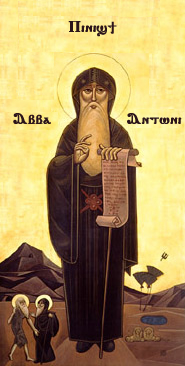
Historically, patterns of prayer and devotion that would later evolve into a “Rule of Life” grew out of the monastic tradition dating back to the Desert Abbas and Ammas of the 4th century CE. There, in the blistering heat of wasteland, they faced down demons, drank deep from hidden wells, prayed unceasingly, listened for the deafening whispers of God, and taught others to do the same. They owned little, but possessed the universe. Over time, their lives, lived small and yielded, but writ large upon the heavens, were lassoed into usable fragments of a living reality.
St. Antony of Egypt
I suspect most are like me, living pugnaciously crammed lives begging for the breath and space.. But, unless one’s name is Antony, or one of his eremetic contemporaries, one has experienced little in the way of solitude.
Such an exercise, as useful and meaningful as it is, necessarily leans upon an accompanying acquiescence on the part of the pilgrim – namely, me – to its regularity, rigour, and influence. Frankly, I’m more concerned about that than the Rule itself. Over the years, I’ve developed a deeply satisfying practice of contemplative prayer, gradually learning the benefits of housing shalom in the confines of a thirsty but unpredictable soul. I’ve spent days alone at any number of monasteries, growing and learning with monks and nuns of various ecumenical stripes. I write extensively on the spiritual life, a blog of my own (www.innerwoven.me), and for numerous others as well. In 2011, I graduated with a Master of Arts in Spiritual Formation and Leadershipfrom Spring Arbor University, Michigan. Since then, I’ve undertaken the Spiritual Exercises of St. Ignatius and was anointed with oil as a lay Jesuit. I’m writing a spiritual memoir. I have studied the life and spirituality of St. Francis (because I’m a hippy at heart) and the Rule of St. Benedict (because hippies lack structure).
Our Lady of Guadalupe Trappist Abbey, Lafayette, Oregon. I’ve spent countless hours at this place.
Why do I boast in such Pauline fashion? Because, after years of ardent pursuit of the Christian spiritual enterprise, and already possessing a not inconsiderable Rule of Life with more than a few years of practice, I am less skilled in it now than I’ve ever been. Without hesitation, I enjoin myself to Paul whose boast is always in weakness about weakness, and leads to his exasperated proclamation, “I am the chief of sinners” (1 Tim. 1:15).
Whatever Rule is forthcoming will be more about my openness to what that Rule represents. It must be more a means to an end than the end itself. Like the rudiments I’ve practiced for decades in pursuit of musical prowess, I construct and practice a Rule of Life to forget it. Musicians play scales without thinking about playing scales. They play music, in which rudiments have formed and buttressed, shaped and evolved that music.
Saints live a Rule that is at all times thinking about union with God, which is the end and the beginning of it all.
…in my dream, I looked out over the rocky embankments
still holding my thoughts and, over the tomb where
recently someone left not long after arriving, a placard read:
“Beware, those still trapped in a life safe, and un-ruined.
You won’t get to enjoy the looks of incredulity from those


 Fishermen in Dunbar Harbour prepare the lobster traps
 My writing perch this morning, Ambleside
  Hay, Monmouthshire – the view I’ve been waiting for
  A bookshop. A café. In Hay-on-Wye. What’s not to love?
  Rae and I on the train to Wales
  The muddy banks of the Usk
  My wife, the human hurricane

 innerwoven