Poulsbo-ing, part 1

Longing - John O'Donohue.jpg

What follows in this series of posts are in fact my notes from a retreat I recently co-led for a delightful bunch of kindred spirits.

I suppose I should have had a more to-the-point title. But, I would have had to produce something innocuous like “CFDM 2019 Retreat Notes.”

Mmm, sexy.

Failing that, I could have gone with my basic premise: Longing – Awakening – Union. 

Too academy.

Instead, I decided to aim at something less high school journal or quarterback mystics club. A collection of family cabins cuddling an inlet in Poulsbo, Washington was where we did our holy business together. We spent an enriching few days Poulsbo-ing, and loved it!

They are alumni of Christian Formation and Direction Ministries Northwest. A more fun and authentic bunch would be hard to find. They’re about as representative of the kaleidoscope of spiritual seekers as any group can be. All of them thirsty for waters of abundance, hungry for food both spiritual and otherwise, and ready to party.

Bible study “disciples” always take themselves far too seriously. Mystics are better at belly laughs any day. Anyhoo, here’s part one.

Introduction                                                                                                           

All of us are in the process of learning how to pursue the spiritual life; how to discover, nurture, sustain, and propagate a Christian spirituality that is life-giving for us and, hopefully, for others. We’re on the significant journey of learning about our own souls, how they relate to God and to one another, for the distinct purpose of guiding others into those same discoveries.

Of the many ways to articulate this, one might be: “Blessed are those who hunger and thirst for righteousness, for they will be filled.” It is a high calling indeed! Let’s look a bit at this thing we call our “spirituality”.

The entire spiritual enterprise can be summed up in this way:

Longing (Desire)                 Awakening (Awareness)             Union (Formation)

Webster’s dictionary defines desire in the following way.

desire

verb

de·​sire | \ di-ˈzī(-ə)r  dē-\
desireddesiring

As a verb, it is to long or hope for something, to exhibit or feel such longing. For example, to desire an immediate answer. It conveys the potential for one to feel the loss of the same as in “she was sad that men no longer desired her.” As a noun, it reveals something longed for, hoped for; or a conscious impulse toward something that promises enjoyment or satisfaction in its attainment. Or, the opposite, ridding oneself of desire in pursuit of some other goal.

Everything we’re about in the process of personal/spiritual evolution and growth hinges on these three things. And, as followers of Father Richard Rohr, or indeed the entire Christian mystical tradition, one would see this formula at work absolutely everywhere in every corner of Christian spirituality. And, not just Christian spirituality, but in most major religions as well. Some iteration of this formula is always at work. We shall discuss this a little more in session two.

It is why mysticism, not theology, will ultimately unite us and bring healing to the world.

The theme of the retreat is formally, desire. However, as an overly melodramatic Enneagram 4, let’s go with the more evocative term, longing. 

I have numerous reasons why this is a happy venture for me to pursue. In a sense, I feel uniquely “qualified” to speak on this particular topic. Certainly not because I have any kind of book learnin’ thereto, although I’ve read dozens on the subject. More because of my particular construction as an individual.

I’m the oldest of three adopted siblings. I have known that powerful longing for one’s first and truest validation of a birth mother who gave me up. It has affected everything I am and do to this very moment. I have struggled to deal with what the psychologists call “the primal wound.” That is, in utero rejection (although she would never say this and I’m happy with how things turned out!), and the process of learning to find the embrace of one’s own mother, and “the breast” elsewhere.

Trust me, I have known longing.

I’m a Scots-Canadian living in the United States. As I’ve discovered over the years, my ancestors were almost entirely English and Scottish, with some deep roots in Canada as well. But, as an adopted child, I grew up never really understanding any of those profundities to which one normally ascribes a sense of belonging. The most elusive concept for me has always been that of “home.”

Trust me, I have known longing.

A thorough going pluviophile, I’ve always yearned for rain. I grew up in Calgary, where rain comes just a few times a year, usually in the form of hail. And, for thirteen years we’ve lived in semi-arrid Yakima.

Trust me, I have known longing.

I longed for the sea but grew up in the foothills of Alberta’s Rocky Mountains. Any time we have lived close to the sea, Vancouver, B.C. or McMinnville, Oregon, we’ve been happy as clams (since we’d be closer to their experience).

Trust me, I have known longing.

I ached for all things ancient. I grew up in a very wealthy oil town in a constant state of construction to build all things new; glass and steel monstrosities in place of wood and stone, which much better house our collective memory.

Trust me, I have known longing.

I’m a mystic at heart in a world where such silliness is hardly tolerated. Alberta cowboy culture has precious little appreciation for anything that doesn’t git ‘r done or earn a buck, quickly. “Just get to the frickin’ point, will ya!” I got tired of hearing it when I was more interested in the way to the point more than whatever point they thought needed making.

Trust me, I have known longing.

As a progressive, it’s been a challenge trying to live my Christian story in the good, but oftentimes, stultifying waters of evangelicalism. The mechanistic framework of it didn’t lend itself well to the contemplative endeavour. Nor did it ever have enough room to ask “unacceptable” questions for “unvetted” reasons. I consider myself a moderately progressive contemplative, post-evangelical of Celtic persuasion.

Trust me, I have known longing.

I’m a curious, armchair intellectual who loves rigorous conversation around difficult and challenging topics. I’m an expert in no topic whatsoever. But they all fascinate me. I grew up with family, friends and associates who felt alienated by it. It made for a lonely upbringing.

Trust me, I have known longing.

I’m a recovering alcoholic. That’s a story in itself as you can imagine. But, if there’s one thing alcoholics know well, it’s desire. Crooked, misplaced, askew, but desire, nonetheless. We learn how to coax it, feed it, protect it, and lie about it. And, if anyone knows anything about alcoholics: we’re the best liars in the business. We experience deep longing but understand it least. Why? Because we’ve effectively hid from it rather than turning to face its immensity.

Trust me, I have known longing.

I’m an ENFP and an Enneagram 4. Need I say more? The world likes to say they love the untamable spirit and unquenchable fire of E4s, but when it comes down to it, they prefer to keep us at arm’s length where we can entertain, be the cool, slightly aloof, friends at parties, or make things more interesting or beautiful. But, just don’t hang around too long, or you’ll bum us all out. By default or design, an E4 is the most complicated person in any room. We have a tendency to make a cottage industry of melancholy. We love to pedal brooding and morbidity. When a person of a different number shares their pain, we inwardly think it quaint or trite by comparison. We’re generally miles ahead of them in that department. Trust me, I have known longing.

As a young boy, I was a shy, escapist lad who lived amidst vast collections of all kinds of things but, primarily, his imagination. On a few occasions, I would have these existential “moments” that would only last a short time. In them, I would get a sense that all was right and good in the world. All childhood anxiety would leave, and I’d be left with a vision or picture of the world as God sees it. I’d be mesmerized…

I share a lot of poetry and writing in these things. It helps keep my thoughts moving in a single direction. I pray you’ll forgive these indulgences. Here may be found an example of one of these contemplative moments as a young boy.

As I’ve grown older and learned of my Celtic heritage, I came to see these moments as descriptive of “thin places” along the journey. How many of you have heard that term before? The Celts believed there were places, both physical and otherwise, where the divine was especially close to us and that we could move in and out of our present realities into something indefinable, effusive. I like to picture it as someone standing behind a thin, white sheet hanging on a clothesline. God’s hand and mine are touching through the thinnest of fabric separating us.

Discussion Questions:

Can you point to a moment or moments in your own life in which you simply knew God’s proximity and presence? When God was decidedly real for you?

What comes to mind for you when we say the words, “desire,” or “longing?”

What images does it conjure?

What feelings does it evoke, either good or bad?

What are the things for which you most long? That you desire most?


A Day in Portland – A Brief Meditation on the Obvious

I think I’ll call this latest phase of my personal development, “observational spirituality.” It’s not particularly original. Kitschy, I suppose. Cutesy? Melodramatic? Perhaps all of that and more. But, at the risk of sounding dismissive of the apophatic theology or the sometimes borderline morose asceticism of some mysticism, I’m squarely in the “see ‘n say” life program. At least right now.

Homeless Man

My prayers are open-eyes, open-hands, double-takes, pen ‘n paper, q & a, and laced-up shoes. Prayer, even contemplative prayer, is on the move, seeking God from a moving center of gravity. 

Those who know me well but not normally affixed to the world of spirituality see this is as a return to normal, whatever that might be. God bless them. I think, on one level, they’re likely correct. My guess is what they mean is that Rob has become less esoteric and more fun to be around. Less spiritually obtuse, opaque, and more…reachable. 

Nothing could be truer. However, it might not be in the way they think. I haven’t given up on the ocean of mysticism and my belief that the truest theology isn’t what we think but what we perceive and experience and live. But I am on hiatus from a contemplative spirituality that, at times, merely perpetuated my need to run from the sharper edges of a life I couldn’t understand, let alone master.

This has profoundly impacted my poetry and writing. Much less moan ‘n groan, much more cry ‘n sigh. Less sad, more glad. Less whine, more wine (metaphorically, of course). Even my demeanour is changing. I’ve fully re-embraced the extravert who had lain dormant for many years while God messed around in my business.

So, a little exercise. What follows is a short journal entry from last weekend in Portland, Oregon. My wife and I were writing, as we often do. Mine became a simple celebration of what was right before me. It helps amplify in me a favourite word these days: notice.

* * * *

Blocks of mismatched, oddly coloured flats, like leftover Legos, greet me upon opening hotel curtains, themselves an unfortunate retro-seventies error in judgment. I open the window and partake of the wet air. This stuff is made for lungs that appreciate breathing like fine dining more than the dry, git ‘r done Yakima dust.

The cool, soppiness of a Portland sky is a cliff dive for me into a densely soft Yorkshire Pudding of nature carbs. Richly satisfying. Even if I had to pay for it later, it wouldn’t matter. I’m full and the landing is even softer than the jump itself.

The almost preternatural way I’ve always taken to the damp, concrete-smell of mossy earth and sky tells an old story. It is one I’m only beginning to understand. There’s something oddly familiar about wiping this outdoor bathroom mirror sky to catch a glimpse of someone I recognize in no other way. 

Not unlike many others, I live for these moments, moments of simple observation. Recognition of what is. Meditations upon the obvious. One discovers that, in discovering whatever lies just beyond our fingers, noses, tongues, and eyelashes provides ample fertilizer for the soul, which remains unseen.

So, in the interest of a better look, I pull down the blue-grey, clouded hat-sky upon my waiting head and tuck into the day.

Here it is, where everything meets, greets, and seats me. I do not need to look any deeper. It is already seeing me as I am. The rest, as they say, is gravy.

Thanks for being here with me. I need you all.

Trading in the Trail of Tears

I recently revealed my struggle with anxiety and depression. For years it created a vortex where living any other way seemed out of place. It birthed a personal industry of what I called “sad-sack sadness.” Impenetrable. Unflappable. Ironclad. Too certain in its uncertainty to be particularly human.

It affected my persona, my personal choices – both good and bad, my relationships, the direction of my pursuits, my spirituality, and basically how I defined the world around me. 

It turned me into a desperate person, desperately seeking answers to the desperation while simultaneously spurning those same answers. I thought it my job to make thinking about it my job.

It failed.

Every time I “figured something out,” another layer yet more complex revealed itself. Of course, I saw that as a challenge and dove right back in. “I’ve got this,” I’d say to myself. “I can sort out these pieces, I’m smart.” Guess what? I am smart. I did sort them out, at least, in part. But, guess what again? I still felt desperate. Mentally unkempt. My spirit like a chaotic, post-coital bed-head, totally unprepared to meet the world.

Messy-and-curly-hair-image.jpg
Picture found here

I’ve taken a lot of poor, unsuspecting souls with me down these rabbit holes. In states of unrest I’d latch on, like a rottweiler on a kitten, to anyone even sniffing around my orbit. It destroyed friendships. Decimated trust. Damaged perceptions. Devalued my own “enough-ness.”

The sadness produced a fog in which the tiniest slivers of light were rejected as imposters. And when they did break through, the habits I’d formed while living blindly in fog rejected them. At times, I’d grudgingly accept suggestions, albeit on probation. Then, too often, I’d just to shoot the bastards. 

skylux-b0b39d6a69f417a71dff0a8baf6cbc53.jpg
Picture found here

It was a lonely road indeed.

Has a friend ever kicked you in the shin to help you forget your migraine? Right. Me, neither. The reason? Suddenly the migraine isn’t quite so bad when your shin is throbbing. Um, thanks I guess. 

shinkick3.jpg
Picture found here

Your “friend” has unwittingly paid homage to an idea I’m exploring: fixing something isn’t always fixing something. She with a broken leg doesn’t just require a painkiller (although offering one is the polite thing to do). She requires surgery. He with a limp doesn’t generally heal so as to avoid it. He learns to walk successfully with a limp and think nothing of it.

Could this be what Paul meant when he couldn’t get God to do much about his “thorn in the flesh?” The best he got was a rather enigmatic response, “my grace is sufficient for you.” I guess that’s what I’m learning (?)

Being human is a complex business. Not only isn’t everything fixable but, sometimes, we do better to leave what brokenness we find and learn to limp. Part of my job is to determine where limping is best and where I’ve been limping already and not really needing to. Where are my limps just cause for self-pity or attention? Are those limpy bits merely a clever cover for what truly ails me? 

What if – just consider the possibility that, for a moment at least, conceivably, all things considered, whether I see it or not, I might have more control over this than I’d imagined?

Gadzooks! You mean there’s hope for my hopelessness?

Nothing is as simple as it seems. One issue always feeds some other thing somewhere else. Nothing is completely isolated. When one thing hurts, everything else does. 

My mental state sachets with my vanity (secretly in love with my diet), which in turn is carrying on an affair with my sleep patterns, which is on record as screwing with my coffee intake who’s been seen skulking about the perimeter of my spiritual practice.

Well, you get the idea.

download.jpg
Found here

Isn’t it strange how interconnected are our issues? Our demons are all inbred. One l’il beast seems always to be a different one’s aunt, sister, and best friend’s boy-friend all at once. We are not as neatly compartmentalized as we’d like to believe. 

But, this much I know. Wherever possible, I’m committed to smile when frowning makes more sense. I’m trying to sell my wholesale business in melancholy in favour of a tiny house of healthy practices that make life more livable for me and those around me (even when it feels a little cramped).

By choosing behaviours, little things I can do, I’m learning (despite all evidence to the contrary) to live contentedly. Leaning a bit more each day into the enough-ness of God in me, I see the benefits of my own weakness. I’m discovering light underneath the dark, up tucked inside the down, good hiding in the bad. Slowly (glacially to be honest), I am trading in the trail of tears. 

The return? The fail of fears. And, even though I suck at it, isn’t it worth the effort, if only to sleep at night satisfied that I haven’t lost any friends today?

Maybe I even gained a few?

making-new-friends-fingers.jpg
Found here

What lies underneath…

All that lies underneath....jpg
Photo taken by me on the dock in Indianola, Washington

Uni-Versitas: Start with Wonder

Albert Einstein and Augustine of Hippo are different people. They are also the same. Having now exercised remarkable powers of observation and obfuscation, allow me to explain.

einstein1_7.jpg
Einstein. A genius, obviously.

Albert Einstein of Theory of General Relativity fame was a troubled failure of a student who became a theoretical physics superstar. He began as Steve Erkel but later became the Tom Brady of the 20th century science world, although rather wanting in groupies I should think. Albert stumbled his way through grade school having revealed a rather less than stellar academic prowess. But his was a great mind waiting to bust out of the starting gate and take a stab at the big world he observed. Better than most as it would turn out.

We’ll call him a good candidate for the Ellen Show.

Augustine of Hippo was a troubled saint-in-training, a self-proclaimed failure whose frat-boy lasciviousness (constantly horny for the lay person) and subsequent coming to Jesus moment is wonderfully outlined in his Confessions. It was the first of its kind. Memoir and theology wed together in a single book. It happens all the time now. Not so much then, however, when even average brains were pushed around in wheel-barrows.

st-augustine-writing.jpg
Augustine of Hippo. Kinda has frat-boy written all over him, doesn’t he?

Frankly, as much as I love the guy, he needed to chill a bit on the whole self-flagellation thing. He commits pages to the ravages of soul he encounters from stealing some of his neighbour’s pears. Really, dude? No “boys will be boys” pass on this one, huh? Like, I’m not trying to justify thievery here, but let’s get a grip, shall we? I sin more before morning coffee than this guy ever did, and he gets to be famous?

He’s more Jerry Springer.

What Gus and Al bring to the table however is exactly the same. A stretch you say? Perhaps. But, in a non-dualistic world, where everything is allowed to be interconnected, the starting point for science and for spirituality are one and the same.

Wonder.

My love for science is birthed from the same place as my longing for God. Frankly, I think they work the same turf, just with different conclusions for different reasons. But, in this uni-versitas, one truth, wonder reserved for black holes and quarks feels tellingly like that which the mystics experienced in the throes of contemplation.

For the sciency types, wonder is of the curious kind. The more rational, sensory kind where eye-balls matter more than Bibles. Observation, experimentation, hypothesis, theory, deduction. Repeat. One can hardly look to the heavens without asking how the hell all that stuff got way out there. It really is quite stunning. Go deep-sea diving and one has both dinner and questions. Or perhaps gaze out across the horizon and discern just how flat or round the earth might be (I leave the conspiracies, snickering and finger-pointing to you).

The greatest explorers, scientists, and theologians all began with the same premise. Wonder. But, it is in rather short supply in a world more concerned with body image or retirement savings than all this silliness.

What’s needed is a healthy dose of children. Not by way of breeding (although not entirely a bad thing), but learning from them. If you’re looking for answers to quantum mechanics, modifying your car, or the latest stock tips, don’t ask children. They’ll just show up with enlightened curiosity and wide-eyed wonder.

And, what good is that? Our lust for all things pragmatic chews away noisily at us, forcing misplaced expectations. We wouldn’t want to get our hopes up too high just in case today sucks. Besides, who has time anyway, right?

Rush, run, push, pull, grunt, wheeze, talk, squeeze – and that’s just zipping up our jeans. The real business happens once we get into our car for work. Then we practice a lifetime of adulting, or at least adultifying our child selves, silenced years ago in the frenetics of bills and babies, dishes and disappointments. Our playlist at the ready, we fire up the car (light on style, heavy on sensible) and join the rest of the one-per-vehicle parade floats. None of us dares to look at each other unless it’s to offer that you’re-really-gonna-change-lanes-here?! look of exasperation.

It’s almost cliché to write about the curse of busyness. Everyone’s doing it. Both the busyness and the writing about it. We’ve learned little in terms of how interconnected the universe really is, chaos theory notwithstanding. We’re fragmented, frightened and frazzled, all before coffee break.

These days, in pursuit of spiritual development, I tend to read Stephen Hawking and Bill Bryson as easily as I might St. John of the Cross or Meister Eckhart (Uncle Wiggy as I like to call him). Their aims are different. Their yearning for knowledge the same. Their process is different, although a case can be made for observation and seeing as central to both. Their outcomes just as mystifying. Just as satisfying.

meister-eckhart-2.jpg
Meister Eckhart (Uncle Wiggy). Brilliant spirituality I like to call Christus Cannabis.

Ironically, I gain as much from reading those whose aim it is to prove God out of existence as those who presuppose that existence. Doctors of astronomy and asceticism, gravity and gratitude, dinosaurs and doxology. They are different, and they are the same. For me, they all begin in the same place. In wonder.

It’s all of a piece. And, if you let it, all of a peace.

_________________________________________________________________________

Picture of Al found here

Picture of Gus found here

Picture of Uncle Wiggy found here

Faithfulness, the Truest Spirituality

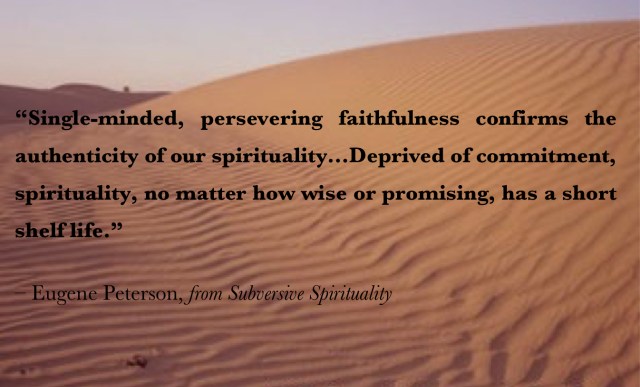
I believe this more every day. If I have all the best, most exotic spiritual practice, but am not prepared to die for another, then spirituality is only a hobby.

Committed Spirituality.jpg

To See or Not to See…

To see or not to see....jpg

We’ve all heard the old adage, “one only sees what they want to see.” We easily and quickly make judgements on our perceptions of things, not always on the truth of things. It’s always been that way. I’m guessing it will always be so to some degree.

Some will see only a page full of black dots. Others see the number hidden in the middle (they kinda piss me off!) Some see the brown barrenness of parched desert. Others see the miracle of life which is possible even in austerity. What is to one a beautiful optical illusion is to another a confusing mess of nothing at all. One sees thirst and death. Another sees possibility and survival.

It is a remarkable feature of human nature that, on the basis of perceptions and in the interest of either self-preservation or the pursuit of fulfillment, we succumb to the process of other-worldly fabrications. Given our predisposition to see only selectively, we sometimes live our lives labouring under misapprehensions.

For my part, I have often built an enormous mental-emotional web of shadows and half-truths and desires and make-believe. A construct on whatever I think is true. It is mental, because so much of who I am and how I behave is conceived and constructed in my mind. Emotional, because, just like yours, my head and my heart are inextricably linked.

To think something is true is, correspondingly, to feel something as well. If I think a loved one is still alive after some long absence, it creates hope, expectation. To believe that same person to be dead is to create despair and hopelessness. If we believe the person to whom we’ve been communicating is still on the other end of the phone, we’ll happily blether on until the bleak reality dawns!

Conversely, to experience an inexplicable hope, is to believe all to be well in our little world. In the world at large. If we feel weighted down, we either have a need for companionship, a change of scenery, or mood-altering substances (my preferred M.O.!) Moreover, we will believe it to be so because, in such moments, the universe may appear to us at the time, a toxic and malignant place, unfit for habitation.

Our brains are a complex lump indeed! From the minutiae in our head comes the fodder for our palaces or prisons. All is either benign, malevolent or benevolent on the basis of what we believe to be true or false.

Perhaps the entire goal of grace, and with it, the contemplative enterprise, is constructed to help us monitor, manage, even master the cognitive dissonance we experience – the chasm between what we observe, what we know (or think we know), with what we experience?

It seems that God’s intention in the Gospel is to gift us with a mental-emotional equilibrium in a universe that, to our physical eyes at least, makes little sense. God seems to be trying to get our attention focused away from what we see and onto what we have yet to see. Or, better, what God sees.

For example, if I see endless amounts of unpromising, fruitless work – God sees a garden. If I see endless hours of frustration, ignorant bumbling and non-Sunday school language – God sees the end product of my labour – a new staircase, or a table. If I see fatigue, poverty, and unpredictability – God sees relationships, children, and the warmth of family.

To say then, “I see,” is no longer just a physical act – observations in time and space of what is immediately before me. In the infinitely broader perspective of God, contextualized in the Gospel, “to see” is simultaneously to hope, to rejoice, to weep with joy.

For, to see as God sees, is to inhabit all things at all times at one time. Things are not only as they appear to me now. They are shown to be what they will be then.

It is there, in that place of seeing through God’s kaleidoscopic eyes, that a universe –  sometimes tasteless, flat and hopeless – becomes a sumptuous feast of possibility. Only then do I experience something counter-intuitive to what I “should” under my limited experience. My heart and head agree because God has introduced them to the broad spacious land – the realm of God. My earth and God’s heaven, kiss.

And I am reborn.

Seeing is believing, say the scientists. Believing is seeing, say the theologians. Being is both seeing and believing, say the mystics. Some cannot believe unless they see. Others claim to see and not believe. Still others claim to see what they don’t believe. Others will not believe whether they see or not. Confused yet? Yeah, me too.

God’s deepest reality? All of us belong in some way along the continuum of belief, sight and experience. God journeys with us wherever and whenever that is.

All that to say this: one’s emancipation comes most readily not from a change in circumstances, but in the readiness, and ability, to see. To awaken. I have often said that, behind and beneath and around everything we see with our physical eyes, is a pervasive spirit of glory.

The light and beauty and truth of God subsumes all things into itself. And, from time to time, there come moments of lucidity, of universal benevolence, when one becomes aware of the overwhelming perfection of it all. A built-in beauty not always immediately apparent.

But such moments are frightfully rare. They are gifts, shards of translucence and splendour, reserved for the unasked-for moments of clarity; when the paleness of our present reality, gives way to something else entirely. When it does, simply observe.

Rub your spiritual eyes and let yourself be roused from slumber. Wachet auf (wake up) as Bach might intone! Awaken to God’s tap on your shoulder. Throw off the covers. Stretch. Say nothing. Speak not a word. Just drink. Drink deeply of this stream. Let it do its work. For, once it’s gone, there is no telling if or when it may come again. But its nourishment is ours to keep.

Forever.

____

Amazing image found here


It’s about breathing

Having just finished Richard Rohr’s Breathing Under Water – Spirituality and the Twelve Steps for the second time, I am suitably inspired. It is an insightful commentary on the wisdom of the twelve steps of Alcoholics Anonymous and their potential for a probing, expansive, and transformative spirituality.

The steps dovetail wonderfully with the best spirituality. They are a template suitable for the best diving – a way of life not just for addicts, but for everybody.

It's about breathing.jpg

Morning, breath

As morning reaches where only night had been,

dew once more settles on the brittle earth

and breath returns to one,

so all can breathe again.

An unexpected invitation

saints and sinners


I have hidden my head

in the cloak of heaven, singing.

I can smell a fragrance

and watch an evening unfold.

Could this be the dance

of saints and sinners,

women and men,

soldiers and satin,

frail and overpowering,

wise and unstable,

sick and perfect,

praise and calumny?

They swoosh and dance and mingle

with heads up and eyes wide

hands clasped and hearts raised.

Listen for their whispered shouts, loudly silent,

heard only by those

with a need to hear something

they did not expect –

“Come.”


Logo: www.tripsmarter.com