In my first post in this series, I explained the origins of my strange, made up word. Adventia, as I see it, is our foray into the headwaters of Advent – waiting, hoping, and preparing, together with Fragmentia, those literary illuminations of God’s in-breaking into our world to which we may unite the former.
For most of these we’re taking our cue from a favourite Instagram site of mine – #realpoetsdaily Today, we’re blessed by this gem by T. S. Eliot, from “East Coker.”
No, the above is not meant as some cheap attempt at a New Joizy accent with the word adventure. I see it more as the amalgamation of Advent and Fragmentia: a place where the illumination of God’s in-breaking into our world found in the Advent narratives unites with the fragments of literature and faith and life seeking to bring us to deeper understanding of it all.
Advent is upon us once more. With it comes a barrage of books and practices all aimed at helping us get the most from the experience. My choice this year is to ride someone else’s coattails. Am I just too lazy to think of anything original? Maybe. To be honest, I just like the approach taken by someone I follow on Instagram – #realpoetsdaily
So then, that is what I am doing for Advent…what they’re doing. I’ll post here but redirect you always back to their site. I give you, Advent, day 1.
“It’s the first Sunday in Advent, and like last year I plan on posting a poem for every day of Advent, and then for ever day of Christmas. Here is “First Sunday” by Sally Thomas (@sallytnnc).
I love poetry. I love its exactitude, its wide-eyed innocence wed to unflinching honesty. The unforced rhythms of perfection, like Grandma’s gaze over well-worn glasses. It is the art of lovers, the science of thinkers, the wisdom of doers.
Poetry gives up her secrets cautiously, altruistically, slowly. Every word, like every note of a great symphony, is fully intended, placed unequivocally in its place with an eye, and ear, to building something remarkable out of simple things, something well beyond the sum of its parts.
In a thousand ways, we are the amalgam of our carefully written words; each one added to the emerging poem of our lives. In this process, there are no real mistakes. There is only the discernment asked of us in the changing turn of phrase that will ultimately become our voice in the world.
For me, Rosebud was one such word. Perhaps an entire stanza.
Although my active period in Rosebud was limited to a few months in 1987, her existential tattoos continue to reveal themselves in enduring ways. A tiny, easily missed oasis in the Alberta prairie percolated in me an entire life thereafter committed to several things: the transformative realities birthed in the canyons of friendship, great things can come from wee places, the pursuit of art wed to faith, and the kind of community possible only through probing, and honest, creativity. Family, lived best in and through, story. Our stories now connect in ways both obvious and subtle.
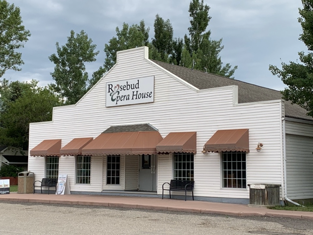
Rosebud Opera House, 1987
Rosebud Opera House, 2021
Our digs
The diminutive Akokiniskway
On the About tab from my spiritual life blog reads the following statement of purpose: “my life is dedicated to those places where life, liturgy, theology, and the arts intersect to promote an authentic spirituality – who we are becoming.” These values existed in me long before I ever made it to this place. But they were stoked by shared inspiration, fireside laughter, broken stage lights and fumbled words, splinters and spoilers, relational fugue and fatigue, the prayers and tears of young lives navigating their way to maturity; to wholeness. To become both passionate and com-passionate, all writ large in the art of our story. The Story.
On the Rosebud Fellowship homepage can be found the following statement, one of the six “objects” that articulates its purpose: “To promote the fellowship of people whose lives have been affected by the Christian mission of Rosebud School of the Arts.”
Friends, I am one such person.
My daily Rosebud prayer walk, Canadian style.
In the short time I spent here I found lasting friendships, a deep gratitude for the quality of connections that exist around creativity rooted in spirituality, and a way of living, boldly illustrative of the kind of “Christian mission” to which Rosebud has always been committed, both spoken and unspoken.
However, the vision of this place was never one for kitsch or the quaintly derivative “evangelism through art” which has damaged both evangelism and art in so doing. Sadly, what begins as evangelism can become nothing more than jingoistic cheerleading or public relations. What begins as “art” descends to something diminished and pale, akin to cultural babysitting, the low hanging fruit of the accessible and “relevant” to the demise of beauty, the archetypal perfections to which God, wide-eyed, once whispered, “it is good.” When beauty and story are the goal, both art and God win. For me, this is Rosebud’s greatest victory.
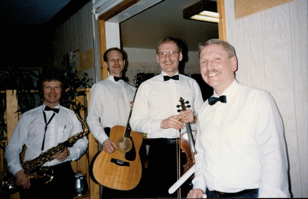
Table minstrels
To witness the leadership, serene but definitive, directive but collegial, of LaVerne Erickson has always been a wonder to me. A man of endless stories (and not a few impressive name-drops), tireless energy, and towering vision inspires me as much now as it did in those pre-Cambrian days of 1987. I’m still shedding the pounds added from Arlene’s unforgivably good cooking. More than a few good words (and some less so!) were knit to my story through the relentless humour of Royal Sproule, the passionate guidance of Doug Levitt, the sanguine wisdom of Lyle Penner, the many towering women of faith and creativity who helped put Rosebud on the map. And, of course, the big-heartedness of Akokniskway herself, calling us all deeper into her welcoming bosom.
My daily outdoor show
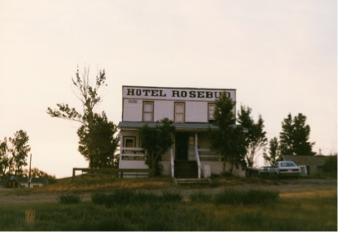
I am as Canadian as the day is long, complete with an undying love of trains. I grew up in a blue-collar home, the son of a brewery worker and homemaker. Our 900 square foot bungalow in the quaint but rough-around-the-edges southwest Calgary neighbourhood was poised right next to tracks, now LRT, but once host to regular trains through town. So, when I moved into my room in the Rosebud Hotel, the nightly train arriving just past midnight was like a well-worn pair of jeans. Her whistle neither haunted nor annoyed. It sang to me of prairie goodness, rich in the Canadian story so much my own. Our own.
The poetry of my life is ongoing. Rosebud has faded well into my rearview mirror. But she has never stopped whispering to me of what could be, those places where my past collides with my present to hint at a future.
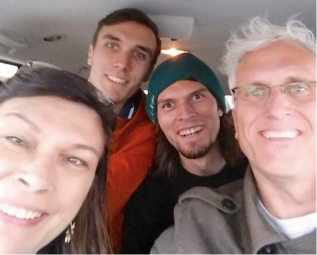
Rife crazies – Rae, Graeme (25), Calum (30), Me
Now, after decades of Christian ministry, a life dedicated to music, writing, poetry, spiritual formation, and the arts, two boys (both professional musicians), together with my wife Rae (Rosebud incubated our love!), we are planting new words in our emerging poem. This newest word takes us across the Atlantic to begin life and ministry in the UK. We invite as many as we can to join us on this journey. Our poetry improves with every letter added, every nuance of word, phrase, and metaphor.
All of you are all of that.
Rosebud, thank you for being a cradle, an incubator, a muse and sage, a friend. Your poetry is now, and will always be, my own. I take you with me, with us, into a new horizon. Our emerging poem.
Word for word, words for Word.
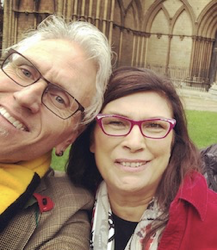
1987-Rae Kenny and I were married the following year.
Same people, almost 30 years later. 2016, Peterborough Cathedral, England
A poem
When muscle, bone, and sinew can’t find heart
and listening and looking. Then, severed in time
from the wishing well of wonder, we wander
through rushes and slivers of our moments, bent
over mirrored water, haunted.
There is a wrinkle in the hour’d fabric of
our days when tender grows the minstrel’s
song. It rings across golden fields of
shimmering wheat – milled hopes, rolled and real.
Bardic but breathless it sounds, reveling in tremors
* Quoted from his famous work, Lines Composed a Few Miles above Tintern Abbey, On Revisiting the Banks of the Wye during a Tour. July 13, 1798 by Wm. Wordsworth
There’s this thing going around about
how we should not want to go back
to “normal” because what came before
should be – upon reflection – forsaken.
I don’t know what your normal looked like
before, but as for me, I can’t wait to
have a random unplanned conversation
with a colleague by the coffee machine
as we hover waiting our turn, stand on
the sidelines with the other soccer moms,
go to the Word Barn crowded with lovers
of poetry and listen elbow to elbow
in rapt attention to a local writer
rap about random shit, sip wine as we listen
fully and nod, walk miles back and forth
with the waves and a hundred other
beach walkers on Long Sands, browse
aimlessly in an indie bookshop – touch
every interesting cover, then wait
in the café for my husband, who will take twice as long to…
I skipped a day yesterday. A little lie to continue calling these Viral Dailies under those circumstances. But, alas, here we go all the same for National Poetry Month’s penultimate offering. Today’s comes from 2012 Washington State Poet Laureate,Kathleen Flennikan.
Kathleen’s awards include a Pushcart Prize and fellowships from the National Endowment for the Arts and Artist Trust. She served as Washington State Poet Laureate from 2012 – 2014.
Kathleen teaches poetry in the schools through arts agencies likeWriters in the Schoolsand Jack Straw. For 13 years she was an editor atFloating Bridge Press, a nonprofit press dedicated to publishing Washington State poets, and currently serves on the board of Jack Straw, an audio arts studio and cultural center. Kathleen holds a Master of Fine Arts degree in creative writing from Pacific Lutheran University, as well as bachelor’s and master’s degrees in civil engineering. She lives in Seattle.
What follows is a gorgeous recitation of her poem, “Angel” in both English and Spanish.
The role of art isn’t merely to inject beauty into ugliness. That’s decoration. Art plays a uniquely prophetic role in the culture. It must help us to see ourselves sufficiently to become not just self-aware, but fully aware of injustice and imbalance needing adjustment.
In this remarkable poem, written shortly after Trump’s inauguration (crowning), it holds truer today after four years of this seemingly unshakable shit-storm than it did when first published.
Sherman Alexei, our featured poet, and those like him, we thank you for the courage of insight and setting it to the music of words.
________________________________________________
Hymn
Why do we measure people’s capacity
To love by how well they love their progeny?
That kind of love is easy. Encoded. Any lion can be devoted
To its cubs. Any insect, be it prey Or predator, worships its own DNA.
Like the wolf, elephant, bear, and bees, We humans are programmed to love what we conceive.
That’s why it’s so shocking when a neighbor Drives his car into a pond and slaughter-
Drowns his children. And that’s why we curse The mother who leaves her kids — her hearth —
And never returns. That kind of betrayal Rattles our souls. That shit is biblical.
So, yes, we should grieve an ocean When we encounter a caretaker so broken.
But I’m not going to send you a card For being a decent parent. It ain’t that hard
To love somebody who resembles you. If you want an ode then join the endless queue
Of people who are good to their next of kin — Who somehow love people with the same chin
And skin and religion and accent and eyes. So you love your sibling? Big fucking surprise.
But how much do you love the strange and stranger? Hey, Caveman, do you see only danger
When you peer into the night? Are you afraid Of the country that exists outside of your cave?
Hey, Caveman, when are you going to evolve? Are you still baffled by the way the earth revolves
Around the sun and not the other way around? Are you terrified by the ever-shifting ground?
Hey, Trump, I know you weren’t loved enough By your sandpaper father, who roughed and roughed
And roughed the world. I have some empathy For the boy you were. But, damn, your incivility,
Your volcanic hostility, your lists Of enemies, your moral apocalypse —
All of it makes you dumb and dangerous. You are the Antichrist we need to antitrust.
Or maybe you’re only a minor league Dictator — temporary, small, and weak.
You’ve wounded our country. It might heal. And yet, I think of what you’ve revealed
About the millions and millions of people Who worship beneath your tarnished steeple.
Those folks admire your lack of compassion. They think it’s honest and wonderfully old-fashioned.
They call you traditional and Christian. LOL! You’ve given them permission
To be callous. They have been rewarded For being heavily armed and heavily guarded.
You’ve convinced them that their deadly sins (Envy, wrath, greed) have transformed into wins.
Of course, I’m also fragile and finite and flawed. I have yet to fully atone for the pain I’ve caused.
I’m an atheist who believes in grace if not in God. I’m a humanist who thinks that we’re all not
Humane enough. I think of someone who loves me — A friend I love back — and how he didn’t believe
How much I grieved the death of Prince and his paisley. My friend doubted that anyone could grieve so deeply
The death of any stranger, especially a star. “It doesn’t feel real,” he said. If I could play guitar
And sing, I would have turned purple and roared One hundred Prince songs — every lick and chord —
But I think my friend would have still doubted me. And now, in the context of this poem, I can see
That my friend’s love was the kind that only burns In expectation of a fire in return.
He’s no longer my friend. I mourn that loss. But, in the Trump aftermath, I’ve measured the costs
And benefits of loving those who don’t love Strangers. After all, I’m often the odd one —
The strangest stranger — in any field or room. “He was weird” will be carved into my tomb.
But it’s wrong to measure my family and friends By where their love for me begins or ends.
It’s too easy to keep a domestic score. This world demands more love than that. More.
So let me ask demanding questions: Will you be Eyes for the blind? Will you become the feet
For the wounded? Will you protect the poor? Will you welcome the lost to your shore?
Will you battle the blood-thieves And rescue the powerless from their teeth?
Who will you be? Who will I become As we gather in this terrible kingdom?
My friends, I’m not quite sure what I should do. I’m as angry and afraid and disillusioned as you.
But I do know this: I will resist hate. I will resist. I will stand and sing my love. I will use my fist
To drum and drum my love. I will write and read poems That offer the warmth and shelter of any good home.
I will sing for people who might not sing for me. I will sing for people who are not my family.
I will sing honor songs for the unfamilar and new. I will visit a different church and pray in a different pew.
I will silently sit and carefully listen to new stories About other people’s tragedies and glories.
I will not assume my pain and joy are better. I will not claim my people invented gravity or weather.
And, oh, I know I will still feel my rage and rage and rage But I won’t act like I’m the only person onstage.
I am one more citizen marching against hatred. Alone, we are defenseless. Collected, we are sacred.
We will march by the millions. We will tremble and grieve. We will praise and weep and laugh. We will believe.
We will be courageous with our love. We will risk danger As we sing and sing and sing to welcome strangers.
Spokane-based Sherman Alexie is a preeminent Native American poet, novelist, performer and filmmaker. He has garnered high praise for his poems and short stories of contemporary Native American reservation life. He has published 22 books including The Absolutely True Diary of a Part-Time Indian, winner of a 2007 National Book Award; War Dances, recipient of the 2010 PEN/Faulkner Award; and The Lone Ranger and Tonto Fistfight in Heaven, which earned the PEN/Hemingway Award for Best First Book.
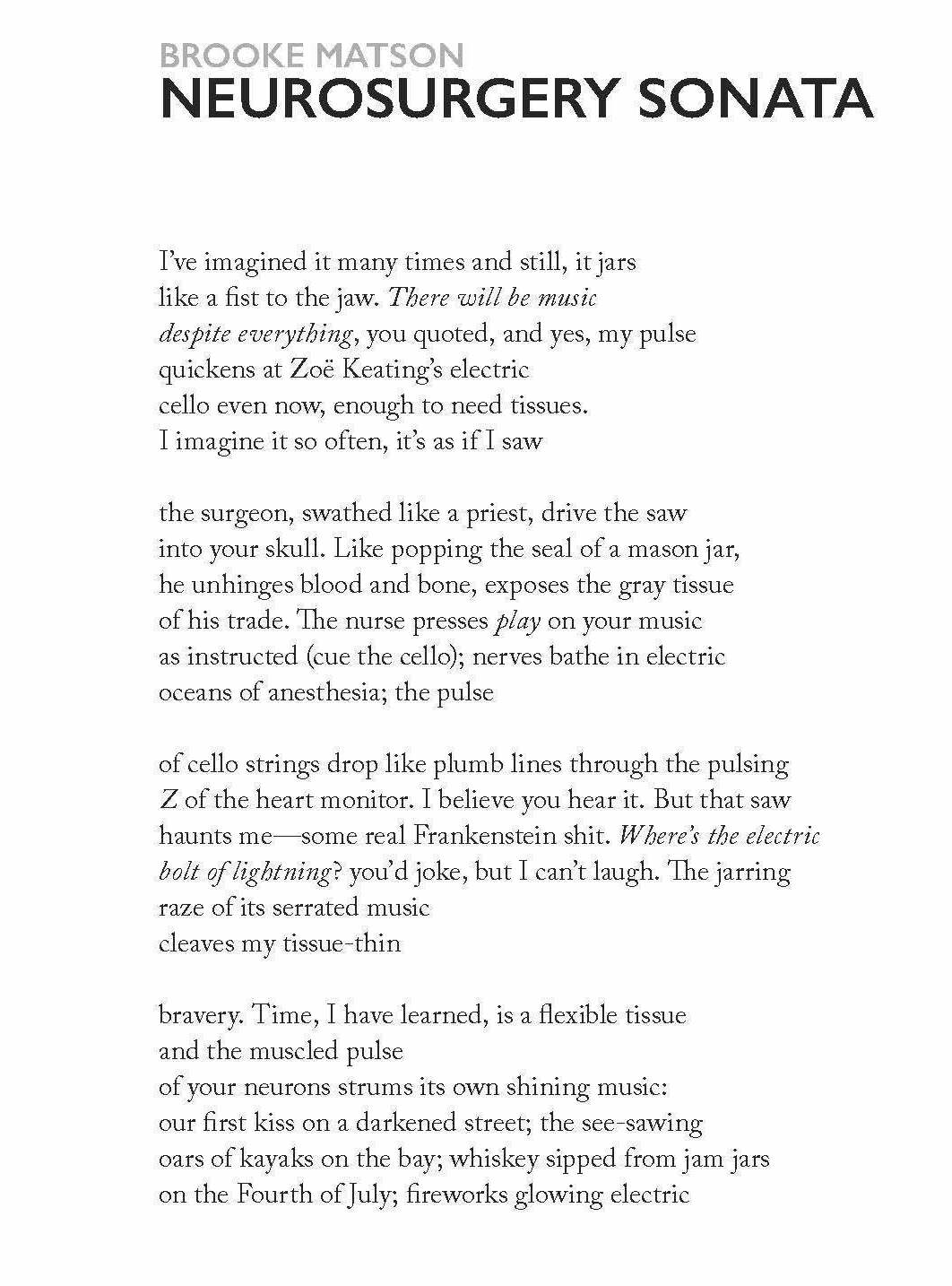
Brooke Matson is a poet and educator in Spokane, Washington. Eight years of teaching and mentoring at-risk youth deepened her study of physical science and the psychological effects of violence and loss. Her current poems explore the intersection of physical science—particularly chemistry, physics, and astrophysics—with human experiences of loss, violence, and resilience.
Matson’s first full-length collection of poetry, The Moons, was published by Blue Begonia Press in 2012 and was also included in the 2015 Blue Begonia Press boxed set, Tell Tall Women. Her poems have most recently been accepted to Prairie Schooner, Rock & Sling, Poetry Northwest, and Crab Creek Review. The 2016 recipient of the Artist Trust GAP Award with Centrum Residency and the 2016 winner of the Spokane Arts Award for Collaboration, Matson poetry has also been selected for regional anthologies such as Railtown Almanac (Sage Hill Press), and Lilac City Fairy Tales (Scablands Books).
She currently serves as the executive director of Spark Central, a nonprofit dedicated to igniting creativity, innovation, and imagination. Find out more about her and how to purchase her work here.
Just five days to go until the quarantine version of National Poetry Month comes to its virtual end. I’m marking the occasion by posting gems from a few of our own Pacific Northwest poets.
We see life a little different here in the PNW. A bit more aloof and distant at times, perhaps to highlight our sense of entrancement at the beauty and danger of our surroundings. Perhaps because the only words that don’t fail are those sung in poems.
Ironically, to say as much, my offering today is from one of our favourite bands, Scottish group called Deacon Blue. They describe it well in their song lyric from “The Hipsters” – “Friends. Who needs friends, when there’s a road and an ocean?”
So then, to highlight the unique Pacific Northwest ethos with a remarkable economy of words is this song by a band not even from here!
The Hipsters
All, all those waves And that old sun Shining
So drive Drive to the coast And let the water Surround you
I was standing by the shore Pulled by the deepest blue Aching for the allure Of the hipster boys And the hipster girls Shining
Friends, who needs friends? When there’s a road And an ocean
I was standing by the shore Pulled by the deepest blue Aching for the allure Of the hipster boys And the hipster girls Shining
When I let the dream Die slowly down Did I do it right Or was I wrong?
I was standing by the shore Pulled by the deepest blue Aching for the allure Of the hipster boys And the hipster girls Shining, falling Glistening, diving…
Today’s Viral Dailies, my recognition and celebration of National Poetry Month in isolation, is by the unforgettable Chilean poet, Pablo Neruda.
He was a contemporary Shakespeare when writing about love. Below is one of his best. Enjoy!
______________________________________
If you forget me
I want you to know one thing.
You know how this is: if I look at the crystal moon, at the red branch of the slow autumn at my window, if I touch near the fire the impalpable ash or the wrinkled body of the log, everything carries me to you, as if everything that exists, aromas, light, metals, were little boats that sail toward those isles of yours that wait for me.
Well, now, if little by little you stop loving me I shall stop loving you little by little.
If suddenly you forget me do not look for me, for I shall already have forgotten you.
If you think it long and mad, the wind of banners that passes through my life, and you decide to leave me at the shore of the heart where I have roots, remember that on that day, at that hour, I shall lift my arms and my roots will set off to seek another land.
But if each day, each hour, you feel that you are destined for me with implacable sweetness, if each day a flower climbs up to your lips to seek me, ah my love, ah my own, in me all that fire is repeated, in me nothing is extinguished or forgotten, my love feeds on your love, beloved, and as long as you live it will be in your arms without leaving mine.









 innerwoven