Brother Merton says

Doorkeepers of a better kind

There are those among us upon whose shoulders we stand when looking for ways out of the claws of darkness. Women and men who have peace and glory in equal measure tattooed upon their souls, waiting to help others across the finish line of pain to peace, chaos to glory. They are often unassuming and hard to spot in a crowd, their humility hiding their heroism. Bill W. (William Wilson (1895 – 1971), Dr. Bob (Robert Holbrook Smith 1879 – 1950), and Rev. Samuel Moor Shoemaker III (1893 – 1963), collectively, the architects of Alcoholics Anonymous. Says Bill of Rev. Shoemaker, “early AA got its ideas of self-examination, acknowledgement of character defects, restitution for harm done, and working with others straight from the Oxford Group and directly from Sam Shoemaker.”*

I Stand at the Door
by Rev. Sam Shoemaker of The Oxford Group

I stand by the door.
I neither go to far in, nor stay to far out.
The door is the most important door in the world –
It is the door through which men walk when they find God.
There is no use my going way inside and staying there,
When so many are still outside and they, as much as I,
Crave to know where the door is.
And all that so many ever find
Is only the wall where the door ought to be.
They creep along the wall like blind men,
With outstretched, groping hands,
Feeling for a door, knowing there must be a door,
Yet they never find it.
So I stand by the door.

The most tremendous thing in the world
Is for men to find that door – the door to God.
The most important thing that any man can do
Is to take hold of one of those blind, groping hands
And put it on the latch – the latch that only clicks
And opens to the man’s own touch.

Men die outside the door, as starving beggars die
On cold nights in cruel cities in the dead of winter.
Die for want of what is within their grasp.
They live on the other side of it – live because they have not found it.

Nothing else matters compared to helping them find it,
And open it, and walk in, and find Him.
So I stand by the door.

Go in great saints; go all the way in –
Go way down into the cavernous cellars,
And way up into the spacious attics.
It is a vast, roomy house, this house where God is.
Go into the deepest of hidden casements,
Of withdrawal, of silence, of sainthood.
Some must inhabit those inner rooms
And know the depths and heights of God,
And call outside to the rest of us how wonderful it is.
Sometimes I take a deeper look in.
Sometimes venture in a little farther,
But my place seems closer to the opening.
So I stand by the door.

There is another reason why I stand there.
Some people get part way in and become afraid
Lest God and the zeal of His house devour them;
For God is so very great and asks all of us.
And these people feel a cosmic claustrophobia
And want to get out. ‘Let me out!’ they cry.
And the people way inside only terrify them more.
Somebody must be by the door to tell them that they are spoiled.
For the old life, they have seen too much:
One taste of God and nothing but God will do any more.
Somebody must be watching for the frightened
Who seek to sneak out just where they came in,
To tell them how much better it is inside.
The people too far in do not see how near these are
To leaving – preoccupied with the wonder of it all.
Somebody must watch for those who have entered the door
But would like to run away. So for them too,
I stand by the door.

I admire the people who go way in.
But I wish they would not forget how it was
Before they got in. Then they would be able to help
The people who have not yet even found the door.
Or the people who want to run away again from God.
You can go in too deeply and stay in too long
And forget the people outside the door.
As for me, I shall take my old accustomed place,
Near enough to God to hear Him and know He is there,
But not so far from men as not to hear them,
And remember they are there too.

Where? Outside the door –
Thousands of them. Millions of them.
But – more important for me –
One of them, two of them, ten of them.
Whose hands I am intended to put on the latch.
So I shall stand by the door and wait
For those who seek it.

‘I had rather be a door-keeper
So I stand by the door.

So then, Mr. Wilson, Dr. Bob, and Rev. Sam, this recovering alcoholic thanks you.


See Wikipedia

Once upon a time – becoming the story

Sunday, September 5, 2021. Rosebud Church, Rosebud, Alberta.

Friday Fragmentia Sacra

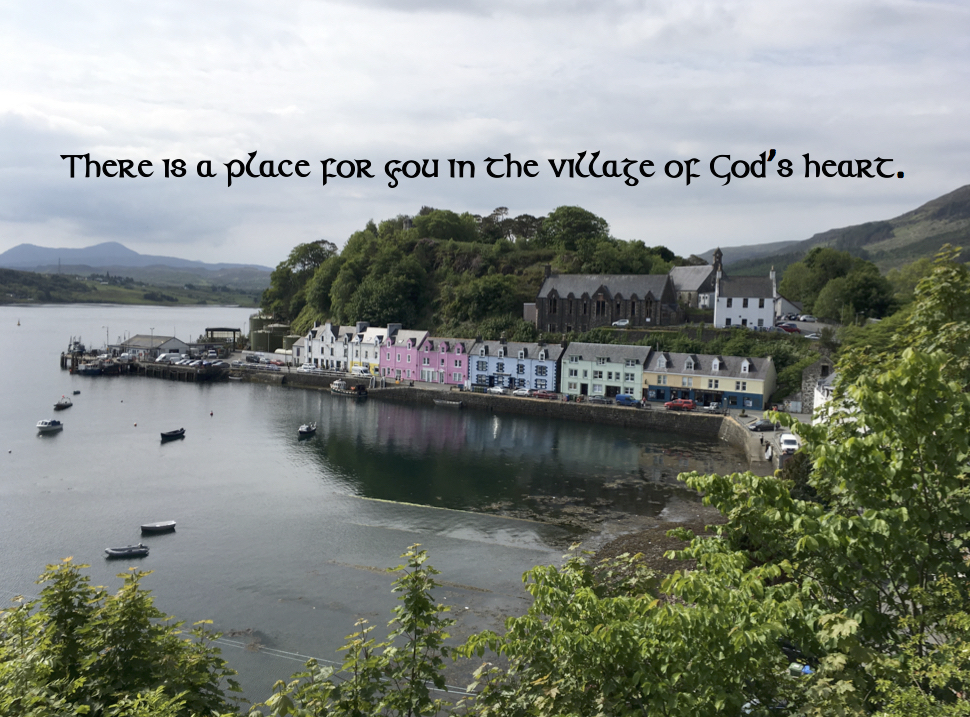
There are no borders in the heart of God.

There is only horizon.

It is the only place where we both see and inhabit our horizon at the same time. Present meets past meets future, all in one glorious ocean of joy-filled grace.

So, swim, dear friends. Swim.

Friday Fragmentia Sacra.jpg
Portree, Skye. June, 2016.


Maybe this Christmas

Christmas Day. My eyes are like twin harvest moons of bloodshot fatigue. There’s a roller derby taking place in my head. My church music ministry gig ramps up something fierce this time of year leaving me satisfied and happy, but a shivering hump of quasi-humanity. The solution? I sent my wife, Rae, out to find anything resembling coffee, if only for a most yummy and effective remedy for my pounding head. God bless her!

A rather poorly decorated poor excuse for a Christmas tree tries unsuccessfully to stand guard over the precious few gifts tucked under her skirt. A single strand of multicolor lights graces her awkward presence in our living room. Perhaps fewer than a dozen ornaments hang suspended, lifelessly, from these poor, little green arms – flimsy and weak.

I speak of symbols, those tried and true geiger counters of the meaning and truth they represent. Many, many thoughtful souls have sought to unravel the ontological mysteries so delightfully pictured by this meager scene before me. As such, of that at least, I must forego.

For me, Christmas this year is a bittersweet remembrance. Every dangling bauble, twinkly light, fireplace pop and suspended sock boasting itself on our mantelpiece seems to me nothing more than sad reminiscences of loved ones gone before us; of friendship, once robust and real, now ruined; of bad things said and good things left unsaid.

Anyone who knows me knows all too well my utter loathing of all things Thomas Kincaid (sorry for the random, awkward segue). Oh, make no mistake, his practical gift at the canvas is indisputable. It’s of the vision, or lack thereof, to which I take issue. This “art” represents the shallowest of wishful thinking, whimsical, Pollyanna non-reality. It is resurrection without a crucifixion. It sets out to illustrate a fantasy world where evil has never existed; a place we all long for but which must be arrived at through God’s channel of self-forgetful love that dies an ignoble death to prove that love.

Back in my living room, my wife and I are writing in different parts of the house. I squeeze out these wandering thoughts while she continues editing her novel. Our eldest son spent the night at the home of dear friends one state away while our other son snores peacefully in his room. We don’t expect his angelic, trumpeted emergence anytime soon.

Every year that passes heaven claims more of those we love. Both of my wife’s parents are gone. My father died in 1985. Those whom we have called friend are strewn about the globe in a flower arrangement of well-memoried laughter and familiar faces. It aches.

This Christmas, all of the regular trappings have escaped me. Instead, it stands as glowing reminder of three things. Life is not as Thomas Kincaid or Barney would have us believe. If this little evergreen means anything it illustrates that our hope springs eternal and that life stubbornly wins out over death. Second, the imperfections which pervade our not-so-Christmasy living room are our own. In the heavenlies, whatever that means, all manner of thing shall be well. Sorrow and sighing trade places with gladness and rejoicing.

Finally, in the words of songwriter Ron Sexsmith, “maybe this Christmas will mean something more; maybe this year, love will appear deeper than ever before. And maybe forgiveness will ask us to call someone we love, someone we’ve lost for reasons we can’t quite recall. Maybe this Christmas.”

Indeed…maybe this Christmas.

Friends, fellowship, fun, frolic and…a contest

From time to time God bowls me over with a renewed sense of God’s faithfulness, goodness and, frankly, sense of humor. Many of my best life experiences can find their way back to times spent with quality people discussing quality things for quality reasons. These are the times that refresh me when too much rust builds up on the underbelly of my life. Good friend, fellow blogger and writer, Chadwick Walenga, is celebrating new pathways of grace in his life together with a wonderful woman, Amy. (Follow them on Twitter).Chadwick

Chadwick and I have history. A short history but a good one. We both studied Spiritual Formation and Leadership online through Spring Arbor University, Michigan. In that place was forged a meaningful bond that will last to our dying day and beyond. He is deeply sensitive, spiritually aware, devilishly handsome (sorry, I promised), extremely funny and just…a good man. He has pastored churches for many years and is father to four of the coolest kids, like, ever.

He and Amy have recently begun a new website with a rather unimaginative but to the point title (dude, really?). I want to endorse not just their website but them, the road they’re on together; the shared invitation to explore life, both theirs and ours. It’s what lives lived openly and honestly can look like.

What I’m particularly jazzed about however is a writing contest they’re hosting through their site. I’m always down for these kinds of things. Anything to keep me writing. Besides, I love this guy and simply want to support he and his new life, his own writing and to say, “dude, you’re awesome!”

Check it out, friends, and throw your hat in the writing ring. I’m gonna. They’re not exactly promising a new car, but if you saw what he typically drives, you’d be grateful.

Let’s have some fun, shall we?

Your partner in shameless shenanigans among the jokes, words and cries for help…Rob

A Sunday Prayer

Truthful One,

why do we start as something,

give others the impression that that something

is our true something-ness when in truth

we are something much different indeed?

Living One,

what is the starting place of our deepest self?

When living day to day, how do we know

we’re giving to others that which

comes from living places and not from dead places

merely adorned with glitter and trinkets to make them appealing?

Serving One,

where are the lines drawn between obligation and self-respect?

When does serving another embezzle their need

to capably discover their own inner strength?

When does such a question even matter –

if at all?

Shining One,

how can the coal dust accumulating on my layered soul

be removed to reveal the sheen of love,

framed in hope, birthed of grace that you see?

That I see in my better moments?

Holy One,

I speak no more.

Instead, speak, for your servant is listening.

My ongoing prayer experiment

A while back I began to write about my big prayer experiment. In that piece, I shared the three greatest gifts to my prayer life:

1. Contemplative prayer, I.e. prayer without agenda/lovingly gazing at God.

2. Total honesty in the presence of a God who already knows all my shit.

3. The gift of Intercession.

Nothing has changed with this experiment. I do want to add something, however; something that has utterly revolutionized my prayer life, turning it into something to which I cannot wait to return.

I pray the Rosary.

Big deal, right? Millions do. Well, here’s the thing – I’m a Protestant. We’re supposed to look with suspicion, pity or even hatred at such wayward, Medieval practices believing them to be the rote, meaningless prayers pooh-poohed by Jesus in the Gospels. How could such a ridiculous thing, something held in regard by little, old ladies and superstitious saintly wannabes possibly lead one to the expected spontaneity and relationship we’re led to accept through our more enlightened “salvation prayer” at the end of the 4 Spiritual Laws booklet? Or so we Protestants are taught to think. You remember…the “Accept you’re a sinner/Believe in the Good News/Confess your sins” prayer that, like magic, whisks us from the apparent hell of our present existence into the Thomas Kinkade wonderland of Jesusy goodness? It’s actually a very good prayer. A necessary one.

It’s just so…incomplete.

Actually, I prayed that prayer once, too. Not necessarily that exact prayer, but one just like it. I credit that prayer for bringing a keener sense of articulation and focus to my otherwise meandering picture of me and God. I suppose I could even credit that “salvation prayer” as my come-to-Jesus moment, with the beginning (continuation?) of a journey even deeper into the heart of prayer.

The Rosary has been an important step in solidifying my need to regulate my prayer practice in chronological, tactile and organized ways. It also invites me to see prayer as more than just talking at God. Here, I can sit with another, Someone whose indelible presence ought to leave me breathless and speechless anyway. Although I’ve owned one before, it wasn’t until my dear Catholic friend, Val Dodge Head, gifted me with one I could actually wear around my neck that I began developing a daily practice. Here is the historic Rosary Prayer:
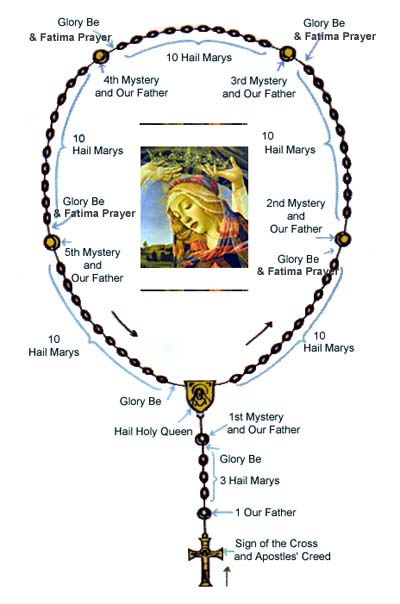
Rosary Prayer

The purpose of the Rosary is to help keep in memory certain principal events or mysteries in the history of our salvation, and to thank and praise God for them. This is the mountain rapids version of the Rosary Prayer. It begins with the Sign of the Cross and the Apostles’ Creed. This is followed, successively, by The Lord’s Prayer (the Our Father or Pater Noster), 3 Hail Marys, the 1st Mystery of Our Father and Hail Holy Queen. There are twenty mysteries reflected upon in the Rosary, all of which are divided into the five JOYFUL MYSTERIES, the five LUMINOUS MYSTERIES, the five SORROWFUL MYSTERIES, and the five GLORIOUS MYSTERIES. The Hail Mary is recited ten times (called a decade) between meditating on the mysteries in question. After each decade is said the following prayer requested by the Blessed Virgin Mary at Fatima: “O my Jesus, forgive us our sins, save us from the fires of hell, lead all souls to Heaven, especially those who have most need of your mercy.” The whole undertaking is a most imaginative blending of redemptive and mystical theology.

Here is my own adaptation.

I begin and end with the Sign of the Cross. The crucifix acts as The Lord’s Prayer both in and out of my Rosary. For morning prayer, the first bead is always Psalm 63 (King James Version), which I memorized many years ago. If in the afternoon, I’ll choose some other Psalm or a Prayer of St. Columba: “Kindle in our hearts, O God, the flame of that love which never ceases, that it may burn in us, giving light to others. May we shine forever in your holy temple, set on fire with your eternal light, even your Son Jesus Christ, our Saviour and Redeemer.” The Hail Mary beads are replaced by 3 Kyries (Lord, have mercy; Christ, have mercy; Lord, have mercy). In turn, these are followed, respectively, by the well known Ignatian Prayer, the Anima Christi and the Prayer of St. Francis of Assisi. The decade beads are breath prayers. With these, I practice more contemplative or centering prayer. Phrases such as “peace, be still” or “in the Lord, I’ll be ever thankful” or “holy is your name, O Lord” or, most often, The Jesus Prayer punctuate this time. It is unhurried and allows my mind to cleanse and my soul to pulsate to the sound of God’s own heart. The Mystery beads form a wonderful place for me to pray the daily Lectionary Psalms, various scriptures I have memorized or, on more creative retreat days, I’ll write or read poetry I’ve written. I exit the Rosary the same way I entered, although in reverse order.

The Rosary has been great respite to me since I am living nowhere near the Monasteries I used to frequent in Oregon. God has shown me just how holy even the most unholy places can be. In those places least ideal for luminosity, God has been busily proving me wrong about my previous misconceptions. The mysterious geography of prayer must begin in the cracks and fissures of the human spirit before it gets the added benefit of the babbling brook heard just outside the Monastery gates.

The Rosary has helped. 

Lord, fashion the slow calligraphy of your name

in a once stone heart, broken now as sand.

Spit out the bones of my old, gristled soul revivified on your tongue,

reattached to the sinews of your own holy arm. 

Sear the brand of white hot remembrance into the skin of my brazen back

so that only those I lead can see it.

In the wordless chatter of our silent conversations,

bring up the topics closest to your heart that breaks so much easier than mine.

Let the voices of a hundred thousand saints

crowd out the stifling arrogance of my solitary blethering.

And into that holy community of singing silence,

sing, Holy One, sing.


PIcture of Rosary can be found here. Rosary Prayer instructions can be found here.

Of changing seasons and the heart of man

The weight, the stink of summer sweat

erased, now late, the greening days.

Pursued no more by Spring’s regret,

once come the crisping Autumn ways.

* * * * *

Delivered, fresh, with fondness, fields

that love no more the drawling heat.

Welcome, Autumn’s respite, real,

her daunting face of beauty, sweet.

* * * * *

To smell the winds and wayward sky

is once again one’s place to know.

A speck, a grain, a hollow sigh-

to plant, to seal, to die, to grow.

* * * * *

And underneath her drying skin

are gifts of death, of seedling hope;

entombed, encoffin’d earth, within

the ground, while truth, with life, elope.

* * * * *

And you, O Man, so faint and dull,

where fate and folly freely meet,

your seasons, many, twist and pull-

your grasping, brash; God’s touch, discreet.

* * * * *

Return and taste the Summer gifts

the iridescent, squeamish Fall;

the Winter’s breathless cold uplifts

till Christ, like Spring, will death annul.

Examen on a Sunday in the Fall

Lord, like you, I am sweeping leaves,

as the trees eschew their fingers,

and turn their heads on part of themselves.

I looked and saw too many leaves

from too many long winters

heaped up on top of each other,

becoming the worm-infested mulch

of a wayward heart.

But, Lord, you also created worms.

They loosen what would otherwise

pack itself down into a deadening tightness,

choking out what life is yet to come.

You seem to prefer it this way, Lord.

New stuff grows from old,

good from bad,

fresh from foul.

So be it.