As morning reaches where only night had been,
dew once more settles on the brittle earth
and breath returns to one,
so all can breathe again.

As morning reaches where only night had been,
dew once more settles on the brittle earth
and breath returns to one,
so all can breathe again.

Last month we began a conversation; a tête à tête if you will about our relationship to the Bible – something we may not know as well as we think we do. And, because so much is riding on our relationship to this library of writings, it behooves us to dig as deeply as we can.
With the help of Glenn Paauw’s masterful book, Saving the Bible from Ourselves: Learning to Read & Live the Bible Well, I have sought to make the case that, in seeking to make the Bible “approachable” we have instead neutered it, making it less transformational. The Scriptures call us to faith, not certainty. Modernity has sought to erase the unpredictability of faith with scientific verifiability. “The bare text is difficult to control. The modernist turn in culture led the keepers of the Bible to transform it into something precise, punctual, calculable, standard, bureaucratic, rigid, invariant, finely coordinated, and routine…This is a Bible that needs to be saved” (p. 37).
We have all heard the adage that “less is more.” It holds true in many areas of life. For example, my wife tells me that much of her editing process involves carving away the literary dross from her manuscript in order to leave the best kernels of story that will keep the reader engaged. She wrote her book in under a year, but has spent over three more in the arduous task of proofing, hacking, chopping, and honing. Michelangelo stated that his masterpiece sculpture of David was “discovered” by simply chipping away all that was not David. It has been scientifically proven that the clutter of too many road signs and instructions cause drivers to disengage, the very thing such signs are designed to avoid.
Less is more. With the many additions and “improvements” to the Bible, aimed at helping us pay attention, we have ostensibly removed its beautiful “surface simplicity that [could] open up for us the inherent and immensely interesting good complexity that lies deep within…The Elegant Bible will reflect the wisdom that form and content always belong together in God’s good creation. Form is part of the content of things” (p. 39).
We must always begin with the questions, what is the Bible and how can we honor what that is? Paauw suggests that we are badly in need of an “extreme Bible makeover” wherein we can undo its fractured format that only leads to fractured reading and commensurately fractured lives. Part of that process will be to learn how to adopt the practice of referencing passages by context and content rather than by isolated chapters and verses.
As is apparent in the rather unique Covenant Community Bible Experience in which our fellowship is presently engaging, Paauw advocates for a Bible less encumbered by the artificiality that has been foist upon it by means of chapter and verse numbers that pull us out of a narrative and broad reading of its contents; section headings that are ultimately interpretive by nature; page layouts which hide from us the diversity of literary forms employed in our original manuscripts; and, particularly, study Bibles that can actually mitigate against the deep, transformative, non-agenda-driven reading that can best draw us into the dangerous place of spiritual formation rather than mere information.
We need to view the Bible more as poetry, which demands exactitude of form as much as content. What a poem “looks like” is intended to speak as loudly as the words themselves. Form and content alike form our understanding of a thing. We have inherited more of a cultural creation than the Bible that was originally intended.
Says Paauw, “to save the Bible from ourselves, we must begin to trust once again its ancient ways of saying things…The path to restoring our Bible begins with chipping away at everything that doesn’t belong there” (p. 50). Our love for God demands no less than an equal love of the Scriptures as they were first delivered.
Those with ears to hear, let them hear…

Lent isn’t just a gift for us convinced “churchy” types. It is the Church’s gift to underdogs, renegades, spiritual deadheads, and cultural hoarders, too. Historically, during Lent (which means quite simply, Spring), God’s rag-tag collective has willingly chosen aridity above over-watering, penitence over pride, self-sacrifice over indulgence, broken interiors over shiny exteriors. It’s the John the Baptist trailer before the Jesus main event. Is it any wonder it has precious little publicity? I mean really, who in their right mind would want a specific period of time considerably longer than the obligatory 30 minute happy ending wrap-ups during which one doggedly pursues the dark, not so pretty parts of our souls?
Actually, quite a few.
Lent is not generally the holiday hot spot of the liturgical calendar. It bids us come and mine our shadowy interiors for soft spots needing stronger foundation, or sinkholes needing to be filled in with something substantive. It’s a bit more like a dentist appointment than a car wash. Both are necessary, but one isn’t as much fun; is a little less sudsy, and creates greater discomfort.
What is the broader invitation of Lent however? In our pursuit of her riches we will use a lot of insider language: repentance, centering, seeking, lectio divina, true self/false self, contemplation, etc. It is wonderful, time-tested language descriptive of something known, experienced and at least partially understood – by the convinced.
There is a very real danger in the Christian spiritual formation enterprise that we become comfortably cloistered in the safety of recognizable, “insider” language. Our shared assumptions, ideology, emphases, personalities, experiences, and ethos almost guarantee some gargantuan hurdles for interested onlookers.
What would the spiritual formation enterprise say to the thrice-divorced Mom of four, without alimony, presently working two jobs, one of them prostitution, just to survive? To the middle-aged businessman who has just lost his business to poor management and embezzlement? He’s trained for nothing else, his self-esteem and confidence are in the toilet. He has mouths to feed. To the fifteen-year-old girl, kicked out of her fundamentalist home minutes before thumbing a ride to obtain her second abortion? To a man on death row, guilty of killing an entire family, including a little child? To the frat house full of “dudes” intent on bagging and bragging their next unaware, likely unwilling, virgin?
Without falling back into another insider language of North American evangelicalism, how would the language of the soul speak to them? To others? To those who have never even heard the words ‘Lent’ or ‘spiritual formation’ or ‘centering’, or ‘apophatic’ or….
Would this be “contemplative evangelism?” If not, then what?
I welcome all of you to a Lenten blog series entitled simply, “Eyes in the Alley.” I have assembled a crack team of bloggers to help us struggle through this a bit. They will engage head on with the places of need and the places of disconnect which keep much needed spiritual nourishment from making its way into the bellies of the least of these, the last, the lost, the shat upon, the hopeless, the frightened, the trapped, the hated, the screwed-up-with-little-recourse among us. I’ll kick it off on Ash Wednesday with an opener and a blank page upon which we may all work.
I…we, heartily welcome you to this series. I’m truly excited about this little venture. My own hope is that our collective voice may offer a probing look into to a topic of increasing interest to many: Christian spirituality for “the rest.” That is, the language of the soul in the grime of the streets; trying to understand ways that our spirituality becomes for us…eyes in the alley.

Ash Wednesday: Yours truly
Lent, Week I: Sunday, March 9 – Christianne Squires
Lent, Week II: Sunday, March 16 – Bob Holmes
Lent, Week III: Sunday, March 23 – Valerie Hess
Lent, Week IV: Sunday, March 30 – Dr. Elaine Heath
Lent, Week V: Sunday, April 6 – Tara Owens
Palm Sunday: Sunday, April 13 – Giff Reed
Easter Sunday, April 20 – Valerie Dodge Head
Pictures from here
Originally posted on the CenterQuest website, I wanted to share it here with you as well. That said, do come and visit us at CenterQuest and we’ll have tea or coffee with cigars…whatever.

Once we sang the blustery tunes
of a people bloated on happy promises.
Now, we wait, the words long forgotten
of songs happier still but too faint
to make any difference.
Once we told tales of kings and giants,
maidens and madmen, serpents and swords
walls that crumbled and glories won.
Now, we inhale the night stars of a brittle,
unfamiliar sky into lungs long dry,
heaving for the breath of Heaven.
Once we sang in dulcet tones
with brothers strong, and sisters proud
the songs, full-throated of Yahweh’s arm,
God’s nurturing wings of holy enchantment.
Now, entombed in raspy voices, we sing,
unpracticed in liberating sounds.
We have lost more than a note or two,
suspended as we are
between the music of here and there,
once and again,
Gehenna and Gabriel,
ranting and ruach.
Once we sang a single song.
Now, too many disparate notes vie
for heart and hearth and the demands of presence,
too dim to matter, too far to see, too good to hope for.
Joseph’s bones still cry out from Egypt,
the one with onions, olives and overflowing fullnesses,
not the one the skinny prophets told us to avoid.
Broken reeds too weak to hold up heads
too bored, too forgotten to feel shame.
Even that would be better than
these furrowed grey skies, frowning in apathetic non-wonder.
Lately, we’ve heard rumors of a man
and his pregnant mistress.
Some girl from who knows where
who talks with angels.
Picture found here

I don’t wait well. Wow, what a stupid and obvious way to begin an Advent blog post. Since I’ve begun this foray into a rather universal bugaboo and done so at that time of year when nothing fresh could possibly be said about the topic, I might as well carry on.
I am one who cannot abide rifts between friends, jagged edges in places where, with a little faith and work, the rough places could be made smooth; broken bridges to reunite two sides of a single stream.
I am told that I am particularly good at defusing conflict. What these same people are too polite to mention, however, is that I’m equally good at creating it. Be that as it may, I apparently have a gift for big picture thinking, peaceful words toward potentially peaceable outcomes.
Damn it.
Ironically (tragically, if you ask me), those who are called peacemakers generally hate conflict more than any others. Hence, the very gifts with which we’re saddled are just that, burdens to be borne more than wings upon which to fly through the mêlée.
I run at the first sign of even a hint of conflict. When they come, I am more unsettled than anyone but, when the time is ripe, the field of battle well-lit and ready, and the stands full of naysayers and side-takers, I will enter the fray, weak in the knees and, with dry mouth, stutter words of “now, imagine how this might be better.”
I’ve had a reasonable rate of success at this. But what about those times of waiting in which no amount of resourcefulness, faith, seeking, pain or bag-‘o-tricks seems enough? When does one say that to wait is no longer a reasonable option? When do we finally reach the point of no return? The statute of limitations on someone’s good promises? The place where it appears waiting was a bad idea to begin with?
Meet a battle-weary, time-scarred, now largely apathetic Israel who only say they’re waiting for the “coming Messiah.” After such a long absence, why bother arousing hope in that which perhaps was a cosmic ruse to begin with? God’s just playin’ around, testing our mettle. Like me, their best approaches, clearest study, best thinking, most robust faith…are for naught. To wait anymore is, well, just a waste of the necessary energy required to just get along.
This was the environment into which “in the fullness of time, God sent forth his Son.” It’s always the environment that God’s Son is most forthcoming. When we can no longer take credit for our astonishing acts of faithful waiting, God comes.
I hate waiting. God loves that because the Gospel of grace, the ultimate peacemaking enterprise, was, is and always will be God’s gig.

Let this Advent be a time of giving up futile fights and endlessly moribund conflicts. Submit to God’s higher waiting; that which is dependent not on our patient endurance, but on God’s perfect track record at keeping promises.
Pics here and here, respectively
Truthful One,
why do we start as something,
give others the impression that that something
is our true something-ness when in truth
we are something much different indeed?
Living One,
what is the starting place of our deepest self?
When living day to day, how do we know
we’re giving to others that which
comes from living places and not from dead places
merely adorned with glitter and trinkets to make them appealing?
Serving One,
where are the lines drawn between obligation and self-respect?
When does serving another embezzle their need
to capably discover their own inner strength?
When does such a question even matter –
if at all?
Shining One,
how can the coal dust accumulating on my layered soul
be removed to reveal the sheen of love,
framed in hope, birthed of grace that you see?
That I see in my better moments?
Holy One,
I speak no more.
Instead, speak, for your servant is listening.
A while back I began to write about my big prayer experiment. In that piece, I shared the three greatest gifts to my prayer life:
1. Contemplative prayer, I.e. prayer without agenda/lovingly gazing at God.
2. Total honesty in the presence of a God who already knows all my shit.
3. The gift of Intercession.
Nothing has changed with this experiment. I do want to add something, however; something that has utterly revolutionized my prayer life, turning it into something to which I cannot wait to return.
I pray the Rosary.

Big deal, right? Millions do. Well, here’s the thing – I’m a Protestant. We’re supposed to look with suspicion, pity or even hatred at such wayward, Medieval practices believing them to be the rote, meaningless prayers pooh-poohed by Jesus in the Gospels. How could such a ridiculous thing, something held in regard by little, old ladies and superstitious saintly wannabes possibly lead one to the expected spontaneity and relationship we’re led to accept through our more enlightened “salvation prayer” at the end of the 4 Spiritual Laws booklet? Or so we Protestants are taught to think. You remember…the “Accept you’re a sinner/Believe in the Good News/Confess your sins” prayer that, like magic, whisks us from the apparent hell of our present existence into the Thomas Kinkade wonderland of Jesusy goodness? It’s actually a very good prayer. A necessary one.
It’s just so…incomplete.
Actually, I prayed that prayer once, too. Not necessarily that exact prayer, but one just like it. I credit that prayer for bringing a keener sense of articulation and focus to my otherwise meandering picture of me and God. I suppose I could even credit that “salvation prayer” as my come-to-Jesus moment, with the beginning (continuation?) of a journey even deeper into the heart of prayer.
The Rosary has been an important step in solidifying my need to regulate my prayer practice in chronological, tactile and organized ways. It also invites me to see prayer as more than just talking at God. Here, I can sit with another, Someone whose indelible presence ought to leave me breathless and speechless anyway. Although I’ve owned one before, it wasn’t until my dear Catholic friend, Val Dodge Head, gifted me with one I could actually wear around my neck that I began developing a daily practice. Here is the historic Rosary Prayer:
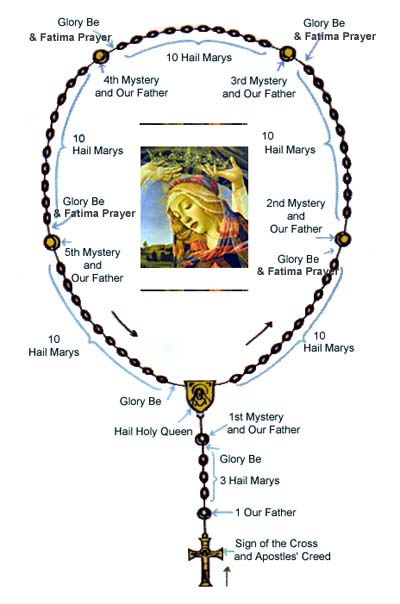
The purpose of the Rosary is to help keep in memory certain principal events or mysteries in the history of our salvation, and to thank and praise God for them. This is the mountain rapids version of the Rosary Prayer. It begins with the Sign of the Cross and the Apostles’ Creed. This is followed, successively, by The Lord’s Prayer (the Our Father or Pater Noster), 3 Hail Marys, the 1st Mystery of Our Father and Hail Holy Queen. There are twenty mysteries reflected upon in the Rosary, all of which are divided into the five JOYFUL MYSTERIES, the five LUMINOUS MYSTERIES, the five SORROWFUL MYSTERIES, and the five GLORIOUS MYSTERIES. The Hail Mary is recited ten times (called a decade) between meditating on the mysteries in question. After each decade is said the following prayer requested by the Blessed Virgin Mary at Fatima: “O my Jesus, forgive us our sins, save us from the fires of hell, lead all souls to Heaven, especially those who have most need of your mercy.” The whole undertaking is a most imaginative blending of redemptive and mystical theology.
Here is my own adaptation.
I begin and end with the Sign of the Cross. The crucifix acts as The Lord’s Prayer both in and out of my Rosary. For morning prayer, the first bead is always Psalm 63 (King James Version), which I memorized many years ago. If in the afternoon, I’ll choose some other Psalm or a Prayer of St. Columba: “Kindle in our hearts, O God, the flame of that love which never ceases, that it may burn in us, giving light to others. May we shine forever in your holy temple, set on fire with your eternal light, even your Son Jesus Christ, our Saviour and Redeemer.” The Hail Mary beads are replaced by 3 Kyries (Lord, have mercy; Christ, have mercy; Lord, have mercy). In turn, these are followed, respectively, by the well known Ignatian Prayer, the Anima Christi and the Prayer of St. Francis of Assisi. The decade beads are breath prayers. With these, I practice more contemplative or centering prayer. Phrases such as “peace, be still” or “in the Lord, I’ll be ever thankful” or “holy is your name, O Lord” or, most often, The Jesus Prayer punctuate this time. It is unhurried and allows my mind to cleanse and my soul to pulsate to the sound of God’s own heart. The Mystery beads form a wonderful place for me to pray the daily Lectionary Psalms, various scriptures I have memorized or, on more creative retreat days, I’ll write or read poetry I’ve written. I exit the Rosary the same way I entered, although in reverse order.
The Rosary has been great respite to me since I am living nowhere near the Monasteries I used to frequent in Oregon. God has shown me just how holy even the most unholy places can be. In those places least ideal for luminosity, God has been busily proving me wrong about my previous misconceptions. The mysterious geography of prayer must begin in the cracks and fissures of the human spirit before it gets the added benefit of the babbling brook heard just outside the Monastery gates.
The Rosary has helped.
Lord, fashion the slow calligraphy of your name
in a once stone heart, broken now as sand.
Spit out the bones of my old, gristled soul revivified on your tongue,
reattached to the sinews of your own holy arm.
Sear the brand of white hot remembrance into the skin of my brazen back
so that only those I lead can see it.
In the wordless chatter of our silent conversations,
bring up the topics closest to your heart that breaks so much easier than mine.
Let the voices of a hundred thousand saints
crowd out the stifling arrogance of my solitary blethering.
And into that holy community of singing silence,
sing, Holy One, sing.
PIcture of Rosary can be found here. Rosary Prayer instructions can be found here.
So it is to be, latent but translucent
that weavings and partings both,
secured in their places best suited
to their emergence or demise,
are laid out on God’s table of cards.
The goodbyes of days that turn to nights
that turn to days that turn to timeless
wonders, the crevices where only God’s
fingers fit. They’re too small for me
because I’m too big in me to see
my own smallness in him.
Wreck all chances for shoddy self-repair
and lay the table for a banquet instead,
where bread on my tongue and
the clinking glasses serve to remind me
of a better meal yet to come.
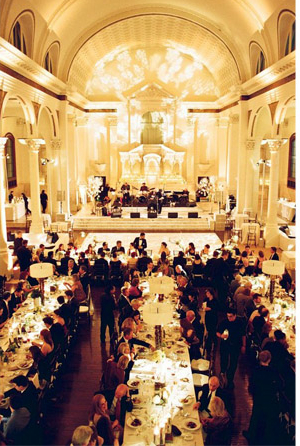
Image: www.annapolitanbride.com

Lately, I’ve been reading the journals of the late Trappist monk, author, priest and activist, Thomas Merton. He has long fascinated me both as a spiritual mentor and as poet and literary figure. In so many ways he is among those I most seek to emulate. He’s artsy – a poet at heart, which means he’s also moody and can take forever to determine new directions because he “lives in his head” too much. He longs for silence and the contemplative life of solitude but cannot escape the draw of the monastic community and the world at large to whom he is constantly being called. “My first duty is to start, for the first time, to live as a member of a human race, which is no more (and no less) ridiculous than I am myself. And my first human act is the recognition of how much I owe everybody else.”
Merton belonged because he didn’t belong. His life away from the world was how he best loved and served it. He was not cloistered to escape his humanity but to better love and live it. “I am coming to the conclusion that my highest ambition is to be what I already am…We must first become like ourselves and stop living “beside ourselves.”” I, like Merton, have learned best from what I haven’t done well than what I have. By how I’ve failed, not passed. By how truly unremarkable and troublesome I am, not my efficiency and accomplishments. I am failing my way to the deeper realities of my own soul.
Thank you, brother Merton, you are helping me to relax in my humanity.
Oddly, I’m finding Jesus there.
I’ve managed to turn brooding and melancholy into a cottage industry. It’s what I love and hate most about myself. I write much about embracing the moment, living into the time as it is given us right now. For example, here. There is an inexorable draw like a lover’s fragrance to mystique in the artist’s emotional vocabulary. It’s hip and sexy to be a little sad which, ironically, is the only thing that keeps us happy…well, keeps me happy. I must drive God up the wall, if that’s what God does when frustrated. There are times my heart seems to hate me. What causes some to shrug their shoulders can paralyze me like well-stuck spider’s prey. Where others build healthy todays on the good gifts of yesterday and the hopes of tomorrow I remain stuck in a yesterday that for me was better than good; it was holy, Otherworldly.

I’m working hard on this (because the meds are only partially helpful). It is hard spiritual work for me, but I’m making baby steps in claiming the brightness and immediacy of now rather than pursuing a pinkish yesterday or projected tomorrow. It’s the best way to show love to those given to us. Presence. Eyes open. Ears tuned and ready. Mouth closed. I love the times in the gospels where Jesus looks directly at those he is about to heal or to whom he is about to speak. To look at someone iris to iris and see past the decor of image and the fear in posture and see him, see her, see me or you as they/we truly are right now is a gift beyond all telling.

People, places, events, experiences; all of these root themselves deep in us, in me. They become a part of the turning pages of the Spirit writ large on the lives of those of us who believe, who boldly affix our little story to the Great Story. An early morning (late night?) reminiscence that pushed itself upon me is evidence of this kind of existential intrusion that hurts, but that I really love. I write of it here.
Jesus is convincing me as I continue to read of his deeply personal exploits among us that that, too, is my task. Live in such a way that whoever I am at this moment is the gift I give to another even if that ‘me’ isn’t the stellar individual my inner press kit says I am. The task at hand, together with the I AM God, equally present in every moment, is to better define my past and let it go. Such authentic encounter with people, with places, with…life, is the best, well the only, way to really live for tomorrow’s yesterday.
So be it.
If we are made in God’s image and God sings, then we should be singing, too.
Ancient Wisdom for Modern Seekers
Spiritual Direction for Integrated Living
From liquid courage to Sober Courage
an anamcara exploring those close encounters of the liminal kind
Collaborating with the Muses to inspire, create, and illuminate
...in such kind ways...
"That I may publish with the voice of thanksgiving, and tell of all thy wondrous works." Psalm 26:7
Blog for poet and singer-songwriter Malcolm Guite
…in the thick of things
REFLECTIONS & REVIEWS
Seeking that which is life giving.
… hope is oxygen
Homepage of Seymour Jacklin: Writer - Narrator - Facilitator
If we are made in God’s image and God sings, then we should be singing, too.
Ancient Wisdom for Modern Seekers
Spiritual Direction for Integrated Living
From liquid courage to Sober Courage
an anamcara exploring those close encounters of the liminal kind
Collaborating with the Muses to inspire, create, and illuminate
...in such kind ways...
"That I may publish with the voice of thanksgiving, and tell of all thy wondrous works." Psalm 26:7
Blog for poet and singer-songwriter Malcolm Guite
…in the thick of things
REFLECTIONS & REVIEWS
Seeking that which is life giving.
… hope is oxygen
Homepage of Seymour Jacklin: Writer - Narrator - Facilitator
 innerwoven

