Clarifying words from Brian Zahnd

There are theologian-writers out there who consistently challenge me, inspire and compel me to prayerful change. Brian Zahnd is one of those. Although I’m including his entire post here, first written in October of 2025, I encourage you to support his ministry and click on his original here.

As Jesus came near and saw the city, he wept over it, saying, “If you, even you, only recognized on this day the things that make for peace! But now they are hidden from your eyes.”

–Jesus (Luke 19:41)

_________________________________________________________________________________________________________

Whether or not slavery was the direct cause for the first shots fired upon Fort Sumter in April of 1861 is a matter of scholarly debate. What is undeniable is that the fuel that caused the American Civil War to ignite into a conflagration that resulted in 750,000 deaths was two-and-a-half centuries of slavery. From its Jamestown beginnings, the American colonies—and later the United States—practiced one of the most brutal forms of slavery the world has ever known. The preservation of an institution that systematically dehumanized millions of people for the sake of economic gain was not a thing that made for peace! Inevitably that kind of cruel exploitation would overflow its cup and unleash death and hell, bringing everything that is the opposite of peace. During the horror of the American Civil War, the land of the free became a burning Gehenna. Thirty percent of Southern men of fighting age were slain on battlefields that saw the birth of modern warfare. From then on, war would be totalized and mechanized. The four horseman of the Apocalypse galloped across America leaving a wake of war, disease, famine, and death.

But in tragic irony the spiritual revival of the Second Great Awakening had swept through America during the decade before the Civil War. Americans flocked to churches and evangelistic meetings. This was especially true in the more religious South, where Christianity was embraced with greater fervency than in the less zealous North. Across the country revival was on, churches grew, conversions multiplied. People got saved, praised Jesus, and talked about heaven. Then they went to hell. Or at least the same kind of hell Jesus had warned Jerusalem about during his final days. Despite a great revival, a nation of Christians was thrust into a hell of cannonballs, Gatling guns, field hospitals, and amputation saws. Great cities were set aflame and fields were littered with thousands of rotting corpses. The fires were not quenched and the maggots did not die. What had gone wrong? Millions had accepted Jesus and shouted hosanna, but they did not know the things that make for peace. They prayed a sinner’s prayer, “got right with God,” and kept their slaves. They had a faith that would justify the slave owner while bringing no justice to the slave. They had faith that gave them a ticket to heaven and a highway to hell. The religious fervor in the conservative churches of the South only served to convince them that they were blessed by heaven. They were quite certain God smiled upon their deep devotion to their southern-fried Jesus. If they had to go to war to preserve their freedom, so be it—God was on their side. They were sure of it. But there would be hell to pay.

To help you comprehend how wrong the conservative churches of the Antebellum South were despite flaunting their faith in Jesus and clutching their well-worn Bibles, I’m going to enlist the help of someone who was there and saw it all—Mark Twain. In the chapter entitled “You Can’t Pray a Lie” in Twain’s beloved novel Adventures of Huckleberry Finn, Huck Finn has helped hide Miss Watson’s runaway slave, Jim. But Huck thought he was committing a sin in helping a runaway slave. Huck had learned in Sunday school “that people that acts as I’d been acting goes to everlasting fire.” So in an act of repentance in order to save his soul, Huck wrote a note to Miss Watson and told her where she could find her runaway slave. Now Huck was ready to pray his “sinner’s prayer” and “get saved.”

I felt good and all washed clean of sin for the first time I had ever felt so in my life, and I knowed I could pray now. But I didn’t do it straight off but laid the paper down and set there thinking—thinking how good it was all this happened so, and how near I come to being lost and going to hell. And went on thinking. And got to thinking over our trip down the river; and I see Jim before me all the time: in the day and in the night-time, sometimes moonlight, sometimes storms, and we a-floating along, talking and singing and laughing. But somehow I couldn’t seem to strike no places to harden me against him, but only the other kind. I’d see him standing my watch on top of his’n, ‘stead of calling me, so I could go on sleeping; and see how glad he was when I come back out of the fog; and when I come to him again in the swamp, up there where the feud was; and such-like times; and would always call me honey and pet me and do everything he could think of for me, and how good he always was; and at last I struck the time I saved him by telling the men we had smallpox aboard, and he was so grateful, and said I was the best friend old Jim ever had in the world and the only he’s got now; and then I happened to look around and see the paper. It was a close place. I took it up, and held it in my hand. I was a-trembling, because I’d got to decide, forever, betwixt two things, and I knowed it. I studied a minute, sort of holding my breath, and then says to myself: “All right, then, I’ll go to hell”—and tore it up. It was awful thoughts and awful words but they was said. And I let them stay said; and never thought no more about reforming.

Huck Finn had been shaped by the Christianity he’d found in his Missouri Sunday school—a Christianity focused on heaven in the afterlife while preserving the status quo of the here and now. Huck thought that helping Jim escape from slavery was a sin, because that’s what he had been taught. He knew he couldn’t ask God to forgive him until he was ready to “repent” and betray Jim. Huck didn’t want to go to hell; he wanted to be saved. But Huck loved his friend more, so he was willing to go to hell in order to save his friend from slavery.

Twain did a masterful job of showing us how wrongheaded Christians can be about what constitutes salvation. For Huck to act according to justice, he had to think he was committing a great sin. For Huck to act Christlike, he had to think he was forsaking Christianity. For Huck to love his neighbor as himself, he had to think he was condemning his soul to hell. Think about that a while!

Mark Twain used his skillful pen to skewer the conservative Christianity of the American South. Though Mark Twain wasn’t a believing Christian (and he wasn’t)—he was a prophet to the prevailing Christianity of his day. This was a compromised Christianity in desperate need of a prophetic voice. In seeking to preserve an economy dependent upon slave labor, Southern churches had embraced a fatally distorted faith. Probably without even knowing what they were doing, these Christians had quite effectively used Jesus and the Bible to validate their racist assumptions and protect their vested interests. They went to church on Sunday. They got saved. They loved Jesus. They waved their palms and shouted hosanna on Palm Sunday. But like the crowd in Jerusalem eighteen centuries earlier, they didn’t know the things that made for peace. And Jesus wept over an America headed to hell. The churches were full and slavery continued—until the Civil War, that is. Then 750,000 people died for the sins of America.

This is more than a recitation of history; there’s a lesson to learn here. When we don’t know the things that make for peace, we can barrel down the highway to hell, all the while singing about how much we love Jesus and how wonderful it is to be saved. This should disturb us. How can it be that generations of religiously observant people can say all the right things about Jesus and still be on the wrong road? How can we know the things that make for a good church service but not know the things that make for peace?

Jesus said that something has hidden the peaceful way from our eyes . . . and more often than not, it’s a flag. If patriotism simply means the pride of place that inspires civic responsibility, so be it. But if patriotism means “my country right or wrong,” it’s a kind of groupthink blindness that hides the things that make for peace. Unfurled flags of nationalism have a long history of hiding the things of Christ that make for peace. Whether they are Roman, Byzantine, Spanish, French, English, German, Russian, or American flags, when they hide the things that make for peace, they are no longer the innocent banners of a benign patriotism.

So what are the things that make for peace? What is it we need to perceive if we are to avoid the bloody boomerang of a self-inflicted hell? Jesus told us when he said:

In everything do to others as you would have them do to you; for this is the law and the prophets. Enter through the narrow gate; for the gate is wide and the road is easy that leads to destruction, and there are many who take it. For the gate is narrow and the road is hard that leads to life, and there are few who find it. –Matthew 7:12-14

The things that make for peace are the two great commandments: love of God and love of neighbor, but especially the second command. (Love of God is only validated by a cosuffering love of neighbor.) The “golden rule” of evaluating our actions through the eyes of our neighbor is the narrow and difficult road that leads to life and peace. The golden rule is the narrow gate. The narrow gate is not a sinner’s prayer; the narrow gate is the practice of the Jesus way. The narrow gate is fulfilling the law and the prophets by empathetic love of neighbor in imitation of Jesus. When we hate and vilify others for ideological reasons, when we demonize and dehumanize others for nationalistic reasons, when we use and exploit others for economic reasons, we are on the highway to hell—we have chosen the well-worn road that leads to war and destruction. The deeply disconcerting thing is that it is entirely possible to cruise down the broad road of impending doom while singing songs of praise to Jesus. It happened on the first Palm Sunday. It happened a hundred and fifty years ago in America. It continues to happen today. If we think Jesus shares and endorses our disdain and enmity for our enemies, we don’t know the things that make for peace, and we are headed for an inevitable destruction, even if it takes a generation or two to arrive at our horrible destination. If we console ourselves with the promise of heaven in the afterlife while creating hell in this present life, we have embraced the tawdry religion of the crusader and forsaken the true faith of our Savior.

The road of nonviolent peacemaking is not an easy road, it’s not a popular road, and it’s certainly not a road for cowards. The road of “God is on our side, and he shall surely smite our enemies” is a wide road. A lot of parades have gone down that road. It doesn’t take much courage to travel that road; just fall in step and follow the crowd. A marching band is usually playing. But it’s also the road that leads to burned villages, bombed cities, and solemn processions of flag-draped coffins. Until the self-professed followers of Jesus are willing to forsake the wide road for the narrow way, the popular sentiment for the unpopular conviction, the easy assumptions for the hard alternatives—Jesus will continue to weep while his disciples shout hosanna.

I won’t pretend I have perfected the art of following Jesus on the narrow way that leads to life and peace instead of traipsing down the broad way that leads to death and war. Far from it. I’m a newcomer to the steep and narrow path of peacemaking. If I’m not careful, I can find myself trying to climb the path of peacemaking in a far too unpeaceable way. Which means I am falling on my face—or even tumbling back down the steep path. But still I know it’s the right path. I would not have found, much less chosen to travel, this hard and demanding path unless Jesus had led me on to it. I wasn’t going to be led onto the path of peacemaking by Gandhi or Rumi—as admirable as those men were. If today I’m trying to walk the narrow path of nonviolent peacemaking, its only because its where I find the footsteps of Jesus. It’s an uncrowded path, perhaps at times a lonely path. But it’s worth traveling, because I keep catching glimpses of Jesus farther up the road.

BZ

P.S. I wrote this thirteen years ago. This is an excerpt from A Farewell to Mars.
Viral Virulence

Today marks twelve years since I started this blog. Twelve years. Let me say that one more time, since it sounds so strange: TWELVE YEARS! How grateful I am to have just a tiny corner of the blogosphere in which to engage you lovely co-sojourner pilgrims. You’ve faithfully followed and read, subscribed, liked, commented, and shared posts. It has meant the world to me. A little community, a global one, intent on learning more about the movements of the human soul under the watchful eye of a loving God (no, this is not Handmaid’s Tale “under his eye” material!).

To honour twelve years I am posting a hard-hitting piece by someone else I admire and follow, Dr. Kevin Young. You can follow him on Facebook and Twitter.

First, as an ordained pastor in the Evangelical Covenant Church serving as a global worker with our missions arm, Serve Globally, in Edinburgh, Scotland, this piece really stuck with me.

Second, since my job puts me in direct contact with people of all races and colours all wanting space at God’s banquet table, this piece really stuck with me.

Third, as one deeply entrenched in the world of scripture: lectio divina, exegesis, homiletics and more, this piece really stuck with me.

I hope you will log onto Dr. Kevin’s blog, support as you’re able, and interact with his excellent material. It is well worth your time. It certainly has been for me.

* * * * *

The Uneasy Business of Being Viral

How one viral post changed the trajectory of my life

It was June 2020, and I was pastoring an overwhelmingly white, justice-minded congregation with a lot of money and snowbirds to match in South Florida.

I was comfortable, and so were they…. until George Floyd.

“Speak up, speak out, get in the way. Get in good trouble, necessary trouble, and help redeem the soul of America.”
— John Lewis

Watching the callous murder of George Floyd wrecked me.

I was angry—so very angry—but pastors have limited options for managing volatile emotions. People tend to want a pastor who will work through words at the pulpit rather than throw a punch.

But I wanted to punch something, hard. And transparently, I was most angry with myself. I had ignored decades of cries from people of color in my life. They were right, and I had been ignoring the deep racism around me.

My eyes were open, but filled with tears.

With blurred vision, I turned to social media and channeled my emotions into words and pictures, and one of those went viral.

I’ve made literally thousands (perhaps hundreds of thousands) of social media posts over the years on Twitter, Instagram, websites, blogs, myspace, and many others… but none of them had ever gone viral… until this post on Facebook on a Monday evening.

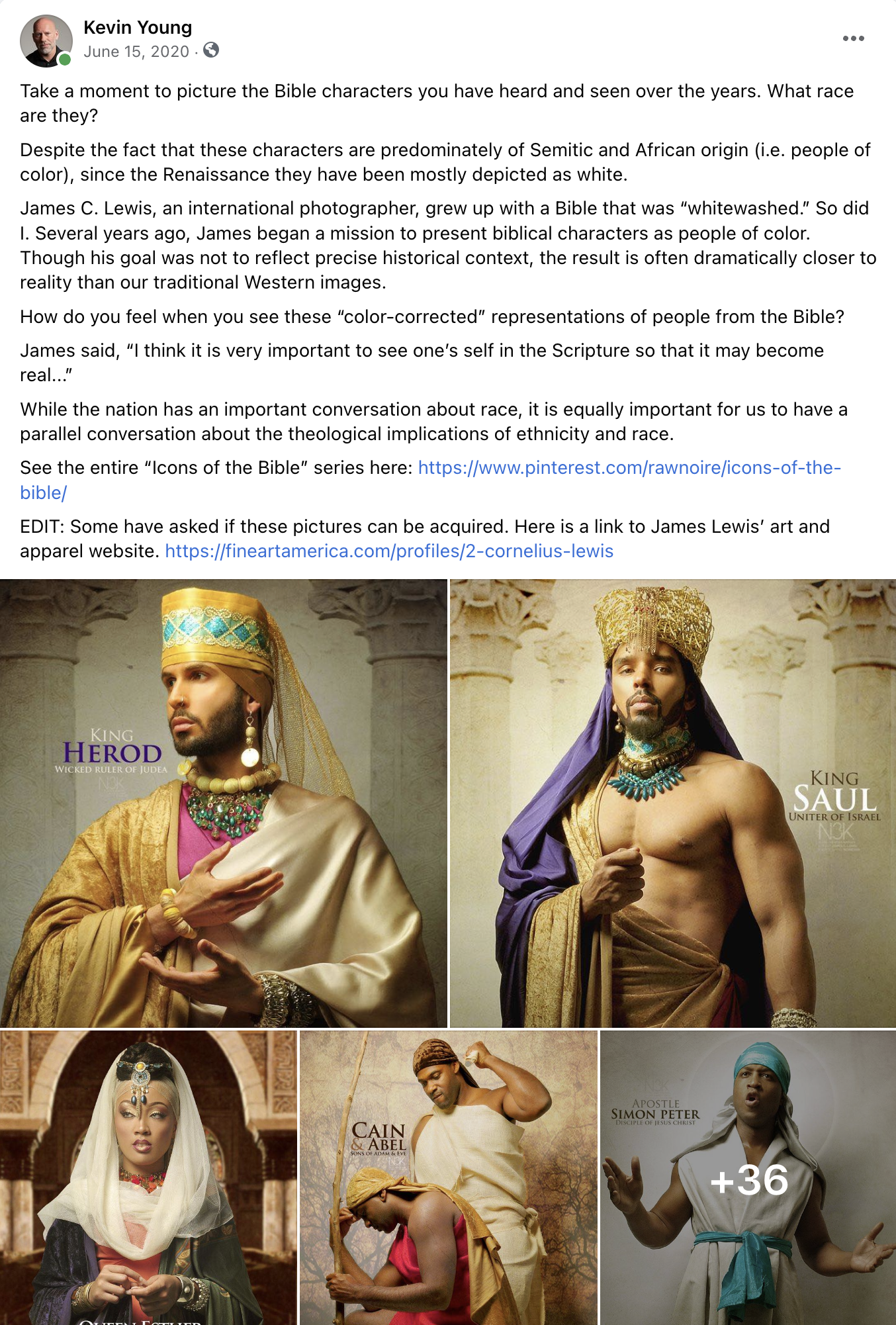
I had run across a set of photographs from James C. Lewis, a photographer in Atlanta who had released a series of Bible character portraits a few years earlier. His goal was to depict the heroes and heroines of the Bible as people of African and Middle Eastern origins, and it featured models who identify as Asian, Native American, Hispanic, African, Middle Eastern, Black American. and West Indian.

At the time, he said:  “I think it is very important to see one’s self in the scripture so that it may become real in our eyes. The whitewashing of the Bible has always bothered me.”

I stumbled across the photos quite by accident, but they moved me in ways I couldn’t fully form words around. So I selected several of my favorites from the series and posted them on my wall with this question: “Take a moment to picture the Bible characters you have heard and seen over the years. What race are they?”

Despite the fact that these characters are predominately of Semitic and African origin (i.e. people of color), since the Renaissance they have been mostly depicted as white. Just like the photographer, I grew up with a Bible that was “whitewashed.” All of the characters were white, all of the nativities were white, and all of the pictures of Jesus in our homes and surrounding churches were white.

So when I saw these images, something inside of me broke open. I couldn’t stop staring at them. They were somehow, real, in a way I couldn’t explain. They were beautiful, haunting, and somehow holy.

And, if I am honest, they were convicting.

When we become convicted by something, one of two things happens: Either we change as a result of the conviction, or we seek to mitigate the conviction by pushing hard against it and seeking instead to change the thing that is causing the discomfort.

So I assuaged my discomfort by pushing Post and going to bed.

It would be the last decent night of sleep I’d get for the rest of the week.

I woke up to almost 100 shares, and by dinner the next day it was up 300 shares… and climbing, quickly. I slept about two hours that night because the West Coast was liking, commenting, and sharing like crazy, trading off with the East Coast early to keep the snowball rolling. It’s popularity kept growing, and it was picking up speed.

I’d never had a post grow after 24 hours. I had no idea what to do or what I was in for.

My Facebook notifications were literally scrolling on my phone day and night. Every second, dozens more would show up. Great Britain, Ireland, Egypt, and Ethiopia. Turkey, Jordan, South Africa, Russia, India, and Japan.

The diversity of comments felt a bit like the Revelation image of the Throne Room of God where John saw “a vast crowd, too great to count, from every nation and tribe and people and language, standing in front of the throne and before the Lamb.” [REV. 7:9]

It was beautiful. And I had never experienced anything like it.

94,000 people shared it. 38,000 like it. Millions of people saw it.

It was incredible. People from around the world were conversing in real-time, on my wall, about the Bible, culture, and race.

They were talking… Together!!

People were laughing about some of the outfits that had creases, “Weren’t there irons back then?” Others pointed out that there wasn’t an ugly person among the bunch (these were some of the most beautiful people I had ever seen). Many said they had never considered “color” beautiful, but these photos had changed their minds… and more importantly, their hearts.

Many were talking about the issue of race and how they had grown up never realizing the biblical characters were people of color. They couldn’t believe that they had never thought about it. Some expressed gratitude that they, for the first time, realized that they had been a bit of a racist.

For a moment people came together to share love and deep regrets.

But then, things began to take a dire turn, and they turned quickly!

What had once been hopeful and uniting quickly devolved into an online version of the Lord of the Flies. I half expected to see a pig’s head scroll up in the comments.

“This biblical character’s skin tone is too light,” one said. For another, “Far too dark.” This one’s hair was too short, another’s too long. Too young; too old. Too pretty; too ugly. Too tall; too short.

Gripe, gripe, gripe.

But the complaints I could have handled. I’m a Pastor, you know.

It was what came next that blew my mind.

Pure Hate.

People began to inject hate into the comments. It caught me off guard. I thought it was a joke at first. But then I started looking at the walls of those who were posting the hate, and, “Nope… This is who they are IRL.” Unhinged, hateful people who were saying horrific things. I simply couldn’t believe it.

I wanted to grab them by the shoulders, shake them, and shout:

“Your Momma didn’t raise you to be like this! Your dad didn’t teach you to act this way!

“Knock it off, already!  Your family would be embarrassed (your family IS embarrassed) by this.”

“Grow up.  LOL. Wow!”

A post that was designed to help us understand the beautiful rainbow of colors in the Bible was being hijacked by hate… by people filled with hate.

So I said something to myself that I’ve said many times over the years…

Not. On. My. Watch.

“Do not let any unwholesome talk come out of your mouths, but only what is helpful for building others up, according to their needs, that it may benefit those who listen.”
— Ephesians 4:29

WORDS CREATE WORLDS.

So many of our families, our homes, our workplaces have been decimated by our mouths. Our words have created war zones in our worlds.

As I scrolled through this terrible content and hate that was multiplying across my page, I knew that there was no way that I could be a part of creating the situation where a person of color had to see those kinds of words written about them, ever.

I could pull the post, or I could scrub the comments.

I feverishly started deleting comments, hiding posts, and blocking individuals who crossed the line. I stayed up late into the night and was back up early in the morning managing the hate. I don’t think my phone left my hand for days. I spent about 20 hours each day actively managing the comments.

But I just couldn’t keep up with the hate.

The post log shows 9,700 comments, but the reality is a total number about 2 to 3 times that.

I was amazed at the things that people were willing to say and post.

And many of these individuals self-identified as Christians!

I mean, come on. Really?!

I learned a long time ago as a Pastor: HURTING PEOPLE HURT PEOPLE.

How many times had I seen this play out in relationships, in workplaces, in congregations, but especially in families!? Fathers, mothers, sons, and daughters who were struggling with one thing or another would use words to harm those they love. Instead of dealing with the root of their problem, they chose instead to project their pain on others. It’s a recipe for disaster.

It is easy for all of us, I suppose, to take the pain and evil that we have experienced, internalize it, and then return that pain to someone else. That was certainly happening in my comment section.

The Bible flat-out calls that evil.  

“Don’t repay evil for evil. Don’t retaliate with insults when people insult you. Instead, pay them back with a blessing. That is what God has called you to do.”
— 1 Peter 3:9

For what it’s worth, that’s pretty good advice.

Don’t argue with people on social media (unless they are dreadfully wrong about something really important), and for the love of God: Don’t attack people.

Give people blessings instead of insults.

That’s not easy to do.

I began to wonder how I might live this out online in the midst of so much drama and trauma. I decided I couldn’t help everyone, but maybe I could do something for a few.

Maybe I could bless some of those who had been cursed by far too many white people.

For instance, one of the bigots had been particularly brutal to a black lady who had lamented the whitewashing of the Bible. She expressed that she’d like to have a color-correct Bible for her son. So I bought her one.

I worked to help others find local congregations that were more diverse than the ones they currently attended.

I listened and apologized A LOT.

I did what I could, but eventually the fatigue caught up with me. Sometime on Friday, five days later, I threw my hands up in the air and said:

“I give up!”

I was done. I was physically exhausted, emotionally spent, and couldn’t deal with the stress of other people’s opinions anymore.

I prayed a short prayer thanking God for allowing my words and James’ pictures to travel the world, creating a dialogue about faith and race.

I closed the prayer by telling God that I hoped it never happened again.

I wasn’t cut out for this.

I don’t have the time for this.

I don’t have the mental health for this.

I knew I needed to BE FULLY PRESENT in the place where I could effect the most change: my family.

“Direct your children onto the right path, and when they are older, they will not leave it.”
—Proverbs 22:6

At that moment, it dawned on me that a large number of those comments likely came from adults whose parents had failed them.

As people commented—some with beautiful and healing words, others with hateful and abusive words—I wondered how much of that was planted in them in their early years.

I know that I said that “their momma didn’t raise them to be that way” and “their father didn’t teach them to act like that”… but now I wasn’t quite so certain. I’ve known many people who weaponized their kids, passing along their partisanship, anger, racism, and hostility. You know, that whole Hebrew Scripture idea that “The sins of the fathers and mothers shall be passed down through the generations.”

Not everyone repeats the sins of their parents’ prejudices, but many do.

I needed to ensure that my four children didn’t grow up to be the type of people who needed to have their comments deleted or hidden by a pastor to protect others.

That simple Facebook post that crisscrossed the globe made me a better dad in the end, but it also was the beginning of the end of my role as pastor in that congregation.

My newfound passion for the oppressed, for justice, and for Micah 6:8 mercy for the marginalized was too difficult for them to stomach.

It would be years before I would have another viral post or platform with any influence beyond a local congregation, but the commitment to be a prophetic voice of uncomfortable honesty was born during that warm week in June 2020.

I had spent too many years being silent and enabling an Evangelicalism that sought to silence dissenting voices.

On things that mattered to God—and now to me—I would speak up.

Even should I lose my pulpit, I had found my voice.

For such a time as this.

* * * * *

Don’t forget to head over to Dr. Young’s page. Join the conversations. Support his ministry. Invite others.

Back to the Bible We Don’t Know, part 2

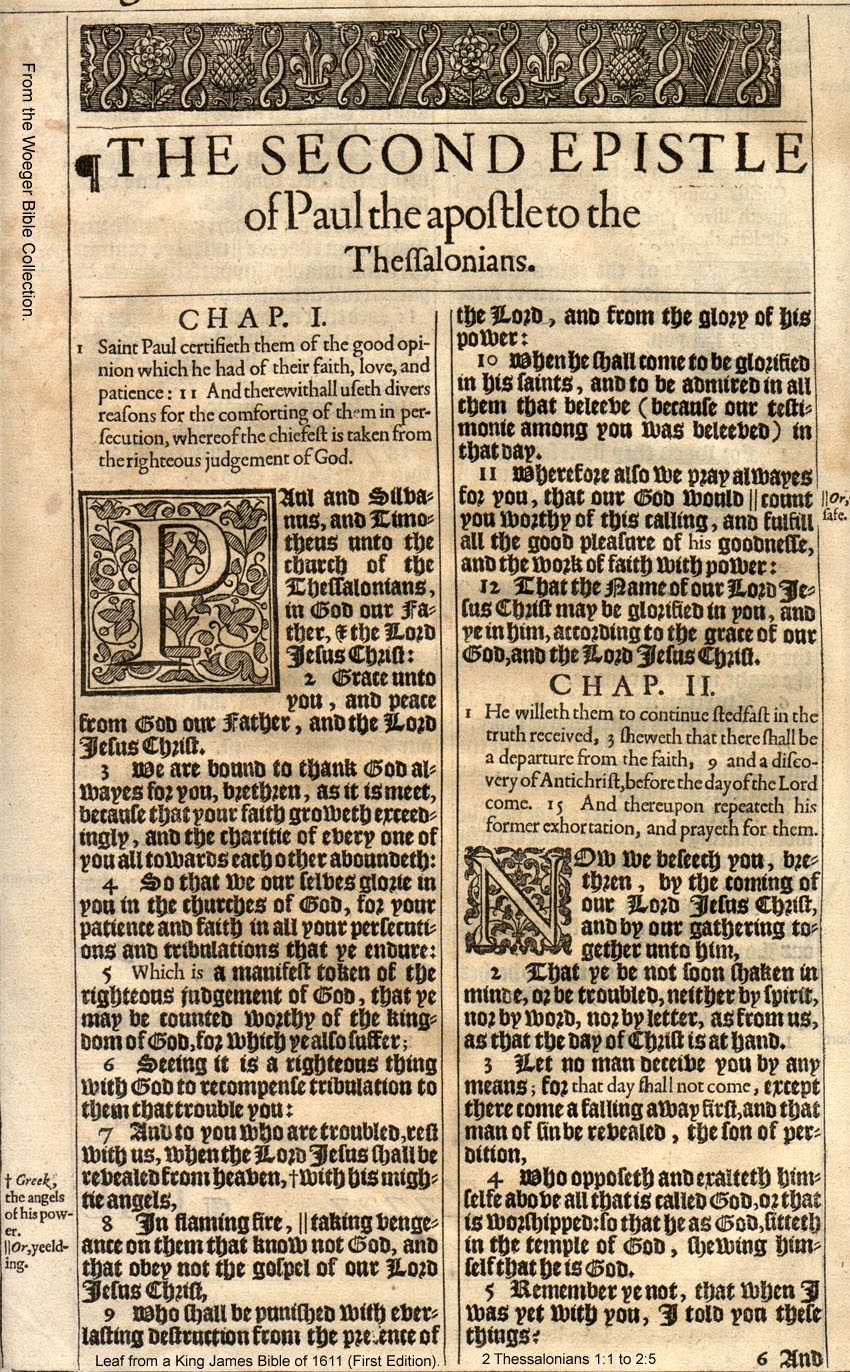
KJAV.JPG

Last month we began a conversation; a tête à tête if you will about our relationship to the Bible – something we may not know as well as we think we do. And, because so much is riding on our relationship to this library of writings, it behooves us to dig as deeply as we can.

With the help of Glenn Paauw’s masterful book, Saving the Bible from Ourselves: Learning to Read & Live the Bible Well, I have sought to make the case that, in seeking to make the Bible “approachable” we have instead neutered it, making it less transformational. The Scriptures call us to faith, not certainty. Modernity has sought to erase the unpredictability of faith with scientific verifiability. “The bare text is difficult to control. The modernist turn in culture led the keepers of the Bible to transform it into something precise, punctual, calculable, standard, bureaucratic, rigid, invariant, finely coordinated, and routine…This is a Bible that needs to be saved” (p. 37).
 
We have all heard the adage that “less is more.” It holds true in many areas of life. For example, my wife tells me that much of her editing process involves carving away the literary dross from her manuscript in order to leave the best kernels of story that will keep the reader engaged. She wrote her book in under a year, but has spent over three more in the arduous task of proofing, hacking, chopping, and honing. Michelangelo stated that his masterpiece sculpture of David was “discovered” by simply chipping away all that was not David. It has been scientifically proven that the clutter of too many road signs and instructions cause drivers to disengage, the very thing such signs are designed to avoid.
 
Less is more. With the many additions and “improvements” to the Bible, aimed at helping us pay attention, we have ostensibly removed its beautiful “surface simplicity that [could] open up for us the inherent and immensely interesting good complexity that lies deep within…The Elegant Bible will reflect the wisdom that form and content always belong together in God’s good creation. Form is part of the content of things” (p. 39).
 
We must always begin with the questions, what is the Bible and how can we honor what that is? Paauw suggests that we are badly in need of an “extreme Bible makeover” wherein we can undo its fractured format that only leads to fractured reading and commensurately fractured lives. Part of that process will be to learn how to adopt the practice of referencing passages by context and content rather than by isolated chapters and verses.
 
As is apparent in the rather unique Covenant Community Bible Experience in which our fellowship is presently engaging, Paauw advocates for a Bible less encumbered by the artificiality that has been foist upon it by means of chapter and verse numbers that pull us out of a narrative and broad reading of its contents; section headings that are ultimately interpretive by nature; page layouts which hide from us the diversity of literary forms employed in our original manuscripts; and, particularly, study Bibles that can actually mitigate against the deep, transformative, non-agenda-driven reading that can best draw us into the dangerous place of spiritual formation rather than mere information.
 
We need to view the Bible more as poetry, which demands exactitude of form as much as content. What a poem “looks like” is intended to speak as loudly as the words themselves. Form and content alike form our understanding of a thing. We have inherited more of a cultural creation than the Bible that was originally intended.
 
Says Paauw, “to save the Bible from ourselves, we must begin to trust once again its ancient ways of saying things…The path to restoring our Bible begins with chipping away at everything that doesn’t belong there” (p. 50). Our love for God demands no less than an equal love of the Scriptures as they were first delivered.
 
Those with ears to hear, let them hear…