“Hi, I’m Rob, and I’m an alcoholic.” I say these words regularly. At this point they’re practically a mantra. Starting with this post, I will be sharing every episode of my new podcast venture: The Creative Recovery Initiative.
And so, it begins…

“Hi, I’m Rob, and I’m an alcoholic.” I say these words regularly. At this point they’re practically a mantra. Starting with this post, I will be sharing every episode of my new podcast venture: The Creative Recovery Initiative.
And so, it begins…
As a recovering alcoholic whose life and ministry revolves around working among others like me, how could I not be inspired by this amazing post by Bradley Jersak? I have this very conversation consistently, constantly, insistently, relentlessly.
The genius of Alcoholics Anonymous lay in its huge welcome mat. It introduces us to God but refuses to quickly define God. For those desperate for sobriety and community but without the trappings of “church” which might be far too triggering, this gentle introduction is perfect.
Please read and I trust you’ll be as compelled as I to learn still more about A.A. and your own “Higher Power.” Be sure to check out Brad’s Substack: “Christianity Without the Religion.”

While I was on a holiday with Eden, I had time to post what I think was an important article I wrote a while back about the God(s) of 12-step recovery.
* NOTE: This resource is not officially approved by any fellowship. These are observations of an individual member.
Introduction: The only prerequisite for joining any 12-Step recovery program is a desire to be free of our addictive behavior. While the program uses the terms “God” and “higher power,” it is also explicit about not imposing any religion, creed or dogma. In this way, anyone can participate regardless of their belief system. The founders of AA were committed to making the program accessible, not only to Christians, but to people of other faiths or no faith at all.
That said, the program does lead people on a journey of surrender to one’s “higher power,” including practices such as prayer and meditation, even if only “as if” God exists. These practices are meant to improve the addict’s conscious contact with their higher power, trusting that this will also deepen and heal their understanding of God.
In that context, I see two notions of God at work within the program: 1. the God of the addict’s understanding and 2. a God whose nature and attributes are described in the program.
Whether one comes from a dogmatic religious background or has no faith at all, when we speak of “God,” we admit that our ideas of God are incomplete and biased, formed by our culture, family and experiences. These ideas form “our understanding of God,” however immature, broken or twisted. Some of the most distorted images of God arise from early childhood trauma or overdeveloped fundamentalist training. Some addicts may be unable to entertain any idea of a God, so they may begin by thinking of their higher power as the principles of the program or embodied by the fellowship they attend. And fair enough.
The point is that however limited or misshapen, the “God of our understanding” is always enough for God to work with. Even if they pray to “the Unknown God”—God Anonymous, if you will—we believe God (as God truly is) sees the addict’s plight and hears the addict’s cry for help. That God will respond to every broken and willing heart. The path toward freedom has begun. The program teaches that this path will include growth and healing in our understanding of God. While 12-Step recovery resists forays into theology, it does in fact attribute at least five important character traits to God that we believe every addict will discover through the program.
The five traits of God revealed through the program are as follows:
A. God is loving: Addicts need to be reassured again and again that regardless of what their shame tells them, God is not angry with them. He is not a punitive judge, scowling at them in condemnation. Many addicts have fashioned a vindictive God out of the dust of their own shame—a God that they feel must hate them and is punishing them for their failings. But 12-Step recovery says, “No! God doesn’t hate you. You need not run or hide from God. God is not a gavel-heavy judge who treats your addiction as a moral failing. Instead, God is a Great Physician who sees your addiction as a disease. And his medicine is the love you’ll experience in the program.” But what does this love look like in practice?
B. God is caring: The love of God is experienced as care. God is not distant, absent or silent. God’s care is real, experienced in a variety of beautiful ways. For example, God’s care is known through the belonging and acceptance of the fellowship. God’s care is felt through the welcome of addicts just like us who listen without judgment—and especially through the care of a sponsor. This sense of care grows as the addict finds their prayers being answered, they know not how, and realize that God’s providential hand is at work for their good. Most of all, God’s care comes as the obsessions and cravings begin to lift, through moments of clarity and growing clean time.
C. God is forgiving: Addicts begin to learn that God is forgiving when they find their higher power already waiting for them at “rock bottom.” No matter how far we sink or how badly we’ve blown up our lives, the truth is that there is nothing God can’t forgive. While we proclaim this regularly in our meetings, we come to know it directly as we work steps 4 and 5 with our sponsor. Our sponsor embodies forgiveness as we share our “fearless moral inventory.” It’s also essential we know God has forgiven us before we make our amends. The reason for this is that God’s love is not conditional on the response of those we’ve harmed. Some may never be able to forgive us, and we mustn’t try to manipulate forgiveness from them. No, it is God who must and will and has forgiven us.
D. God is responsive: 12-Step literature tells us that we’ll gradually learn that God is responsive. A practice as simple as the Serenity Prayer comes with a growing expectancy that when we pray, God does and will grant us serenity, courage and wisdom beyond our temperament. As we work the steps, we discover that God truly does answer unselfish prayer. The step-3 prayer says, “God, I offer myself to you – to build with me and to do with me as you will. Relieve me of the bondage of self, that I may better do your will. Take away my difficulties, that victory over them may bear witness to those I would help of your Power, your Love, and your Way of Life.” As we practice daily gratitude for how these prayers manifest in our lives, we come to believe God is responsive and thus, personal.
E. God is personal: Many of us began as agnostics or even as atheists, and could not associate our higher power with a personal God. But by working the steps in earnest and even just praying “as if” faithfully, we came to believe that the “power greater than ourselves” is more than a projection. Words such as loving, caring, forgiving and responsive become lived realities, regardless of the name we chose for our higher power. We were no longer simply personifying the program—we were relating daily to something, or rather, Someone, who was personal—who never abandoned or condemned us, who would never leave us or give up on us.
Through Step 11, our spiritual awakening now included conscious contact with “the God of our understanding.” And that understanding now became a conviction: this God was loving, caring, forgiving, responsive and personal. This God humbly came to us, even anonymously, to guide us from shame to grace, and into the freedom of recovery.
Christians in 12-Step programs around the world have noted that making Jesus Christ their higher power has been beneficial to them personally. Certainly, the God who Jesus proclaimed as “Our Father” is loving, caring, forgiving, responsive and personal. However, some Christians have felt discomfort with speaking about God generically or “reducing” God to a “higher power.” They believe it might be “watering down the gospel” and reason that the program itself needs to upgrade its higher power to Jesus for it to truly be effective. Some groups, such as Overcomers Outreach and Celebrate Recovery, believe they have successfully transposed 12-Step recovery into a fruitful Christ-centered option suitable for their churches and ministries. That may be. I’ve heard some good reports.
However, it was not without reason or wisdom that Alcoholics Anonymous and its affiliates began as they did, despite their Christian foundations. Nor is Christianizing the program without its own perils.
First, the founders of AA understood some important truths that are compromised when we Christianize the program:
While any member is welcome to name Christ as their higher power, the peril of creating a fellowship where that confession is required (a) creates an exclusive “outer court” of conditional grace, and (b) gives the impression that until an addict believes what Christians believe, lasting recovery is not possible. This just isn’t so. God’s healing grace for addicts is not conditional on using the right name.
Conversely, while one might believe that naming Christ as one’s higher power is an obvious upgrade to our idea of God, the very opposite can and does happen! How so? Namely, in the name of Christ, certain fundamentalist aberrations concerning the nature of God are smuggled in. These include, for example, (a) shame, (b) punishment, and (c) moralism. These elements have no place in the program. Some Christian traditions would add that they have no place in Christianity either—and yet they have frequently infected the gospel with a fear-based message of an ugly and angry God.
The unspoken scandal is that the God of Christian religion has tended to be far less Christlike than the God of AA et al! Christian members of AA, NA, SAA, etc. ought to be encouraged to see their open fellowships, not as a watered-down gospel, but as a place for Christ himself to move anonymously, a hospital not for those who believe they’re righteous, but for those who know they need a doctor.
The Creative Recovery Initiative is a labour of love I’ve developed over the past couple years living with my wife in Edinburgh, Scotland as global personnel with Serve Globally, our denomination‘s mission wing. I don’t pretend to be a professional vlogger, influencer, or documentarian. I don’t even own fancy equipment. What I have however is an iPhone, a story, a Saviour, and a desire to tell that story to as many who might benefit from hearing it.
Perhaps you’ll find yourself here in some way? Perhaps someone you know might find hope from the stories I tell here? Either way, I invite you into this space to join me in the telling. In so doing, we’ll find healing and build community, together.
Peace to you all…R
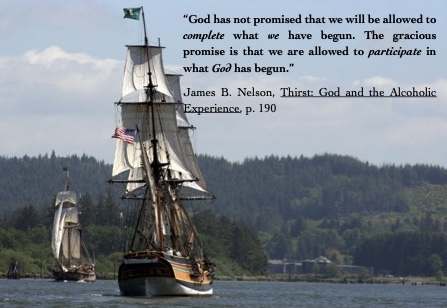
Life as an addict/alcoholic, whether in recovery or not, is treacherous. Fraught with sandbars, rocky shoals, and gale-force winds forever obstructing any forward motion. Shore could be in sight, hopes elevated, and one’s ship gets dashed against the rocks of the unexpected, uninvited, and unwelcome. Sadly, many do not survive. This is the story of one such soul.
We shall miss you, Elle.

There are those among us upon whose shoulders we stand when looking for ways out of the claws of darkness. Women and men who have peace and glory in equal measure tattooed upon their souls, waiting to help others across the finish line of pain to peace, chaos to glory. They are often unassuming and hard to spot in a crowd, their humility hiding their heroism. Bill W. (William Wilson (1895 – 1971), Dr. Bob (Robert Holbrook Smith 1879 – 1950), and Rev. Samuel Moor Shoemaker III (1893 – 1963), collectively, the architects of Alcoholics Anonymous. Says Bill of Rev. Shoemaker, “early AA got its ideas of self-examination, acknowledgement of character defects, restitution for harm done, and working with others straight from the Oxford Group and directly from Sam Shoemaker.”*
I Stand at the Door
by Rev. Sam Shoemaker of The Oxford Group
I stand by the door.
I neither go to far in, nor stay to far out.
The door is the most important door in the world –
It is the door through which men walk when they find God.
There is no use my going way inside and staying there,
When so many are still outside and they, as much as I,
Crave to know where the door is.
And all that so many ever find
Is only the wall where the door ought to be.
They creep along the wall like blind men,
With outstretched, groping hands,
Feeling for a door, knowing there must be a door,
Yet they never find it.
So I stand by the door.
The most tremendous thing in the world
Is for men to find that door – the door to God.
The most important thing that any man can do
Is to take hold of one of those blind, groping hands
And put it on the latch – the latch that only clicks
And opens to the man’s own touch.
Men die outside the door, as starving beggars die
On cold nights in cruel cities in the dead of winter.
Die for want of what is within their grasp.
They live on the other side of it – live because they have not found it.
Nothing else matters compared to helping them find it,
And open it, and walk in, and find Him.
So I stand by the door.
Go in great saints; go all the way in –
Go way down into the cavernous cellars,
And way up into the spacious attics.
It is a vast, roomy house, this house where God is.
Go into the deepest of hidden casements,
Of withdrawal, of silence, of sainthood.
Some must inhabit those inner rooms
And know the depths and heights of God,
And call outside to the rest of us how wonderful it is.
Sometimes I take a deeper look in.
Sometimes venture in a little farther,
But my place seems closer to the opening.
So I stand by the door.
There is another reason why I stand there.
Some people get part way in and become afraid
Lest God and the zeal of His house devour them;
For God is so very great and asks all of us.
And these people feel a cosmic claustrophobia
And want to get out. ‘Let me out!’ they cry.
And the people way inside only terrify them more.
Somebody must be by the door to tell them that they are spoiled.
For the old life, they have seen too much:
One taste of God and nothing but God will do any more.
Somebody must be watching for the frightened
Who seek to sneak out just where they came in,
To tell them how much better it is inside.
The people too far in do not see how near these are
To leaving – preoccupied with the wonder of it all.
Somebody must watch for those who have entered the door
But would like to run away. So for them too,
I stand by the door.
I admire the people who go way in.
But I wish they would not forget how it was
Before they got in. Then they would be able to help
The people who have not yet even found the door.
Or the people who want to run away again from God.
You can go in too deeply and stay in too long
And forget the people outside the door.
As for me, I shall take my old accustomed place,
Near enough to God to hear Him and know He is there,
But not so far from men as not to hear them,
And remember they are there too.
Where? Outside the door –
Thousands of them. Millions of them.
But – more important for me –
One of them, two of them, ten of them.
Whose hands I am intended to put on the latch.
So I shall stand by the door and wait
For those who seek it.
‘I had rather be a door-keeper
So I stand by the door.
So then, Mr. Wilson, Dr. Bob, and Rev. Sam, this recovering alcoholic thanks you.
See Wikipedia
I’ve been quite open about my struggle with alcoholism and subsequent recovery. Perhaps it is because, through my association with the program and community of A.A. I’ve rediscovered the loving, trustworthy God I once knew. That God somehow got lost along the way, despite my practices of faith, my role as a “professional Christian,” and a radical conversion experience at eighteen.
These days, my faith is simpler. It is not so cliché-ridden, expectation-laden, preconceived notions-driven. It is one of basics: learning humility, self-love, and the practices necessary to maintain and nourish the same. Along the way, I read everything I can get my hands on to assist in that journey. This is a short excerpt from my Seeds of Grace: A Nun’s Reflections on the Spirituality of Alcoholics Anonymous by Sister Molly Monahan (pseudonym).

Uncertain times.
Unreliable emotions.
Unreasonable expectations.
Unfair xenophobia.
Unrealized dreams.
We are living in a strange day, and with no way of really knowing what direction the wind will blow next. As a writer, poet, musician, and pastor, it is my job and my joy to speak truth to falsehood, love to hate, light to darkness.
So, in our current Coronahaze, rather than load up the Internet with more data, as helpful as it is, I thought I’d leave you with a daily dose of hope, some of it backdoor, some overt.
Today’s is brought to you from the queen of quirky gospel truisms, Nadia Bolz-Weber. Our responses to fear are not always our best selves. Trust me, as a recovering alcoholic, I know of which I speak. Let’s begin from via negativa and see what light may come before long, shall we?

Friends, be wise.
Stay kind to others.
Pray and hope.
Let healing begin…

What follows in this series of posts are in fact my notes from a retreat I recently co-led for a delightful bunch of kindred spirits.
I suppose I should have had a more to-the-point title. But, I would have had to produce something innocuous like “CFDM 2019 Retreat Notes.”
Mmm, sexy.
Failing that, I could have gone with my basic premise: Longing – Awakening – Union.
Too academy.
Instead, I decided to aim at something less high school journal or quarterback mystics club. A collection of family cabins cuddling an inlet in Poulsbo, Washington was where we did our holy business together. We spent an enriching few days Poulsbo-ing, and loved it!
They are alumni of Christian Formation and Direction Ministries Northwest. A more fun and authentic bunch would be hard to find. They’re about as representative of the kaleidoscope of spiritual seekers as any group can be. All of them thirsty for waters of abundance, hungry for food both spiritual and otherwise, and ready to party.
Bible study “disciples” always take themselves far too seriously. Mystics are better at belly laughs any day. Anyhoo, here’s part one.
Introduction
All of us are in the process of learning how to pursue the spiritual life; how to discover, nurture, sustain, and propagate a Christian spirituality that is life-giving for us and, hopefully, for others. We’re on the significant journey of learning about our own souls, how they relate to God and to one another, for the distinct purpose of guiding others into those same discoveries.
Of the many ways to articulate this, one might be: “Blessed are those who hunger and thirst for righteousness, for they will be filled.” It is a high calling indeed! Let’s look a bit at this thing we call our “spirituality”.
The entire spiritual enterprise can be summed up in this way:
Longing (Desire) Awakening (Awareness) Union (Formation)
Webster’s dictionary defines desire in the following way.
As a verb, it is to long or hope for something, to exhibit or feel such longing. For example, to desire an immediate answer. It conveys the potential for one to feel the loss of the same as in “she was sad that men no longer desired her.” As a noun, it reveals something longed for, hoped for; or a conscious impulse toward something that promises enjoyment or satisfaction in its attainment. Or, the opposite, ridding oneself of desire in pursuit of some other goal.
Everything we’re about in the process of personal/spiritual evolution and growth hinges on these three things. And, as followers of Father Richard Rohr, or indeed the entire Christian mystical tradition, one would see this formula at work absolutely everywhere in every corner of Christian spirituality. And, not just Christian spirituality, but in most major religions as well. Some iteration of this formula is always at work. We shall discuss this a little more in session two.
It is why mysticism, not theology, will ultimately unite us and bring healing to the world.
The theme of the retreat is formally, desire. However, as an overly melodramatic Enneagram 4, let’s go with the more evocative term, longing.
I have numerous reasons why this is a happy venture for me to pursue. In a sense, I feel uniquely “qualified” to speak on this particular topic. Certainly not because I have any kind of book learnin’ thereto, although I’ve read dozens on the subject. More because of my particular construction as an individual.
I’m the oldest of three adopted siblings. I have known that powerful longing for one’s first and truest validation of a birth mother who gave me up. It has affected everything I am and do to this very moment. I have struggled to deal with what the psychologists call “the primal wound.” That is, in utero rejection (although she would never say this and I’m happy with how things turned out!), and the process of learning to find the embrace of one’s own mother, and “the breast” elsewhere.
Trust me, I have known longing.
I’m a Scots-Canadian living in the United States. As I’ve discovered over the years, my ancestors were almost entirely English and Scottish, with some deep roots in Canada as well. But, as an adopted child, I grew up never really understanding any of those profundities to which one normally ascribes a sense of belonging. The most elusive concept for me has always been that of “home.”
Trust me, I have known longing.
A thorough going pluviophile, I’ve always yearned for rain. I grew up in Calgary, where rain comes just a few times a year, usually in the form of hail. And, for thirteen years we’ve lived in semi-arrid Yakima.
Trust me, I have known longing.
I longed for the sea but grew up in the foothills of Alberta’s Rocky Mountains. Any time we have lived close to the sea, Vancouver, B.C. or McMinnville, Oregon, we’ve been happy as clams (since we’d be closer to their experience).
Trust me, I have known longing.
I ached for all things ancient. I grew up in a very wealthy oil town in a constant state of construction to build all things new; glass and steel monstrosities in place of wood and stone, which much better house our collective memory.
Trust me, I have known longing.
I’m a mystic at heart in a world where such silliness is hardly tolerated. Alberta cowboy culture has precious little appreciation for anything that doesn’t git ‘r done or earn a buck, quickly. “Just get to the frickin’ point, will ya!” I got tired of hearing it when I was more interested in the way to the point more than whatever point they thought needed making.
Trust me, I have known longing.
As a progressive, it’s been a challenge trying to live my Christian story in the good, but oftentimes, stultifying waters of evangelicalism. The mechanistic framework of it didn’t lend itself well to the contemplative endeavour. Nor did it ever have enough room to ask “unacceptable” questions for “unvetted” reasons. I consider myself a moderately progressive contemplative, post-evangelical of Celtic persuasion.
Trust me, I have known longing.
I’m a curious, armchair intellectual who loves rigorous conversation around difficult and challenging topics. I’m an expert in no topic whatsoever. But they all fascinate me. I grew up with family, friends and associates who felt alienated by it. It made for a lonely upbringing.
Trust me, I have known longing.
I’m a recovering alcoholic. That’s a story in itself as you can imagine. But, if there’s one thing alcoholics know well, it’s desire. Crooked, misplaced, askew, but desire, nonetheless. We learn how to coax it, feed it, protect it, and lie about it. And, if anyone knows anything about alcoholics: we’re the best liars in the business. We experience deep longing but understand it least. Why? Because we’ve effectively hid from it rather than turning to face its immensity.
Trust me, I have known longing.
I’m an ENFP and an Enneagram 4. Need I say more? The world likes to say they love the untamable spirit and unquenchable fire of E4s, but when it comes down to it, they prefer to keep us at arm’s length where we can entertain, be the cool, slightly aloof, friends at parties, or make things more interesting or beautiful. But, just don’t hang around too long, or you’ll bum us all out. By default or design, an E4 is the most complicated person in any room. We have a tendency to make a cottage industry of melancholy. We love to pedal brooding and morbidity. When a person of a different number shares their pain, we inwardly think it quaint or trite by comparison. We’re generally miles ahead of them in that department. Trust me, I have known longing.
As a young boy, I was a shy, escapist lad who lived amidst vast collections of all kinds of things but, primarily, his imagination. On a few occasions, I would have these existential “moments” that would only last a short time. In them, I would get a sense that all was right and good in the world. All childhood anxiety would leave, and I’d be left with a vision or picture of the world as God sees it. I’d be mesmerized…
I share a lot of poetry and writing in these things. It helps keep my thoughts moving in a single direction. I pray you’ll forgive these indulgences. Here may be found an example of one of these contemplative moments as a young boy.
As I’ve grown older and learned of my Celtic heritage, I came to see these moments as descriptive of “thin places” along the journey. How many of you have heard that term before? The Celts believed there were places, both physical and otherwise, where the divine was especially close to us and that we could move in and out of our present realities into something indefinable, effusive. I like to picture it as someone standing behind a thin, white sheet hanging on a clothesline. God’s hand and mine are touching through the thinnest of fabric separating us.
Discussion Questions:
Can you point to a moment or moments in your own life in which you simply knew God’s proximity and presence? When God was decidedly real for you?
What comes to mind for you when we say the words, “desire,” or “longing?”
What images does it conjure?
What feelings does it evoke, either good or bad?
What are the things for which you most long? That you desire most?
If we are made in God’s image and God sings, then we should be singing, too.
Ancient Wisdom for Modern Seekers
Spiritual Direction for Integrated Living
From liquid courage to Sober Courage
an anamcara exploring those close encounters of the liminal kind
Collaborating with the Muses to inspire, create, and illuminate
...in such kind ways...
"That I may publish with the voice of thanksgiving, and tell of all thy wondrous works." Psalm 26:7
Blog for poet and singer-songwriter Malcolm Guite
…in the thick of things
REFLECTIONS & REVIEWS
Seeking that which is life giving.
… hope is oxygen
Homepage of Seymour Jacklin: Writer - Narrator - Facilitator
If we are made in God’s image and God sings, then we should be singing, too.
Ancient Wisdom for Modern Seekers
Spiritual Direction for Integrated Living
From liquid courage to Sober Courage
an anamcara exploring those close encounters of the liminal kind
Collaborating with the Muses to inspire, create, and illuminate
...in such kind ways...
"That I may publish with the voice of thanksgiving, and tell of all thy wondrous works." Psalm 26:7
Blog for poet and singer-songwriter Malcolm Guite
…in the thick of things
REFLECTIONS & REVIEWS
Seeking that which is life giving.
… hope is oxygen
Homepage of Seymour Jacklin: Writer - Narrator - Facilitator