My constant muse both in poetry and life in general is the late John O’Donohue. A Celtic poet, philosopher-mystic…what’s not to love?
The following is an excerpt on poetry and presence from “Eternal Echoes: Celtic Reflections on Our Yearning to Belong (1999):”
“All the great art forms strive to create living icons of presence…I am always amazed that poems are willing to lie down and sleep inside the flat, closed pages of books. If poems behaved according to their essence, they would be out dancing on the seashore or flying to the heavens or trying to rinse out secrets of the mountains…A poem can travel far into your depths to retrieve your neglected longing.”
It was 1970. I was under-ripe, but hoping for the best at 7 years old. My Dad was developing the basement in our tiny 1000 square foot bungalow in Calgary, Alberta. Part of that process was building my own bedroom (let applause dwindle before carrying on). I was elated. During part of the process I was sick and recall sleeping on a movable cot in an unfinished room into which my parents had brought a TV that I could watch while convalescing. Poor me, I don’t know how I managed under such rigorous conditions.
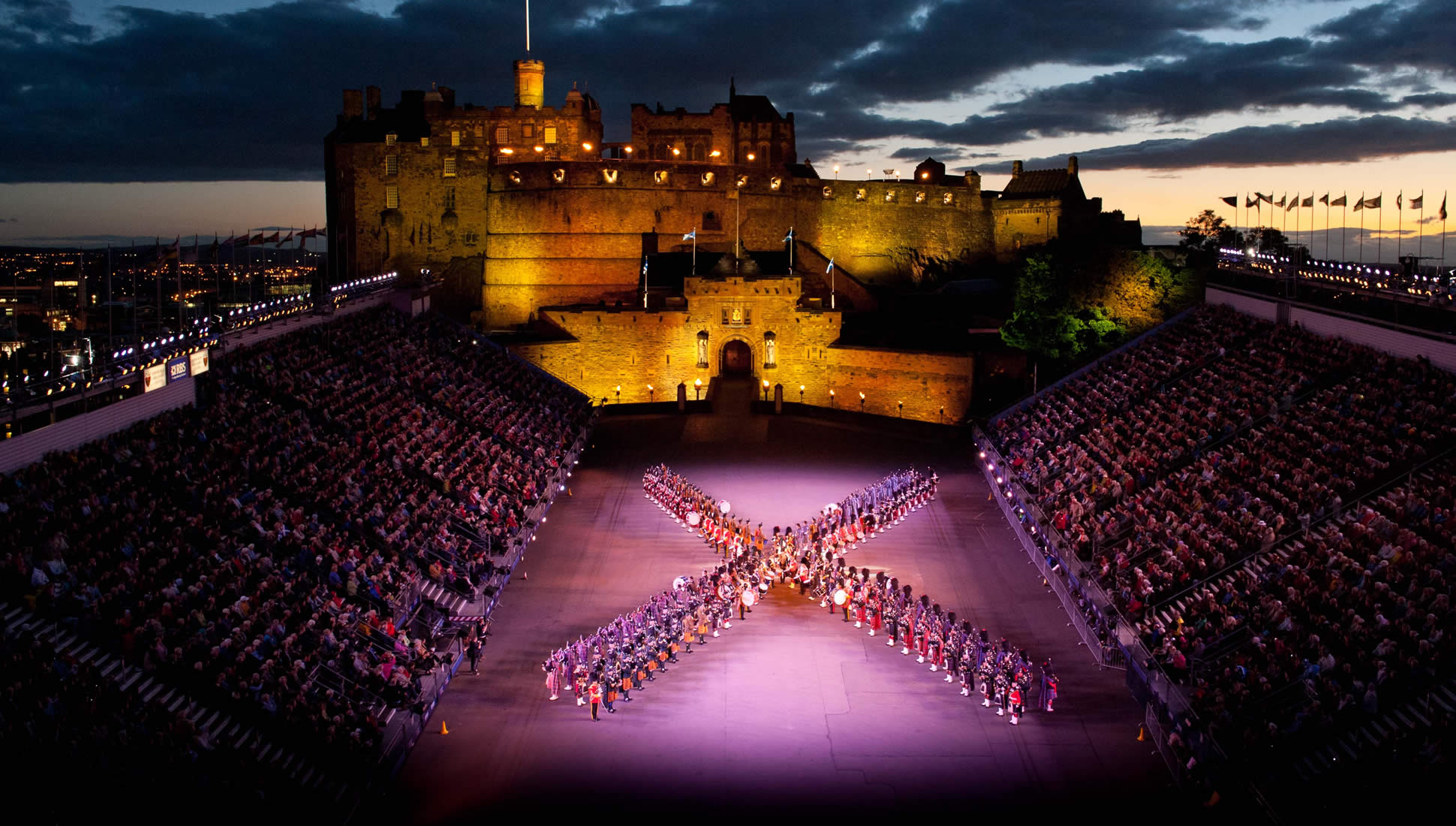
My life forever changed one evening upon watching a live presentation of the Edinburgh Military Tattoo from Edinburgh Castle. I was smitten.
Edinburgh Military Tattoo
I had encountered something so pristine and wild that I told my parents the next morning I wanted to learn to play the bagpipes. Instead of the response generally expected, perhaps even advisable, for any parents, mine were intrigued and supportive. In less than a year I’d become part of a local Boy’s Brigade company hosted at the nearby St. Andrew’s Presbyterian Church where I would also begin my first lessons.
Perhaps the biggest discovery however was that I was becoming aware of my beginnings. My parents made it clear to me (as clear as such things can be to an eight year old) that, as the oldest of three adopted children, I came from Scottish DNA. Spooky to some. Intriguing to others. My response to this growing revelation of my biological roots was an insistence that I was finding my spiritual ‘home.’
Alongside many others through the centuries, I am one who uniquely identifies with what we believe to be true about the Celtic way of life.
I’m happiest when I’m a little sad.
Life is always better in the rain.
Green will always be the best color.
Everything is a metaphor for something else.
When I wander, I long for home. When I’m home, I long to wander (translation: whiny and impossible to live with).
Stories, music, poetry, and art are still the best way to teach anything.
Men look best wearing colorful dresses, tossing around telephone poles, and making themselves dizzy blowing ridiculously loud instruments.
Women are best when allowed equal voice in the community.
The forest may still be the best place to worship together.
Dark skies are a sign of hope more than weather.
The best life is when one day we sing together, the next we die together.
And, learning means more about living than just knowing.
What I’ve loved most about my place on the Celtic role call is that life for the Celts wasn’t neatly compartmentalized, as it is in our western, rationalist world. The idea of one’s “spiritual life,” or “physical life,” or “social life,” or “sex life” would have been quite foreign to them.
It was, quite simply, life. Everything mattered equally. Everything counted. Nothing was completely meaningless but contributed to their daily and eternal existence.
They lived very outward lives from very inward places. They spoke of “thin places;” the nexus where one could feel the outline of God’s hand touching theirs from behind the thin sheath of reality. The thin place, where transcendence meets the here and now, was where the Celts felt most comfortable.
It contributed in forging a Christianity deep enough to pray ceaselessly, strong enough to endure a pushy Roman empire and countless robust threats, and bold enough to sail into the unknown and share what they had experienced.
I like to call them “practical mystics.” They rehearsed the soul well enough to sing its song in the byways and the unforgiving wilderness. Their memory of mystical encounters with God propelled them outward to meet innumerable dangers to preach and live the Gospel.
They possessed a unique zeitgeist I like to call “shared home.” Hearth and home, food and fire, pain and process, bird and beast, wine and women, song and celebration, faith and family, God and neighbor, self and sacrifice, love, laughter and loss – all of a piece, one undivided garment of singular living. What they shared with the world they had already experienced in their daily lives.
They were perhaps one of the most genuinely whole peoples the world has ever known. I would even go so far as to suggest that they exemplified a very biblical faith. They marched to the skirl of their own bagpipes!
As a result, Rome absolutely LOVED them and offered their undying support (pry tongue from cheek here____________).
What the Celts understood is that there would be no outward “success” without honest, inward labor. The great, wide sea that would lead them to countless would be Kingdom-citizens awaiting their hopeful voice could wait long enough for them to be well acquainted with the reason for their journey. Boats easily sink when left untended for too long.
They went out boldly to see God at work in the world, but did so through the in door of communal spiritual practice. They had more than ideas to share. They took their photo albums and welcome mat with them.
The insatiable longing to belong so pervasive in the Celtic spirit changed their way of living. They willingly and consistently explored what it meant to be “home,” all the while sailing to the ends of the earth in pursuit of what they sought. In so doing, they brought the hopeful message of Jesus’ new Kingdom to those people everyone else called “barbarians.”
The Celts called them neighbors.
The Celts loved silence and the life of the soul. But they loved it too much to keep it a secret. They went out through the In door. And, with this inner treasure in tow, they sailed the great deep to change the known world.
We are their legacy.
Great Guardian of hearth and horizon, soul and sail,
I have lifted my feet in obedience to an insistent wind. I have lifted my head up above this tiny-rimmed being. I have sought again what once was too costly. I have set out once more upon a wildly restless sea.
Just about the time the afternoon had worn off its edges enough to let the daylight leave, there came to mind a certain wave of thought. Lovers made love. Haters made hate. The rest of us huddled in between where incoherence meets yearning and found each other’s company. It was first names only but, cheek to cheek meant mouth to ear, and tales got told before long. So, about the time the afternoon had frayed its fringes enough to wink at us in passing, we found ourselves left-foot dancing to right-foot music. It had a good beat but lost itself in too much s p a c e between notes. That’s where we met each other. Bump and shuffle. Step and slide. Groove and grunt. We moved in moments like hands looking for each other to clap along. Things only got weird once the music stopped and we were left with nowhere to hide our inhibitions. Funny how musical awkward silences can be. Maybe that’s when we really got to see something other than feet and our eyes told the better stories.
The first word: “Father, forgive them; for they do not know what they are doing.” (Luke 23:34)
As people, we assign significance to many things, deserving or not. But, if there is anything to which we assign particularly deep significance, it is to the words spoken to us by others we hold dear. A jaunty “good morning” from a work associate could never hold the same weight as if the words are spoken by that special someone whose attentions we’d been trying to attract. The regard we give to words spoken to us is directly proportionate to the one from whom and the context in which they are spoken.
For example, if we’re honest, how many of us would admit to twinges of discouragement, disappointment, or even anger at statements on social media that seem dismissive, flippant or maybe even abusive? They may never have been intended that way. But, devoid of a significant person’s voice and presence, and accompanying body language, we’re left to interpret from one-dimensional communication a multi-dimensional message.
We may read on our Facebook wall: “so, you’re happy with that, then?” Pretty benign really, isn’t it? Or is it? We don’t know. Those same words feel quite different when heard directly from the mouth of our best friend standing in front of us with a quirky grin on his or her face…”so, you’re happy with that, then?” We don’t have to “fill in the blanks.” We “get it.”
The generally agreed upon “7 last words of Jesus” from the cross have the deepest significance when understood in the broader context in which and by whom they were spoken.
To a group of men called out of their settled lives into the nomadic, unsettled life of Rabbinic apprentices, Jesus’ words already had weight. They may not always have understood. But they respected the source and therefore the words. But, remember that, by this point, they were busy licking their emotional wounds from having dismissed, betrayed, denied, disowned and finally abandoned him when he needed them most. They were literally swimming in grief and shame.
Therefore, it was significant that the first words from Jesus’ mouth were not of condemnation as one might reasonably expect. No, they were of forgiveness. They are also of particular importance given the shady circumstances surrounding his death.
Jesus had been handed over to be killed, not as a religious heretic or prophetic martyr, but as a political revolutionary. Jesus’ ignominious death was never really about blasphemy, or heresy as the religious leaders were fond of contending. Those were surface issues that made it easier to get rid of him. They were the straw man that became the elephant in the living room. Since we can’t seem to deal with this guy by theological means, let’s play the political card. Let’s throw him at Caesar and see what happens. Let’s appeal to the mass hysteria induced by authority figures telling people what they should be thinking about something. It was about a threat to power and control. He represented a genuine threat to the religious establishment.
The cross tells us many, many things. It tells us firstly, that Jesus didn’t give up, either on his mission or on the first recipients of that mission. He saw it through to the end. Not just any end, but an ignominious end at the hands of his own people willingly handing him over as nothing more than troublemaker to the Roman powers-that-be. It also tells us that his own people distanced themselves from him spiritually by insisting on crucifixion as the means of his death; a form of torture reserved for enemies of the state, not the nation of Israel.
That’s the context. “Father, forgive them, for they do not know what they are doing.” Under such shameful circumstances, no other words could possibly hold more powerful meaning.
Before Jesus says, “It is finished” he says, “Father, forgive them.” We are drawn to faith not in the hope of forgiveness but in the reality of forgiveness. We rush into the arms of a God not waiting to forgive, but a God who has already forgiven. The first words from the cross frame all the rest. We do not have to assign any other significance to them because God himself is the one who has answered the cry of Jesus.
Friends, forgiveness isn’t the end game of the cross. It’s the starting point. It isn’t the result. It’s the means of revealing a result. Our journey with God doesn’t come to a point of forgiveness. It begins there. Relationship doesn’t happen once forgiveness is offered. It can happen precisely BECAUSE forgiveness has been offered.
As I deepen, glacially but surely, in the Way of Jesus I am finding freedom in the manner, frequency, and creativity of spiritual intercourse. There are a number of factors in these discoveries. I am getting older – a fact, apparently, applicable to all. The passing chronos lends a certain gravitas to the focus of kairos. And, the slow-cook crockpot of my formation adds fewer ingredients every year to an already complicated soup. Sometimes it’s not more, or even better, ingredients that are required for the quintessential meal. Sometimes it’s the right ones at the right time that leave the palette happy and wanting more.
As I’ve written numerous places, the past few years have been richly experimental in regions of contemplative prayer. Learning to love silence. Seeking out solitude. Making friends with simplicity. Studying the nuanced coup d’etat of lectio divina. Prayer walking. Being enriched through congregational liturgy. Journalling the works.
All these and more continue to contribute to whatever Rob, slightly enhanced, may be forthcoming off the stove.
But something is changing. With the increasing 20/20 available through the grace of kairos and the experience of chronos, I’m latching more and more onto the fluidity and ubiquity of unceasing prayer, specifically as it has come to be associated with who I am more than an action to which I commit. If in fact it is true that God is omnipresent, theologically, and an unceasingly constant spiritually, then it should come as no surprise that prayer can and perhaps should be, everything.
There is a state of being available to all persons everywhere that is readily found in that which most thrills the soul. For some, the ticking clock, counting the passing hours immersed in good literature. For others, it is the choir of smells united in one explosive song on a nature walk. For still others, it may be culling from the raw ingredients of the earth, something rich and flavorful with which to delight the tastebuds of friends and family.
For me, it was music and writing.
Me, roughly a millenia ago
As a teen, and a budding musician, I would often sit for hours on the front step of our house simply playing my guitar. The notes, some of them good, others lined up for the shower, collided together to produce more than just music. They created space; a kind of generous openness to whatever the universe was at the time. A particular kind of peaceful “zen” or as Thomas Merton might call it, “contemplative awareness” resulted, leaving me just where I needed to be. This was true even as I spent countless agonizing hours learning impossibly difficult melodies (I certainly thought so at the time!).
In recent months, as more conventional understandings of contemplative prayer have waned a bit, I’ve had a certain yearning to resurrect this practice. And resurrection has been the result. To plant myself on a lawn chair a few feet from my rose bushes (such as they are) and play music inspired by the same, in tune with the wind, has once again ushered in a holy Presence. It has centered me like nothing else lately.
Taken on Okanagan Lake, Kelowna, B.C., 1999
It has also brought a much cherished simplicity and deepening unification of all I am into pulsating notes, maybe not always in tune, but always tuning. Music, once again, has become for me the changing face of prayer, changing me.
He died of lymphoma on September 15th, 1985 at 10:22 pm. I was 21 years old. At that moment, a man I never really knew, passed into the aether, and was crushed tight to God’s bosom. Found by God and lost by me, he is to this day, an enigma and my regret. He was my father.
We spoke precious little while he was alive. A sense of quiet desperation peppered his disposition. A staunchly stoic individual, his upbringing in the wild, velvet foothills of Maple Creek, Saskatchewan burnished a certain leathery sheath to his already withered spirit.
Maple Creek, Saskatchewan
I saw my father cry only three times. Once, during a conflict with my younger brother, whose pained cry (he was only a kid after all) of “yea, well, you’re not my real Dad, so I don’t have to listen to you,” saw him descend into bitter weeping (all three of us are adopted). On another occasion, my Mom was reacting to my new but immature faith, a faith terribly demeaning to anyone outside the tiny club I then called Christianity. My own inability to navigate the complexities of this new life of faith had thrown a monkey wrench into the heart of our family. My Mom was hurt and let me know about it. Dad tearfully held my hand, recognizing in me his own lostness in the world and responding as he generally did, silently, but deeply.
I had driven him to Rockyview Hospital so he didn’t have to be alone when he got his biopsy results. The very fact that the doctor couldn’t tell him over the phone had already primed the pump as to what we could expect. I sat in the waiting room while he consulted with the doctor. What seemed like days passed until he finally emerged. Tears drew lines down his ashen face. It was the third, and would be the final time, I ever saw him cry. His words haunt me to this day, “well, looks like I got a touch of the cancer.”
The denial in his words bespoke a terror I had hitherto not seen on his usually emotionless face. He was genuinely afraid and communicated as much in the only way he knew: cautious deflection. Perhaps if he treated it like a bad cold it might just disappear like a bout of coughing or a snotty nose. And, as we would discover later, he had most likely lived with the growing cancer for a number of years, successfully hiding lumps even from my mother. These may have been the actions of a man too rough ‘n tumble to be bothered with such matters. More likely, they picture someone lacking the interpersonal skills necessary to build a supportive foundation upon which he could pilot these stormy waters.
He was as lost as we were.
Tom Baker Cancer Centre
In the months that followed we learned well the half hour journey from our home to the Tom Baker Cancer Center where he would be subjected to one test after another, one trial after another, one failed approach after another. He lost half his body weight and was an eerie shade of grey-green. Ultimately, he was admitted as a long-term patient. I learned how to help my own father shower and use the toilet. Any preexisting awkwardness was forced out in this new and vulnerable frontier. Old fears and presumptions fell away every time I helped pull his pants back up or helped him into pajamas before he fell, exhausted, into bed.
I was studying classical voice and choral conducting at the time and would often sit by his bedside reading and even humming pieces I was to have memorized for the following morning. From time to time I’d look up from my textbook to be sure he was still breathing, only to catch him looking back. Our words were few to none. But, to us, those looks bore volumes of communication unnecessarily crowded by such things as talk.
In the early evening of September 15th we had been made aware by the doctor that he had contracted pneumonia as a result of increasing weakness and the pure oxygen that was keeping him alive. Ironically, in so doing, it crystallized his lungs, turning them into glass shells. He was given zero chance to live off the respirator. Despite the knowledge that this day was coming, we stood like plastic dolls, unable to speak.
This reality had us cornered, and we succumbed to its horror, saying our trembling goodbyes. I bent over to kiss his forehead, whimpering quietly in his ear, ”Goodbye, Dad. I love you. I always have.” It was one of the few precious “moments” we ever enjoyed together. He would be dead two hours later.
My father was that man about whom one says, “He was someone I never knew.” I cannot say however that he wasn’t the father I needed. I was as negligent and uninterested as he was tense and unable to forge anything substantive in our father-son relationship.
They say regret is a wasted emotion. Maybe so, but few emotional triggers are more difficult to undo. It lies in wait every time we are reminded how our successes bowed to failure, our fears grew through inaction, our relationships dug themselves deep into a quicksand of mutual ignorance or naïveté.
In the years that followed, I’ve been forced to come to terms with my passivity and self-driven carelessness regarding my father. It has left me struggling with mountains of regret and the self-loathing it can generate. Left untended, regret can cloud the soul and create blockages to the inflowing of new love, new relationships, even newness in old relationships.
My Dad, Reg
With my Dad it wasn’t about forgiveness. It wasn’t even really about misunderstanding. I am ashamed to say that, for me it was, quite frankly, lack of interest. He was everything I was not but secretly wished to be: unyielding, unflaggingly committed, self-denying, self-forgetful, self-reliant, with a willingness to forego relishing in his fears in the interest of those he supported and loved.
My lack of interest and passivity crashed headlong into his inability or perhaps tentativeness to face something he’d never known himself, tenderness. The casualty? Relationship.
Since then I’ve done a poor job, although with lessening self-flagellation, at honesty and intentionality in human relationships. Friends, pastors, colleagues, and spiritual directors have all shared in this journey with me. The one message most readily cobbled together from their loving advice is this: if the gospel tells us anything it’s that there is always redress for regrets. The Way of Jesus keeps open the door that leads to new and renewed relationships, to companionship for the lonely and an anchor for souls adrift.
I miss my Dad. I regret never really getting to know him. I miss what might have been. But, the Way of Jesus, lived with courage, promises second chances for chances not taken.






 innerwoven