With this new series of posts, I am entering a conversation. I do this for several reasons. It is partly in celebration of a journey recently embarked upon by our fellowship (Yakima Covenant Church) into the Covenant Community Bible Experience. It is an initiative of our denomination (Evangelical Covenant Church) to help rattle our scripture cages a bit by placing in front of us a New Testament compiled chronologically and without any of the customary headings, chapter and verses. I trust some of the reasons for this shall become clear over time.
Secondly, it touches on a topic of fascination to me personally: my love for the written word. That, combined with a growing love for the God who could never be contained by it, compel me to share these things.
Finally, it is in answer to various queries following a sermon I preached on this topic a few weeks ago. In these conversations, I’ll be utilizing ideas, and materials spanning decades. Specifically, I’ll be referring often to one particular book from which I’ve gleaned much of late, Saving the Bible from Ourselves: Learning to Read & Live the Bible Well by Glenn R. Paauw. The topic? The Bible of course. More specifically, the terminology, ideas, misunderstandings, projections, additions, expectations – both false and otherwise – that have arisen around it and from which it presently suffers.
The week of my “conversion” I quickly became fascinated by the strange and enigmatic words on the wispy pages of a Bible given to me by my grandmother. For years, it sat, neglected and increasingly dusty, on a shelf in my bedroom. My senior year it began to grow in my mind as something much more significant than that which I had hitherto attributed to it.
The first verse I ever memorized? “The grass withers, the flowers fade; but the word of our God will stand forever.” (Isaiah 40:8 NRSV)
If we are to give to the Bible the love and respect it deserves we should experience no small discomfort with the words “back to the Bible.” It belies a naïve, even whimsical view of it that has the potential to diminish its depth and complexity and, as such, its impact.
As we shall see from looking at Paauw’s book, we commonly approach this ancient library of texts with a truck load of preconceived notions, pet ideas, personal preferences, cultural parameters, and less than informed expectations. Paauw believes that we have “over-complicated its form while over-simplifying its content” (p. 16).
He makes the case that, over the course of many centuries, Bible scholars and publishers have increasingly added to it what is thought to be helpful – chapter divisions, verses, subheadings, notes, etc. – all in an effort the “make it easier to understand.” The result has been the opposite however and, in the process, we’ve been led to sample rather than feast deeply on the Scriptures. It has led to a narrow, individualistic and escapist view of salvation. And, rather “than being a culture-shaping force, the Bible has become a database of quick and easy answers to life’s troubling questions.”
So then, let us enter a conversation together. Let’s talk about the Bible. What it is. What it is not. The purpose? To develop a truly broad, deep, informed, and appreciative view of this enigmatic collection of ancient writings. Because much of what we understand about God and one another comes from it, I think it wise to do so. Don’t you?
“So when you are offering your gift at the altar, if you remember that your brother or sister has something against you, leave your gift there before the altar and go, first be reconciled to your brother or sister…” – St. Matthew’s Gospel
So, with subtle indirection, the toolbox of yearning
wed to oratory, wed to a cloud of unknowing,
expecting nothing more than a tale well told,
comes the bard and we are given –
a road for our story.
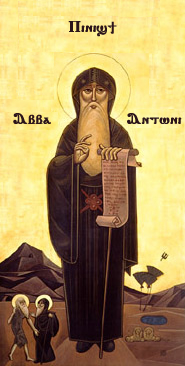
Historically, patterns of prayer and devotion that would later evolve into a “Rule of Life” grew out of the monastic tradition dating back to the Desert Abbas and Ammas of the 4th century CE. There, in the blistering heat of wasteland, they faced down demons, drank deep from hidden wells, prayed unceasingly, listened for the deafening whispers of God, and taught others to do the same. They owned little, but possessed the universe. Over time, their lives, lived small and yielded, but writ large upon the heavens, were lassoed into usable fragments of a living reality.
St. Antony of Egypt
I suspect most are like me, living pugnaciously crammed lives begging for the breath and space.. But, unless one’s name is Antony, or one of his eremetic contemporaries, one has experienced little in the way of solitude.
Such an exercise, as useful and meaningful as it is, necessarily leans upon an accompanying acquiescence on the part of the pilgrim – namely, me – to its regularity, rigour, and influence. Frankly, I’m more concerned about that than the Rule itself. Over the years, I’ve developed a deeply satisfying practice of contemplative prayer, gradually learning the benefits of housing shalom in the confines of a thirsty but unpredictable soul. I’ve spent days alone at any number of monasteries, growing and learning with monks and nuns of various ecumenical stripes. I write extensively on the spiritual life, a blog of my own (www.innerwoven.me), and for numerous others as well. In 2011, I graduated with a Master of Arts in Spiritual Formation and Leadershipfrom Spring Arbor University, Michigan. Since then, I’ve undertaken the Spiritual Exercises of St. Ignatius and was anointed with oil as a lay Jesuit. I’m writing a spiritual memoir. I have studied the life and spirituality of St. Francis (because I’m a hippy at heart) and the Rule of St. Benedict (because hippies lack structure).
Our Lady of Guadalupe Trappist Abbey, Lafayette, Oregon. I’ve spent countless hours at this place.
Why do I boast in such Pauline fashion? Because, after years of ardent pursuit of the Christian spiritual enterprise, and already possessing a not inconsiderable Rule of Life with more than a few years of practice, I am less skilled in it now than I’ve ever been. Without hesitation, I enjoin myself to Paul whose boast is always in weakness about weakness, and leads to his exasperated proclamation, “I am the chief of sinners” (1 Tim. 1:15).
Whatever Rule is forthcoming will be more about my openness to what that Rule represents. It must be more a means to an end than the end itself. Like the rudiments I’ve practiced for decades in pursuit of musical prowess, I construct and practice a Rule of Life to forget it. Musicians play scales without thinking about playing scales. They play music, in which rudiments have formed and buttressed, shaped and evolved that music.
Saints live a Rule that is at all times thinking about union with God, which is the end and the beginning of it all.
…in my dream, I looked out over the rocky embankments
still holding my thoughts and, over the tomb where
recently someone left not long after arriving, a placard read:
“Beware, those still trapped in a life safe, and un-ruined.
You won’t get to enjoy the looks of incredulity from those
In early November, I was a participant in a class toward my ordination entitled “Vocational Excellence.” This is part 4 of the paper I submitted, aimed at constructing and presenting a Rule of Life.
Calgary sunrise…apt metaphor
Eschewing Truancy
In every life, there are (mis)guiding voices. Inner recordings, as it were, play loudly and insistently, often dictating how one goes about the tricky task of living. Put another way, all of us live from somewhere – fear, suspicion, self-aggrandizement, false hope, willing blindness, ass kissy-ness. They cast long shadows upon our spiritual landscapes and pull us away from the perfect centre of our circle.
Every time I drift from my centre, I cease trusting in the glacial process of transformation at work within me. My trust gets misplaced, landing on anything quicker and easier to a perceived end of satisfaction. The shortest distance between two points can become the broad road to ruin the quickest means of personal misanthropy.
Something inimical of the human heart is its apparent willingness to be anywhere other than where it should. The place most required of us is where we least show up. And with so many competing allurements to our deepest allegiance and passions this is a bit like crossing the freeway naked and blindfolded. It seldom ends well.
Better might be the comparison of grade school students. Some, like myself, adored school and never missed a day (I skipped twice and was caught both times…another blog perhaps?). Others reveled in the delicious naughtiness one experiences in going to the mall, or simply hanging out behind it smoking untoward substances (again, what could I possibly know of such shenanigans?).
A rule of thumb for fellow Christ-followers, prone to wobbly wheels but who yearn to embody their Rabbi is to pay heed to Stan Smith’s words from American Dad. When pressured as to why he keeps rubbernecking women other than his wife, he responds: “my eyes may wander, but my heart comes home.”
Instead, I am being directed to return to the quiet, contemplative life, planted in the Benedictine moniker: ora et labora – prayer and work; contemplation and action, inner and outer life wed as one. To care for the centre is to care for everything else at once.
Although not a word one might use in everyday life, truancy pictures a life on the edges of things. It is uncommitted – wayward, as in a constant insistence upon finding any path other than the one presently under foot. In gospel terms, to show up is to find oneself amid the delight of Holy Spirit constancy and the hope of a future that will never be cut off.
To eschew truancy in the spiritual life – to abide in the vine, as it were – is to embrace the promise of a rather adept gardener of my soul.
* * *
“God cannot be found by weighing the present against the future or past, but only by sinking into the heart of the present as it is.” -Thomas Merton
all counting, forsaken, in the business of nothing –
and watch what yet will come.
Ora et Labora: A New Gestalt
“Now the Lord is the Spirit, and where the Spirit of the Lord is, there is freedom. And all of us, with unveiled faces, seeing the glory of the Lord as though reflected in a mirror, are being transformed into the same image from one degree of glory to another; for this comes from the Lord, the Spirit” – St. Paul, 2 Corinthians 3:17-18
The Celtic mystic in me, enamoured as it is with a blurring of edges that allow all to fade into a singularity of life and love and lessons learned, squirms at the notion of life in quadrants, or pieces. With that proviso, I submit and share some insights that can help shape a new Rule of Life.
The history of Christian spirituality would dictate a unity of personhood; a whole individual, undivided into constituent parts. It would argue for a centering motif through which a follower of Jesus is made complete by means of consistent focus on the interior life. Buttress the centre of the wheel and the spokes become stronger by default. This has consistently been my experience.
As mentioned previously, a poster-boy 4 on the Enneagram and an INFP on the Meyers-Briggs scale, I’ve made a cottage industry of melancholy. I capably personify inwardness; an artistically-brooding poor-me-ism. The result? A paralyzing self-referentialism that prefers the role of armchair philosopher-poet than street corner pastor or jungle Bible translator. But, as Dr. Robert Mulholland urges in his book, Invitation to a Journey, it is the holistic life to which the Gospel calls us. He suggests that, as a result, where we feel least useful or competent is often where we are most required to be.
Spiritual Directors have played a significant role in my journey for many years. That said, the pain I’ve harboured well and nurtured often, of Sister Alice’s retirement from her ministry with the Sisters of Providence here in Yakima, has left me gasping for breath. Sister Alice played that role in my life for almost 5 years. Every time I stepped into her quaint living room, the presence of God was thick in the place, literally dripping from the walls and windows and oozing out of the carpet.
She was fond of saying that the ways by which God reveals Him/Herself becomes who I am and paves the way for whatever ‘me’ is still emerging. If she is any indication of the ramifications of that notion, then I need to reimagine this journey once again. It is a trip exponentially greater than the sum of the miles involved – it is a foray into the heart of God.
Combined with a compelling need to share my story once more I heed the counsel of my Vocational Excellence peeps and I’m prayerfully scouting out a new Spiritual Director. As in the past, I am submitted to the quietly insistent guidance of God in this.
Lord, have mercy.
Eschewing Truancy
Every time I drift from my centre, I cease trusting in the glacial process of transformation at work within me. My trust gets misplaced, landing on anything quicker and easier to a perceived end of inner satisfaction. The shortest distance between two points becomes the quickest means of my personal misanthropy. Instead, I am being directed to quiet, consistent return to the contemplative life, planted in the Benedictine moniker: ora et labora – prayer and work, contemplation and action, inner and outer life wed as one. To care for the centre is to care for everything else at once.
Getting Out from Under God’s Feet
I hear some very clear injunctions all week. They crystallize gradually into the plans I am now putting to page. It taps into my love for Celtic spirituality, which teaches a three-fold martyrdom as askesis for the soul. Red martyrdom is death for one’s faith. Green martyrdom is a life of deep self-denial in pursuit of union with God. White martyrdom typifies many Celtic saints, specifically St. Patrick, who chose willingly to leave his native Wales and return to Ireland as a missionary. It is to this idea God calls me, metaphorically speaking. I am often vexed by fear, passivity, and loneliness. Together with the invitation to the silent cave of the heart, I hear God shoeing me out the door to “go play outside.”
“You live too alone, so you live in your head. Get outside of your head and home. Make relationships. Show up so I too may do the same. Learn by doing. Let your prayers be out of needs generated by the work of your hands rather than hiding from your life and escape my redemptive gaze…”
Therefore, my instructions and my plan are to go out and make things happen, trusting in God for whatever results might be forthcoming. A mystic to the core, God has placed a yearning for a chance to hop into the nearest boat to anywhere that might lead me outside my own head. My path of deepest transformation is to move in through the out door: to find God’s presence in the other.
The Blessing of Good Soil
Congruently, my itch to run is met with clear instruction to stay where I am. Far too many uprootings in my wake fueled by a well-honed fight or flight mechanism make me grateful for the stability we enjoy here in Yakima. It’s surprising how God’s vitals become more pronounced when one isn’t always out of breath, heart pounding in the ears. It makes inner silence and listening so much easier. My friendships may barely exceed a decade. But God has planted me in a distant soil to bring me and mine closer to the fattest harvest, that of the heart.
For reasons much deeper than career satisfaction, I choose to stay and use what skills and passions I’ve been given to make Yakima the kind of place in which I’d choose to retire. In Jesus, the exiled alien, I find identification and strength to stay.
Trust Your Own Press
A victim of my own mental gallows, I am hearing quite clearly the necessity of “trusting my own press.” Self-love is strongest not in the proud, but in the humble. “You’ve earned the ear and respect of a congregation. Don’t be afraid to leverage that in pursuit of your desires.” Good advice under my present circumstances.
In sum, my spirituality will strive to be more illustrative of a commitment to move back in by moving out but staying put. It must involve pursuing and engaging with a Spiritual Director who in turn can assist in the accountability and faith required to do so.
I have a long and complicated history with a mistress. An insidious lover is she, alcohol once steered me nearly to ruin. Since getting sober in 2002, and again this year, my choice of addiction has changed. It is running. Lots of it. It has translated to a minimum of thirty miles a week and a loss of twenty-six pounds. I’ve run marathons before but a serious accident in 2010 robbed me of rigorous, injury-free movement until recently. Running provides thin place (pun shamelessly intended), incarnational moments of contemplative awareness for me and requires little in the way of accountability. It simply happens. Pounding feet on pavement mesh with pounding heart seeking rhythm with God’s. Here, God saves me.
The Spokes: Rediscovering Me for Others
As outlined earlier, I battle with a certain degree of mental-emotional illness. Historically, it has been both medicated and exacerbated by alcohol. The sturm und drang of the disease pushes and pulls one into places one would never otherwise go. It, together with all its ramifications, has me in regular therapy. Dr. L. has been seeing me now for a little over a year. God has made it clear that, until recently, she would act as my Spiritual Director; one of a different sort. She has helped me to wander down the confusing corridors of my psyche in search of the minefields that destroy and maim. I look for another Spiritual Director. But, this must continue apace as parallel healing. Hence, any kind of Rule will include constancy under the scrutinizing light of her scalpel.
The benefits of this professional relationship have been staggering in my relationships, both personal and professional. Once the misplanted weeds are plucked from my mental garden and lie open for consideration, my family, friends, and colleagues have been more than happy to help me replant. The healing has been demonstrable and satisfying.
I write. A lot. I don’t see that changing anytime soon. For me, writing is prayer; contemplative space – catharsis wed to self-care on a bed of creative spiritual process. I am being urged toward an even greater regularity of this artistic-spiritual process as it relates to spiritual praxis. It brings a peace that translates to all my relationships.
It is apparent that I am under-fed socially. Although an introvert, I have become far too withdrawn and isolated from the warmth and challenge of ministry colleagues. This must change immediately. In the interest of a better self-understanding, I commit to a better developed collegiality and accountability among mutual professional friends.
The Spokes: Serving
“My life mission is to draw people to God through my life and work, which strive to meaningfully communicate God’s beauty and truth.”
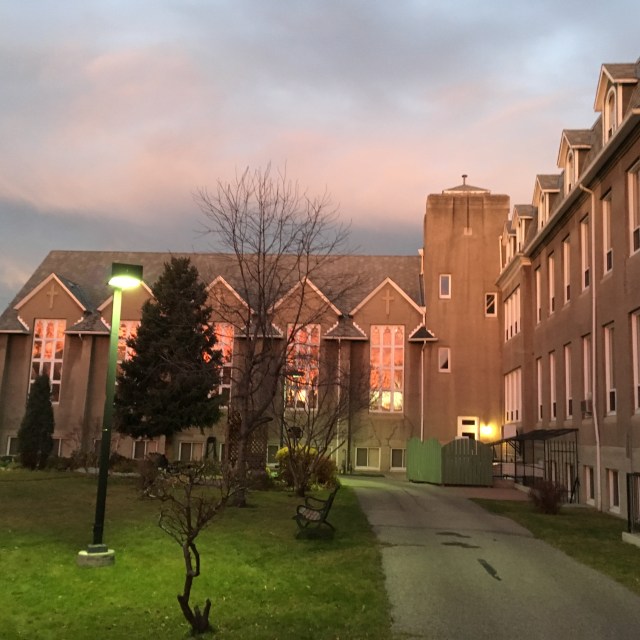
Faithful Companions of Jesus (FCJ) Conference and Retreat Centre, Calgary
What one sees is not always what one seeks.
And what one seeks is not always what one says.
And what one says is not always what one starts.
It’s okay, there’s no difference between what
I didn’t see yesterday and what landed itself full upright
in today’s path, muse-appointed.
There are the moments when, at a
full stride, forehead high and strong,
come words and stories, notes and beams,
high-stepping toes, pointed at heaven;
brushstrokes for love or anger, life or less –
those are the boldest strokes, the highest notes,
the brightest steps…
The sound of music is good wherever notes
find you. Let it be your symphony.
The initial reticence I felt as I warmed a car seat for twelve hours – with all the attendant over-thinking to which I’m already prone – promptly unravelled upon arrival. My penchant for wow-factor uniqueness finds a backseat in favour of the welcome mat of other faith-commoners; like-minded, thirsty-souled, vocationally-curious individuals more like me than I care to admit. It would prove to be one of the most significant weeks of my personal and professional life.
Since God loves the twist-in-the-tale, this mystic-philosopher-poet-dreamer-romantic-idealist-non-pragmatist is ripe to meet the vacuum at the shallow end of his soul. In company with fellow travellers of the Way, I come up wanting every time, albeit with a blossoming knowledge that “all manner of thing shall be well” (Julian of Norwich, Showings).
Via Negativa
Staying true to my “via negativa” modus operandi, the most significant gleanings from the week are found in what I don’t want to be about; who I don’t want to be. I’ve been in professional ministry long enough to enjoy a few tricks of the trade sufficient to dazzle and woo – successfully limping through that ministry for many years. It isn’t the material so much as the context for it. Many words are spoken, good ones. But, it is parsing those same words with other colleagues that distills the broadest reality. It makes for a week of living object lessons of what’s missing most in my experience: the mutuality of friendship, the deeper blessing of stability and sobriety, and a renewed commitment to monastic spirituality: ora et labora – prayer and work.
The intentionality of connection and outward motion is a challenge for a poster-boy Enneagram 4 (The Individualist), INFP (Meyers-Briggs), who loves passive-aggressive self-pity. If seeking a life more patterned after historic saints is what I seek, these ones prove just as good; perhaps better given their physical presence in the room. Proximity makes immediate the holy danger of accountability in the Jesus Way.
Through many words rich with advice and good counsel, it is the relentless voice of God that most unsettles me. God impresses only a few simple things, repeatedly. Repeatedly. Re….It is those things that spin around my head and to which I now turn.
* * * * *
I am twice adopted. In biological terms, this means effectively that I am riddled with fear – of risk, of invalidation, of abandonment, of failure – of success. Pursuant to this is a terrible sense of boundaries, which to one such as I, are not an end, but a means to it.
I suffer from GAD, (Generalized Anxiety Disorder), ADD (Attention Deficit Disorder), mild OCD (Obsessive Compulsive Disorder), and CGEODD (Can’t Get Enough of Disorders Disorder). I live in a veritable sea of worry, and panic, and the over-thinking commensurate thereof.
I’m a recovering alcoholic. Given the first two points, this should come as little surprise.
I have mountains of unresolved pain, grief, and guilt. I grieve poorly.
I am a mystic-contemplative in a culture, drunk on self-important pragmatism, that eats such ones for lunch.
Via Positiva
I’m a gifted musician, writer, poet, and liturgist. With these gifts, I’ve been blessed to draw others with me into the shimmering thin places that life can truly be.
I have a deeply intuitive, imaginative spirituality; an abundantly creative orthopraxis, so to speak.
I’m gifted in interpersonal conflict resolution – ironic, given my depth of hatred for the same.
I’m a gifted teacher and group facilitator.
I’m a culture and bridge-builder, finding ways for diverse segments of the church to envision a better way to walk the Way.
I’m compassionate and like to hear travel tales of other sojourners.
I’m very funny. No, really.
I’m a handsome, irresistibly debonair, man-about-town simply fun to be around.
Best of all, with much hard work and prayer, I’ve finally been gifted with self-forgetful humility (superglue tongue to cheek here).
A Rule of Life will, for me, bridge these two lists.






 innerwoven