Corona-daze: just breathe

bridge-19513_1920.jpg

When the walls of fury and dystopia threaten our made up worlds,

just breathe.

When coughing madness spews upon us its pointless fury,

just breathe.

When those bent on denying as “fake” anything “those ones” have said,

just breathe.

When “those ones” spend all their time trumpeting the correction as the end,

just breathe.

When hints of community are abandoned for mutual blaming,

just breathe.

When neighbours and friends respond to us as foreigners and enemies,

just breathe.

When social distance becomes an excuse to deepen selfishness,

just breathe.

When social distance deepens our loneliness, broadens our fears,

just breathe.


When time and brilliance and humanity once again find their way,

just breathe.

When the disparate voices of the many find semblance of singularity,

just breathe.

When the despair from our losses kisses the tears of our gratitude,

just breathe.

When the detritus of our streets, our homes, our world is swept away,

just breathe.

When the heroes of our wholeness return to their own neglected homes,

just breathe. 

When opens again the doors of mosque and church, synagogue and hall,

just breathe.

When real, unimagined community replaces rampant, unbalanced commerce,

just breathe.

When masks, gloves, distance, and disinfectant give way to gathered embrace,

just breathe.

When the darker memories of our day become the fodder for our laughter,

just breathe.

When breathing and prayer are indistinguishable,

just breathe.


Just breathe.


Remarkable image by Larisa Koshkina


Corona-daze, chapter two

What everyone doesn’t need right now:

More bad news.

More anxiety.

More uncertainty.

More xenophobic virus responses.

More conspiracy-theorist nut jobs.

More division (only now pictured by quarantine).

What everyone could use right now:

Belly laughs.

Real community.

A feeling of health and safety.

Mutual kindness.

A C19 vaccine.

Hope.

Invitation.jpgThank you, Dina Gregory, for posting this to our Facebook chat room. It’s perfect for all of us right now.

Corona-daze, chapter one

Uncertain times.

Unreliable emotions.

Unreasonable expectations.

Unfair xenophobia.

Unrealized dreams.

We are living in a strange day, and with no way of really knowing what direction the wind will blow next. As a writer, poet, musician, and pastor, it is my job and my joy to speak truth to falsehood, love to hate, light to darkness.

So, in our current Coronahaze, rather than load up the Internet with more data, as helpful as it is, I thought I’d leave you with a daily dose of hope, some of it backdoor, some overt. 

Today’s is brought to you from the queen of quirky gospel truisms, Nadia Bolz-Weber. Our responses to fear are not always our best selves. Trust me, as a recovering alcoholic, I know of which I speak. Let’s begin from via negativa and see what light may come before long, shall we?

Darkness....jpg

Friends, be wise.

Stay kind to others.

Pray and hope.

Let healing begin…

Toward a finished poem

I’ve been feeling like a suburban home,

family-bound, dog-eared, cat-haired, dust-bunnied.

The floor sprawls, covered in lines of loosely connected

bits of string and tape, shoes without mates,

things without name or purpose or place,

shoved in too many drawers, beside stray Tupperware lids

unsure where home is.

I’ve been thatching a wayward garden,

long since surrendered her virginity to the fate of

time and neglect. Her gnarled roots now

the bed of fools – those with nothing to do 

but wait for another dry Spring and

long, parching Summer to follow.

I’ve lost the memory of how to cultivate in her

whatever tempts or teases a solitary bud.

I’ve lost my place in the song,

where happy, drooling drunks drop their lines

of sprawling melody, disconnected from time or tune

or taste, but dripping, soaked in the solicitude of friends.

Old lyrics lie waiting for my attention,

faithful old soldiers of forgotten wars,

older still, fought on fields among the family

of tables and tumbling talk, well-practiced lies

in well-memoried songs.

I’ve been acting like a poem in progress –

a toss-about of lost words, tongue-tombs tied

together by accident in a free-falling frenzy.

Outdoor syntax lost in the mall,

painted-on ivory-tower lips for her rent-a-friend parties.

The ironies, playground of op-eds and writers of no

fixed address, wasted in wordless

sentences no one can read.


But the best poems are never really

finished

Negative capability

In my last post I shared a gorgeous prayer poem written by Richard Carter. It is one of many in a deeply satisfying spiritual treatise written by the same. My lovely wife bought it for me when last we were at St. Martin-in-the-Fields in London’s Trafalgar Square just last November. This is the book in question: 49098535._SY475_.jpgWhat follows is from the penultimate section of the book entitled “Staying with,” in which he outlines the Rule of Life for the recently established Nazareth Community. I found it especially poignant give our current situation in which we find ourselves – in much that is unknown.
Exhilarating, yes. Motivating, to be sure. But…uncertain. I find this little segment encouraging to say the least. It is, in a word, inspiring.

I’m sure you’ll love it as much as I did! Enjoy (then, buy the book!).

Negative capability

“The phrase was first used by the poet John Keats to characterize the human potential to pursue a vision of beauty even when it leads through intellectual confusion or uncertainty: ‘when a man is capable of being in uncertainties, mysteries, doubts, without any irritable reaching after fact and reason’. In fact, the sense of unknowing becomes the catalyst or the very thing that focuses, intensifies and enhances the search for a greater truth. There is an importance in staying with the discomfort of the unknown, fear and the unresolved, because it is in that place that we reach the borders of what we are and discover what we could become. Thus this uncomfortable place, or place of trepidation where there are no quick fixes or easy answers, can become the place of transformation. It is often the very things we fear and our own lack of certainty that help us to break through all pride and discover the truth of living at ground zero. Perhaps it is here that we will learn what it means to live by faith and by love. It is in this hard place that the face of the unknown can reveal to us the face of the beloved.”

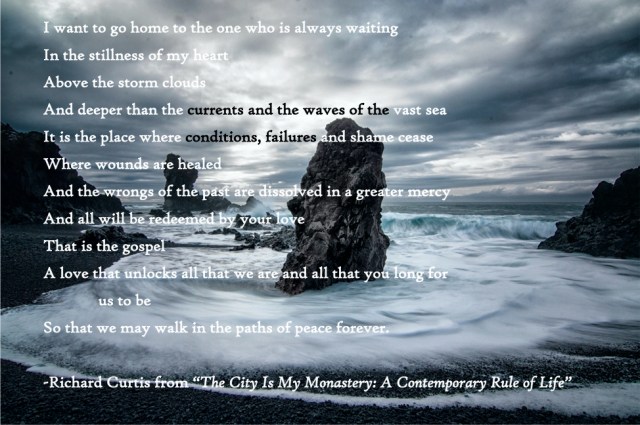
I want to go home

I’ve been reading a wonderful book, “The City Is My Monastery: A Contemporary Rule of Life” by Richard Carter. My wife bought it for me when we last visited St. Martin in the Fields in London last year. It outlines the Nazareth Community established by Richard Curtis, a place where all may come, whether rich or poor, whatever their background, to participate in the common life of Jesus. Curtis, on staff at St. Martin’s and a former monk, reveals his personal journey of discovering community, contemplation, and peace in the heart of London.

What follows is just one of many gorgeous prayer poems found in its pages. A highly recommended read.

I want to go home....jpg

Gorgeous photo thanks to Mr. Roan Lavery

Breathe – A Prelude

Breathe - A Prelude.jpg

An Examen

photo-1535332371349-a5d229f49cb5.jpg

Don’t leave the day behind.

Instead, let its bones dry in the warmth of your daylight memories,

held tight to the breast of God.

What’s so different?

LFIMVFUM2JEXRI7GBYQ2WNAHSI.jpgWhat’s so different,

now that one bundle of thirty,

arbitrary and detached, passes,

barely noticed, from one to another?

We have a time.


What’s so different,

as we look out from inside the same

rooms with their corners, known but

unobserved, safe but stultifying?

We have a place.


What’s so different,

the streamers fallen, wine now flat

in decanters of promise, jokes all told,

recognized, congratulated?

We have another.


What’s so different,

these moments of grey ineptitude

encased in more moments, equally

lacking in certitude?

We have ourselves.


What’s so different,

promises made, unkept from the year before,

through wine-stained teeth, and 

blurry, careless shrug?

We have a hope.


What’s so different – 

she still can’t remember your good things;

he still doesn’t recognize your worth;

they still haven’t apologized

from last year’s infraction?

We have more time.


What’s so different?

We’re alive to ask the question.

New Year’s Eve: What does Auld Lang Syne Actually Mean?

From friend and fellow seeker, Justin Coutts, comes a short but timely exposé on our favourite New Year’s Eve song tradition. A happy and prosperous 2020 to all of you. “Should auld acquaintance be forgot…”

Justin's avatarIn Search of a New Eden

two people standing beside body of water watching fireworks

Every year, on New Year’s Eve, people all around the world sing a few lines in Scots which most people don’t understand. Those lines are:

“Should auld acquaintance be forgot, and never brought tae mind. Should auld acquaintance be forgot, and the days of auld lang syne.”

I bet you always wondered what that even means. Well, I’m about to tell you.

The phrase Auld Lang Syne is in Scots. Now, Scots is a language which is very similar to English but is different enough to confuse people who aren’t familiar with it. It evolved at the same time as English did and was the main language of the Scottish lowlands for a long time. It is still spoken there today.

Many people think that Scots is just a weird accent that makes English hard to understand, but it is actually a language in its own right with similar…

View original post 269 more words