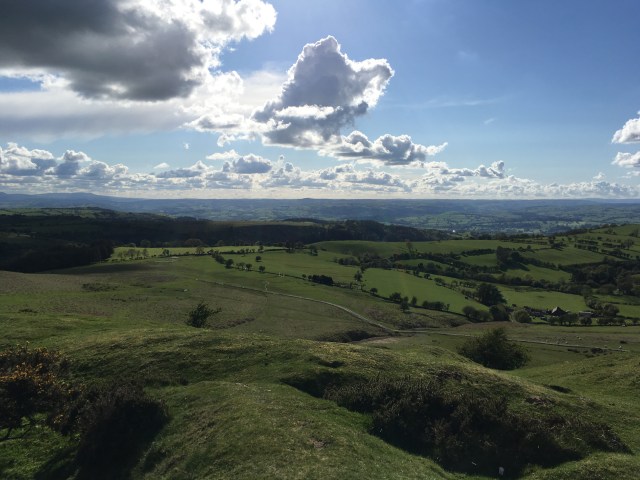
Down in the throat of Wales

The view to end all views.jpgIn the throat of Wales,

where light is sparse, then it is best.

This land of green trousers with grey hat,

hair coiffed in bluebells, tulips,

and yellow daffodils.

She is held in frames of arbour, where bristle-faced hills

are bred for poetry – Coleridge, Thomas, Wordsworth.

Down in the throat of Wales.


In the throat of Wales,

we pass the standing stones, God’s elder brothers,

and their eyes follow us.

Rain falls like sweat from the coal miner’s brow

while praying hands of hedgerow herald peace on every side.

A bleating sheep choir beckons eyes up to the watching hills.

Down in the throat of Wales.


In the throat of Wales,

down, down the Brecon Beacons beckon, swallowed down

where the green things live – down in the throat of Wales.

At the Blue Boar Pub, regulars and weekend

intellectuals hold out town secrets.

Practiced tongues wag in dark corners, breathing out suds

and gossip and recycled stories with fresh laughter.

Down in the throat of Wales.


In the throat of Wales,

at Hay-on-Wye – these streets are full of pages,

ten thousand dog-eared voices

tucked away on shelves and tables,

under arms and coat pockets.

American streetlights bow to clock towers, cheery pubs,

and weary stones. Long-drawn lines of primogeniture sing

the songs everyone still knows. And, the many-throated

happy-hour jubilee of a thousand years gone by

still steeps in the glow of candles,

wine-bright eyes, and cell phones.

Down in the throat of Wales.


In the throat of Wales,

the hills stand guard, where stone and memory bleed

the colours of the ancestors,

drawing their long and bloody shadows over Beddgelert.

The River Colwyn, host to muddy boots and hooves and paws –

I pause to imprint her banks of sleep.

Down in the throat of Wales.


In the throat of Wales,

Harlech’s stiff-shouldered castle juts out a jarring face

into Cardigan Bay, catching salt kisses

blown from the cold, grey sea.

Oh, where to wander in this wild and brooding land,

where friend is stranger – stranger, friend –

and all that ever wrung true hangs tightly

to the soft skeleton of a land made

from the stoutest stone, the strongest sheep, the swollen stories

of hearts that glow brighter than the smiles of children?

Down in the throat of Wales.


In the throat of Wales,

I place my ear next to her breast

to hear the consonantal tongue

make love to songs as old and wise as she –

where still, of all sad souls,

the blind man is poorest.


Down in the throat of Wales.

Learning new songs

Don’t let the sadness of silent friends

become the muse of panicked pain.

Let, instead, a song of silent sadness

bedeck the mystery of patient place.


Don’t wait to hear the morning birds –

listen instead to the quiet humming

of trees whose secrets are theirs to share

with those, waiting, craning their necks.


Give what time is left in the weeks of minutes

in days of nowhere to wait –


wait


for what yet will come

in songs, freshly sung,

by voices, newly found.


God has not left you –

she only sings to others still waiting for

notes and what assurance is given

in the pin-pricks of light invading your dark. 

Roadside infatuations

I have wandered down this creek-side road

with a kind of curious ebullience –

a roadside infatuation with hard-to-pull weeds.

The long cool of it disrupts the day long

enough to breathe in the dust,

to hear the gravel crunch beneath these boots –

and let my eyes wander

                                    upward

                                                where the clouds compete

                                                            with geese and hours,

and poetry the color of rain.

Now

An iron clutch without hope of release

gives way to an embrace

where death and dragons are vanquished

with a kiss from the once dead lips of the truest man.

Yesterday, too ordinary to see –

today, too bright to miss –

unless you were looking elsewhere.

And the happy songs of women

tell of news we should never have heard.

Dullards refuse, and, breathless now, men must admit

what was then has become heaven’s now.


the non-plan

If not for this, then all would be that,

and when forsakes why,

and time gasps for breath.

Stand still with nowhere left to go.

Sing these notes now,

these words for this, not that,

waiting for the longer wait;

the unplanned non-plan;

all counting, forsaken, in the business of nothing –

and watch what yet will come.

A road for our story

In those long and pasty days,

wrung out with the common befuddlements of

our race, there can seem to be no

end to the tributaries,

soggy back roads,

sullen detours, the personal politics

of working in a chain gang fog.


The sun, warming and full, is the same to

saint and sinner, soldier and sailor.

But doubly-parsed is its heat, meted out to all,

recklessly packaged for warmth, whim or want –

hope to one, threat to another, necessity to all.


Yet in between the particles of dreams lie

the pocked and random picture of our days.

To hoist and heft, backs bent and necks strained,

seems lighter when singing – or laughing because

the joke is good.


To laugh means more when everyone hears

the same words but the punchlines are different.

And only the skilled purveyor of the phrase, delicately

turned and timed with skill, can help the cautious and

skeptical, proud and aloof, naïve and wide-eyed alike

to get in on something good.


The better the tale, the shorter the toil.

So we dig deep to find the best tales straining

to sort and sift and make sense of 

the broken, unpatterned pieces

strewn about the edges of things.


So, with subtle indirection, the toolbox of yearning

wed to oratory, wed to a cloud of unknowing,

expecting nothing more than a tale well told,

comes the bard and we are given –


a road for our story.

_____________

Dedicated with great respect, gratitude, and love to pastor and friend and retired bard, Duncan A. MacLeod

Building cages from fence posts

I

With robust assurances his heart gives him leave, and he chooses where to put up fence posts. A random job at best, like cliff jogging in fog, he dons a belt of desire with the tools of need. Soon, even the smallest creature will set its mind to the task of destroying what little is planted – turnips, sour, or lettuce, damp – sustenance an after thought to the insistent impracticalities of spice and garnish, sweet. 

II

He hums a happy tune, just loud enough to drown out his wiser, elder self – safe but jejune, unlike the dashing rarities of a ripe and unpitted longing. It helps to take the edge off catacombed thoughts, still damp and painted brightly in drooping caves of swelling light.

III

He watches how her tongue dances from lips to teeth, teeth to palette and back again – mesmerized like too much moon behind too little cloud. He matches word for word, glance for glance and what started as picket fence has become an encampment. And his bludgeoned fingers bleed and weep only slightly less than his forehead, sweat-bedewed in the ritual of dalliance.

IV

The stumps go down, first one, then another, haphazard arrangement built to harbor dreams, not capture dreamers. Nails leap from hammer in wood soft and easy, like feet in wet clay. And soon, the world watches in the laissez faire of bored repetition. Not even an eyebrow raised, curious about a man backing into his own battlements, a penned bird, stuck in a cage he built while looking the other way.

2015 in review

My RobsLitBits year in review!

Here’s an excerpt:

A San Francisco cable car holds 60 people. This blog was viewed about 2,900 times in 2015. If it were a cable car, it would take about 48 trips to carry that many people.

Click here to see the complete report.

wordlessness

Sometimes he gets stuck in the dictionary so

long that his brain becomes alphabet soup.

He wears his skin tattooed with another’s thoughts.

And he waits.

No, he frets – and sour apprehensions

swim atop a slowly scumming pond

of wilted words, reeking of lost sleep.


And, if reflections in the coffee shop window

are meant to serve as metaphor,

they only spur on the edict

of secondary pictures mirrored from

another’s doubting face.


Come then, if you must,

shadows from a cold mist to

rattle and rustle the bones.

Come, take up residence beside

one with a plasticine pencil,

pliable to cautious hands –

worthless in sweaty palms,

squeezing desperately against

the inevitable.


In this reverie to a ghost –

vestibule in an empty house,

birthing only the vestige of coffee-stained

intentions, a writer paces –

penning wordlessness.


The day renders well her light to cast

The day renders well her light to cast,

comes, with hopeful glance, her tidings bring –

haunting dark, like some unholy past

soon yields his woe to this better thing.


Alone, but for his pale, waning grin,

he staggers backward in view of her;

never have his shaking knees remained

full upright. Now they buckle, unsure.


A formal respite, east is yearning,

stolen glances, her scent is bringing

laughter for those whose wild discerning

feeds upon this freshness glad, singing


songs, and dancers too are gathering,

all but mirth and cheerfulness disdains.

Soon, the fretful past’s unprompted sadd’ning,

forced to flee, and only light remains.


As daylight parts dark mystery’s curtain,

there, with courage, we must take our stand;

e’er the burden of mis’ry certain,

comes to pummel, firm, our heart’s command.


Still, with faith, our prayerful souls blazing,

God shall come to squelch what brings our fall;

must flee the night, our spirits’ hazing,

departed, then goodness we recall.


Now, cacophonous voice, full deafened,

silenced is the darkly strident pull

of that which, lying, steals our heaven –

God, his faithfulness, our promise, full.