The Story of a Song

I’m a musician.

More specifically, a songwriter, a composer of three to five-ish minute stories, sung exposés of heart and soul, guts and grime, faces and places. Sometimes they squeeze out of me like toothpaste from the tube, globular and grotesque until they shape up, shine up, or ship out. Sometimes they feel like a Rubik’s cube – confused and mystifying until the right colours align and the palette finds its rightful place. Sometimes they are a town made of Legos, uninhabitable ghettos, angular, sharp, hard on the feet, until the final block snaps into place and home comes into view.

In rare moments, they arrive complete. Finished. No edits required. A gift that asks only to be notated, promptly sung, and properly introduced to whomever might be interested.

2015. It came to me while sitting in my reading room at our home in Yakima, Washington. What follows is the story of its (and my own) emergence.

A church music director for most of my adult life, it had been my remit to satisfy front-of-house needs for artistic class, professionalism, cultural relevance (whatever that means), beauty, and involvement in the particular church of my employ. Choral directing, training, and performance; listening endlessly to frequently banal worship songs, pursuing the best ones for consumption; composing and/or arranging new songs; identifying, training, and releasing new musicians; seasonal concerts and performances; hobnobbing with the muck-a-mucks to ensure funding and support to our program; fielding “concerned” emails about my approach, methodology, song choices, or choice of hairstyle (no, really).

I genuinely loved it. I think I’ve been good at it but won’t ask too many questions, just in case…

But, any job, even one as fulfilling as this, can become stretched, insufficiently gratifying to ensure warmth on those cold days of uncertainty and desire for something new. The best tricks up one’s sleeve become well known, even expected, to onlookers. Tricks of the trade, inside jokes, clever banter (at least I thought so) – where once they generated wonder and amazement, now, at best, they go all but unnoticed and, at worst, prompt eye-rolls, chuckles, even groans generally reserved for Dad-jokes.

A second presenting concern was the resignation of the senior pastor with whom I’d enjoyed years of heady and inspiring co-leadership. Duncan, a young and vibrant Princeton graduate with off-the-charts charisma, energy, creativity, competence, and ideas had joined our staff. I was smitten by his indefatigable creativity, compassionately confident, and compelling leadership. It was, in a word, a bromance.

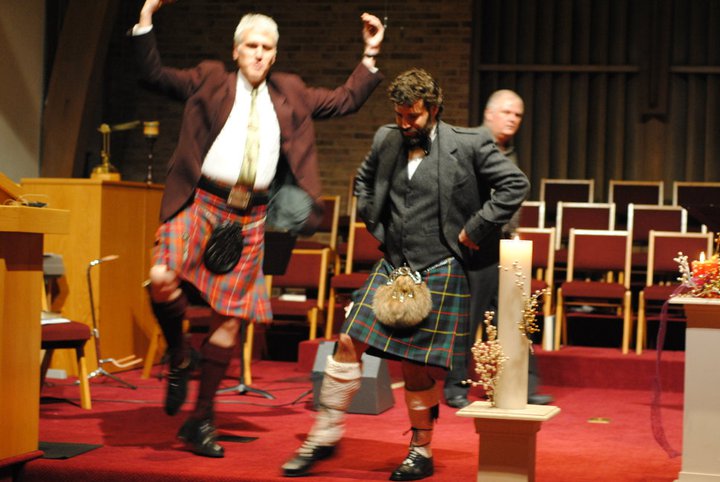
Duncan and I in 2011
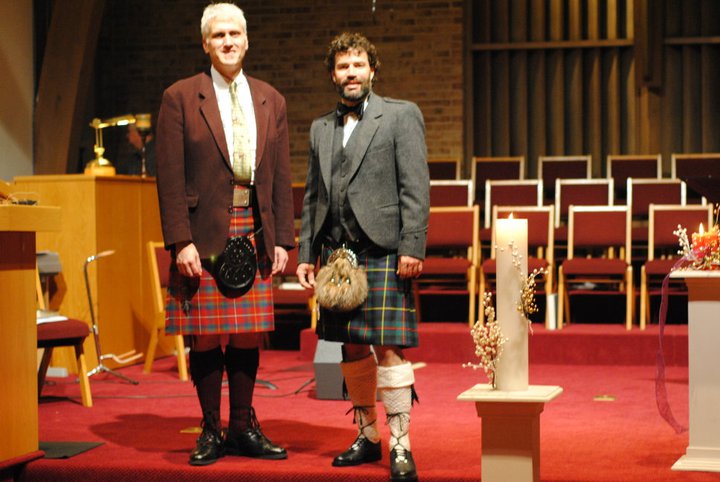
He had hit a wall personally and professionally and felt the need not just to resign from guiding our church, but from ministry altogether (he is now a happy and successful fire fighter). The news hit me like a train. I believed us to be the Simon and Garfunkel, Lennon and McCartney, Plant and Page of our church. By his own admission, he felt similarly. All that, however, was to be no more. I was lost and shouldered it like Apollo’s world-bearing curse. Could I continue doing all this but in brand new ways? Should I do these things but in a new location? Would I find satisfaction doing something else entirely? None of the above? All of the above?

For many, these questions are professional ones, career-defining questions designed to clarify and shape one’s evolving professional life. For me, they were existential and required a deeper dive towards any kind of answer. Let’s try anyway, shall we?

Those like me, perpetually wandering melancholics, happiest when a bit sad can feel a little lost as this begins to melt away in the face of…peace. Shalom. How can it be that someone whose cottage industry had been disenchantment and ennui suddenly finds contentment?

After a sabbatical in 2016 to the UK, it was clear that this was where we were truly meant to be. There began a long process of discernment through which we embarked upon a new journey: a move from Yakima, Washington to Edinburgh, Scotland.

“You Want to Fly Again” was my heart’s cry for what we’re currently experiencing. The song had been covertly prophetic of what was yet to come. I was unaware that I’d written a song intended for everyone but which held within it the seeds of an unfolding reality. And that reality is good. Very good.

I encourage anyone who happens upon these words to do so with faith in the God who still works in mysterious and miraculous ways. If this can become our journey, I am bold to say it can be so for you as well.

May it be so.
The Celts…again

I read. Like, a lot. Mostly narrative (novels), poetry, and spirituality. But also loads of practical, pastoral fare; the expected manuals of those like me in the craft of soul-shaping. As one who still stands uncomfortably close to the edges of evangelicalism, it is generally expected that I be of the ‘soul-winning’ trade. It’s not as though I’m uninterested as much as I’m…uninspired. The language is so quaint and banal by comparison. Hardly the kind of thing to draw anyone into the kaleidoscopic mystery of the Trinity.

For that, I turn to the Celts. Their muskiness and John the Baptisty daring-do has an almost Homeric quality about it. I revel in their disinterest in the urban diaconates of Rome in favour of the murky oak groves more suited to the thicker material of Desert Fathers-inspired mysticism.

Trust me, I am no expert in any of this. But I can say, without embarrassment, I’m an enthusiast. Living in Edinburgh now since October of 2021 has helped this thirst. My proximity to the mythic environs in which Celtic monasticism was born and from which it traversed the globe is delirious at times.

So, where was I? Oh yes. I read. Like, a lot. A lot of Celtic-related material. Some of it fictional, (as in my first ever Waverley novel of Sir Walter Scott. Highly recommended by the way, although not without copious cheat notes to help guide your way through narrative literally dripping in self-importance and fourth-wall breaks). But, I also love history as well, which is what I’m currently reading.

A more thorough review may well be forthcoming. But, for now, here’s a taste of writing so good it makes me cry, both with the joy of its beauty and in the discouragement that I possess a skill rather quaint and elementary by comparison. Sigh.

For now, just listen to these rigorous but calming waves of literary water lapping on the shores of your imagination.

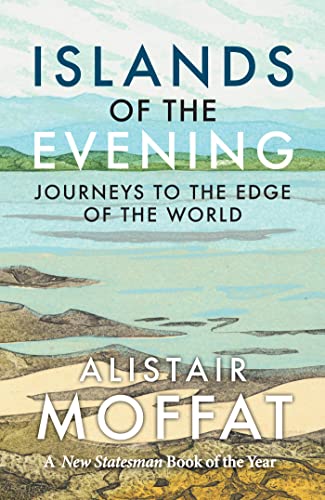
“The monks who took their curraghs to the Hebrides knew that they sailed along the edge of the world and perhaps they also believed that they were moving along the edge of Heaven.

Seen from the Atlantic shore, silhouetted by the westering sun slowly enveloped in the still, soft air of the gloaming, the Hebrides become metaphors. Beyond these islands of the evening lay the vast wastes of the ocean, and beyond that, the end of the day, the dying of the light, the darkness. But beyond even that, there was hope, the eternal light of Heaven, where the sun warmed the fields and all those who had been saved, and where God smiled and stretched out His hand to bless those who had sailed to the islands in their curraghs and given their lives to Him.”

Good, right?

So then, back to reading and the dream of the world the Celts envisioned, and maybe just…be a part of creating it.

Adventia, day 23

Currently, I am reading through a favourite book of prayers, poetry, and contemplative practice entitled “Hearts on Fire: Praying with the Jesuits” (Loyola Press, Chicago / ed. by Michael Harter, SJ 1993/2004). It is a useful and rich resource as an accompaniment and guide to the Ignatian Spiritual Exercises. It is also a perfect place to start for anyone interested in exploring the highly imaginative, participatory manner Ignatian spirituality teaches meditation by drawing one to inhabit biblical narratives.

For Adventia, day 23, I am sharing this gorgeous and inventive retelling of the Luke 2 story by Michael Moynahan, SJ simply titled, “In the Out House.”

It’s been a long,

dusty ride.

A steep and winding road

weaves serpentine

up the side of mountains.

They race the sun

with prospects of a new head to tax,

albeit a small one,

an impending certainty.

Sky and mother

are visual proof.

They reach the city

exhausted

but full of hope.

The husband,

mistaken on occasion

for her father,

fails to act his age

and dashes toward

a door about to close.

“Excuse me,

Could you give us a room for the night?

Some place to lay our heads?”

“Can’t you read, buster?

We’re all filled up.”

“I understand.

It’s my wife,

She’s about to have her first child.”

“That’s not my problem.”

“He’s not a problem.

He’s a fact

of life.”

“Open your ears, buddy,

because I’m only

gonna say this once.

We ain’t got no room.

So scram!”

“I understand”

is drowned

by the sound of a

slammed door.

Three times he will try

to find them lodging.

And with each failure

fell less capable

of caring for his wife

and that life within her

wanting out.

“It doesn’t look good.

All their rooms are taken.”

“Don’t worry.

God will provide.”

And all the time thinking:

“That’s what I’m afraid of.

They’re sorry

but they’re full.

It’s looking bleak.”

“God will give us

what we need.”

He shakes his head.

She believes this

and it comforts him little.

The third stop

looking like a

distant bleak relation

of the previous two.

Until the owner’s wife

spies the young girl wince

from movement she understands

all too well.

“You can have

the place out back.

It isn’t much

but it will be a roof

over your heads.

There’s fresh hay thrown.

The animals won’t bother you

and the child will be warm.

I’ll get some rags and water.

Go on now,

the mother

and baby

are waiting.”

Silently

the young girl’s face

proclaims:

“Magnificent!”

Adventia, days 19 & 20

The following prophetic poetry has always been such a seismic piece that it deserves a couple days. For Adventia, days 19 and 20, I am posting one of the most remarkable, strangely comforting, but deeply subversive prophetic passages in the entire Scripture.

These words, from the mouth of a young, pregnant Mary are as powerful now as they ever were. For those who think the Gospel nothing more than one’s personal ticket to heaven with little social impact, the poem that would become known as “The Magnificat” easily challenges such quaintly dismissive, erroneous assumptions.

In two translations, the New Revised Standard Version and The Message, I give you –

Luke 1:46-55 – “The Magnificat” 

(NRSV)

And Mary said,
‘My soul magnifies the Lord,
47   and my spirit rejoices in God my Saviour,
48 for he has looked with favour on the lowliness of his servant.
   Surely, from now on all generations will call me blessed;
49 for the Mighty One has done great things for me,
   and holy is his name.
50 His mercy is for those who fear him
   from generation to generation.

51 He has shown strength with his arm;
   he has scattered the proud in the thoughts of their hearts.

52 He has brought down the powerful from their thrones,
   and lifted up the lowly;
53 he has filled the hungry with good things,
   and sent the rich away empty.
54 He has helped his servant Israel,
   in remembrance of his mercy,
55 according to the promise he made to our ancestors,
   to Abraham and to his descendants for ever.’

(The Message)

46-55 And Mary said,

I’m bursting with God-news;
    I’m dancing the song of my Savior God.
God took one good look at me, and look what happened—
    I’m the most fortunate woman on earth!
What God has done for me will never be forgotten,
    the God whose very name is holy, set apart from all others.
His mercy flows in wave after wave
    on those who are in awe before him.
He bared his arm and showed his strength,

    scattered the bluffing braggarts.
He knocked tyrants off their high horses,
    pulled victims out of the mud.
The starving poor sat down to a banquet;
    the callous rich were left out in the cold.
He embraced his chosen child, Israel;
    he remembered and piled on the mercies, piled them high.
It’s exactly what he promised,
    beginning with Abraham and right up to now.

Um, wow.

Thanks, Bruce…

67474583_10158586894473709_2369543928333467648_n.jpg

“All through my life I have embraced and questioned the night, and loved its random light: the aurora borealis, the starry reaches of the cosmos, streetlight ricochet off car metal and darkened windowpanes…the light of friends and lovers.
 
We are on a great journey, through darkness and dawn, across time, though sometimes I fear that our journey is about to end. We must not succumb to fear or avarice; we must continue to embrace life, seek light, and gather in the charity of night. This is what God wants from us and for us. Mirrors of the past shine with the hue of unborn days, just as stars glitter in the dark night to light our way.”
 

I love metaphor. I appreciate the multitudinous ways it invites us to consider really big stuff. Night and day, dark and light, doorways and highways – all of it in pursuit of understanding that which can be never be fully understood. 

Longing, as I’ve written many other places, is a condition most endemic of the hungry human spirit. If we are anything as humans, we are spiritually starving. Like the blessing of pain to a body out of joint is that of longing to the soul under duress, or even just at rest. We long not because we’re broken necessarily, but because we want either to be unbroken, or, in my case, to experience the proximity of God as God when last I WAS broken.

However, there’s a danger implicit in longing for its own sake. It can easily become an obsession, a drug without which we feel we can never really be whole. For too many years, in the name of contemplation, I lived in what could only be described as wallowing. It was often a cottage industry of self-pity in the guise of discerning depth; “look at me suffer and enjoying it” rather than the healthier pursuit of gratitude-in-darkness while praying for light. Persona incognito.

I’ve learned since then to notice the subtle differences which exist between genuine longing and a self-imposed spiritual subterraneanism posing as such. Nowadays, whenever longing arises within me, a few questions arise with it. First, where is this coming from? Why is it there and what is it telling me? Is this genuine heartsickness or just indigestion?  Does my spirit need something or am I falling into addictive thinking once again? 

As beautiful, daring, mystifying, and thirsty as the human soul can be, it is also fickle and will play tricks on us. What presents as darkness might just be ennui, the listlessness which is part of being human. What presents as sadness might better be described as an insufficient attention to the light of Christ always burning in our deepest places.

The Bible and, by extension, the great tradition of Christian spirituality have aligned the parallel barrels of mystery and metaphor as their formational crosshairs. The immense enterprise of God’s program of cosmic reclamation remains unsuited to the quaint and glib prognostications of “systematic theology”, or as I like to see it, the detached mechanics of straining eternity through an eye-dropper. Protestantism in general, evangelicalism in particular, are guilty of this diminution.

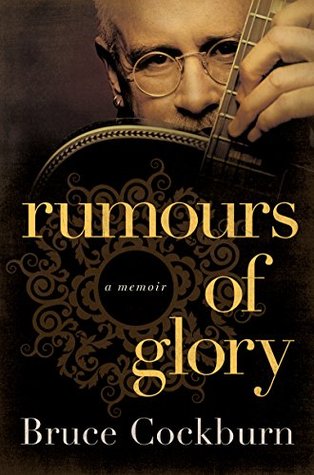
All of the above has been the experience of my hero, Bruce Cockburn. I recently finished his memoir. A favourite person. My favourite genre. The chance to devour, even absorb, the fascinating lives of fascinating people. My life grows from the experience, every time. What’s not to love? Ah, but this is not just any memoir. 

18498533

It is impossible to understate the impact Cockburn has had on me. My music. My approach to the guitar. My songwriting. My ongoing love for literature and words. Especially, my spirituality, infused with longing as it has been. Even my personality exudes a certain whiff of Cockburnesque mystique, much of it intentional.

He doesn’t know it (yet), but I credit him in large measure for my career in music, songwriting, and for my journey of faith. While he was still pursuing something beyond the pale for himself, he speaks of “the speech of stones.” It was probingly pagan but sufficiently poetic to peak my interest. There was something out there worthy of seeking.

Bruce (may I call you that?), if it’s good enough for you, it’s good enough for me.

It still is.

Enneagram 4 – Perfecting Ennui

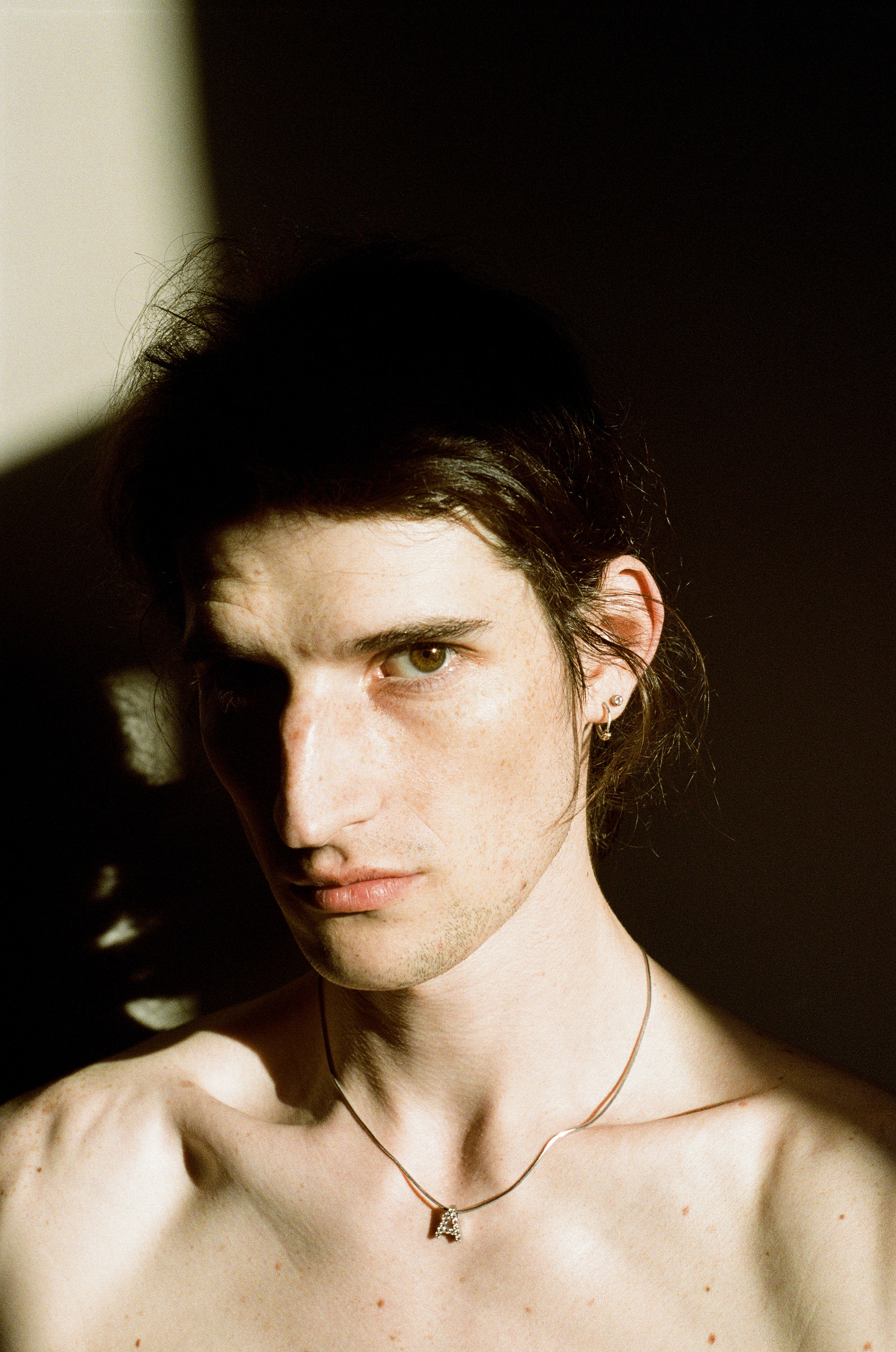
E4s: undisputed masters of stormy mystique (photo credit: Илья Пахомов)

Enneagram 4s.

The world is too beautiful.

The world is too ugly and needs the beauty we bring.

We are the world’s mystics, the existentialists. Poets, philosophers, artists, dreaming wayfarers, ever searching for some far and distant land that lies just beyond our grasp. And, if it’s beyond our grasp, it won’t even be on your radar, I promise.

Our worlds are those most real as ones which dwell in our overwrought imaginations; Paradise projected, longed-for, through-a-glass-darkly. These realms are as equally insistent as they are evasive. They foist themselves upon us when we’re not looking, and hide themselves when we are. They promise an almost constant angst-ridden ennui, what the ancients called “acedia.” We’re the noonday demons of the emotional world; skulking about in the shadows lest we burn out our retinas in a direct gaze upon that which only avails itself as peripheral.

That is why we’re always a little sad, distracted, disabused of whatever is directly in front of us. Obvious is so gauche. When bliss is just beyond the scope of our sensory perception, in shadows of liminality, why waste our precious energy on the muted confines of what everyone else merely sees, hears, feels, touches, smells?

It means that those of us living in this cosmic Purgatory are expert romantics, idealists, mystics, contemplatives, tortured artists; a slow, gothic parade of the perpetually misunderstood and underappreciated. We dish up depths of feeling, life, and experience in our spare time, that which is well beyond the quaintly over-considered crumbs the rest of the world ogles over. That world, chest puffed out in pride, gives us Beyoncé. “Top that, we dare you,” it taunts.

“Ah, how sweet,” we respond, and give them Hildegard von Bingen.

The world hacks up a Danielle Steele or a Nicholas Sparks, confident in their ability to impress with such stellar heavyweights.

We merely yawn and hand them our copies of Tolkien, Thomas Merton, and Flannery O’Connor.

There is rarely much overt satisfaction for the Enneagram 4 whose psycho-social psyches emit requirements which far outstrip the window-steam generally on offer, quickly faded and lost. After all, when one feeds upon manna served up on plates of raw energy, listening to the winds of heaven, carrying celestial songs of joy, through our golden, cherubic locks amid the host of heaven, everything else is just raw sewage by comparison.

4s – the hippy star-children of the Enneagram (photo credit: Anna Shvets)

We are monastics forced to abide a NASCAR life. We must forever shuffle about in a fog of self-satisfied smug. Our long noses are ski-jumps down which we gaze in thinly veiled cynicism and self-righteousness. We’re perfectionists swimming in a fetid stew of cosmic mediocrity. Everything we do is quite simply, better. We shouldn’t have to tell you this.

But, we will. Oh, we will. Often, and in as many ways as it takes you to finally understand our obvious supremacy. You may think you’ve finished with us and have moved on to some other shimmering bouncy bauble thingy which occupies your days.

Alas, no. Nobody says when they’re finished. That gift has been given by the gods to us. Us alone. We, in well-practiced passive-aggression, will give our royal nod when it is appropriate, and safe, for your dismissal. Then, and only then, may you slink away to your My Little Pony world.

As for me, you shall find me when I’m ready (and longing) to be found. Then, as I ugly-cry my way back into your good grace, you can hold me close, assuring me that we can start all over again tomorrow. Thanks for listening (yeah, like I care).

Wait, please don’t go…!

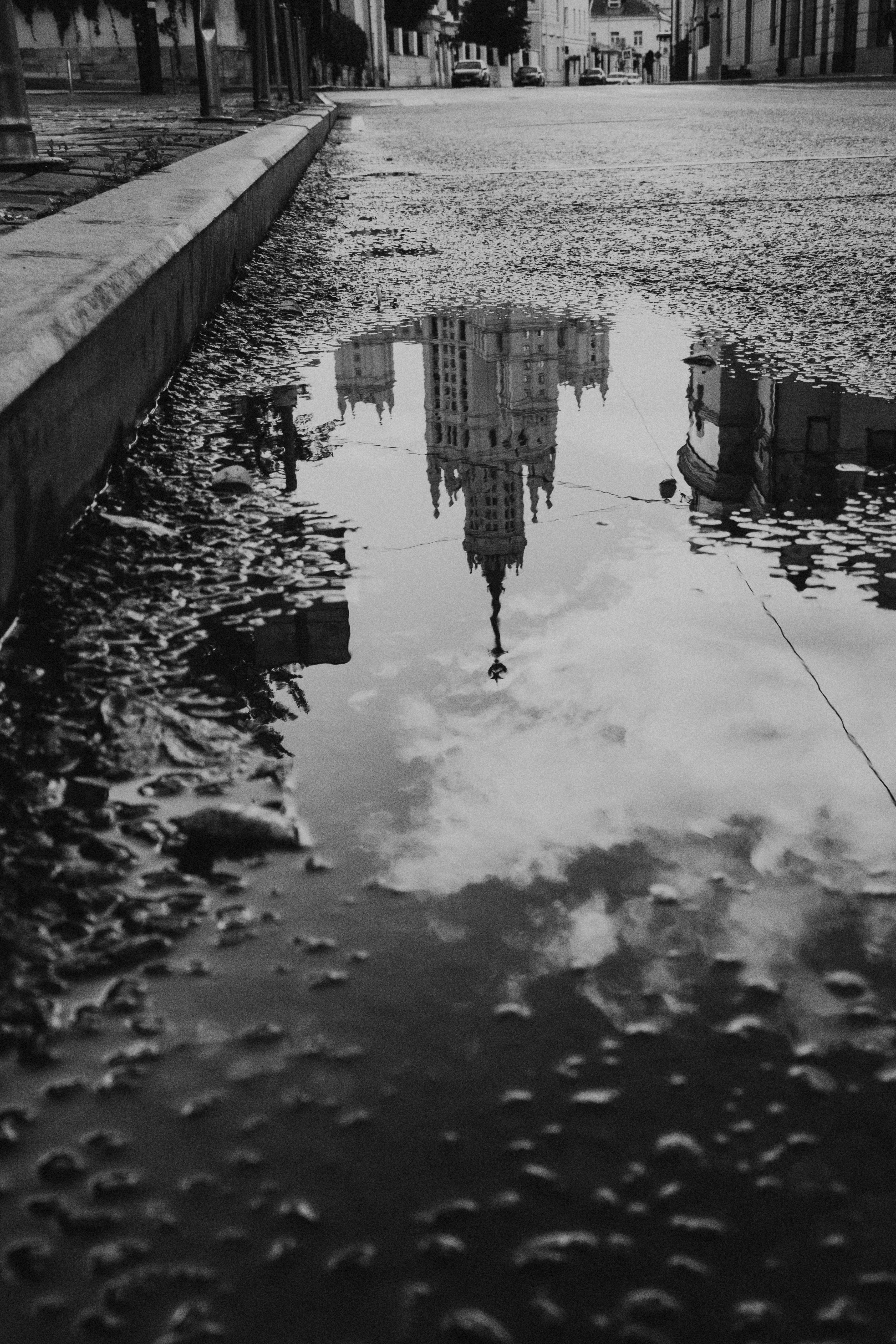
Pursuing beauty, ever-elusive, always-reflected (photo credit: Anna Rye)

Building Our Poem

“…in thy voice I catch

The language of my former heart…”*

“The Bud,” 1987

I love poetry. I love its exactitude, its wide-eyed innocence wed to unflinching honesty. The unforced rhythms of perfection, like Grandma’s gaze over well-worn glasses. It is the art of lovers, the science of thinkers, the wisdom of doers.

Poetry gives up her secrets cautiously, altruistically, slowly. Every word, like every note of a great symphony, is fully intended, placed unequivocally in its place with an eye, and ear, to building something remarkable out of simple things, something well beyond the sum of its parts.

In a thousand ways, we are the amalgam of our carefully written words; each one added to the emerging poem of our lives. In this process, there are no real mistakes. There is only the discernment asked of us in the changing turn of phrase that will ultimately become our voice in the world.

For me, Rosebud was one such word. Perhaps an entire stanza.

Although my active period in Rosebud was limited to a few months in 1987, her existential tattoos continue to reveal themselves in enduring ways. A tiny, easily missed oasis in the Alberta prairie percolated in me an entire life thereafter committed to several things: the transformative realities birthed in the canyons of friendship, great things can come from wee places, the pursuit of art wed to faith, and the kind of community possible only through probing, and honest, creativity. Family, lived best in and through, story. Our stories now connect in ways both obvious and subtle.

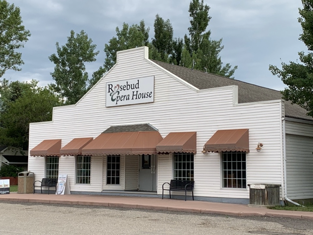
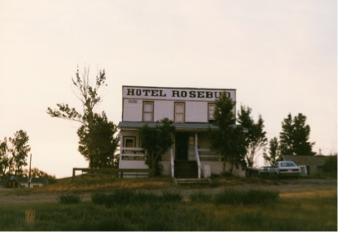
Rosebud Opera House, 1987
Rosebud Opera House, 2021

Our digs
The diminutive Akokiniskway

On the About tab from my spiritual life blog reads the following statement of purpose: “my life is dedicated to those places where life, liturgy, theology, and the arts intersect to promote an authentic spirituality – who we are becoming.” These values existed in me long before I ever made it to this place. But they were stoked by shared inspiration, fireside laughter, broken stage lights and fumbled words, splinters and spoilers, relational fugue and fatigue, the prayers and tears of young lives navigating their way to maturity; to wholeness. To become both passionate and com-passionate, all writ large in the art of our story. The Story.

On the Rosebud Fellowship homepage can be found the following statement, one of the six “objects” that articulates its purpose: “To promote the fellowship of people whose lives have been affected by the Christian mission of Rosebud School of the Arts.”

Friends, I am one such person.

My daily Rosebud prayer walk, Canadian style.

In the short time I spent here I found lasting friendships, a deep gratitude for the quality of connections that exist around creativity rooted in spirituality, and a way of living, boldly illustrative of the kind of “Christian mission” to which Rosebud has always been committed, both spoken and unspoken.

However, the vision of this place was never one for kitsch or the quaintly derivative “evangelism through art” which has damaged both evangelism and art in so doing. Sadly, what begins as evangelism can become nothing more than jingoistic cheerleading or public relations. What begins as “art” descends to something diminished and pale, akin to cultural babysitting, the low hanging fruit of the accessible and “relevant” to the demise of beauty, the archetypal perfections to which God, wide-eyed, once whispered, “it is good.” When beauty and story are the goal, both art and God win. For me, this is Rosebud’s greatest victory.

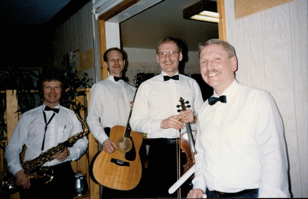
Table minstrels

To witness the leadership, serene but definitive, directive but collegial, of LaVerne Erickson has always been a wonder to me. A man of endless stories (and not a few impressive name-drops), tireless energy, and towering vision inspires me as much now as it did in those pre-Cambrian days of 1987. I’m still shedding the pounds added from Arlene’s unforgivably good cooking. More than a few good words (and some less so!) were knit to my story through the relentless humour of Royal Sproule, the passionate guidance of Doug Levitt, the sanguine wisdom of Lyle Penner, the many towering women of faith and creativity who helped put Rosebud on the map. And, of course, the big-heartedness of Akokniskway herself, calling us all deeper into her welcoming bosom.

My daily outdoor show

I am as Canadian as the day is long, complete with an undying love of trains. I grew up in a blue-collar home, the son of a brewery worker and homemaker. Our 900 square foot bungalow in the quaint but rough-around-the-edges southwest Calgary neighbourhood was poised right next to tracks, now LRT, but once host to regular trains through town. So, when I moved into my room in the Rosebud Hotel, the nightly train arriving just past midnight was like a well-worn pair of jeans. Her whistle neither haunted nor annoyed. It sang to me of prairie goodness, rich in the Canadian story so much my own. Our own.

The poetry of my life is ongoing. Rosebud has faded well into my rearview mirror. But she has never stopped whispering to me of what could be, those places where my past collides with my present to hint at a future.

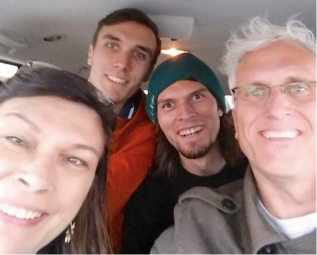
Rife crazies – Rae, Graeme (25), Calum (30), Me

Now, after decades of Christian ministry, a life dedicated to music, writing, poetry, spiritual formation, and the arts, two boys (both professional musicians), together with my wife Rae (Rosebud incubated our love!), we are planting new words in our emerging poem. This newest word takes us across the Atlantic to begin life and ministry in the UK. We invite as many as we can to join us on this journey. Our poetry improves with every letter added, every nuance of word, phrase, and metaphor.

All of you are all of that.

Rosebud, thank you for being a cradle, an incubator, a muse and sage, a friend. Your poetry is now, and will always be, my own. I take you with me, with us, into a new horizon. Our emerging poem.

Word for word, words for Word.

1987-Rae Kenny and I were married the following year.

Same people, almost 30 years later.
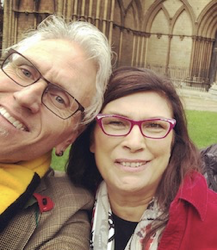
2016, Peterborough Cathedral, England

A poem

When muscle, bone, and sinew can’t find heart

and listening and looking. Then, severed in time

from the wishing well of wonder, we wander

through rushes and slivers of our moments, bent

over mirrored water, haunted.

There is a wrinkle in the hour’d fabric of

our days when tender grows the minstrel’s

song. It rings across golden fields of

shimmering wheat – milled hopes, rolled and real.

Bardic but breathless it sounds, reveling in tremors

of songs still sung to handmade candles.

They shine to our hopes, ablaze with just

a hint of what could be.

There is a certain moment, beholden to itself,

in which ghosts and gazes meet to discuss

their future. Still, birthed

from the ashes of forgottenness

an ember yet lurks, small but waiting, patient –

alert to any movement or sounds of humming.

Catch it if it sings.

©R. A. Rife, 2016

___________________________________________________________________________________________________

* Quoted from his famous work, Lines Composed a Few Miles above Tintern Abbey, On Revisiting the Banks of the Wye during a Tour. July 13, 1798 by Wm. Wordsworth

Quaranthings: Birds, Books, Bathtubs, Blogs

My wife and I are quarantined. One man’s prison is another’s paradise as they say. The forthcoming ramblings emerge because, at present, I cannot. So, when faced with much time and little to do, one needs places to squeeze the cheese and blurt out some thoughts: quaranthings.

Birds

We are in southern Alberta in late Spring (or, in the indigenous language of territorial Calgarians, fourth winter). In our two-week quarantine digs it is achingly quiet. And yes, it is snowing. For the third day in a row. In late May. Welcome to southern Alberta in late Spring, or almost any time of year really.

Remove all the insistently effusive city noise and birdsong rises to the aural surface like moonlight bouncing on evening water. Except, it is morning, and their songs jostle the air around in delightful patterns of grey-green notes which tickle ears and strengthen resolve.

Not to belabour the point but, these are songs I never stop long enough to hear. Listening to them, even deciphering or pretending to interpret them, seems so much easier when, in utter silence they so prominently emerge to present themselves.

Sometimes we like to imagine heaven as a great candlelit cathedral drowning in the broad sounds of thrumming choirs. Yet, something tells me we might be surprised to discover how often Jesus – who loves sparrows, lilies, mustard seeds, lepers, and counting hairs – shushes everything so he can hear the birds in the morning, the crickets at night (apparently, heaven is in Nebraska).

Books

I’m not alone in bibliophilia. In fact, buying, hoarding, studying, defacing, loving, and buying more, books has been my sport of choice for many years. My expertise has landed me in good company with others similarly afflicted. Book nerds: we find each other. That knowing look of glassy-eyed wonder and swollen noses from walking into posts is recognizable to anyone.

This is only Day 5 of 14 and I’m almost finished book 2. To the readers in the crowd that would normally be good news, congratulations and queries abounding. However, it is book 2 of the 3 books in total I managed to squeeze into my bag before leaving to come here. Ah yes, now the anxiety level rises in the pit of every bibliophile’s stomach. All that time left and nothing to read? Indeed. Pray for me. Maybe the third book will somehow last for over a week.

Of course, my overly-clever wife looks sideways at me, flashing her Kindle. Something about the Internet and endless downloadables. Okay, as an old school kinda guy I admit my issue is self-inflicted.

Frankly, it’s a gift to have unapologetic time for reading. Not just any reading, too. Guilty pleasure reading. Books with no apparent benefit to either career or self-betterment. Books perfectly designed to help lure me away from the temptation of perpetual improvement – the curse of the self-obsessed.

Bathtubs

What’s not to love about lavishing to the point of languishing in a hot, soapy bath? Showers are quaintly utilitarian by comparison. It’s the I’m-too-busy-just-git-r-done way to wash. To the bathtub guild, speed and even clean aren’t the issue. It’s the spirituality of it all – hot water on clammy skin, add time, epsom salts, and of course, a book, and we are transformed into wrinkled, wobbly Jello-saints with whom decent conversation might actually be possible.

I’m aware of the hoggy water usage and the ever-so-slightly poshness of time spent in the tub. However, if you’ve ever sat with me after a long run in unnecessarily absorbent clothing and you’d certainly insist that a simple shower might not do the trick. Actually, once your eyes stopped watering you’d pour it yourself on my behalf. Trust me, I get it and I’m grateful for your involvement in my self-care.

My love affair with the bathtub started young. Even as a boy I could happily wile away hours at a time in hot-become-tepid water. They were so important to me that I would fight for first dibs on our limited hot water. That way, I could apologize to whomever followed rather than whine like a banshee over the misfortune of insufficient hot water for my tubbish mysticism.

Thank you, Bobby Darin, for the precision of your own watery observations. “Splish splash, I was takin’ a bath, long about a Saturday night…”

Blogs

You are reading this on a platform cleverly called a “blog.” It is a “web log,” or better, a long and chaotic rambling of insufficiently edited TMI from someone you’ve never met nor intend to ever meet who takes too long to say nothing of any real consequence. Therefore, dear friend, if you’ve made it this far, you’re my hero.

I’ve been putting far-too-personal journal entries on the World Wide Web now for about twelve years. I am one of about six hundred million others all vying for your Internet attention. And well over half a million new websites are added every single day. Talk about your rush hour traffic. L.A. or Mexico City at 5:00pm have nothing on that!

Still, here we are. I write because it’s so much cheaper than therapy and generally more effective than the mood-altering substances which ruled my life for too many years to recall. And, I have the gift of time, a certain level of presence of mind, and you dear souls with which to share a few words of mental reconnaissance. We can see ourselves in each other and be the better for having shared our stories together.

That’s about it for now. I congratulate you for meandering with me over the space of a few words, cast aimlessly about with no other purpose but to perambulate in quarantine.

“These are a few of my new quaranthings…”

Christmastide – Practicing Surprise

Much has been written about this period of the holy story the church has called Christmastide. We hear words like waiting, longing, anticipation, inbreaking, birthing, hoping, emmanuel, and sing of shepherds and sheep, angels, alleluias and announcements, mangers and mangy stables and , all in voices bright sing gloria in excelsis deo (glory to God in the highest).

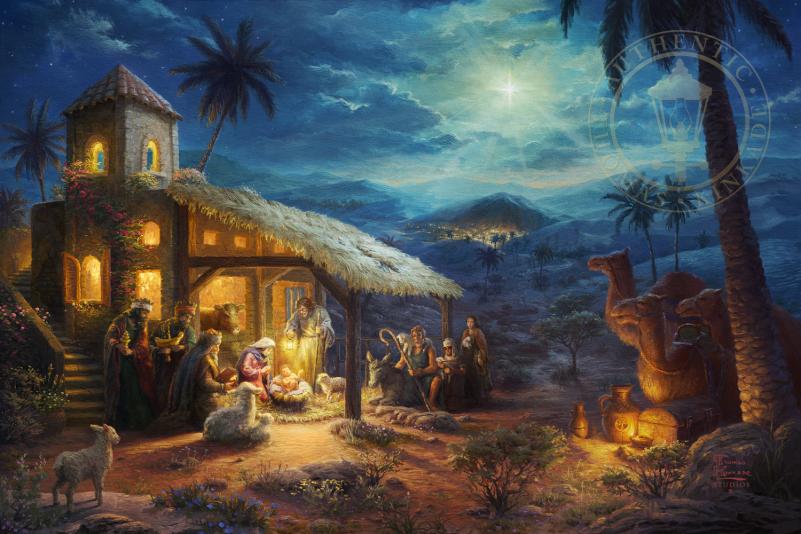
Consumer culture rides its coattails toward a bloated bottom line. Corporate culture plays with its nuances to encourage warmth of feeling and brand vibes. Christian culture uses it to battle their annual “war on Christmas.” Cancel culture uses it to remedy the former. And, Hallmark culture uses it to sell Thomas Kinkade paintings (I have nothing against him, I promise!). Such a tangle of ideas and emotions, all running rampant…at Christmas.

Thomas Kinkade, “The Nativity”

Even in an arguably post-Christian culture, it is challenging to share anything particularly new about a story this well known. For those of us tasked with its telling it can be especially difficult to reverse the potential for a familiarity-bred contempt, both in the church, and in the culture at large. But tell it we do. Every year.

The stultifying caprice of our COVIDays, coupled with unparalleled political farcity seems to have diminished our ability to see any hopeful horizons and consequently, ravage our capacity to dream. One wonders if one can ever again, wonder. As the writer of Proverbs once observed, “Hope deferred makes the heart sick, but a longing fulfilled is a tree of life” (13:12).

But, dare we think ourselves alone to be the hope-starved? Those to whom the heavenly babe first came were far more so.

Read appropriately, in its original context, the birth narrative of Jesus would have sounded incredulous. A questionable yarn akin to UFO talkies or gu’rmint conspiracy theories in the local version of Bethlehem’s National Enquirer. ‘Twould have been anything but a family-friendly, consumer-ready tale fit for animated movie screens and glittering holiday bling.

Instead, the Hebrew nation fixated on their lot as Roman-branded religious fanatics and kicked against the goads of military occupation. And, theirs was an occupation not just politically by the Romans, but theologically and morally by religious leaders pretending to follow Torah but largely interested in political safety and the biggest voice at the table (sound familiar?).

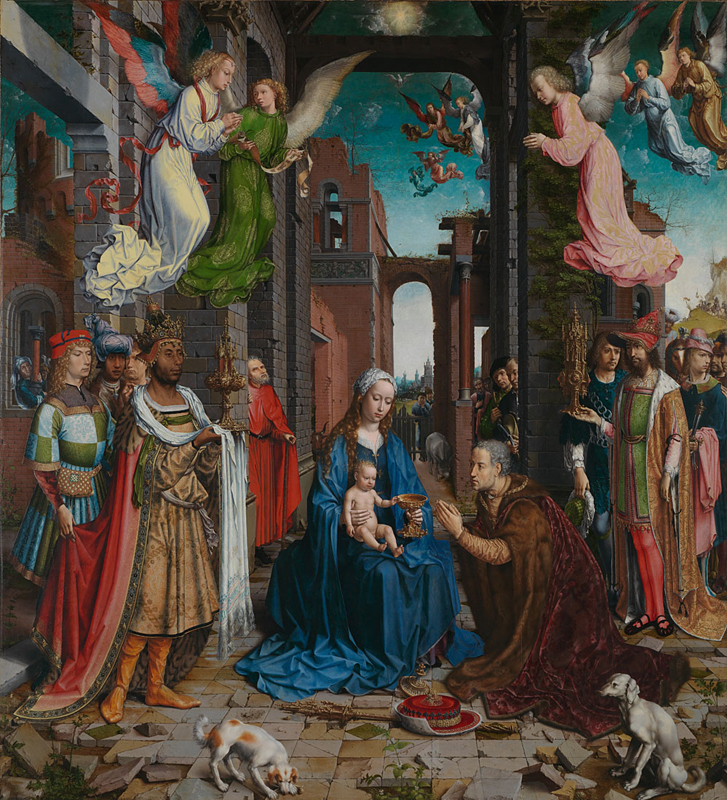
Jan Gossaert (Jean Gossart) (Flemish, d. 1532), “The Adoration of the Kings,” 1510–15. Oil on oak, 179.8 × 163.2 cm. National Gallery, London. https://www.nationalgallery.org.uk/paintings/NG2790

Long had they given up hope that anything would actually change. That their station might somehow improve. That, in great, great grandpa’s memory was something about messiah, the line of David, and covenant promises, among other fantastical things. They had done what almost every other conquered people has always done – settled into the long night of mediocrity and acceptance. Their survival mode button was stuck in the ‘on’ position.

Oh, there were outliers for sure. History is replete with them. There are always a remnant of stalwarts who refuse such resigned demeanour.

For example, Anna, whose long and lonely life had been given to prayerfulness and presence. Simeon, similarly, happy just to die having seen the fulfillment of a promise. Zechariah, whose priestly advocacy over Israel was well-known and whose doubts equalled his dedication. Elizabeth was giddy just to be pregnant in old age (God rather fancies such stunts), let alone with the New Testament’s resident off-the-grid hippy. And, of course, Mary. Aw, Mary – sweet but strong, young but wise, believing but thoughtful. Mary, perhaps more than anyone, understood the full importance and impact of what was told her by the angelic messenger. Apparently yes, she did know. ; )

“My mind is blown and my heart is full. Okay, so if I’m hearing you correctly, God’s finally doing something? Not just anything, but making the cosmic statement that the lesser is the more, the small leads the great, the poor rule over the rich. It’s all been upended, and you remembered everything that you’ve ever promised to me and my people? I’m in!”*

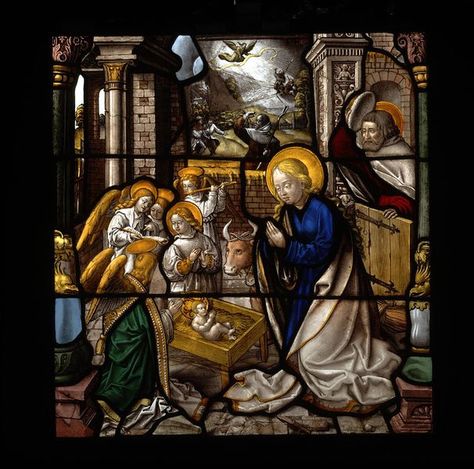
Danylo Movchan (Ukrainian, 1979–), “Nativity,” 2015. Tempera and gilding on board, 32 × 24 cm. Descending down into death. In icons, the cave of the nativity is meant to recall Christ’s tomb.

It is on the one hand a strength that such a story resides deep in our shared memory and finds revered place in our common consciousness. But, sometimes the familiarity of character, plot, and setting can sublimate the luminous mysteries at work under the surface. We kinda know the story but it doesn’t move us anymore. The aha! has been lost in the constant retelling that lacks reliving.

We can attribute much that is warm and good and beautiful to our affixation with the Christmas story. We still value the notion, however vague, that love lies at its heart, that forgiveness has at least something to do with all this, that family and community somehow matter, and that God doesn’t mind getting his hands (and diapered backside) dirty.

In our cynical moments, if nothing else, it keeps us looking for good deals at Walmart and happily arguing over Starbucks cups. And who doesn’t love that after fighting winter traffic for two hours?

But, upon reflection, guided by the Spirit who guided the star who guided the wise men who guides us still, we confess Christmastide to be a picture of heavenly surprise. To retell such a treasured tale should be of all things, an exercise in practicing surprise.

And everyone loves surprises.

A happy and surprising Christmastide to each and every one of you!

*Rob’s take on Luke 1:46-55, often called “The Magnificat” or simply “Mary’s Song of Praise.”

Thank you, Yakima Herald!

I’m especially grateful to Tammy Ayer at the Yakima Herald who thought our story interesting enough to include the following piece about our final Celtic Christmas Eve. 

80867692_10156312679816895_1439314918951092224_o.jpg

Details for how you may choose to support our venture are found in the article. The link goes live tomorrow. Blessing and peace to you all as the Yule is once again upon us and the smell of food fills the air to meet with laughter, fellowship, hopefulness and gratitude!