Reflections of January Residency, 2009 – Part 2

I promise I’ll be done with these soon. I gotta get it all out first, though!

What was to become an ever increasing reality however was that I had not merely been invited into a saving knowledge of Christ but to a journey replete with the confusing pain of God’s purifying crucible of suffering. In short order the heady elation of my conversion experience gave way to the darker waters of the journey into…journey. My family scoffed, my friends left, my stomach tightened and I became the pilgrim whose path is unclear and whose control over the exigencies of day-to-day experience disappeared entirely. I lost what little control I did have for the uncertainties of living by faith and not by sight.

Concurrently, I was enjoying my foray into the realm of discipleship and learning the language of faith. I attended a “Bible believing” church which leaned fundamentalist. Although restrictive in certain ways, my lack of comparatives disallowed me the luxury of complaint and I developed meaningful relationships with wonderful people. Here I sat under the tutelage of my first mentors who helped establish in me a deep love for the Scriptures. It is a love I carry to this day. It would not be until much later that I would discover this new faith language would prove vastly insufficient in providing clear descriptors and adequate paradigm for one predisposed to mysticism and more…let’s say, progressive (small ‘p’) proclivities than my contemporaries.

Be that as it may, my original career path of English Literature succumbed to God’s call to enroll in Bible School and for the next six and a half years I hungrily devoured whatever theological morsels were on my plate. A careful, oft defended, construct of conservative evangelical Calvinism provided the framework and the desire to further discover my identity in church music – the impetus for my call to paid ministry. However, cracks were beginning to appear in the perceived safety of this construct. I hid from all but a few people a deep and abiding love for Catholic spiritual formation, music, and art, a growing dis-ease with the conservative ideologies I had been taught so assiduously and a longing for “something more.” Hence, my collection of “odd” books, well outside prescribed parameters, a change to a local Anglican church and a quickly expanding John Michael Talbot and Gregorian Chant album collection (yes, record albums!), all belying my surroundings. My vast spiritual curiosity was also enriched through my discovery of the charismatic movement, a movement with which I’ve enjoyed an uneasy love-hate relationship for many years. In those meaningful but mystifying days, the addition of a few kindred spirits with whom to share this journey I will forever be grateful.

It was in this intellectual-spiritual funk that I offered my prayer in the gymnasium. And twenty-six years later, from the environs of a Master’s program in spiritual formation I see the undeniable power and centrality of that prayer.

There have been further indicators of God’s redemptive activity through my prayer. I graduated from Winnipeg Bible College (now Providence Christian College) with a B.A in Music in 1988 and was married two weeks later to the girl who would not only bear my two boys but with whom I would ramp up exponentially my decades long search for the “something more.” I have since belonged to a host of varying churches from Pentecostal to Baptist to Lutheran. Now, at the Presbyterian congregation where I presently serve as Minister of Worship and Music I am forced to consider the question: is this spiritual stew the result of the fulfillment of an intentional curiosity, the pragmatisms of ministry or merely the result of an identity crisis? Who am I, indeed! On countless levels, I am a poster child for the Spring Arbor Master of Spiritual Formation and Leadership program!

Twenty-six years after saying a rather unremarkable prayer I can safely say that my week of community, prayer, lecture, laughter and tears has revealed the deepest levels of God’s answer for me. For the first time in this twenty eight year spiritual journey, the pieces came together to form the clearest picture I’ve yet enjoyed of what it means for Rob Rife to be an integrated man of God. My best attempt at a summary would be to say that, similar to Job before me who asked hard questions of God, the answer to my question came in the guise of a better question. The rich, heady tributary waters of the Christian faith merged in even more spectacular fashion as God invited me this week to consider not who I am but rather, who am I becoming? Not the “what” and “when” but the “who”, “how” and “why”.

Reflections of January Residency, 2009 – Part 1

By now it has become rather apparent that my M.A. program January Residencies have been deeply formative experiences. At the risk of boring the reader into a coma, I continue to share these experiences with part 1 of my 2009 reflections…

Who am I? In total recognition that I am among the countless throng throughout history who have asked this deepest of questions, my query is not of the kind asked by the philosopher who plumbs archetypes, epistemologies and the like. My question is less enigmatic and more practical in nature. More personal. My reflections on the January Residency are within the broader framework of my spiritual journey over the past few years.

I play the bagpipes among other Celtic instruments. It’s not that this information is particularly unique or interesting in and of itself. However, an early childhood fascination with all things Celtic and the means by which I began to learn the instrument make for good dinner conversation. Watching a television program featuring the Edinburgh Military Tattoo from Edinburgh Castle as a boy forever sealed my fate as a lover of the instrument. It also ended any hopes my parents may have had that I might play Chopin Etudes or Beethoven Sonatas in the shopping mall with the other little social climbers!

No, it was the fact that my mother revealed certain information to me after that night which forever changed the trajectory of my life. I am adopted. Moreover, I am adopted from a family with profound Scottish roots. The connection was complete. I was a mystic long before I ever knew what that meant. Who I am has been the primary question I’ve asked ever since.

In October of 1983 while praying in a dark gymnasium at Foothills Christian College, Calgary, Alberta I prayed a prayer: God, I want to be a man of integrity. At the time, steeped as I was in conservative evangelicalism, this meant a certain thing to me. I believed I was asking for a solidity, immovability, authenticity and trustworthiness – in essence, to say what I believe and believe what I say. My inability to stay very long with anything, to make decisions or share convictions rather than opinions revealed the fissures in the fractured windshield of my projected life. My prayer, in retrospect, was a prayer for something I didn’t fully understand. It was a prayer that I become a man of God, or at least to be known as a man of God.

The years that followed have, for me, completely unraveled a commonly held assumption among western evangelicalism – that a post conversion life was to be reflective of victory, an unwavering trust in God, and a consistency in discipleship and faithfulness to the primary tenets of Bible study, prayer and witnessing. Although these things will always be central for me, the circuitous journey I have undertaken has shown me many things I could never have foreseen.

My life prior to my conversion at age 18 could best be described as narcissistic, blissfully entitled and blessed. The world held great wonder for me. Everything around me – relationships, the created order, experiences, my place in the world – was cause for wonder, celebration and poetry. However, the oldest of three adopted children, I enjoyed a great deal of freedom and lived a pampered life with respect to the fulfillment of desires. Our home was small by most standards, five people in a 900 square foot bungalow (with one bathroom!) in a decidedly blue-collar area of town. But I was denied nothing. I could easily celebrate my existence since I was rich, globally speaking, and was the center of my family’s time and attention.

As my life continued to point me ever so gradually toward heavenly things I succumbed to the romancing of God while driving home from a singing gig in Edmonton, Alberta. I was 60 pounds overweight and profoundly hung over. My conversion was for me, earth shattering. At least in the short term I was an excellent candidate for the evangelical demand of a good testimony. I can in fact point to the existential realities of a deep sorrow for my sins accompanied by the delicious joy reserved for those who serendipitously embrace a way of life birthed in hope. Changes in my demeanor, direction, sensibilities and relationships were immediate and obvious. I was, in C. S. Lewis’s words, surprised by joy…

Dying to Live: A Lenten Reflection

It is nearly ten years since “9/11”, one of the most heinous acts of violence ever perpetrated on American soil. Whatever one may believe about the socio-political ramifications of what our response should be/should have been to this event, the fact remains that we are left with a sense of violation, vulnerability and uncertainty. As is the case with all international conflicts there are common patterns that emerge when we look at the players involved.

We experienced many of the same feelings of shock, dismay and indignation that faced the nation after the bombing of Pearl Harbour in 1941. There is a certain déjà vu rooted in our psyches that can haunt our shared memory. What are we to make of all this? What does it say about God? About our world? About us?

One man of God, a German Lutheran preacher, writer and theologian, Dietrich Bonheoffer, asked these hard questions to an audience who watched with baited breath the insidious advance of the Nazis through Europe during the Second World War. As one well acquainted with a dark and broken world desperately needing the redemptive touch of God, few others can speak more capably to the gospel notion of life through death. Bonheoffer’s personal commitment to Christ and the humble way of the cross led him into a Nazi prison and ultimately to a martyr’s death at the hand of his captors literally hours within reach of an allied rescue and the fall of the Third Reich. As we seek to follow Jesus and the way of the cross, we, like Bonheoffer and countless ones before and after him, will be expected to “die” in order that others may live.

Ash Wednesday, historically the beginning of the Lenten season, pictures Jesus’ 40 days of fasting in the wilderness and signifies a time of contrition – of repentance, humility and self-inspection before God and others. Whether in the larger events of our day or the minutiae of our lives both hidden and otherwise, we are beckoned to the desert with Jesus. Bonheoffer’s writings invite us, especially at the Lenten season, to a place of introspection and smallness before God. We are urged to frame the question, how are we ‘dying’ to live?

Scripture, Conspirators and the Jesus Way

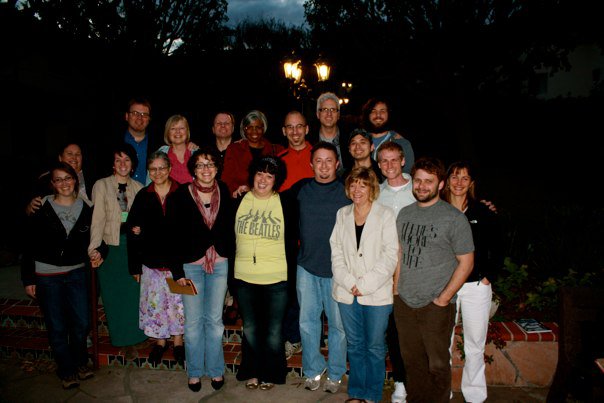
I have journeyed with these people since September, 2008, at which time we embarked on a wild ride into the spiritual formation labyrinth together via a Master of Arts program through Spring Arbor University. We graduated in May, 2011.

This was what I originally posted after our final residency in Malibu (yes, California, where we suffered immeasurably even as the prophets before us). I miss them.

The “Conspirators” we call ourselves, based loosely on Eugene Peterson’s notion of subversive spirituality; that which weaves itself as an unstoppable force in faithful lives, moving deftly under the radar. We’re setting out to dethrone evil and injustice in the world while people are looking the other way and we’ve set a goal of becoming more like Jesus. Were I to forget everything read, spoken, thought or written, them I could not. They are Jesus to me. In them I “get” God; through them, God has skin to feel, hands to hold, eyes to see, lips to kiss, tongue to speak, arms to embrace and a heart that pounds, aches, breaks. Indeed, “in the shelter of each other we will live” (Jars of Clay).

The Christian journey makes no sense in any posture other than a humble yearning for light or any other backdrop than others bent on the same. The widow’s mite, small and seemingly insignificant, is the greatest gift of all since God’s face is on one side; everyone else’s on the other. As I have discovered, the best way of speaking to one another is through the haze of glassy eyes red with the tears of redemptive community. I feel utterly alone and yet surrounded by the spirits of others touching mine, hand clasped in hand in the metaphoric distance of geography. They are now who I am. Their voices are now my voice. The world I now see is the world they have known. The pitiful ache in my soul belongs to them and is for them. In this bittersweet pain I can do all things. God is never more real than when seen through the kaleidoscope of other journeys knit to my own. Their light merges with mine to create a single, piercing ray of illumination – God’s eyes for the world. This is the Church. Nothing less will do. Ever.

Reading the Bible as Scripture-part 2

As the Word in the word slowly transforms us we come to live in kairotic ways; the time behind time, the spaces between the words in which God works mystical wonders in us. In abandoning ourselves to this encounter we become incarnational shadows of Ultimate Reality. This cannot be the case if we approach holy writ as mere text; God reduced to a subject of textual dissection. In so doing, we deny the Spirit in the text access to an available and willing subject for the healing scalpel of God. God wants not to be a concept for us to master. God invites to submit ourselves to the revealing light of the Logos, witnessed to in Scripture, whereby we are laid bare before the One with whom we have to do.

If, as Bob suggests, the Scripture is to be approached as a place for transformative encounter with God this presents a most baffling dilemma. We must place ourselves before the text as we would our spouse, in utter love, humility and surrender for understanding. As Wesley insisted, we must come to the text in the same spirit in which it was inspired and recorded. It can then do its deepest work as a living entity; alive because of the Life dwelling both in and outside its pages.

Experiences like a January Residency would feel more sterile and less dynamic were it not for the communal context in which we may, together, seek. It is one thing to speak of love. It is quite another to see it at work and be the object of the same. Such mysteries beg description like setting to words one’s first kiss or hearing the needy cry of one’s newborn child. Few things feel so jarring to the soul as the dislocation one experiences in the shadow of the Mount of Transfiguration. The memory of fellowship, still ripe with nuances and hope-filled déjà vu can seem a mockery when trying to retro-fit ourselves for life in the low places. Says the Psalmist, “I think of God, and I moan; I meditate, and my spirit faints. You keep my eyelids from closing; I am so troubled that I cannot speak.” Although spoken in a spirit of anguish, the Psalmist here outlines the bemusing distress of his own spirit before Yahweh.

This perfectly describes my post-Residency anguish. It is my fifth; my third as a student. In none of them have I walked away so utterly undone as this one. Was it the fact that, for our cohort at least, it was the last one? What was so different this year than other years when all of the elements that make these residencies so magnificent were just as present? What were all of the intersecting points between who they are to me and who I am becoming?

Reading the Bible as Scripture

As mentioned in a previous entry, I am enjoying the rigors of an online Master’s program in Spiritual Formation and Leadership through Spring Arbor University. My next few posts will be reflections on our annual January Residency requirement. What follows are the beginnings of my thoughts from our most recent one. To wit…

It has been a rare occasion indeed when I have walked away so wrecked from an encounter than from this year’s January Residency. All of the reasons for this will, quite possibly, never be totally clear to me. What I can unpack with any sense of intelligibility is what follows.

Particularly appropriate to, and ironically illustrative of, our time with Dr. Robert Mulholland was a 2-day spiritual retreat under the leadership of Dr. Wil Hernandez. The inner nourishment provided by means of silence, community, liturgy and prayer served as an ideal foundation, the soil as it were, into which words about the Word might be planted. And that was the essential point of the entire week: how the word is ever the Word or Logos to us, God as text, the place of transforming encounter with God. My continuing reflections seek to answer some of the questions posed to us in a communal song, “The Summons”:

Will you come and follow me if I but call your name?

Will you go where you don’t know and never be the same?

Will you let my love be shown, will you let my name be known?

Will you let my life be grown in you and you in me?

Like millions before me, my initial introduction to the Scriptures was welcome, warm and winsome. Words fell effortlessly off the page to meet eyes lusting after more truth than I could possibly understand, let alone live. Jesus seemed alive in the gospel narratives. Paul’s careful exegesis of life, church, Jesus and their interrelationship was at once intriguing and alluring. The Psalms whispered or shouted in turn their voice of blessing, comfort, anger or woe and the Prophets proclaimed loud and clear God’s desire for holiness of life and faithfulness in worship.

Numerous study Bibles and countless marking pens later and I was neither appreciably closer to God nor to God-likeness. In fact, it was actually starting to become boring and stale. I found reading Shakespeare or Gerard Manley Hopkins more satisfying, theoretical physics more challenging and novels interpreting Arthurian legend more engaging. It seems that I had fallen under the same spell as any other post-Enlightenment, rational, Western individualist and treated the Bible much like the DVD Player or X-box instruction manual. What happens when I get it mastered? What then? Should I move on to more “difficult” material than God? When all the pieces are finally put together, as is the intent of such an approach, will I be more like Jesus? More fulfilled? More?

Dr. Mulholland set out to address this among other issues related to the role of Scripture in the process of spiritual formation. He was tacitly engaging, consistently interesting and a model of the interplay between keen intellect and deep faith. How could this not be a challenging experience!? In the words of Thomas Merton (a favorite author of Mulholland), “it is of the very nature of the Bible to affront, perplex, and astonish the human mind. Hence the reader who opens the Bible must be prepared for disorientation, confusion, incomprehension perhaps outrage” (Thomas Merton, Opening the Bible, pg. 13). Mulholland sets out to address why this is so.

Of particular interest to me were Bob’s (see how I did that? I waited before being so presumptive) stories and analogies which richly illustrated his thoughts. As a Presbyterian church music director I appreciated his analogy of Scripture as a symphony – in this case the Third of Beethoven – by which we might come to understand the heart and intentions of a God made “real” in a musical score. It is not a dry, academic exercise. It is the evocative dance of lovers set to the music of heaven. God’s heart is best seen in poetry and art than prose and mechanics. As Bob describes, the Scripture is iconographic in that it provides for us a living, multivalent window into the sacred.

In a sense, rather than having our nose pressed to a book for study we were taken high above the Scripture to see it as birds see the ground. The knowledge we seek is not a factual mastery of text but the relational subtleties of experiential knowing. To “know” our spouse in a biblical way seldom seems to translate to our knowing God in a “biblical” way: a visceral, sensual, vulnerable reality between two lovers in communication.

Part 2 later…Rob

Life as a canvas

I, like so many others, am one on a journey.  As a man who, at best, is in a state of constant spiritual curiosity, ever thirsty for knowledge and, at worst, indecisive and flippant, I am always on the look out for organizing principles.  However, as a poster child for the post-modern milieu, I have at times had an aversion to the codifying of faith and life into a non-integrated, linear set of theological propositions designed to classify my place in the big picture of Christian dogma.  Statements of faith, as needful and helpful as they are merely portray details of the tapestry; those main threads that bind the tapestry together and create a pattern. The beauty in the context of the body of Christ is that these statements, non-integrated though they may be, can provide the basic threads of the faith – the common threads – that unite all Christians.

Taken as a whole and seen from God’s perspective, this tapestry is a portrayal on fabric of one’s essential “picture” to the world.  Threads of differing colours and weights for different purposes are woven at ninety degree angles to one another, providing multiple cross-roads at each meeting place.  Lacking meaning by themselves and lacking the creator’s perspective, these threads can quickly lose hope, finding themselves at crossed purposes and conflictually related.  At micro level each thread travels a continuous forward road sometimes above its perpendicular counterparts perhaps with an accompanying sense of pride, accomplishment and clear vision.  At other times, life is submerged and “under the surface” as the creator allows other colours to predominate.

Life is a canvas.  Broad brush strokes upon newly prepared canvas provide the ethos and essential feel of the finished work.  The predetermined size of the work allows the canvas to be stretched and prepped for that which is to emerge.  Location, location, location – as in real estate, so in art, the placement of the canvas ensures adequate light pragmatically to the artist as well as proper light artistically for the ensuing endeavour.  The artist works quickly at first seeking to get on canvas the basic structure of the vision which prompted the painting in the first place.  As the vision unfolds, smaller, more painfully intricate strokes occur leaving vast portions of canvas untouched for long periods.  No brush stroke is less important than the other.  Each one a promise fulfilled toward the unfolding masterpiece.

Contemporary Christianity with its love for the corporate America constructs of vision statements, leadership gurus, definitions and strategies has sometimes fallen prey to “we are our vision statement” reductionism.  In other environments lacking the redemptive pressures of the gospel to the contrary, these become designs for “getting everyone on the same page” – a bottom line for the bottom line so to speak.  The unfortunate ramifications of a purely rationalist paradigm in such matters (clearly the love of post-Enlightenment humankind) is a lusting for unanimity rather than a move toward diversity in unity.  After all, homogeneity is easier to control and quantify.

With all of that as precursor I must say that writing a personal mission statement has been one of the most meaningful undertakings of my entire adult life.  Although not a complete picture of the tapestry unfolding, it has acted nonetheless as an important organizing principle for my life in general terms. It has also acted as a helpful guide in my own spiritual formulation.

I’ve often questioned whether spiritual formation can ever be “offered” as such, believing that it can only be “encountered.”  However, I am pleased by the resurrection of the terminology in post-modern thinking to describe this goal of the redeemed life.  It is a classical Christian perspective on one’s continual conversion, incarnationally, into the person of Jesus Christ.  Unfortunately, “discipleship”, has become its modernist, Descartian counterpart, by contrast more suggestive of a mental assent to universally agreed upon systems of thought and doctrine birthed in rationalism.  It, for me, has often been the clearing house for “believe this and all shall be well” data-driven Christianity.

God’s personhood and redemptive action (and by extension, my own) work both in and through the worshipping ecclesia. As God’s physical voice in the world, we are, clearly and hopefully, to state God’s loving intentions without the typical “mighty speak” rhetoric which can have the effect of bull’s eye Christianity loudly declaring who’s in and who’s out.   A progressive orthodoxy, diversity in unity, and holistic sensibilities are what encourage me. If that is what the church is about, count me in.

God with skin

Christianity is a lived reality, not just an idea.

It is also something shared. Faith is a communal notion. It was never intended that we be individual ivory towers of righteousness. Rather, we are made strong in community with others whose gifts and strengths augment our own; where our weaknesses are rendered small and insignificant in light of the strengths of those around us who also name the name of Christ. This is about that – the Body of Christ, or as Ronald Rolheiser says, “God with skin.”

At times, our bodies work well. At other times, not so well. For example, we may be on the mend from a broken leg but still suffer migraine headaches. Or perhaps we suffer from rheumatoid arthritis but our minds are keen and sharp, providing clarity and wisdom for others.

When two friends know each other intimately they share life and joy even when they hold to very different views on topics. A husband and wife will often finish each others’ sentences. They think as one. They act as one. They live as one. Two old lovers can sit silently in front of the fireplace, he with pipe and paper, she with pillow, knitting and the cat on their lap and say everything that needs to be said without speaking a word. They say everything without a sound. Their relationship has been forged in the crucible of life and experience and suffering and overcoming and failure and time. Its richness is seen in the ability to simply be in the presence of the other without pretense or embarrassment or expectation.

At certain periods in our relationships, be they childhood friendships, a husband or a wife, or spiritual kin in the family of Jesus, there will be times of celebrating newness. A child is born – we celebrate a new life. What kind of parent would we be if we never rejoiced in the little successes of our children? Two people who, unknowingly perhaps, sought for each other for many years finally meet, fall in love and are united in marriage – we joyfully celebrate their new union. What kind of spouse would we be if we never voiced our appreciation and love for the one who shares life with us? A close friend whose chronic disease is finally brought under some measure of control and we see them laugh for the first time in years – we celebrate new life. A young woman dogged by years of career failure finds her niche in a new job discovered “by accident” – we celebrate her newly resurrected self-awareness and pride of place. What kind of local church would we be if we never took time to champion the selfless efforts of our brothers and sisters?

What indeed.

In the name of the “God with skin”…

Hippolytus or Willow Creek?

It seems to me that, wherever one hears conversations about worship and music, three words rise to the top of the lexicon: contemporary, traditional, and blended.

“Blended”. Hmm, what a strange word! It sounds so…, well…, grey and porridgy to me; kind of like a colorless mush which leaves nobody happy, everyone confused, nobody satisfied, and everyone wanting more of what they call contemporary, traditional, or this or that, or…whatever.

“Contemporary”. Hmm, whose contemporary I wonder? How contemporary does it need to be to attain “contemporary” status? How long before that contemporary is traditional, neo-classical, neo-traditional, or God forbid, retro?  If I play a U2, Coldplay, or Metallica song on flute, cello, and harpsichord, is it still contemporary? Ask my 14 year old what he considers contemporary and you will receive a vastly different answer than if you ask even a classmate with whom he shares a lunch table!

“Traditional”. Hmm, what traditional I ask? Presbyterian traditional? Reformation traditional? Augustinian traditional? European-post-Enlightenment-Victorian-dead-white-guy traditional? Grandma traditional? What if I sing a brand new song in a old style? Is it contemporary or is it traditional? How about singing an old song in a new style? Is it traditional or is it contemporary? What do I call it when I sing the folk songs of Ireland, Scotland, Wales, or French Canada? What if I sing them with a Beatles style backbeat? Where does contemplative music fit in to the picture?

As you can plainly see, I struggle with the terms of the equation as much as the next person. As I continue to wrestle through these matters, I’ve come to believe, increasingly, that personal preferences, consumer mindset, the commodification of Christianity, our love in the West for arguments based on logic, and a certain sense of entitlement all play a significant role in how we think of worship these days. In the present milieu traditional often means “I know it. I’m comfortable with it. Don’t mess with it.”  Conversely, contemporary generally means “it’s hip, user-friendly and asks little of me.” It is culture-driven with the inevitable result of dumbing down the great universally stretching themes of the gospel.  Blended can sometimes mean that we struggle to pull both together into one stew often at the expense of authenticity or believability in either.

Imagine if we were neither traditional nor contemporary? These are linear terms born of a pendulum mindset. What if, as the post-moderns like to say, we discover the future through the past?  Writer and preacher, Tom Long, refers to a methodology of convergence worship. That is, the creation of something entirely different utilizing the tools at our disposal. He suggests that most church-goers see worship life in one of two categories: The Hippolytus Factor (looking back; for us) or The Willow-Creek Factor (looking forward; for them).  How incomplete each of these are on their own should be self-evident.  Stoic, elitist, naval-gazing, versus white-bread-‘n-apple-pie-Ken-‘n-Barbie worship.  Both offer something while not being complete in and of themselves. The late Robert Webber, utilizing the language of ancient-future, suggests that we can best approach a blended-contemporary model as contextualized through ancient liturgical formats.

One of the reasons I understand worship in more liturgical these days is that it pre-dates our musical preferences by quite some time.  It also helps to remove us from the prevalent ideology that worship=music.  Moreover, in liturgy, whether our music be contemporary, traditional, or blended we become completely involved rather than sit and soak in the presence of incessant “talking heads”; pursuing an incarnational Christianity versus a merely presentational Christianity.

It is much easier to simply divide and conquer – split everyone up on the basis of consumer preferences so that one can say, “I go to the ‘retro-post-hippie-progressive-emo-goth-industrial-death-metal’ service for the 18.5-22.25 year olds”. For better or worse, Westminster Presbyterian Church whom I serve is seeking to bring everyone under the same roof, at the same time, to worship the same God, in the same hour, using all the best, most excellent, most diverse, and most life-changing elements we can find to deepen souls and build the kingdom of God.  Everyone sacrifices something to be together on a Sunday morning.  Albeit we live with a higher base line of discontent, we believe this to be a more accurate picture of God’s kingdom.

Essayist Annie Dillard likens worshipers to children.  She states, we are “children playing on the floor with their chemistry sets, mixing up a batch of TNT to kill a Sunday morning.”  Regardless what position we take on matters of worship, we need not be oblivious to the fact that “the One whose presence we so casually invoke summons the creation out of nothing, commands the moon and the stars to sing, shatters kingdoms and brings tyrants to their knees, shakes the foundations of the world, and causes the earth to melt at a single word.” She continues, saying “ushers should issue life preservers and signal flares; they should lash us to our pews.  For the sleeping god may wake someday and take offense.”

When all is said and done, “we need to remind ourselves”, states Tom Long, “that even when Christian worship is at its best, it is…always the work of amateurs, people who do this for love, kids in the kitchen overcooking the prayers, half-baking the sermons, and crashing and stumbling through the responses on the way to an act of adoration.” These days, I’m much more interested in discussions which revolve around the philosophy of ministry and Trinitarian theology than about music preferences in a worship service; questions of ethos or style or appropriateness or whether something is glib or elitist. Let’s keep talking about the WHO and WHY than the WHAT and HOW.  Beloved, herein lies the rub; irrespective of where we are on any worship pendulum, we need to turn our eyes inward toward self-abasement and upward toward heaven’s unspeakably glorious but eternally forgiving God.

On the journey together, Rob

The art of words

Gerard Manley Hopkins. John Donne. Wm. Shakespeare. Christina Rosetti. Emily Dickinson. Paul Simon. Bono. Since I was a very young lad growing up in Calgary, Canada, I’ve had a love affair with language; specifically the art of words. Words spoken. Words written. Words read and re-read, like ingesting food for the eyes that gets digested in the heart. In the holistic sense of the term, words are sensual. They are meant for more than simply corralling ideas or channelling information. They can and should be beautiful for their own sake. Carefully chosen and meted out in gradual succession like adding the correct ingredients in proper order to the perfect meal, words are part of the whole and greater than the sum of their parts. They massage meaning into our spiritual skin, perking up our inner ears to hear what our unseen lover whispers in our unguarded moments.

The Christian life is more poetry than prose; more a wild garden than suburban lawn. To that end I share this brief poem:

am

Day kisses night

on its way to dawn,

soon to draw her droplets

of dew, the sap of hope lain low

on earth’s misty treasure.

Morning meets hollow,

Sullen, soaked in the sallow,

dimpled winter, Spring

taps impatiently her shoulder

cold, but waiting, back turned

to face of the new.

I sit

Sit with her in hard patience

Awaiting promise of ante-meridian

Resurrection.