A philosophy of spiritual formation

In a little over four days from now I, along with 18 other stellar individuals, will graduate from a 3-year foray into an M. A. in Spiritual Formation and Leadership. Part of our final synthesis/integration class was to encapsulate in 2 pages or less our personal philosophy of spiritual formation. Well, as a guy generally wallowing in my own self-important verbosity with ne’er a hope of eschewing obfuscation, what follows is mine, such as it is.

The term, spiritual formation, presupposes a number of things. It assumes that we are possessive of a spirit to which spiritual matters of concern point and from which emanate certain characteristics. The word formation is both a practical and a conceptual word suggesting that whatever spirit is, it can and should be formed in some way. Together, they presuppose the possibility and potential for such change to occur.

God is. God’s self-revelation tells us all we need to know about who God is, who we are and how we inter-relate (1 Cor. 1:30; Gal. 4:4-7; 1 John 3:2). Our very existence testifies to a God whose boundless desire to express Godself is bespoken through the created order in which we share (Psalm 19). We exist because God did before us and spoke all things into being (Gen. 1:26-31; John 1:11-5). We are like God (Psalm 8). More importantly, God is like us (Matthew 1:22; Luke 2:7-20; Gal. 4:4; Hebrews 4:15-16). Before he ever spoke a word, Jesus, as God-with-us, made it astonishingly clear that this God loves us and desires to identify with us (John 3:16-17). Spiritual formation begins in our awakening to these mysteries.

I am. When we awoke this morning, what we saw in the mirror gazing back at us was a complex being indeed. We are polyvalent but indivisible beings possessive of a mind, heart, body and soul; all of it “fearfully and wonderfully made” (Psalm 139:14). We grow to become the amalgam of our every thought, word, relationship, joy, pain, experience, decision and whim. Everything shapes who we will become. When all of the varied parts of one’s life are functioning optimally under God’s leadership, integrated and moving toward the singular end of “holiness”, we may be said to be a spiritually formed person. Our growing awareness of this, the intentionality with which we capture this reality and the ever-increasing depth of our relationship in the Triune God may be said to be the process of spiritual formation. 

The gap between God’s self-revelation as both immanent and wholly other and our existence as good and perfect beings, but marred by sin, is the region of our redemption, the place wherein God finds us in Christ Jesus and begins, in partnership with us, the process of re-formation (Luke 19:10; 2 Cor. 3:18, 5:17; Gal. 3:19-20; Eph. 2:4-9; Phil. 2:20-21; Col. 1:19-20). It is less about obedience to a prescribed body of law as it is about wholeness and integration of all the varied and complex facets of our human existence under God (Rom. 1:17, 4:3, 9, 22, 10:4; Gal. 2:16, 19, 20). We join God in something God, in love through grace, has already started. As such, spiritual formation is more about the Who than the what and how (John 14:6-7; Col. 1:15-18; Rev. 1:8; 4:8b, 9b-11; 5:9-14).

God as perfect community, eternally existing as Father and Son, whose mutual love is the Spirit, portrays the fullest expression of communal love. God’s desire is that we share in this love. “The aim of God in history is the creation of an all-inclusive community of loving persons with God himself at the very center of this community as its prime Sustainer and most glorious Inhabitant (Eph. 2:19-22; 3:10).”[1] To the extent that we live out our lives in similar loving community we in fact mirror the Trinity.

Hence, the goal of all authentic spiritual formation is the tri-fold love: God, neighbor, self, as shared by Jesus in the “Great Commandment” (Matthew 22:36-40; Mark 12:29-31; Luke 10:26-28). All self-discovery when under the guiding rubric of a humble seeking after all that is true will result in a simultaneous self-love with love for the One whose fingerprints we bare (John 14:21). The result, in keeping with God’s self-giving nature, is a love for all God loves (John 13:34-35; 1 Cor. 13; 1 John 3:14, 16, 23; 4:7-21).

As distinct from prevailing marketplace spiritualities, Christian spirituality will, in cruciform identification with the Savior, always lead to our death whether real or symbolic (Matthew 16:24-26; 2 Timothy 4:6-8). Nurtured inwardly but expressed outwardly, Christian spiritual formation aims at Someone else for everyone else (John 15:12-14; Phil. 2:1-11; 3:7-11).

God’s forming work is done in an effort to make us more like the archetypal human person, Jesus.  Until we are as he is in all things, the oft-painful road of spiritual formation is the one we must travel. It is the road I choose.


[1] The Life With God Bible – New Revised Standard Version Richard J. Foster, editor HarperOne Books

A short poem from last summer.

Yakima to Ellensberg

July 21, 2010

Mottled and tustled blows

the Spring lint of fields;

hills blown dry in Summer’s bosom.

Little drunk parch-ed promise

whispers her secrets.

Moving over the gentle curves of

her brown back, full-breasted,

bloated not from watered spring

but gloating in perpetual want –

satisfied with less; less than satisfied

having drawn her drink from wells unseen.

I will lift up mine eyes unto the hills…

Thoughts from the beach…

Thoughts from the beach…

To commemorate a beach walk with my wife.


1

Beauty.  Random squalor in effortless

Wave deposits her treasure

In our efforts to build that which

Hand could never grasp we trade

Quintessential.  Queer.  Quiet for

Quantifiable.  Quick.  Casual.

Oh, such grand wordless words-

Wonder, World-watched prayers

Waiting…waiting.

That which is unseen – now

I see.

2

Wind-soaked beach-stained

Dark; darker still where waves

Kiss the sand of my imagination.

Flat boards float on round earth

Plays with my finitude and finer still,

Fills my earthen breath with

Deeper wind.

3

Dare she flits on so light a wing,

Fading into vastness, blue

The sky and water, one.

Where one defines what much cannot

In so many syllables contain

The vast smallness of it all.

May 12, 2003

Over Scotland

I love poetry. I used to write much more poetry than I presently do. I feel bad about that. Consider this part one in rectifying this. This poem was written gazing out from an airplane window while flying over Scotland in 1989. It was finished in 1991, the next time I was in Scotland.

High flying, window glass reveals tattered floor-

Pristine heaven greets eyes open to curving planet yonder

Stretching, reaching, sky-borne, we soar.

Place of kings bringing wonder to hearts that wonder.

Stipple green, ground richly steeped in lush, purple hue-

Woven pattern of road-cut scenes moves closer,

Sky meets peripheral sky, horizon’s hazy blue.

Shadows run as daylight comes.

Well-fermented scenes from ancient dreams-

Walls of stone, hearts of flesh, eyes of steel,

Pageantry in motion, all is as it seems.

Like God in man, surreal kisses real.

Robert Rife © 1991

Life as a canvas, part 2

Contemporary Christianity loves its corporate America-style constructs of vision statements, leadership gurus, definitions and strategies. Sometimes churches and Christians fall prey to “we are our vision statement” reductionism.  In other environments lacking the redemptive pressures of the gospel to the contrary, these become designs for “getting everyone on the same page” – a bottom line for the bottom line so to speak.  The unfortunate ramifications of a purely rationalist paradigm in such matters (clearly the love of post-Enlightenment humankind) is a lust for unanimity rather than a move toward diversity in unity.  After all, homogeneity is easier to control and quantify.

With all of that as precursor I must say that writing a personal mission statement has been one of the most meaningful undertakings of my entire adult life.  Although not a complete picture of the tapestry unfolding, it has acted nonetheless as an important organizing principle for my life in general terms. It has also acted as a helpful guide in my own spiritual formation.

I’ve often questioned whether spiritual formation can ever be “offered” as such, believing that it can only be “encountered.”  However, I am pleased by the resurrection of the terminology in post-modern thinking to describe this deepest of life goals.  It is a classical Christian perspective on one’s continual conversion, incarnationally, into the person of Jesus Christ.  Unfortunately, “discipleship”, has become its modernist, Descartian counterpart, by contrast more suggestive of a mental assent to universally agreed upon systems of thought and doctrine birthed in rationalism.  It, for me, has often been the clearing house for “believe this and all shall be well” data-driven Christianity.

God’s personhood and redemptive action (and by extension, my own) work both in and through the worshipping ecclesia. As God’s physical voice in the world, we are, clearly and hopefully, to state God’s loving intentions without the typical “mighty speak” rhetoric which can have the effect of bull’s eye Christianity loudly declaring who’s in and who’s out.   A progressive orthodoxy, diversity in unity, and holistic sensibilities are what encourage me. If that is what the church is about, count me in.

Life as a canvas

A bit frantic and scattered by nature, I am always on the look out for organizing principles.  However, as a poster child for the post-modern milieu, I have at times had an aversion to the codifying of faith and life into a neatly integrated, linear set of theological propositions designed to classify my place in the big picture of Christian dogma.  Statements of faith, as needful and helpful as they are merely portray “details of the tapestry…those main threads that bind the tapestry together and create a pattern…the basic threads of the faith…the common threads…that unite all Christians” (Thomas Merton).

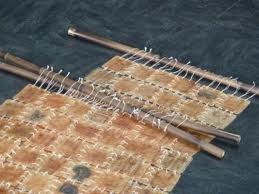
Taken as a whole and seen from God’s perspective, the tapestry that is our life is a fabric portrayal of one’s deepest essence.  Threads of differing colors and weights for different purposes are woven at ninety degree angles to one another, providing multiple cross-roads at each meeting place.  They lack meaning in themselves and without the creator’s perspective, these threads can quickly lose hope, finding themselves at crossed purposes; conflictually related.  At micro level each thread travels a continuous forward road sometimes above its perpendicular counterparts, perhaps even with an accompanying sense of pride, accomplishment and clear vision.  At other times, life is submerged, under the surface, as the creator allows other colors to predominate.

Life is a canvas.  Broad brush strokes upon newly prepared canvas provide the ethos and essential feel of the finished work.  The predetermined size of the work allows the canvas to be stretched and prepped for that which is to emerge.  Location, location, location – as in real estate, so in art. The placement of the canvas ensures adequate light to the artist for the ensuing endeavor.  The artist works quickly at first seeking to get on canvas the basic structure of the vision which prompted the painting in the first place.  As the vision unfolds, smaller, more painfully intricate strokes occur leaving vast portions of canvas untouched for long periods.  No brush stroke is less important than the other.  Each one a promise fulfilled toward the unfolding masterpiece…

The Chicken and the Egg…

The Chicken and the Egg: Henri Nouwen and the Coinherence of Christian Spirituality and Theology

Henri Nouwen’s spirituality was all of a piece. Although not necessarily all at the same time, he lived as the fullest picture, an amalgam as it were, of everything he believed to be true about life, love and God. His Catholic sensibilities offered him the mystical and relational foundation he needed upon which to build a life of inspiring integration. Nouwen loved movement. Journey. We find it everywhere in his writing. From loneliness to solitude; from hostility to hospitality; from illusion to prayer[i]; from opaqueness to transparency; from sorrow to joy; from resentment to gratitude; from fear to love, from exclusion to inclusion and from denying to befriending death,[ii] all which point to a profound understanding of the dynamic character of the spiritual life as lived out with God and among others leading toward self-understanding.

In the Great Commandment, Jesus gave to those who asked him a comprehensive curriculum for the invitation and expectation of the Triune God. It presents in kernel form the foundation and direction – the point – of the Gospel. It can be summed up in a single word: love. I am intrigued by the fact that Jesus did not say to believe in the Lord God absolutely with unassailable doctrine because out of it will come the safety of heaven. Nor did he say that, once our doctrine is without spot or wrinkle, will we then find the love to which Jesus herein alludes.

What Jesus does in fact tell them/us is that the sum total of the Gospel is a thoroughly inner disposition toward God and by extension, others. Moreover, since God’s definition of love is exceedingly more practical than ours, this idea takes root in the day-to-day realities with which we are faced. And, as love becomes an increasing reality in our lives, not only do we become more fully aware of God’s love for us but, reciprocally, others become the beneficiaries of this love. This is the integration I seek. It is the integration that Nouwen sought and, better than most, found.

As I would love to use the words “Rob” and “theologian” in the same sentence I must honestly affirm that I am an armchair academic at best. I know just enough theology to be interesting at parties, impress strangers and frustrate true theologians. I have, however, been an avid reader of theology among other areas of interest and believe I have sufficient epistemological architecture upon which to put the meat of life and my heart’s true passion: Christian spirituality. It is one of many ways I relate to Henri (as he would insist we call him). He believed that God was much more interested in the many ways theology serves spirituality, not the other way around. I suppose in a sense I am drawn primarily to what Henri Nouwen did intuitively – live an integrated life where all facets function in one kaleidoscopic whole.

For Henri, as for me nowadays, if it doesn’t start, continue and end in the vast expanse of contemplative prayer I am generally interested but not particularly invested. It was Nouwen’s answer for everything. His theology was apparent in both his teaching, his priestly duties and, with most clarity, through his spiritual disciplines. This, I think, is why I find him utterly refreshing and a good companion for my own journey.

I have already indicated that a reasonable summation of Christian theology could well be the ethic of love; love exhibited most beautifully and effectively through the presence, teaching and sacrifice of Jesus Christ. Much of contemporary evangelical theology leaves one with the impression that the incarnation and teaching of Jesus is of little account as long as one intellectually accepts the substitutionary-penal atonement (with ne’er a hint that, historically, other theories abound) made real through the crucifixion and heaven made available, personally, through the resurrection. Nouwen would find this insufficient at best, individualistic and self-serving at worst.

Nouwen’s Catholic theology permitted him to view the Incarnation as a central focus for his spiritual journey. The very fact of God-with-us told him everything he needed to know about the God he loved and served. Everything else was icing. It also gave much more room to see prayer as more than just ancillary to the Christian experience. It is the primary conduit through which we learn life-with-God in the now. For Nouwen, prayer was a daily, vital experience best found in silence. He advocated in almost all of his writing the further experience of prayer as silence in the context of solitude.

The Scriptures give us ample encouragement to do the same. Jesus’ wilderness temptations (a favorite passage of Nouwen, see Matthew 4:1-11; Luke 4:1-13), the choosing of the apostles (see Luke 6:12-16) and Gethsemane (see Matthew 26:36-46; Mark 14:32-42; Luke 22:39-46) provide Jesus’ own practice of peace and resolve through prayerful solitude. Although it is true that the reasons for our own foray into the spiritual desert, unlike Jesus, involves our battle with the ravages of sin, Nouwen is a tireless advocate for the place of silence and aloneness in which we are found and loved by this Jesus. Contemplative prayer can only happen between lovers; like the married couple, together for decades, each in their own chair beside the fire. Neither speak a word. There’s no need. They’ve said it all in the silence.

Throughout the entire two and a half years of our program a number of key words have lodged themselves rather obtrusively in my consciousness: integration, transformation and grace. That is, if I could distill from the Christian journey a singular notion it would be this: spiritual transformation takes place in my life to the degree that the grace of God is woven into my entire being to the end that my personhood becomes visibly and existentially integrated.

With adequate observation and honesty, one can see just how much we have prostituted theology to rationality, reducing it to points of doctrine best kept on paper but divorced from our actual experience, much like studying quantum physics or cellular biology. When theology never makes its way out of the intellect and into one’s experience, it remains an abstraction and about as useful as reciting the phonebook. It is fascinating but ultimately worthless.

For Nouwen, theology should have the quality of prayer. In fact, theology should always lead to prayer. All theology starts with “fear” or “our trembling response of unknowing to the unknown God.”[iii] Just as Mary in the annunciation…”what was experienced as a moment of interruption proves to be a moment of revelation. The theologian responding in faith to the situation of the moment discovers God’s active presence in the midst of the pain and, trusting in that presence, dares to raise a question.”[iv] It is a primarily relational, not intellectual matter. Knowing God and loving God are one and the same. It is relational in terms of community and not to be understood as an ivory tower pursuit where individualistic intimations are done with cool detachment much like the study of genomes, tectonic plates or planetary motion.

Nouwen insisted that theology is best done in a spirit of obedience and awe. The irony of this is that, to some degree, we are all sinners on a theological journey in and toward salvation. From start to finish it is a work of grace – unearned and uninitiated. In the words of Augustine, “I believe that I might understand.” Faith, in terms of how we live our lives and with Whom must ever precede the intellectual tenets by which we define such faith. Christian theology rightly understand is that it is ultimately only a scaffolding for the cathedral of our soul under construction. It is the skeleton upon which the meat of our spiritual existence adheres and grows. This was ever Henri’s way. I would that it were mine, too.

I’m a musician. Musicians learn scales like Christians should learn theology – to forget them. The point is the music. Theology lies hidden, like the trout swimming just below the surface of the water, which is the peaceful beauty we see. They not only live in concert together but also are utterly dependent upon one another. The water needs the fish to add a practical context to the beauty it possesses. It will yield something wonderful to those who seek. The fish requires the water for life and survival. Without it, it lives but a moment and then perishes.

This, to me, is Henri Nouwen’s greatest gift to the faith community. Equal parts theologian, priest, prophet, psychologist, educator, communicator, author and friend, he spun out these numerous roles in richly diverse but integrated ways. I have never read a single word of Nouwen’s vast output that didn’t lead me into much deeper, more real, more genuine places in my spiritual journey. Long after others’ works have faded into distant memory and are collecting dust among my innumerable other “important” books, Henri’s will still be on my nightstand, my desk or even the car.

A favorite phrase parents everywhere direct at their self-seeking children, ourselves included, is “you can’t have your cake and eat it, too.” Similarly, whenever budding philosophers submit mutual queries for mental acrobatics a favorite one is, “what came first, the chicken or the egg?” When it comes to how we embrace God and the Good News of Jesus Christ, Nouwen would suggest, as much from his life as from his words, that, in the marriage of Christian theology and spirituality, we can indeed have our cake and eat it, too. God’s best-kept secret translates well to the necessary coinherence of what we believe with how we believe it. And, as far as chickens are concerned, no chicken, no egg; no egg, no chicken.

At least, that’s what Henri might say…

[i] Nouwen, Henri Reaching Out: The Three Movements of the Spiritual Journey Image Books: Doubleday Publishing, ©1975

[ii] Nouwen, Henri with Michael J. Christensen and Rebecca J. Laird Spiritual Formation:Following the Movements of The Spirit HarperCollins, NY ©2010

[iii] Nouwen, Henri, from Caring for the Commonweal: Education for Religious and Public Life, Chapter 5-Theology as Doxology: Reflections on Theological Education Parker J. Palmer, Barbara G. Wheeler and James W. Fowler, editors Mercer University Press, pg. 95

 

[iv] Ibid, pg. 95

Ruminations of a Post-Modern

If someone had told this Canadian boy 10 years ago that one day I would leave behind everything I had ever known including the very ideological context in which I had first come into Christianity I would have scoffed at the notion.  As one often trapped between the competing needs of comfort through familiarity versus a constant dissatisfaction with the status quo, my journey has provided healthy doses of both!

In my ruminations on these matters, allow me to recall a few of my own experiences to help frame some thoughts.  Since early childhood, I’ve been drawn to all things artistic, historic, and mystical.  As a musician I have been impacted and transformed by a plethora of very eclectic musical influences ranging from the haunting sounds of Paddy Maloney’s uillean pipes in the Chieftains to Bruce Cockburn singing of “the speech of stones”; from the beauty of Brahms’ Piano Intermezzo in A, or Anton Bruckner’s, Ave Maria, to the skilful ramblings of Nickel Creek; from the Ordo Virtutum of Hildegard von Bingen to the songs of Supertramp, Steely Dan, Rush, or U2. We all have a picture of what can be called “sacred.”

As a Christian I’ve always been drawn to the beauty and meaning of ancient ritual and liturgy, my circuitous journey of faith ultimately leading me to the door of Westminster Presbyterian Church.  Each stop along the way has afforded me a little deeper understanding of my Christian faith.  From my early sojourn in the Evangelical Free church I developed an appreciation for a systematic theology centred in the Word of God.  From the Anglican (Episcopal) Church I fell in love with the Book of Common Prayer.  From the Pentecostal Church I entered deeper into the mysteries of the Holy Spirit.  From the Southern Baptists I learned…umm…well, I’m sure I learned something ; ^ ] From my Catholic friends and favourite writers I gained a profound appreciation for silence, contemplation and the idea of spiritual formation or gradual conversion.  From the North American Baptists I discovered the wonder of potlucks and learned some German.  From more liberal friends and writers I’ve learned of the kinship of the human family, a tip of the hat to common experiences of life and faith, our call to be the Body of Christ to the poor and disenfranchised, and the need for more female expressions of God.  If I’ve learned anything along this meandering road of faith, I’ve learned that within the circle of friends who call Jesus their friend and Lord, there is a place even for anomalies like myself.

In my mind, what all of this equates to is a montage of pictures of Christ and the Church.  I believe that there are many others like me out there – those who often defy definition but who are generally categorized as “post moderns.”  Their journeys are circuitous like my own – those who, by virtue of a profound disenchantment with modernism’s drive to explain everything to death, exhibit a need for creativity over continuity, high touch over high tech (ironically, however, we are the most high tech generation in history), community over individualism, form over function, beauty over brawn, people over program, mystical over management.  In faith terms, for me, this translates into a deep love for all things ancient – that which has stood the test of time and provides a shroud of mystery but is married to the futuristic cyber-intense world of the Matrix or X-Men.

Many in our “post-Christian” culture have NEVER said the Lord’s Prayer, owned a Bible, sung a hymn (let alone a praise song), read music notes, have heard of a narthex, lectern, chalice, or chancel, much less the redemptive power of the gospel.  Tellingly, however, there is a real thirst for just such things.  They must, however, be wrapped in a language and skin which is accessible to them: Ancient-future.

Jesus, in calling his disciples, does so for three primary reasons: “that they might be with him” (relational), “to be sent out to proclaim the message” (proclamational), and “to have authority to cast out demons” (missional); in that order (see Mark 3:13ff).  And, what a fine horde of diverse individuals they were, too!  From Matthew (Levi), a corporate yes-man, utilizing the system to bilk people all the way to Simon the Zealot, an anti-establishment, leftist revolutionary.  Christ first, last, and forever?  Indeed.

My life mission is as follows: “to draw people to God through my life and work which seek to meaningfully communicate God’s beauty and truth.” As a Worship & Music Minister, my hope is to “put a fresh face” on the wonder of our ancient faith.  In so doing, perhaps other strange anomalies like me can find Christ and a place to call home. There, but for the grace of God go I….

Pax Christi,  Rob

When rightness trumps goodness: theology and Rob Bell

As part of my master’s degree, we were recently asked to reflect on the ways in which we seek to live an integrated life: our theology and spirituality. Oh goody, a favorite question! My thoughts…

I’ve watched with both fascination and consternation the utter nonsense surrounding the newly released Rob Bell book, “Love Wins” as the doctrine cops race out of the starting gate, Bibles in hand, barking like rabid dogs at any hint of theology that in any way falls outside their miniscule parameters.

I know a ton of atheists, agnostics, and ass-holes whose theology gleams like the sun on the windshield. Jesus did, too. They were called Pharisees. They were those who held the keys to heaven and hell, blessing and curse, whether you were in or out, good or bad. In fact I seem to remember reading somewhere, “the demons also believe and shudder” – oh yeah, the Bible. Merely saying the right stuff out of a head full of all the right stuff doesn’t make us the right stuff.

The early theologians were more concerned that bad theology would corrupt good character. Theology as it is often lived out in contemporary terms is an exercise in “right” ideas, character be damned. In fact, in our rush to prove one another wrong, we display the very bad character that good theology seeks to redirect. We become the very demons we strive so assiduously to exorcise.

Moreover, I fear that the American cult of nationalist conservatism/moralistic ideology has hijacked Christianity in our culture. What passes for the gospel is too often a fundamentalist Puritanism that relishes in telling all of us how wrong (liberal, apparently, by default) we all are. Believe this stuff, and then give up pretty much anything that would ruffle our plumes ‘n feathers in the Victorian tea ‘n sympathy society.

Jesus risked living life with the ever present possibly of being misunderstood. Guess what? He was. He told his friends cool stories while taking walks and loved to be the life of the party. He quoted Old Testament poetry. He would never make it past the front door of our well-heeled, respectable, doctrinally correct churches. The ushers would escort out the street guy who stunk like wine and fish and refused to keep his mouth shut about disputable things.

I’m a musician. Musicians learn scales like Christians should learn theology – to forget them. The point is the music. Theology lies hidden, like the trout swimming just below the surface of the water, which is the peaceful beauty we see. They not only live in concert together but are utterly dependent upon one another. The water needs the fish to add a practical context to the beauty it possesses. It will yield something wonderful to those who seek. The fish requires the water for life and survival. Without it, it lives for but a moment and then perishes.

This, my friends, is what happens when the church becomes an edifice, protected rather than a garden, planted. This is what happens when being right trumps being good. This is what happens when we disavow grace in favor of controlling who’s in and who’s out. When our theology is divorced from life changing practice, i.e. orthodoxy without orthopraxy, we become headhunters rather than lovers of our brothers and sisters. The beauty of Christian theology rightly understood is that it is ultimately only a scaffolding for the cathedral of our souls under construction. It is the skeleton upon which the meat of our existence adheres and grows.

All of that to say this: I’d rather be judged for having compassion without holiness than holiness without compassion; for being more righteous than right; more glad than sad; more inclusive than exclusive; more truth-“filled” than “truth”-full; more understanding than understood; more gracious than corrective and, to quote Anne Lamott, more “Jesusy” than “Christian.” I want weirdos in the Church. Too many ties. Too few beanies. Too many BMWs. Too few skateboards. Too many businessmen. Too few radicals. Too much tidy. Too little messy. Too much church. Too little Jesus.

Despite obvious frustration over these matters, I love the Church in all her hypocrisy. I share in this hypocrisy. It has meant a willingness on my part not to enter into blogospheric theological debate, preferring instead to seek out relationships. It has also meant handing over my ministry, my music, my values, my long-term direction and everything else over to God in a posture of trust. I fear a day of reckoning is coming to the Church in North America when many of us will be revealed as those more committed to party line ecclesiastical politics than to an ethic of love. We’ll probably be blamed for being a weak-kneed kumbaya liberals who don’t “stand for anything.”

That’s alright – what that meant to Jesus wasn’t winning arguments. It meant dying at the hands of his own people. In the end love wins. And that’s the truth.

Just another online blowhard…R

Reflections of January Residency, 2009 – Part 3

Dr. Tony Campolo has been the large open door I’ve needed to call myself both a liberal and theologically orthodox; to somehow unite an Apostle’s Creed faith with progressive sociopolitical ideals. For me, this means an ever-deepening love for the Hebrew and Christian Scriptures as Holy Writ, inspired by God and the means by which God’s Spirit brings salvation, reconciliation and enlightenment.

Only a few years ago I had all but given up on contemporary evangelicalism. It no longer provided sufficient nourishment for my soul, framework to my changing ideals or challenge to my prevailing modus operandi. I was desperately thirsty for what I could neither name nor describe. Moreover, a certain underlying fear of “falling from grace” or “straying into error” pervaded my thinking. It made the decision to leave the Willow Creek Association church I was serving and take up a ministry in a liberal American Baptist church easy on one level and horrifying on another.

What I was to discover however was that it wasn’t liberalism I was searching for. My three years as Music and Worship Minister at this church revealed the following things to me. First of all, I had never experienced Christian spirituality practiced to that degree in a local church setting. The relative freedom afforded to me in asking archetypal questions of faith opened some delicious ontological windows into which flowed the warm sunlight of God’s face. But I needed tools to build on my ever-increasing thirst for a more mystical Christianity – a spiritual scaffolding as it were upon which to build my “interior castle.” Secondly, the inadequate Christology and, by default, atonement theology left a gaping hole in my need for a stoutly trinitarian soteriology. Christianity and specifically Christian spirituality made little sense to me otherwise. Finally, it was clear that I needed unifying principles around which to develop a totally new paradigm.

In the years that followed my short tenure at First Baptist Church, I have fully embraced the dual necessities in me of a peace and justice ethic coupled with an historically orthodox Christian faith. I have further devoted myself entirely to the spiritual life through my commitment to Renovaré, spiritual disciplines and expression of these in my home, my church of employ, my community and my hamlet of Yakima, Washington.

The latest and arguably most meaningful piece of the puzzle has come by means of this program. Specifically, the January Residency to which I owe this reflection, left me breathless on the numerous occasions when tears of joy refused composure or the best laughter in recent memory denied sleep. Best of all, seeing the bright and yearning faces to whom only names and letters have been previously affixed, sealed forever in my heart some of the finest individuals I have yet known. Tony’s eloquent and well presented thinking on matters related both to the Scriptures from which springboard his ethics coupled with Shane Claiborne’s radical, albeit non-judgmental, Christian journey, and Mary Darling’s straight forward and well laid out connecting points between mysticism and social justice gave me pause to exhale. I was many steps closer to home!

The events of one single evening bear greater reflection here. Dr. Ken Brewer’s explanations and evident love for the intersection of the Charismatic tradition with social justice was excellent. I must say however that, for one such as I who has swum in these waters before, with not a few bad experiences, his talk was much easier than the prayer and worship time to follow! I was immediately thrust into the uncomfortable reality that, if I was to be fully authentic and represent in my character every facet of God’s work in my life, I needed to exercise a willing suspension of disbelief. Songs were sung. Hands were raised in praise. Bodies swayed rhythmically to the voices of the saints praying together to our one God. My mind was haunted by an old cynicism. I have “worked a room” for many years and know just how to find the most vulnerable people to whom I sing just a little louder. The liturgies of Pentecostalism sneered at me from every corner of the room with voices I didn’t want to hear, let alone entertain. Then, a hand. Val Head, one I profoundly love and respect, had taken it upon herself to pray for me, uninvited (by me at least). It was a beautiful moment. She said nothing but allowed God’s Spirit to guide her silent prayer. In my struggle against cynicism, that action opened a door to God’s inner voice in me, which stated simply, “since when is it about you anyway?”

Dumbfounded that God would speak such simple but delightfully convicting words to me I proceeded to follow Val’s example and prayed individually for each of my cohort members in turn. The more I prayed, the more joy-filled I became. It was then that I “got” it. Even if the entire exercise is a manufactured one (to quote my cynicism), why not participate fully in the dance of the Spirit going on at some level whereby I become a servant and not merely a passive consumer? The release within was magnificent. I cannot say where God will take me regarding my theology in these matters. This much I can say, I do not need to be cynical anymore when faced with such events. I do not need to “hear from God” in the restrictive ways I had imposed upon God. In still one more way I am slowly becoming the man of integrity I so long to be.

A final thought: I have always believed that the more spiritually formed a person is, the greater their freedom from the conventional niceties of a tea ‘n sympathy religion. With the nearly two dozen people who comprise my cohort kindred, I prayed deeper and laughed harder than I ever have in my entire life. And, in God’s economy, since laughter sits next door to tears, I walked away a man utterly filled and transformed.

The integrity I once prayed for is taking shape in painfully slow but tangible ways. The discussions, worship, community, prayers and tears of a week with a few Spring Arbor University saints have painted wholly new and fresh blessings upon the canvas of my life. I am a man most grateful.

I still play the bagpipes.