
The impossibly orange morning sky mocks my melancholy and seeks to repeal my commitment to a sober day. The feathered fingers of precocious light embroider a morning otherwise condemned to generous helpings of over-thinking and under-living. Like passive-aggression to a psyche better suited to hiding than fighting, I brace myself for the full welcome of morning and, coffee in hand, steep in my self-righteous adherence to less than full inclusion in the happy chatter. If another somber, artsy day of writing and pain-mining was truly what I was after, then why the open laptop at the center table of my local Starbucks? Dear God, am I becoming “that guy”- the artsy, Mac-toting, liberal coffee snob?

Those like me are typically well-versed in the finer points of self-pity and overwrought, dilapidated prisons of Freudian fear wed to Jungian collective consciousness, albeit devoid of the intended mutuality to which it points (or much consciousness for that matter, either). The artistic temperament, housed in most musicians, writers, painters and the like, excels at emotional dumpster diving for those occasional jewels found at the bottom of a whole lot of shit. For some strange reason, it contributes to the creative process, for me at least. The smelly job of wading through my fly infested felch gives a certain twisted pleasure if the reward is a gleaming bit of writing or lyric or melody.
Even as I write these words I can’t help thinking to myself, is it any wonder type-As generally hate guys like me?! Growing up, I was that ki d who was either so preoccupied with his own swirling world of imagination that I could just as easily walk into walls as find my desk or whose swashbuckling stories of whim and woe – many of them stolen – regaled whatever girl was most likely to buy into it. In fact, a gift with words (my parents and friends called it bullshit) from an early age made finding friends an easy task, especially girls. This was not because I was particularly good-looking but more so because I was a skilled navigator of whatever self-projections were the most captivating. One might say I was a bit like a buzzard who scavenged tidbits of social detritus suitable to any given moment but who prettied them up with the fineries of clever, droll turns of phrase.
There’s a problem with this however. It has meant that a pleasant, even-tempered melancholy, peppered liberally with witty banter instead of good, old-fashioned hard work and embracing failures, have propped up my life artificially. I’m smart enough to have talked my way out of being wise. And now, at nearly 50, I realize just how little I really know; how little I’ve truly lived. It would have been better to shut-up until I actually had something worthwhile to say!
Now, lest I begin wallowing in self-pity and regret, let me assure you that this demeanor, although prevalent, is not an entirely accurate picture of my modus operandi. I suppose the most apt metaphor I can find for my life is that of the Major Seventh chord.
The Major Seventh chord is non-definitive, unlike the Dominant Seventh chord that pushes its way around until it gets what it wants: resolution. The Dominant Seventh chord is the spoiled child that has never had a need go unmet. Ever. And we get to hear about it regularly and insistently. It needs ground zero to be happy and is pissed off when it must hang around for any length of time without that resolution. It’s like the guy standing at the urinal but forgetting to put stuff away before walking out of the restroom. It’s unsightly, largely unnecessary (unless you’re from Australia) and, well, kinda stupid.
In musical terms, the Major Seventh chord has a raised seventh degree of the scale. She has moved past the standard seventh to a higher plane of consciousness less impacted by the need to settle everything but still yearning after something else. It is still built on a good foundation of a root, followed by a strong and happy major third, and another minor third on top of that. All the building blocks are in place to produce something of strength and beauty. To add the seventh is to add something uncertain, even unstable. The number of notes begins to feel crowded like too many people on a bus after taco night at the pub. Something has to give.
The Dominant Seventh says, in essence, fuck you, this is my show and you bloody well better serve up my demands for a trip back to home plate. The Major Seventh chord has a higher sensibility about it. She never demands anything. She suggests something, something angst ridden and indefinable. Her top note signifies searching, longing. The seventh note of an eight-note diatonic scale is what musicians call a leading tone because it’s leading us back “home” wherever “home” happens to be. However, in her case, there is a kind of contentment with the in-between liminality of a bossy Dominant and a restful Tonic. A quaint story of dubious origin tells of Mozart’s father, Leopold who, in his final attempt to get Wolfie out of bed, went to the piano and played the first seven notes of a diatonic scale, leaving it unresolved. Within seconds, feet were heard flying down the stairs to play the final note. To a musician, it’s a sin akin to lighting the curtains on fire and then walking away.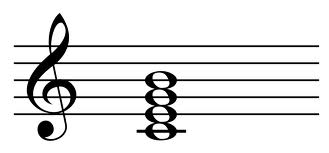
Major Seventh chords practically defined the 1970s’ Adult Contemporary music scene. Artists such as Bread, America, Gordon Lightfoot and Don MacLean built entire careers on them. They’re perfect for songs about lover’s triangles with the loser singing. They reek of the melancholy I’m so in love with.
And that is my point. Those of us condemned to live in the spongy greyness of our own articisms can ill afford too fine a definition of who we are. We don’t want to be too pinned down, boxed up or, God forbid, understood. And yet, deep within, there remains a fervent longing for just that: to be known, heard, experienced. If I am to find my best self, I’ll have to settle for the delicate balance of sadness and hope enshrined in the Major Seventh chord. It is life in the rain, an honest addiction to melancholy.
Frankly, it has served me well.





 innerwoven