December 4th. The Second Sunday of Advent. Sometimes, in terms of prophetic Scriptures, the Sunday representing hope. The gravitas of a future better than our past, of something yet to come that outshines the gloom of dark days, uncertain and fear-filled.
I can’t say this is necessarily that, but it is a new one all the same. And, if it helps to birth hope, all the better.
Advent
R. A. Rife
Cup before the pour, cocoa, or tea.
Clouds, rain-swollen, before taking their moment.
Hearts before words, warm and rightly spoken.
Page before pen, story pushing out to meet its maker.
Inside, a child gazes out at virgin snow.
Child, new and eyes closed, before the first embrace.
Car, keys jangling in shaky hands, before first welcome.
Our offering for Adventia, day 6 comes to us by way of the Adventus Project, which did a wonderful Advent exploration a couple years ago. And, of course, C. S. Lewis never disappoints.
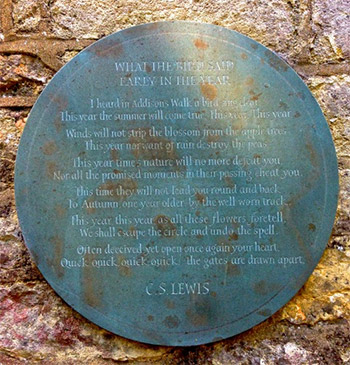
What the Bird Said Early in the Year C.S. Lewis
I heard in Addison’s Walk a bird sing clear: This year the summer will come true. This year. This year.
Winds will not strip the blossom from the apple trees This year, nor want of rain destroy the peas.
This year time’s nature will no more defeat you, Nor all the promised moments in their passing cheat you.
This time they will not lead you round and back To Autumn, one year older, by the well-worn track.
This year, this year, as all these flowers foretell, We shall escape the circle and undo the spell.
Often deceived, yet open once again your heart, Quick, quick, quick, quick! – the gates are drawn apart.
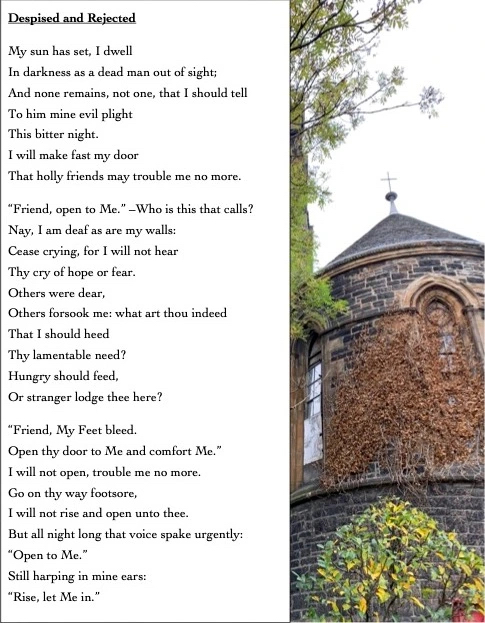
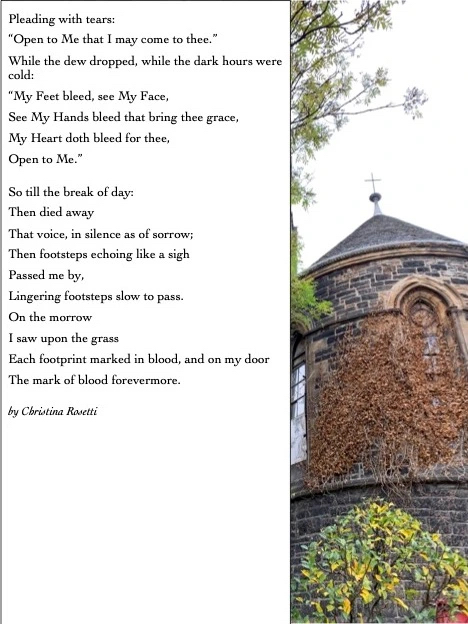
Christina Georgina Rossetti (1830 –1894), born in London, was an English writer of romantic, devotional, and children’s poetry. She is also famous for having written the texts of two well-known Christmas carols: “In the Bleak Midwinter” and “Love Came Down at Christmas.”
This poem combines Advent and Lenten themes; the sacrificial Christ pursuing the hospitality and kindness represented by the inn where there was no room for the holy family. The question ever asked of us, “is there room for the Christ within?”
Don’t forget to pop over and visit Real Poets Daily. They’re a wealth of inspiring poetry!
For Adventia, day 4 I submit a poem I composed a few years ago. Rough around the edges perhaps, but I hope it scratches at the surface enough to help us find place in our Advent journey all the same.May the angst, ambivalence, austerity, and frustration of waiting be rewarded in our common longing for the coming Light.
We Wait
Too many moons after too many suns and still –
we wait.
To arise to yet another day with no sight of promised end –
we wait.
My great, great, great grandparents told this same tale. Still –
we wait.
My great, great, great grandchildren, will they tell this same tale?
We wait.
For once pliable, elastic, hope-filled words, spoken from that creepy prophet guy –
we wait.
In hopscotch rhymes, coffee table books, Sunday paper riddles –
we wait.
Faithless ones mock. Faithful ones pretend to believe. Seeking ones struggle to hope –
we wait.
Stuck. In stasis. Solitary, floating in an endless ocean of shark infested water –
we wait.
Nine-year-old boys sneak their umpteenth grab of dinner being prepared a year after lunch –
we wait.
We’ve long ago forgotten or even care about what we were waiting for –
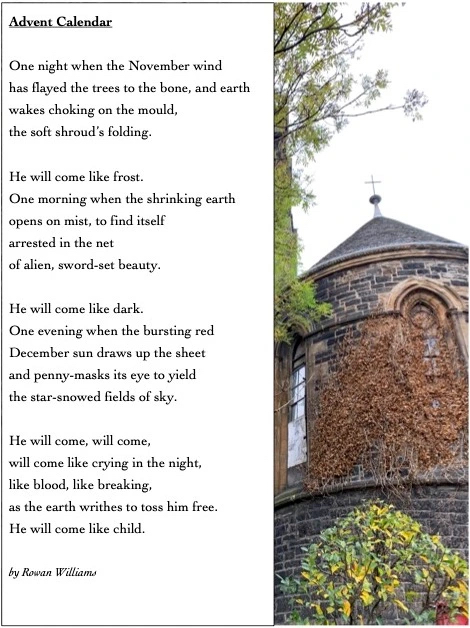
For Adventia, day 3, we are graced by the always luminous words of Welsh Anglican bishop, poet, writer, theologian, and former Archbishop of Canterbury, Rowan Williams.
In my first installment in this series, I explained the origins of my strange, made up word. “Adventia;” as I see it, a poetic foray into the headwaters of Advent – waiting, hoping, and preparing, together with Fragmentia, those literary illuminations of God’s in-breaking into our world to which we may unite the former.
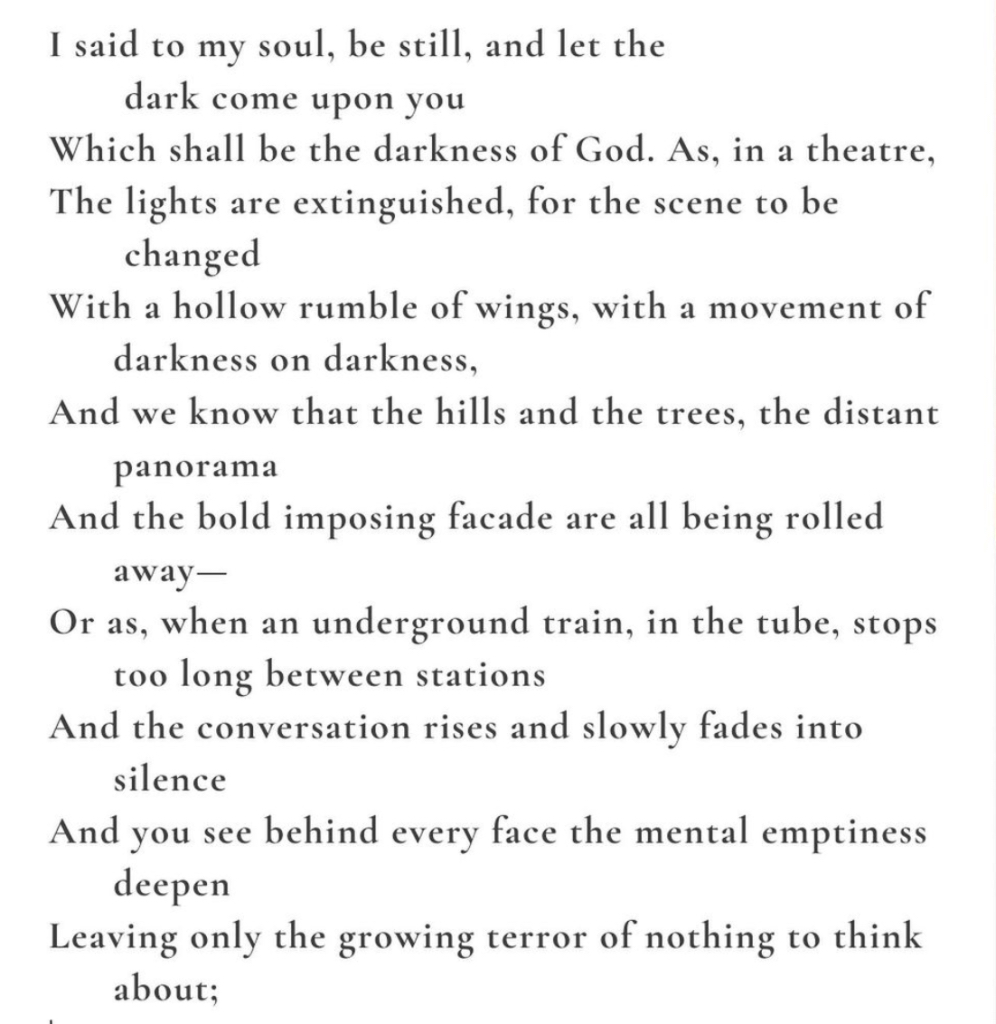
For most of these we’re taking our cue from a favourite Instagram site of mine – #realpoetsdaily Today, we’re blessed by this gem by T. S. Eliot, excerpted from “The Four Quartets.”
No, the above is not meant as some cheap attempt at a New Joizy accent with the word adventure. Let’s just call it the purposeful amalgamation of Advent and Fragmentia. Let it be a place where the illumination of God’s in-breaking into our world found in the Advent narratives unites with the fragments of literature and faith and life seeking to bring us to deeper understanding of it all.
Advent is upon us once more. With it comes a barrage of books and practices all aimed at helping us get the most from the experience. Last year I chose to post a daily poetic reflection on my poetry website. This year I’d like to do something similar here on innerwoven. It gives me opportunity to dive deep into some of the best words about the best time of the year; the beginning of the church’s calendar at Advent. These poems are both old and new and are found in various places.
For Advent, day 1 we begin with a gorgeous piece by Sally Thomas, which I saw first on a favourite Instagram channel, #realpoetsdaily
Here is “First Sunday” by Sally Thomas ( @sallytnnc )
On January 31st, 2011, I posted my very first piece on this blog. After much consideration I chose the name innerwoven because it seemed to capture what I believe to be true about all of us – we are beloved creatures kneaded into the dough of earth and eternity by God. An often-nasty business requiring much punching and bending and mucking about that constantly shapes our raw material into something warm and nourishing to be served up to a world starving for its goodness. And, although true spirituality is a two-way street – impulses and experiences, ideas and trouble, ecstasy and environments – moving in and out of us, the work of God is largely an inner one. God, at the very center of us, pushing His/Her way out like radiating circles of magma to the mouth of our volcano, ready to burst out upon the world.
This blog then was originally designed to be a catch-all spiritual notepad upon which I could scribble a few ideas about the nature of the soul, the shape of my emerging life, and in so doing, build a little community. Writing about all that required poetry which is what happens when words make love. They impregnate the page with something remarkably sweet and real. Robslitbits became the creative writing arm of the blog which I later portioned into a separate entity. At first, however, it was all right here.
To celebrate eleven years, I repost one of my earliest blog entries. This one was originally early February, 2011, but it still says the kind of thing I’d typically say. Thanks to all of you for taking this journey of spirituality and literature with me. You make life fun, interesting, and just…better!
* * * * * *
Gerard Manley Hopkins. John Donne. Wm. Shakespeare. Christina Rosetti. Emily Dickinson. Paul Simon. Bono. Since I was a very young lad growing up in Calgary, Canada, I’ve had a love affair with language; specifically the art of words. Words spoken. Words written. Words read and re-read, like ingesting food for the eyes that gets digested in the heart.
In the holistic sense of the term, words are sensual. They are meant for more than simply corralling ideas or channelling information. They can and should be beautiful for their own sake. Carefully chosen and meted out in gradual succession like adding the correct ingredients in proper order to the perfect meal, words are part of the whole and greater than the sum of their parts. They massage meaning into our spiritual skin, perking up our inner ears to hear what our unseen lover whispers in our unguarded moments.
The Christian life is more poetry than prose; more a wild garden than suburban lawn. To that end I share this brief poem:
I love poetry. I love its exactitude, its wide-eyed innocence wed to unflinching honesty. The unforced rhythms of perfection, like Grandma’s gaze over well-worn glasses. It is the art of lovers, the science of thinkers, the wisdom of doers.
Poetry gives up her secrets cautiously, altruistically, slowly. Every word, like every note of a great symphony, is fully intended, placed unequivocally in its place with an eye, and ear, to building something remarkable out of simple things, something well beyond the sum of its parts.
In a thousand ways, we are the amalgam of our carefully written words; each one added to the emerging poem of our lives. In this process, there are no real mistakes. There is only the discernment asked of us in the changing turn of phrase that will ultimately become our voice in the world.
For me, Rosebud was one such word. Perhaps an entire stanza.
Although my active period in Rosebud was limited to a few months in 1987, her existential tattoos continue to reveal themselves in enduring ways. A tiny, easily missed oasis in the Alberta prairie percolated in me an entire life thereafter committed to several things: the transformative realities birthed in the canyons of friendship, great things can come from wee places, the pursuit of art wed to faith, and the kind of community possible only through probing, and honest, creativity. Family, lived best in and through, story. Our stories now connect in ways both obvious and subtle.
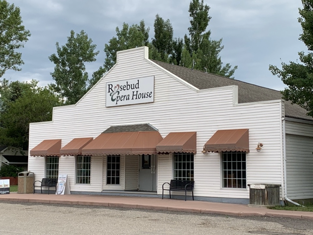
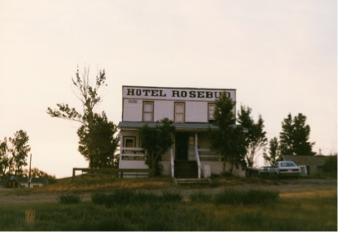
Rosebud Opera House, 1987
Rosebud Opera House, 2021
Our digs
The diminutive Akokiniskway
On the About tab from my spiritual life blog reads the following statement of purpose: “my life is dedicated to those places where life, liturgy, theology, and the arts intersect to promote an authentic spirituality – who we are becoming.” These values existed in me long before I ever made it to this place. But they were stoked by shared inspiration, fireside laughter, broken stage lights and fumbled words, splinters and spoilers, relational fugue and fatigue, the prayers and tears of young lives navigating their way to maturity; to wholeness. To become both passionate and com-passionate, all writ large in the art of our story. The Story.
On the Rosebud Fellowship homepage can be found the following statement, one of the six “objects” that articulates its purpose: “To promote the fellowship of people whose lives have been affected by the Christian mission of Rosebud School of the Arts.”
Friends, I am one such person.
My daily Rosebud prayer walk, Canadian style.
In the short time I spent here I found lasting friendships, a deep gratitude for the quality of connections that exist around creativity rooted in spirituality, and a way of living, boldly illustrative of the kind of “Christian mission” to which Rosebud has always been committed, both spoken and unspoken.
However, the vision of this place was never one for kitsch or the quaintly derivative “evangelism through art” which has damaged both evangelism and art in so doing. Sadly, what begins as evangelism can become nothing more than jingoistic cheerleading or public relations. What begins as “art” descends to something diminished and pale, akin to cultural babysitting, the low hanging fruit of the accessible and “relevant” to the demise of beauty, the archetypal perfections to which God, wide-eyed, once whispered, “it is good.” When beauty and story are the goal, both art and God win. For me, this is Rosebud’s greatest victory.
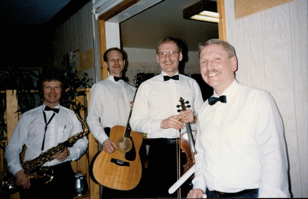
Table minstrels
To witness the leadership, serene but definitive, directive but collegial, of LaVerne Erickson has always been a wonder to me. A man of endless stories (and not a few impressive name-drops), tireless energy, and towering vision inspires me as much now as it did in those pre-Cambrian days of 1987. I’m still shedding the pounds added from Arlene’s unforgivably good cooking. More than a few good words (and some less so!) were knit to my story through the relentless humour of Royal Sproule, the passionate guidance of Doug Levitt, the sanguine wisdom of Lyle Penner, the many towering women of faith and creativity who helped put Rosebud on the map. And, of course, the big-heartedness of Akokniskway herself, calling us all deeper into her welcoming bosom.
My daily outdoor show
I am as Canadian as the day is long, complete with an undying love of trains. I grew up in a blue-collar home, the son of a brewery worker and homemaker. Our 900 square foot bungalow in the quaint but rough-around-the-edges southwest Calgary neighbourhood was poised right next to tracks, now LRT, but once host to regular trains through town. So, when I moved into my room in the Rosebud Hotel, the nightly train arriving just past midnight was like a well-worn pair of jeans. Her whistle neither haunted nor annoyed. It sang to me of prairie goodness, rich in the Canadian story so much my own. Our own.
The poetry of my life is ongoing. Rosebud has faded well into my rearview mirror. But she has never stopped whispering to me of what could be, those places where my past collides with my present to hint at a future.
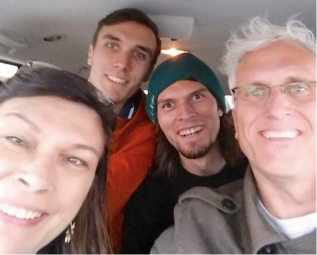
Rife crazies – Rae, Graeme (25), Calum (30), Me
Now, after decades of Christian ministry, a life dedicated to music, writing, poetry, spiritual formation, and the arts, two boys (both professional musicians), together with my wife Rae (Rosebud incubated our love!), we are planting new words in our emerging poem. This newest word takes us across the Atlantic to begin life and ministry in the UK. We invite as many as we can to join us on this journey. Our poetry improves with every letter added, every nuance of word, phrase, and metaphor.
All of you are all of that.
Rosebud, thank you for being a cradle, an incubator, a muse and sage, a friend. Your poetry is now, and will always be, my own. I take you with me, with us, into a new horizon. Our emerging poem.
Word for word, words for Word.
1987-Rae Kenny and I were married the following year.
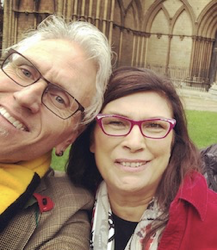
Same people, almost 30 years later. 2016, Peterborough Cathedral, England
A poem
When muscle, bone, and sinew can’t find heart
and listening and looking. Then, severed in time
from the wishing well of wonder, we wander
through rushes and slivers of our moments, bent
over mirrored water, haunted.
There is a wrinkle in the hour’d fabric of
our days when tender grows the minstrel’s
song. It rings across golden fields of
shimmering wheat – milled hopes, rolled and real.
Bardic but breathless it sounds, reveling in tremors
* Quoted from his famous work, Lines Composed a Few Miles above Tintern Abbey, On Revisiting the Banks of the Wye during a Tour. July 13, 1798 by Wm. Wordsworth













 innerwoven