Ruminations of a Post-Modern

If someone had told this Canadian boy 10 years ago that one day I would leave behind everything I had ever known including the very ideological context in which I had first come into Christianity I would have scoffed at the notion.  As one often trapped between the competing needs of comfort through familiarity versus a constant dissatisfaction with the status quo, my journey has provided healthy doses of both!

In my ruminations on these matters, allow me to recall a few of my own experiences to help frame some thoughts.  Since early childhood, I’ve been drawn to all things artistic, historic, and mystical.  As a musician I have been impacted and transformed by a plethora of very eclectic musical influences ranging from the haunting sounds of Paddy Maloney’s uillean pipes in the Chieftains to Bruce Cockburn singing of “the speech of stones”; from the beauty of Brahms’ Piano Intermezzo in A, or Anton Bruckner’s, Ave Maria, to the skilful ramblings of Nickel Creek; from the Ordo Virtutum of Hildegard von Bingen to the songs of Supertramp, Steely Dan, Rush, or U2. We all have a picture of what can be called “sacred.”

As a Christian I’ve always been drawn to the beauty and meaning of ancient ritual and liturgy, my circuitous journey of faith ultimately leading me to the door of Westminster Presbyterian Church.  Each stop along the way has afforded me a little deeper understanding of my Christian faith.  From my early sojourn in the Evangelical Free church I developed an appreciation for a systematic theology centred in the Word of God.  From the Anglican (Episcopal) Church I fell in love with the Book of Common Prayer.  From the Pentecostal Church I entered deeper into the mysteries of the Holy Spirit.  From the Southern Baptists I learned…umm…well, I’m sure I learned something ; ^ ] From my Catholic friends and favourite writers I gained a profound appreciation for silence, contemplation and the idea of spiritual formation or gradual conversion.  From the North American Baptists I discovered the wonder of potlucks and learned some German.  From more liberal friends and writers I’ve learned of the kinship of the human family, a tip of the hat to common experiences of life and faith, our call to be the Body of Christ to the poor and disenfranchised, and the need for more female expressions of God.  If I’ve learned anything along this meandering road of faith, I’ve learned that within the circle of friends who call Jesus their friend and Lord, there is a place even for anomalies like myself.

In my mind, what all of this equates to is a montage of pictures of Christ and the Church.  I believe that there are many others like me out there – those who often defy definition but who are generally categorized as “post moderns.”  Their journeys are circuitous like my own – those who, by virtue of a profound disenchantment with modernism’s drive to explain everything to death, exhibit a need for creativity over continuity, high touch over high tech (ironically, however, we are the most high tech generation in history), community over individualism, form over function, beauty over brawn, people over program, mystical over management.  In faith terms, for me, this translates into a deep love for all things ancient – that which has stood the test of time and provides a shroud of mystery but is married to the futuristic cyber-intense world of the Matrix or X-Men.

Many in our “post-Christian” culture have NEVER said the Lord’s Prayer, owned a Bible, sung a hymn (let alone a praise song), read music notes, have heard of a narthex, lectern, chalice, or chancel, much less the redemptive power of the gospel.  Tellingly, however, there is a real thirst for just such things.  They must, however, be wrapped in a language and skin which is accessible to them: Ancient-future.

Jesus, in calling his disciples, does so for three primary reasons: “that they might be with him” (relational), “to be sent out to proclaim the message” (proclamational), and “to have authority to cast out demons” (missional); in that order (see Mark 3:13ff).  And, what a fine horde of diverse individuals they were, too!  From Matthew (Levi), a corporate yes-man, utilizing the system to bilk people all the way to Simon the Zealot, an anti-establishment, leftist revolutionary.  Christ first, last, and forever?  Indeed.

My life mission is as follows: “to draw people to God through my life and work which seek to meaningfully communicate God’s beauty and truth.” As a Worship & Music Minister, my hope is to “put a fresh face” on the wonder of our ancient faith.  In so doing, perhaps other strange anomalies like me can find Christ and a place to call home. There, but for the grace of God go I….

Pax Christi,  Rob

Reflections of January Residency, 2009 – Part 1

By now it has become rather apparent that my M.A. program January Residencies have been deeply formative experiences. At the risk of boring the reader into a coma, I continue to share these experiences with part 1 of my 2009 reflections…

Who am I? In total recognition that I am among the countless throng throughout history who have asked this deepest of questions, my query is not of the kind asked by the philosopher who plumbs archetypes, epistemologies and the like. My question is less enigmatic and more practical in nature. More personal. My reflections on the January Residency are within the broader framework of my spiritual journey over the past few years.

I play the bagpipes among other Celtic instruments. It’s not that this information is particularly unique or interesting in and of itself. However, an early childhood fascination with all things Celtic and the means by which I began to learn the instrument make for good dinner conversation. Watching a television program featuring the Edinburgh Military Tattoo from Edinburgh Castle as a boy forever sealed my fate as a lover of the instrument. It also ended any hopes my parents may have had that I might play Chopin Etudes or Beethoven Sonatas in the shopping mall with the other little social climbers!

No, it was the fact that my mother revealed certain information to me after that night which forever changed the trajectory of my life. I am adopted. Moreover, I am adopted from a family with profound Scottish roots. The connection was complete. I was a mystic long before I ever knew what that meant. Who I am has been the primary question I’ve asked ever since.

In October of 1983 while praying in a dark gymnasium at Foothills Christian College, Calgary, Alberta I prayed a prayer: God, I want to be a man of integrity. At the time, steeped as I was in conservative evangelicalism, this meant a certain thing to me. I believed I was asking for a solidity, immovability, authenticity and trustworthiness – in essence, to say what I believe and believe what I say. My inability to stay very long with anything, to make decisions or share convictions rather than opinions revealed the fissures in the fractured windshield of my projected life. My prayer, in retrospect, was a prayer for something I didn’t fully understand. It was a prayer that I become a man of God, or at least to be known as a man of God.

The years that followed have, for me, completely unraveled a commonly held assumption among western evangelicalism – that a post conversion life was to be reflective of victory, an unwavering trust in God, and a consistency in discipleship and faithfulness to the primary tenets of Bible study, prayer and witnessing. Although these things will always be central for me, the circuitous journey I have undertaken has shown me many things I could never have foreseen.

My life prior to my conversion at age 18 could best be described as narcissistic, blissfully entitled and blessed. The world held great wonder for me. Everything around me – relationships, the created order, experiences, my place in the world – was cause for wonder, celebration and poetry. However, the oldest of three adopted children, I enjoyed a great deal of freedom and lived a pampered life with respect to the fulfillment of desires. Our home was small by most standards, five people in a 900 square foot bungalow (with one bathroom!) in a decidedly blue-collar area of town. But I was denied nothing. I could easily celebrate my existence since I was rich, globally speaking, and was the center of my family’s time and attention.

As my life continued to point me ever so gradually toward heavenly things I succumbed to the romancing of God while driving home from a singing gig in Edmonton, Alberta. I was 60 pounds overweight and profoundly hung over. My conversion was for me, earth shattering. At least in the short term I was an excellent candidate for the evangelical demand of a good testimony. I can in fact point to the existential realities of a deep sorrow for my sins accompanied by the delicious joy reserved for those who serendipitously embrace a way of life birthed in hope. Changes in my demeanor, direction, sensibilities and relationships were immediate and obvious. I was, in C. S. Lewis’s words, surprised by joy…

Scripture, Conspirators and the Jesus Way

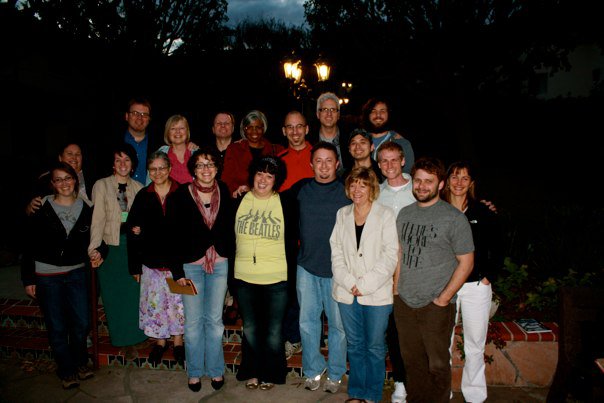
I have journeyed with these people since September, 2008, at which time we embarked on a wild ride into the spiritual formation labyrinth together via a Master of Arts program through Spring Arbor University. We graduated in May, 2011.

This was what I originally posted after our final residency in Malibu (yes, California, where we suffered immeasurably even as the prophets before us). I miss them.

The “Conspirators” we call ourselves, based loosely on Eugene Peterson’s notion of subversive spirituality; that which weaves itself as an unstoppable force in faithful lives, moving deftly under the radar. We’re setting out to dethrone evil and injustice in the world while people are looking the other way and we’ve set a goal of becoming more like Jesus. Were I to forget everything read, spoken, thought or written, them I could not. They are Jesus to me. In them I “get” God; through them, God has skin to feel, hands to hold, eyes to see, lips to kiss, tongue to speak, arms to embrace and a heart that pounds, aches, breaks. Indeed, “in the shelter of each other we will live” (Jars of Clay).

The Christian journey makes no sense in any posture other than a humble yearning for light or any other backdrop than others bent on the same. The widow’s mite, small and seemingly insignificant, is the greatest gift of all since God’s face is on one side; everyone else’s on the other. As I have discovered, the best way of speaking to one another is through the haze of glassy eyes red with the tears of redemptive community. I feel utterly alone and yet surrounded by the spirits of others touching mine, hand clasped in hand in the metaphoric distance of geography. They are now who I am. Their voices are now my voice. The world I now see is the world they have known. The pitiful ache in my soul belongs to them and is for them. In this bittersweet pain I can do all things. God is never more real than when seen through the kaleidoscope of other journeys knit to my own. Their light merges with mine to create a single, piercing ray of illumination – God’s eyes for the world. This is the Church. Nothing less will do. Ever.

Hippolytus or Willow Creek?

It seems to me that, wherever one hears conversations about worship and music, three words rise to the top of the lexicon: contemporary, traditional, and blended.

“Blended”. Hmm, what a strange word! It sounds so…, well…, grey and porridgy to me; kind of like a colorless mush which leaves nobody happy, everyone confused, nobody satisfied, and everyone wanting more of what they call contemporary, traditional, or this or that, or…whatever.

“Contemporary”. Hmm, whose contemporary I wonder? How contemporary does it need to be to attain “contemporary” status? How long before that contemporary is traditional, neo-classical, neo-traditional, or God forbid, retro?  If I play a U2, Coldplay, or Metallica song on flute, cello, and harpsichord, is it still contemporary? Ask my 14 year old what he considers contemporary and you will receive a vastly different answer than if you ask even a classmate with whom he shares a lunch table!

“Traditional”. Hmm, what traditional I ask? Presbyterian traditional? Reformation traditional? Augustinian traditional? European-post-Enlightenment-Victorian-dead-white-guy traditional? Grandma traditional? What if I sing a brand new song in a old style? Is it contemporary or is it traditional? How about singing an old song in a new style? Is it traditional or is it contemporary? What do I call it when I sing the folk songs of Ireland, Scotland, Wales, or French Canada? What if I sing them with a Beatles style backbeat? Where does contemplative music fit in to the picture?

As you can plainly see, I struggle with the terms of the equation as much as the next person. As I continue to wrestle through these matters, I’ve come to believe, increasingly, that personal preferences, consumer mindset, the commodification of Christianity, our love in the West for arguments based on logic, and a certain sense of entitlement all play a significant role in how we think of worship these days. In the present milieu traditional often means “I know it. I’m comfortable with it. Don’t mess with it.”  Conversely, contemporary generally means “it’s hip, user-friendly and asks little of me.” It is culture-driven with the inevitable result of dumbing down the great universally stretching themes of the gospel.  Blended can sometimes mean that we struggle to pull both together into one stew often at the expense of authenticity or believability in either.

Imagine if we were neither traditional nor contemporary? These are linear terms born of a pendulum mindset. What if, as the post-moderns like to say, we discover the future through the past?  Writer and preacher, Tom Long, refers to a methodology of convergence worship. That is, the creation of something entirely different utilizing the tools at our disposal. He suggests that most church-goers see worship life in one of two categories: The Hippolytus Factor (looking back; for us) or The Willow-Creek Factor (looking forward; for them).  How incomplete each of these are on their own should be self-evident.  Stoic, elitist, naval-gazing, versus white-bread-‘n-apple-pie-Ken-‘n-Barbie worship.  Both offer something while not being complete in and of themselves. The late Robert Webber, utilizing the language of ancient-future, suggests that we can best approach a blended-contemporary model as contextualized through ancient liturgical formats.

One of the reasons I understand worship in more liturgical these days is that it pre-dates our musical preferences by quite some time.  It also helps to remove us from the prevalent ideology that worship=music.  Moreover, in liturgy, whether our music be contemporary, traditional, or blended we become completely involved rather than sit and soak in the presence of incessant “talking heads”; pursuing an incarnational Christianity versus a merely presentational Christianity.

It is much easier to simply divide and conquer – split everyone up on the basis of consumer preferences so that one can say, “I go to the ‘retro-post-hippie-progressive-emo-goth-industrial-death-metal’ service for the 18.5-22.25 year olds”. For better or worse, Westminster Presbyterian Church whom I serve is seeking to bring everyone under the same roof, at the same time, to worship the same God, in the same hour, using all the best, most excellent, most diverse, and most life-changing elements we can find to deepen souls and build the kingdom of God.  Everyone sacrifices something to be together on a Sunday morning.  Albeit we live with a higher base line of discontent, we believe this to be a more accurate picture of God’s kingdom.

Essayist Annie Dillard likens worshipers to children.  She states, we are “children playing on the floor with their chemistry sets, mixing up a batch of TNT to kill a Sunday morning.”  Regardless what position we take on matters of worship, we need not be oblivious to the fact that “the One whose presence we so casually invoke summons the creation out of nothing, commands the moon and the stars to sing, shatters kingdoms and brings tyrants to their knees, shakes the foundations of the world, and causes the earth to melt at a single word.” She continues, saying “ushers should issue life preservers and signal flares; they should lash us to our pews.  For the sleeping god may wake someday and take offense.”

When all is said and done, “we need to remind ourselves”, states Tom Long, “that even when Christian worship is at its best, it is…always the work of amateurs, people who do this for love, kids in the kitchen overcooking the prayers, half-baking the sermons, and crashing and stumbling through the responses on the way to an act of adoration.” These days, I’m much more interested in discussions which revolve around the philosophy of ministry and Trinitarian theology than about music preferences in a worship service; questions of ethos or style or appropriateness or whether something is glib or elitist. Let’s keep talking about the WHO and WHY than the WHAT and HOW.  Beloved, herein lies the rub; irrespective of where we are on any worship pendulum, we need to turn our eyes inward toward self-abasement and upward toward heaven’s unspeakably glorious but eternally forgiving God.

On the journey together, Rob

Welcome.

Welcome to innerwoven, a place to discuss matters related to the Christian spiritual journey. Specifically, my interests lie in the many places of intersecting dialogue among worship, the arts, liturgy, and spiritual formation. As both a church music director (Yakima Covenant Church, Yakima, WA) and a graduate in spiritual formation and leadership (Spring Arbor University, MI) these are for me, increasingly, matters of genuine excitement. More selfishly, it is a place to share my circuitous journey of faith and the ways I’m seeing God in my world. In the world.

This is a safe place to be where all discussion is good discussion inasmuch as it strives unto mutual respect, love and understanding. Denominational baggage…please leave it at the door upon entering. But when you do, do so with my warm invitation to share this journey with me.

Pax Christi, Rob

A longing fulfilled

On August 28th, 2008, I began a journey 20 years in the making – I started my Master’s degree. What am I studying? I’m glad you asked. I am taking a Master of Arts in Spiritual Formation and Leadership. It is an online degree through Spring Arbor University in Michigan. Responses I’ve received have ranged from mild curiosity to deep fascination to turned up noses! So, why that and why now? Again, thanks for asking.

A favorite Rife family rock band, U2, wrote a chart topping song in the 80’s called, “I Still Haven’t Found What I’m Looking For”. Since Bono, their lead singer, was widely known to be a Christian, they received much bad press from the church for not speaking in more definitive terms about their experience of faith. However, it was something deeper that he was singing about. Like Bono of U2, ever since I can remember I’ve had a similar unfulfilled longing. You know that gnawing ache inside when you are standing in front of the refrigerator eyeing all the possible ways to deal with it? You can’t sit still. You’re bored but don’t know why. Nothing you do makes any difference. Augustine called it a restlessness. Ah, I knew you were going to ask that…yes, I do know and love Jesus Christ and his loving presence is everything to me. Then, why this “unfulfilled longing”? Let me briefly try to explain and in so doing describe why I’m studying this stuff.

I love the Church. But it makes me sad as well. I believe that we have abdicated our role as “God’s skin in the world” (see “The Holy Longing” by Ronald Rolheiser). Our mad dash toward relevance has squeezed out significance. Our insistence on just the right doctrine has left us with all the wrong lives. We’ve traded in righteousness for “rightness”. We have exchanged transformed lives for informed heads. Often, what passes for faith is a “notebook Christianity” where, with pen and paper, we learn God rather than love and live God. We study and memorize Scripture trying to control and tame God rather than being read by Scripture, thus being brought under its control. We have taken our risen, ever-living Savior and boiled him down to an idea or a worldview. We have a theology divorced from spirituality.

Says Dallas Willard, “we live from our heart.” Jonathan Edwards, the great 18th century Congregationalist pastor and theologian spoke much of “religious affections” which provide us with a “spring of action.” Willard calls the lack of real spiritual formation in the Western church “the Great Omission..  THAT is what I am studying.

I love Jesus Christ. I love the church. I love the rich and varied tapestry of Christian history and I love classic Christian spirituality. I have a longing to help all of us who are victimized by a materialistic, consumer society but who hunger after deeper realities to find wholeness and the re-integration of our fragmented lives. My own life mission is “to draw others to God through my life and work which strive to meaningfully communicate God’s beauty and truth.” Through worship, spiritual disciplines, liturgy and the arts my goal is to become the very Jesus we sing about and help others do the same.

Writer and theologian M. Robert Mulholland defines spiritual formation as “the process of being conformed to the image of Christ for the sake of others.. May God lead us to discover all the riches of Christ in order that we are conformed to God’s image for the sake of others. THAT is what I long for.