Glimpses VII: the blessing of obscurity

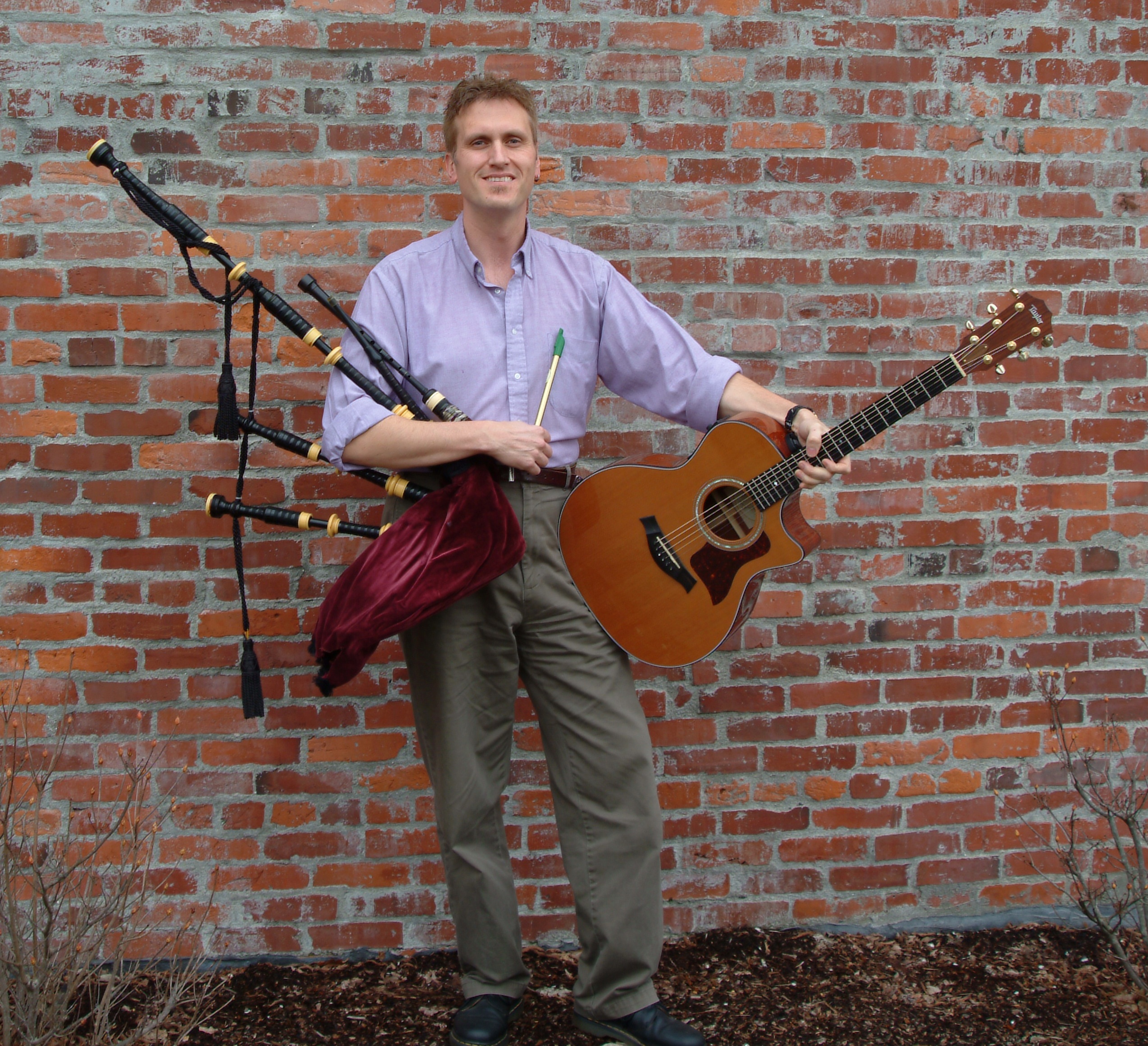
I’m a musician. A fairly good one I suppose, if I believe my own press. I’ve had at least nominal success at performing, writing, recording, arranging…the gamut really. It feels good whenever someone notices my ability. Really good. I have learned how to revel in a good compliment without either sidestepping it to the embarrassment of the one offering it or, by contrast, basking in it to the chagrin of those who then have to live with me.

I am (or so I’m led to believe) an Enneagram FOUR. The Individualist. Fours, when describing ourselves, are compelled to do so with more articulation, wit, sophistication and joie de vivre than the last FOUR who just described herself. We have to make a splash, an entrance of swishing haberdashery, groove, and devil may care cool that at once attracts attention but with just a hint of nonchalance to avoid inauthenticity or scorn. That way, we get both the notice of the entrance and the respect in spite of it. I call it the spirituality of swagger. It is the spiritual equivalent of the hip, there-to-be-seen, Starbucks cultural attaché. And it is temptingly indispensable for we artsy types.

Professional music ministry has figured into my journey for a number of years now. And, despite frequent boatloads of stress, they have been a gift beyond all telling. They have not, however, been the shiny, mist-around-the-edges trip to bountiful I’d hoped they might be. Probably for the best since, to know the truth ahead of time would pretty much empty the ministry of other foolish mortals such as I.

Since I’m waxing personal here, I am forced to admit that, rooted deep in much of my early ministry, was ambition pure and simple; a lust for high profile face time (places everyone, jazz hands, show me some sizzle). Of course, I would choose other language to describe it (I’m humbled to use my gifts in praise to God, and yes, I’ll sign that CD). The paid ministry gig would often pose as a front for whatever ambitious projects I was hungrily involved in that might otherwise guarantee even greater notice. In retrospect, ministry, at times, laundered my budding recording-performing career. That’s not to say that I was some kind of narcissistic monster. I performed the tasks of my call to the best of my ability and with as much love to which I was then privy.

While I was busily involving myself in as many satisfying ‘yeses’ as I could, God was pulling back the covers from my spirit, hitherto hidden and insufficiently tended. I was exploring my talent for music, creating, writing and leading alongside of God, insistently laying bare the deep wounds of my soul, a process yet ongoing.

The last few years have been (not entirely unwanted) a descent into obscurity, deconstruction, geographical isolation, and, to quote Henri Nouwen, “downward mobility”…and a boat-load of healing.

This has meant many things; concessions of a sort to the broader context of God’s work on my interior life. For example, I love overcast skies, rain, damp, shiny streets on dark mornings when, jogging, I can see my breath and smell the biosphere.

We live in the desert.

I love to gig and have done so for decades. Yakima has a tiny, struggling Indie music scene barely within anyone’s peripheral vision. I love all things eclectica; the strange, the eccentric, the anything wannabes and the rigorous interplay of opposing cosmo-political entities. We dwell in a town with few international restaurants of note and a rather simple demographic of whites and Hispanics.

I love the jaunty tête-à-tête so readily available in more left-bank Bohemian locales. I live and move among honest, hard-working, conservative, salt-of-the-earth types who could care less about my recent forays into metaphysical ontology, apophatic theology or Dostoevsky (apparently, I’m a socialist, a moniker I only half-heartedly deny). They have served me and my family tirelessly, supporting me in spite of my innumerable eccentricities. That is better than all the fame one can own.

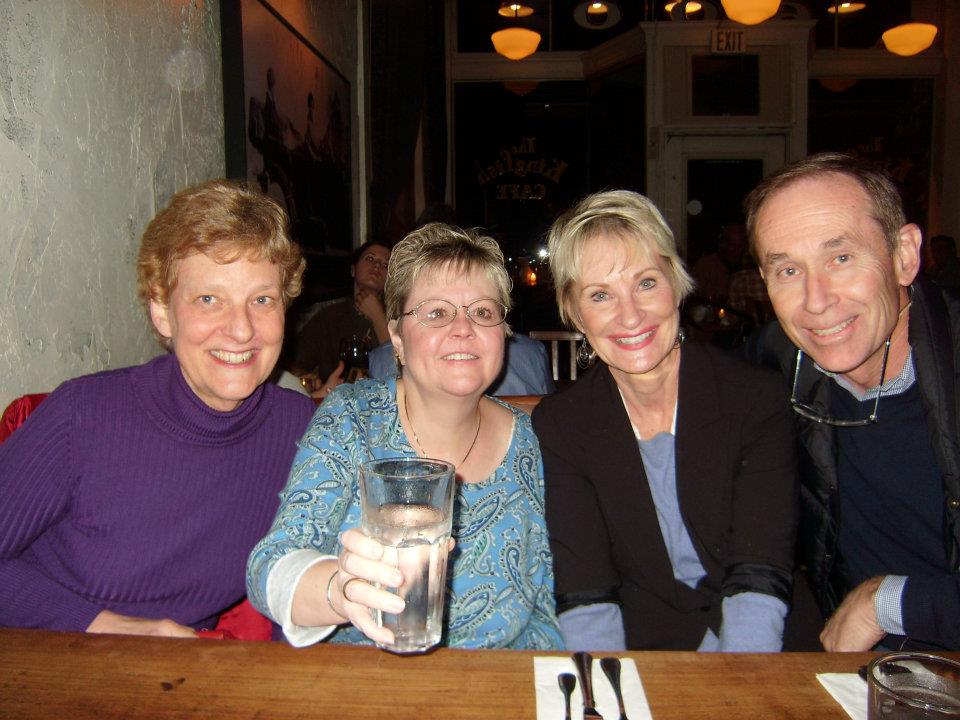
(A few precious friends)>

That which has postured as my life – panting, and out of breath – is slowly giving way to the more subtle, softly glowing embers of God’s gentle fire. I cannot in good conscience suggest that I no longer strive after validation or acclaim. Any shreds of real confidence, lasting relationships and consistency in my life have been attained through profound pain, multiple failures, (I add for emphasis: multiple) and forgottenness. These have been God’s preferred tools in adding leaven to the dough of my expanding soul.

Ambition and notoriety are deadly to the spiritual life. Exaltation is never to be our goal. Jesus promised it only through the more difficult way of humility, a path better defined by wood and nails than monitors and stage make-up. The restfulness and routine of life in obscurity I have embraced these days, gratefully. Nowadays, I’m plenty happy reading, writing or composing in my living room chair than I am anywhere more grandiose. For from here, I can hear…sacred whispers, most of which make no sense to me, but which shadow me everywhere and, rather strangely, guide me. I can honestly say that, this blessing of smallness has revealed the face of God and it is horrifying in its beauty.

Now, I must excuse myself. I need to check my blog stats…; –  ]

Glimpses, part II – the spirituality of place.

Where a person is can be as important to one’s spiritual development as what they believe. Long have spiritual masters proclaimed the benefits of sacred places. The Hebrew scriptures are replete with God’s directions to Israel to mark out territories prescribed by God that would both demonstrate God’s faithfulness and Israel’s special role in God’s redemptive economy. From the irrigated, verdant hills dotting the landscape around his hometown of Galilee, Jesus would spend countless hours with his Father. From such wilderness haunts he would find nurture, tenacity, strength, succor, and, frankly…answers.

So much of who we are and what we are becoming is directly attributable to the places that have graced us (rhyme subliminal but entirely intentional). In the comparative spiritual laissez faire of Constantine’s newly Christianized Rome, Abba Antony of Egypt started a mass exodus into the deserts of Egypt, those who would become known as the Desert Fathers and Mothers. The barrenness and desperation of the desert mimicked a similar cry deep within the hearts of these enigmatic souls. What is the obvious lesson? When there isn’t anything to titillate the senses, one might as well deal with the soul!

As a result of their foray into geographical nothingness, they became everything. They became the fullness that lies beneath the surface of what one misses when only seeing the desert sand.

The Celts, well known for their keen kinship with their environment, made much of this desire. Not unlike the Native populations of the US and Canada, not a feather of wing-ed bird, nor bark of tree, nor single trickle of rainwater escaped their notice. All carried within it some morsel of meaning for them.  Because everything received notice, nothing got wasted and this outer kinship found expression through inner resolve and great spiritual creativity.

My own holy places, the cairns of my wanderings, are generally old, rather solid, often drafty and poorly insulated, but full of the memory of stones that have long cried out to their Maker. Long have I had an historical and spiritual affinity for those stuffy, rarely air-conditioned chapels that never cease to draw me elsewhere…to the great Other. Let me share just a few.

St. Saviour’s Anglican Church sanctuary in Nelson, British Columbia where for a number of years I taught at a Highland Bagpiping School (a place where other strange souls like myself learn to tame a five-legged creature designed to rouse neighbors and destined to arouse suspicions). Connections in the community opened the door figuratively and, in this case, literally, to spend as much time as I wanted in the church sanctuary after everyone else had gone home. I was given a key and carte blanche run of the place.

Most evenings after a long day of bagpipe students, some whiny, some lazy, all of them noisy, I would retire to the sanctuary with my pipes. For an hour or so I would simply play, enjoying the epic reverberance of the sound bouncing off the hard stone walls, and finding no sonic respite from the hardwood floor. It was, for me, the closest I had yet been to what I might have then described as heaven. At times it was 2:00 am before finally getting back to my room.

The hospital chapel in the same city was another such place. I was falling apart after a recent break-up with a girl to whom I had been engaged. My shattered interior was gradually reintegrated in that little chapel where I would weep and pray for hours, listening to John Michael Talbot, or the Monks of the Weston Priory sing beautifully doleful refrains. It was for me, through gallons of heart-crushing tears, the perfect requiem to my stubbornly elusive peace of mind. It would become the Introit to a new place of healing and restoration, albeit gradually.

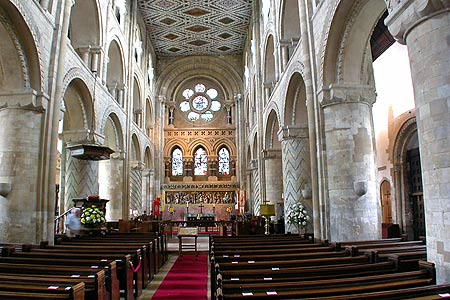
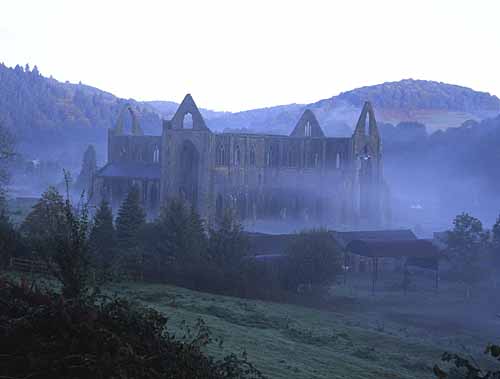
Tintern Abbey in Wales, the place I believe could be boasted by angels as heaven’s waiting room, the lobby to eternity. My first experience of this roofless wreck of holiness was following a six month sojourn as a missionary to youth in Edinburgh’s rough Pilton district with my new wife of a year. We were tired and needed time to traipse about the land of our ancestors (and her relatives) before returning to Canada, unsure of what awaited us there. The warm, lazy day infused with the angular light of Fall caressed the ancient stone walls easily visible from almost anywhere. The pointed gables of apse and nave bespoke a darker but simpler time. All we could do was sit and pray.

Less than two years later a picture of Tintern Abbey would help pull her through a terrible first pregnancy with our son, Calum. The same photo performed this function five years later as our second son, Graeme, reluctantly succumbed to womb-ed pressure and left his humble abode to make his premier. However, it is difficult to compete with William Wordsworth whose words best complete this picture:

While with an eye made quiet by the power

Of harmony, and the deep power of joy,

We see into the life of things…

And somewhat of a sad perplexity,

The picture of the mind revives again:

While here I stand, not only with the sense

Of present pleasure, but with pleasing thoughts

That in this moment there is life and food

For future years. And so I dare to hope…(Wordsworth on Tintern, 1798)

Everyone can point to at least one place where something important, even seminal occurred and they sense something is different. There it is that our life has been forever changed, perhaps only incrementally, but transformed just the same.

I believe it is God’s way of playing spatial peek-a-boo.

Think deeply of a place or two that have been places of rest and reconstruction. Picture that place in your mind. Now let that picture juggle your heart.

As you do so, re-member the pieces of you that may have been broken or lost in that place. Quietly give thanks to the God who loves to find us where we’re least looking or at least looking the other way.

Commissioning prayer

I moved with my family from Kelowna, British Columbia to McMinnville, Oregon a month before the infamous events of 9/11. I’m not generally known for great timing! The move was for the purpose of assuming my role as Minister of Worship and Music at First Baptist Church. My short, 3 year tenure there was challenging and exciting and growing for me. A congregant, Densley Palmer, was a wonderful hymn text writer and poet. The following is a commissioning prayer he composed for the occasion of my coming to FBC.

Commissioning

Densley and Joyce Palmer ©October, 2001

For the commissioning of Robert Rife as Minister of Worship and Music

First Baptist Church, McMinnville, Oregon, October 14, 2001


Let all earth dance and sing in the presence of the eternal God.

Let us blend distinct voice and individual song in praise and thanksgiving

to God who makes all things one.

Let us worship God with our voices,

on the organ, and on the pipe and drum.

Be still, and await God’s voice in the pregnant moments of silence.

Calm the erratic cadence of daily life and move to the rhythm of the eternal.

Through worship, glimpse God’s infinite breadth, eternal length,

and encounter the intimate presence of the holy.

Wherever we worship God, let it be with a sense of awe and expectation,

a spirit of joy, and an awareness that,

through worship, we encounter the sacred

and stand barefoot on holy ground.


Let all earth dance and sing in the presence of the living God.


Newcastle

Seven years ago today, I said goodbye to a good man. His name was James (Jim) Kenny. He was (is) my father-in-law. This song was a tribute I wrote and sang for him before he died. Why? Because I didn’t want to happen what happened with my own father where, even on his death bed, we really had nothing to say to each other. My loss. Not twice.

Newcastle

Words & Music by Robert A. Rife ©March 1/03


Somewhere, calling out into a dark, October sky

I think I can hear a grey gull cry – Newcastle.


Out there is a man who, if given half a chance,

Would no longer dance this dance – Newcastle.


Cold now, water dripping down upon the floor,

Can this be all there is in store? – Newcastle.


Some day in the matter of the twinkling of an eye

A dreamer will reach to kiss the sky – Newcastle.


And I kind of wonder what brighter vision holds for one

Whose spirit stretches far beyond these walls – Newcastle.


Newport and the year was 1964,

a 7 pound wonder at your door – Newcastle.


3 souls setting out for a far and distant land,

never look back with heart in hand – Newcastle.


Never, ever had it in your heart to say goodbye,

The faces at home, they wonder why – Newcastle.


And I kind of wonder what brighter vision holds for one

Whose spirit stretches far beyond these walls – Newcastle.


Sometimes ya gotta wonder why you’re giving up your best,

Smudge and toil for the rest – Newcastle.


Some men never imagine what it’s like to have it all,

To live and to die, to risk it all – Newcastle.


And I kind of wonder what brighter vision holds for one

Whose spirit stretches far beyond these walls,

And I kind of wonder what brighter vision holds for one

Whose spirit stretches far beyond these walls – Newcastle.


Newcastle…


Different Voices, Many Songs, One God

The great medieval feminist and Christian mystic, Hildegard von Bingen, composed a famous choral work, entitled “Ordo Virtutum.” It is really more of a musical narrative in which she weaves sublime choral and instrumental music punctiliously around ominous interjections of a sinister speaking voice, that of the devil, who utters hateful words towards the Almighty. As such she makes the metaphoric statement that all of God’s creatures were created to sing God’s praise.  However, only the enemy of God is denied the gift of song.  As God’s beloved creation, we are all a part of God’s redemption song in Jesus Christ.  Melody bespeaks our common humanity.  It defines our existence.  It narrates our story.  It proclaims God’s story.  It enshrines community and it is the food of glory.

Certainly, for many years choral music has played a central role in the worship life of the church.  It has been so in my own spiritual journey.  I credit Bach’s “Wedding Cantata”, his Brandenburg Concerto #2 and Anton Bruckner’s “Ave Maria” for creating the emotional backdrop for my own conversion.  As a young boy I enjoyed singing with the Children’s Choir of St. Andrew’s Presbyterian Church (the place I also learned to play the bagpipes – forgive them, they knew not what they were doing!).  I submit that a majority of folks on the faith journey would share similar sentiments regarding their own connection with music especially as it relates to worship.

I’m delighted to serve a rather odd Presbyterian church as music director; odd because we have determined not to divide ourselves up along preferential music lines based on consumerist ideology. Instead, for good or ill, we have journeyed together down the long and winding road of a single “convergence” worship service (I first heard this term used by Dr. Tom Long in his book, Beyond the Worship Wars). I actually prefer “eclectic” worship since “convergence” can feel a bit like someone hit the puree button on the music blender that spills out some indefinable ooze of congregational sludge.

We’ve sung everything from Bach to contemporary praise song arrangements to “Down to the River to Pray” from the movie, “Brother, Where Art Thou?”  We have sought to re-envision ourselves.  We have had many tough conversations together.  We have laughed and cried and prayed together in our quest to dwell under one roof, at one time, on one day, for one purpose: to bring honor to God by our common voice –  different voices, many songs, one God.

What this means is that we will never really be able to commit to the full on praise band since, to do so would immediately alienate those for whom such worship language would be far too big a challenge. It also means that our organist will always be under-utilized and over-anxious because she never gets to play as often as she would like and in ways that are most conducive to her own musical proclivities. Everyone sacrifices something to be together as a single family, albeit with a slightly higher baseline of discontent!

The joy and camaraderie of voices raised in harmonious praise is something that must be experienced for oneself. The shared sacrifice required to offer one another room for divergent but unique voices to be heard and appreciated is the true stuff of heaven. It is singularly Kingdom driven and really difficult to pull off. But it’s the best struggle I’ve been a part of thus far.

So, dear Hildegard, I’m inspired by your musical picture of God’s Kingdom. It is a Kingdom where everyone can sing together but where the enemies of God and God’s community are forced to bellow, grunt, wheeze and whine instead of joining that single, great choir called from every corner of the globe to worship this God. I leave you with these words from Hildegard: “Your Creator loves you exceedingly, for you are His creature, and He gives you the best of treasures.”

Music is just one of those.

Of Lent and Bagpipes: Lean Over Loud in the Spiritual Life

Lent is that time in the Church calendar historically set aside for an “under the hood” diagnostic of those things most needful for the optimization of our lives in Christ. It is a rich time, not for mere maintenance, but for the introspective dialogue with one’s own inner voice that, in concert with God’s voice, guides us to “practice resurrection” as Wendell Berry so eloquently advises.

Allow me to clarify with a story.

I’ll never forget the day I first told my bewildered parents that I wanted to learn how to play the bagpipes. I was seven. I had just watched a televised Edinburgh Military Tattoo replete with color-laden, swinging kilts, swashbuckling pipers, and swishing notes all clammering for attention under the bright lights of a night-lit Edinburgh Castle. From the first humming drone and pinched gracenote to the final cannon blast salute I was forever hooked. A seed was planted that has matured into a forty year career of performing, accompanying, competing, composing, judging and recording with this enigmatic instrument.

Under most circumstances, when one’s child shows even the slightest interest in music, it is generally accompanied by proud winks of acknowledgement, cackled whispers of “I always knew he had it in him” and blustery coffee room comments like “it was only a matter of time” or “our family has always been musical.”

At the risk of understatement, this was different.

Any parent hopes their groomed and dapper ten year old will be playing Chopin on the piano in the mall with the other bright and shining stars. With this announcement, those hopes were dashed. Instead, my parents (and poor, unsuspecting neighbors) would be forced to endure the long, loudly awkward learning curve the instrument promises all student comers. It most likely involved having to apologize to neighbors only pretending to be patient as some overly confident ten year old insists on playing, poorly, in the backyard.

On Sunday…night…late.

They did all this with patience and pride.

Similarly, a doting, jealous God waits like a holy panther ready to pounce on any sign of our awakening to God’s romances kissed in our direction. Patient and crouched, hopeful and proud, our Holy Parent, yearns for all that is best in our human lives. From first light of spiritual birth to the brighter light of eternity in us, God waits to discover, or uncover, our intentions toward God.

What does this mean? Will he stick with it only long enough to tire of it and move onto something else, despite the considerable expenditures of cash and time? Or will he seek to express a complex nature through an equally complex instrument designated for oatmeal-savage mystics whose love for center stage is well serviced here?

To parents, it simply does not matter.

For a bagpipe to function optimally it must have at least three things. It must be utterly airtight, with no chance whatsoever for the not-so-easily-blown instrument to lose any of its chief operating component, air. The only allowable air should be that in service to the four reeds dependent upon a steady stream of the same, and all at a highly regulated psi. Likewise, the best Lenten practices lend themselves to tightening up any holes in our spiritual lives, perceived or not. We must place ourselves willingly at the behest of a God who tugs at the cords holding our varied parts together in order to ensure the least “leakage” of the precious commodities of abundance and hope. In so doing, we relinquish our ownership over all we think to be primary for the singular goal of obtaining God alone. A heartily resonant helping of “lov[ing] the Lord your God with all your heart, with all your soul, and with all your strength” will do nicely here.

Secondly, it must possess the best reeds available (4 in all) in order for all energy expended to be done in service of a quality sound. It will only be as good as the weakest link in the complex chain of piping accoutrements. An unfortunate side effect of sin is our willingness to settle for counterfeit grace, for the short-term fix we think will provide quick, spiritual benefit but which, in the end, only multiplies our sorrows. All that we strive to do, at whatever level and for whatever reason in our pursuit of God will ultimately lead us astray unless we see it as pure grace; as gift. God’s purposes in us will always guide us to “whatever is true, whatever is honourable, whatever is just, whatever is pure, whatever is pleasing, whatever is commendable…any excellence and…anything worthy of praise” (Phil. 4:8).

Finally, all of its constituent parts of wood, bag and reeds are to be kept as impervious to excess moisture as possible – moisture that can foul the best reeds and, in worst-case scenarios, shut them down entirely. As with most mouth-blown instruments, outside influences of weather, barometric pressure, humidity and temperature have profound impact on whatever sounds are forthcoming. The via negativa of the spiritual life is to renounce anything that adversely affects one’s progress in the Way. John Calvin believed that self-denial lay at the heart of all spiritual transformation. To the degree we keep ourselves impervious, or at least well resourced, against the worst that life will most certainly throw at us, we will remain progressively more immune to outside influences that cause cracks to appear in our deepest parts where we need it to be well-contained and whole. The sage in Proverbs encourages us to “keep [our] heart with all vigilance, for from it flow the springs of life.”

It is a standard faux pas of pipers to assume that the biggest, fattest reeds will automatically proffer the biggest, fattest sound – an important and coveted feature of the instrument. At issue here is the fact that, the bigger the reed, the bigger the effort required in playing it.

The dilemma is one of physics. Sometimes trying harder with bigger than normal reeds simply forces a law of diminishing returns. In the young piper, less familiar with those physics and more inclined to early onset frustration with an already mystifying instrument, this can be daunting to say the least. As one grows in knowledge of bagpipe physics it becomes apparent that the best sound production isn’t merely one of effort. It is primarily one of the integrated and streamlined functioning of all the factors necessary to make the instrument the beautiful experience, and sound, it can be.

Similarly, the spiritual life, like the Highland Bagpipe, works optimally when we can see the big picture; how each element fits into the whole and, as a result, produces what we will ultimately become. God’s intentions in us include all elements of our existence, our choices, our conversations, relationships, experiences both good and bad, love gained and lost, anger welcomed and spurned, pain suffered and healed…everything.

The seasoned piper learns that a tightly-fitted, well-maintained, thoughtfully set up instrument makes for the best possible sound. Then, what at first can be a most, let’s say…unfortunate, sound ultimately becomes something of beauty that actually produces a bigger sound with greater resonance, nicer pitch and less energy. Good discernment and skill leads to something leaner that is, in turn, louder but also sweeter to the ear.

This is the magic of the Lenten gift of grace. We are better poised to usher a generally gangly, uncomfortable instrument into places of sweetness, strength and otherworldliness. That is how a bagpipe should sound. That is how I’ve heard it sound.

I think you know what I mean.

St. Patrick’s Day – Why the world needs the Celts

Today is Saint Patrick’s Day. A guy has to be a press-ready, crowd-pleasing commodity to get his own day. But, perhaps I’m just jealous. Besides maybe Saint Columba, he’s our best known Celt. And, in honour of his Celtic lineage, I share the following.

When one thinks of the term Celt or Celtic what images spring to mind? Is it the Pictish war-paint donned by William Wallace in Braveheart as he prepares to take Scottish troops into yet another conflagration with England? Is it the Military Tattoo at Edinburgh Castle where hundreds of overly plumed peacock pipers and drummers march to and fro in a celebration of Scotland’s warring past?

Edinburgh Military Tattoo.jpg
Edinburgh Military Tattoo, Edinburgh Castle

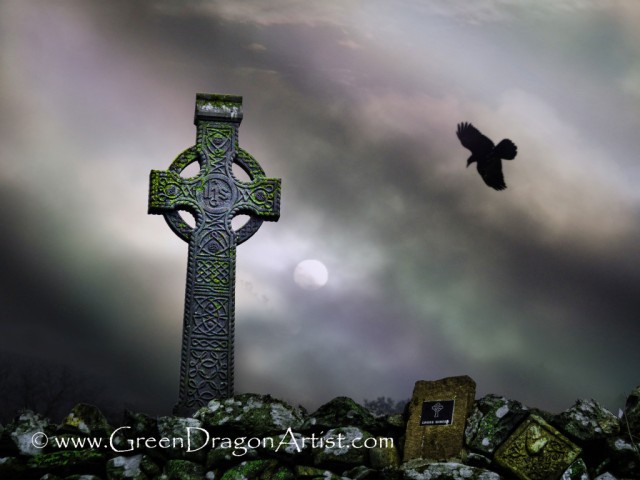
Is it the drunken party at the local pub as it becomes abundantly apparent that you’ve walked into some secret society, all of whom are experts on their instruments, can drink more than any human should be capable of but with whom you feel completely welcome? Is it the great standing crosses of Ireland? Is it Larry Bird?

IMG_0902-1024x768.jpg
Picture found here

Whatever one may think of the Celts, one thing is sure: they were a people absolutely unique in history and centuries ahead of their time. They were an aural culture, a bardic people of story, song, poetry and mythology. As such there exists a great deal of misunderstanding regarding their exact history. In fact, they seem quite simply to have passed out of existence like a fisherman’s boat sailing into the morning mist.

One example of this relates to something many bagpipers, including myself, play on the bagpipes: Piobaireachd. Let us review that spelling, shall we?

P I O B A I R E A C H D.

It was never their intention to leave any letters for anyone else. Piobaireachd is the co-mingling of 2 Scots Gaelic words: piobaire, or piping with eachd, music. Hence, piped or piping music. Piobaireachd is the classical music of the highland bagpipe and is loosely based on the musical idea of a theme and variations. It was most likely developed by a highland clan dynasty of the MacCrimmons, ancestral pipers to the MacLeod clan on the Isle of Skye. But since there remains so little written evidence of the clan and their history, many believe them, and their development of piobaireachd, to be the fanciful fabrications of folklore.

There is plenty that we do know that can benefit us, however. The Christianity that emerged in Ireland, Cornwall, Brittany, Gaul, Isle of Man, Scotland and Wales possessed some valuable gifts. I list here but a few.

The Celtic Christianity that thrived, undivided, from roughly the fifth through the twelfth centuries, is as deeply influenced by the culture in which it was birthed as the culture that was transformed by it. It is the child of the pagan culture that preceded it. We rationalists squirm a little at this idea.

We need the Celts because of their love for the poetic imagination and artistic creativity, building on a rich tradition of bards who sang the shared stories and exploits of her kin.

We need the Celts because of their similar love for kinship, relations and the warmth of a hearth. Their love of hearth and kinship translated in spiritual terms to what they called “anam cara” or “soul friends”, those with whom they shared their deepest joys, fears, sins, hopes, dreams.

The Celts were forever at odds with Mother Rome. To my mind, this equates to a paradox or at least to a willing suspension of seeming opposites. On one hand they were as profoundly Catholic as any other sect of Medieval Christendom. They yearned to be part of the larger Christian family. That is the Celtic way. On the other, they ever marched to the beat of their own drum – a Catholicism swimming in the quasi-pagan, swarthier style of the brooding Celts. They were both in and out.

How quintessentially Celtic.

We need the Celts because they insisted on the equality of all people in the eyes of God. They celebrated an egalitarianism in everything even allowing women to perform the Mass, a heresy of the first order even in contemporary, post Vatican II Catholicism! While worshippers throughout Europe frequented any number of great cathedrals, the Celts preferred smaller, homemade altars around which they would celebrate a deeply intimate Eucharist. Especially irksome to Rome was their liturgical calendar taken more from Druidic astrology than the accepted Church calendar. Rogues to the core, what’s not to love?

We need the Celts because of the monastic communities that flowered in Britain and elsewhere that became centers of classical education and learning, even possessive of literature outlawed by the Holy Roman Empire. As such, it can be said without exaggeration that the Celts kept knowledge alive and growing throughout the Middle Ages.

We need the Celts for their great love for the natural world and for preaching a God who loved it, too. They attached particular significance to particular animals, numbers, places and natural objects. Their spirituality was mystical in character, bathed in silence and solitude but rooted squarely in the everyday. It was a rich blend of the immanence and transcendence of God.

Skye 57.jpg
Quiraing Ridge, Skye. With this as inspiration, who wouldn’t see the sacred everywhere?

We need the Celts because of their unquenchably adventurous spirits, well known as explorers and/or missionaries to many places. Some have suggested that they may have been some of the earliest explorers to South America where Peruvian artwork mimics Celtic knot work.

We need the Celts to broaden our sense of time. They had an understanding of time that was less chronological than kairotic. In other words, they were not especially linear in their approach to life, love, faith and relationships. They valued the cyclical dimension of time, believing that by immersing themselves in the seasons of the year and uniting their lives with the liturgical seasons of the church, they could more effectively celebrate their journey through the sacredness of time.

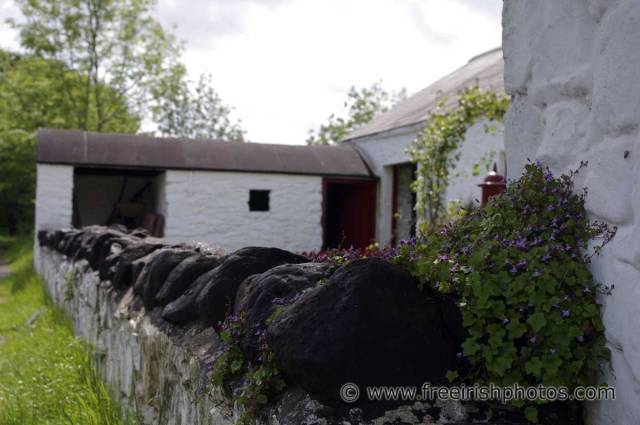
We need the Celts for a further distinctive, related to their concept of time; their appreciation of ordinary life. Theirs was a spirituality characterized by gratitude, and in their stories we find them worshipping God in their daily work and very ordinary chores. We, as they, can see our daily lives as a revelation of God’s love.

old_farm_2.jpg
Irish farm


_76438198_croftrunnerup.jpg
Rural Celtic life. Picture found here.

We need the Celts since their spirituality has great ecumenical value, transcending the differences, which have divided Christians in the East and the West since before the Reformation.

We need the Celts because, unlike we who are often more interested in what to believe than Who to follow, their Christianity was a way of life, a spirituality lived gratefully each day, one day at a time.

Finally, we need the Celts because they give us reason and opportunity to party in the presence of the God who loves us.

I’m in!

Glimpses – awakening to the indescribable

Early in a new year, and a leap year at that, I want to take a stab at describing what cannot adequately be described. As a contemplative and a musician, I have met, from time to time, with mystical experiences that beggar explanation, categorization or temporal understanding. In order to do so, a short preface.

At the foundation of Christian spirituality is the very basic principle of awakening or awareness. It comes in many different packages, under numerous ideologies, representative of a host of approaches each with practices that lend themselves to one’s emerging spiritual life.

To become aware is to wake from some form of slumber, sleep or sloth. One of the mysteries of spiritual awareness is that one does not awaken naturally. We are prodded awake by the loving work of God upon the sleeping soul. It requires this nudge of God upon our shoulder before any meaningful process of receptivity and relationship can occur. In order for us to ‘awake to our awakening’ we must receive the whisper of God speaking grace into the spiritual ear of our understanding.

I do not speak so much of the prophetic proclamation to “arise, shine; for your light has come.” No, before we can be so attuned to the prophet’s voice calling us to faithfulness and righteousness, we must first hear the voice of the Lover calling us to succumb to this wooing upon which our only response can be, “I am my beloved’s and my beloved is mine.”

As comforting and romantic as that sounds, however, upon awakening to the first primal strains of the song of God, there comes a dissonance amidst the lilting notes. We awake to beauty and begin to see that which we have always yearned after but of which we were unaware, blind. This, however, can often be a fearful and groggy experience. Cobwebs yet invade our minds unaccustomed to such sharpness of color. Ears that have been plugged up suddenly pop as our inner altitude changes. It is as disorienting as it is invigorating…

I remember places, glimpses into…something; an awareness that hints at a proximity to the indescribable, numinous presence of God. These are never easy things to describe, but there is a delight in the attempt for, in so doing, I am taken back to some of those places. Not always, but for me it is often some dusty, old church or monastery; most often at night, alone. Yet, not alone. As I have since come to believe, they were, as the Celts called them, thin places where a barely perceptible sheath surrounds the holy otherness of God and where comes a mystical awareness of God so immanent that one feels he can literally smell God’s breath, touch God’s skin. These experiences have often made the hair on the back of my neck stand up.

Ironically, they used to happen often when I was a boy, long before I had any faith lexicon or tidy systematic theology with which to scrub them up and describe them away. I recall one particular time as I lay on our living room floor. I was probably eight or nine years old and, as I did every year, was watching the first snowfall of winter as flakes danced past the streetlight that stood outside our house. In that moment, I became curiously aware of a haunting peace that arrested my sensibilities and held me spellbound in what I can only describe as ‘rightness.’ In that moment, the cosmos and I were one. God, as I now understand God, was laying beside me on the living room floor that night, whispering wordless words to me, convincing me of my place in it all, be it ever so miniscule.

Another such thin place for me was an Anglican Church sanctuary in Nelson, British Columbia where for a number of years I taught at a Highland Bagpiping School (a place where other strange souls like myself learn to tame a five-legged creature destined to arouse suspicions and rouse neighbors). Connections in the community opened the door, figuratively and, in this case, literally, to spend as much time as I wanted in the church sanctuary after everyone else had gone home. I was given a key and carte blanche run of the place.

Most evenings after a long day of bagpipe students, some whiny, some lazy, all of them noisy, I would retire to this sanctuary with my pipes. For an hour or so I would simply play, enjoying the epic reverberance of the sound bouncing off the hard stone walls and floor. It was, for me, the closest I had yet been to what I might have then described as heaven. At times it was 2:00 am before finally getting back to my room.

A third such place was the hospital chapel in the same city. I was falling apart after a recent break-up with a girl to whom I had been engaged. My shattered interior was gradually reintegrated in that little chapel where I would weep and pray for hours, listening to John Michael Talbot, or the Monks of the Weston Priory sing beautifully doleful refrains. It was for me, through gallons of heart-crushing tears, the perfect requiem to my dying peace of mind. It would become the Introit to a new place of healing and restoration, albeit gradually. This is a story best left unfinished…

Tale of a Wanderer

What follows is the manuscript of a talk I delivered at Linfield College, McMinnville, Oregon at their Thanksgiving service in 2003.

Brendan set out with fourteen companions, travelling westward. The wind carried them to the port of Arran. Brendan said farewell to Enda and the other saints of Arran and left a blessing with them. Then they sailed due west across the ocean. It was summer, and they had a favourable brisk wind behind them, so they did not have to row. After they had spent ten days in this way, the wind lowered its loud voice and whistling. With its force spent, they were compelled to take up the oars. Brendan spoke to them, saying: “Do not be afraid, for we have our God as our guide and helper. Put up your oars, and do not toil anymore; God will guide this boat and company as God pleases.”

One day when Brendan and his company were traversing the sea, they finally happened upon the little country they had been seeking for seven years; that is, the Land of Promise. As it says in the proverb, “He who seeks, finds.” When they approached the land and were entering its harbour, they heard the voice of a certain elder speaking to them: “O holy pilgrims, tired men who have searched for this country for so long, remain where you are a little while and rest from your labours.” When they had done so, the elder said, “Dear brothers in Christ, do you not see that this is glorious and lovely land on which human blood has never been shed? Leave everything that you have in your boat, except the few clothes you are wearing, and come on shore.” When they had landed, each of them kissed the others, and the elder wept tears of great joy. “Search and see the borders and regions of Paradise where you will find health without sickness, pleasure without contention, union without quarrel, feasting without diminution, meadows filled with the sweet scent of fair flowers, and the attendance of angels all around. Happy indeed is he whom Brendan, son of Findlug, shall summon here to join him, to inhabit forever and ever the island on which we are now.”

When they saw Paradise in the midst of the ocean waves, they marvelled at the wonders of God and his power.

After this, Brendan and his monks proceeded to their boat and departed from Paradise…It was thus seven years in all that it took them on the two voyages to reach the Land of Promise….At the end of that time they…proceeded to Ireland, where they dropped anchor in the sea near Limerick.

So goes the tale of St. Brendan the Navigator, one of Irish Celtic Christianity’s best known saints. As a post-everything guy (modern, evangelical, liberal, etc.), the spiritual life for me is best captured in story and in the metaphor of journey and it’s more intentional counterpart, pilgrimage.

The “tale of this wanderer” began one snowy October afternoon in 1981. Hung over, exhausted and broke, I embraced Christ (or he embraced me, you figure it out!) driving home from a 2-week stint singing in a pub in Edmonton, Alberta. I was not a reluctant convert to Christianity like C.S. Lewis, who, upon his own conversion to Christianity, “admitted that God was God, and knelt and prayed: perhaps that night, the most dejected and reluctant convert in all England”. No, instead my lifelong fascination with Christ succumbed to the “peace that passes all understanding.” Says C.S. Lewis, “there burst upon me the idea that there might be real marvels all about us, that the visible world might be only a curtain to conceal huge realms uncharted by my very simple theology.”

My first impressions of organized Christianity were as follows: Gee, this music sounds hoaky! There’s such a thing as Christian music? Ooh, time for a haircut! My how these people love to sing! And finally, look how husbands put their arms around their wives.

Time spent in hotel taverns and smoky lounges did 2 things for my soul: it helped to engender a taste for something deeper than the rum and coke that washed down the “Achy Breaky Heart” songs we were expected to play ad nauseam. I remember saying to my music partner, “if I have to sing “Good-Hearted Woman” or “Margaritaville” one more time I will positively gag!” As well, it helped me to see what I didn’t want in terms of interpersonal relationships. As a result, my early foray into the safe and sanitized walls of the local church was strange but welcome.

My first introduction to the world of discipleship was in the socially cautious environs of the Evangelical Free Church. I learned quickly that everything was a “warm-up” to the sermon. True to evangelical form, 40, 50 and sometimes 60 minute sermons kept things moving so as to ensure that all the quota of words required would be wrung out of whatever the topic of the day was. I lapped it all up like a stray cat to a bowl of milk.

There was a certain warmth and charm to those early days. Sunday evening services were where I was able to encounter something I had never encountered before – a rather enigmatic creature called – the Christian girl. Truly remarkable beings these: beautiful, articulate, compassionate, intelligent, beautiful, strong, focused, beautiful…However, as these things go, anyone who has ever been “in the band” knows that it’s the girl who gets blamed for the break-up.

Vanessa was her name and she was an Anglican (that’s Episcopalianism, Canadian style). How could I not be drawn to St. Laurence Anglican Church to discover together with her all that it had to offer? Since Christianity was so new to me, it was bound to make an impression. And again, as a faith-rookie, I was struck by a few uninformed first impressions: this is also Christianity? Wow, sooooo many books to hold. So, where are we anyway? How perfectly unified this all is.

Everything had purpose, nothing was wasted, all was intentional and in order. It was blissfully wonderful. We were not to remain at St. Laurence for long as we were also introduced to a local Pentecostal pastor at a college group event. This introduction led to an investigation of Neighbourhood Church where I would ultimately be baptised. The journey took a sharp jog as this church, typical of many churches in Calgary, split over issues I didn’t even understand at the time. I took a part-time ministry at one half as Pastor of Music and Youth ministries.

Concurrent to this I had been touring with any number of Christian groups sharing music ministry on weekends at churches as different in scope as Hutterite colonies, charismatic Anglican churches, Baptist, Mennonite, and Catholic churches, to the many small conservative country churches which dot the countryside of the Canadian prairies. Amid their differences, the curious commonalities shared by all of them are, to this day, a wonder to me.

Deep friendships with Anglicans, Presbyterians, Catholics, Pentecostals and others of faith have helped me to appreciate the many “colours” of God. Although the foundational elements of my Christian faith have not changed, their expression is changing. Thomas Merton once remarked that “at night our vision is reversed from…day. During the day the things that are close to us are clear and visible. But at night, while we stumble about over things that are near us, the stars (invisible during the day) shine in the heavens with a clear and delicate clarity. Faith is like this.”

There is a tendency in much contemporary Christianity to remove the element of journey out of our walk with God. Says Brian MacLaren, “It’s as if we have taken what is for Jesus a starting line and turned it into a finish line. Sounds like another case of modern reductionism-going for the greatest efficiency, the most measurable results, the least common denominator…We need a post-modern consideration of what salvation means, something beyond an individualized and consumerist version.”

As a Christian I’ve always been drawn to the beauty and meaning of ancient ritual and liturgy. But, as an artist and creator, I’ve needed fresh expressions of ancient things. My own spiritual “identity crisis” is part of a larger cultural one. The shapelessness of modern life and the absence of authoritative paradigms is the cause of much thirst among many for the recovery of tradition, of cultural and historical location. This is the attraction of the historic traditions of the church, into whose established, time-proven, objective forms of devotion and worship one may enter and find oneself. And yet, in all this, my own roots remind me that, if evangelicals do anything well, it’s to exegete the Word of God to the culture with ever new methodology.

From each “stop” along the way I’ve gained a little deeper understanding of my Christian faith. And, in my mind, what all of this equates to is a montage of pictures of Christ and the church. I believe that there are many others like myself out there, those who often defy definition but are generally categorized as “post moderns.” Their journeys are circuitous like my own.

I have, for over 22 years now, been on a journey – a journey with Jesus. I’ve often said that my life was just great before encountering Christ. Jesus ruined everything! More darkness than light, more sadness than joy, more questions than answers – this has often characterized my Christian experience. Nevertheless, Jesus continues to captivate me regardless of the skin my Christianity might have. And so, like Saint Brendan, I’m a relentless traveller.

In conclusion, then, our journey, like the stylised adventures of this enigmatic Irish saint, setting out into uncharted waters seeking the riches of God will ensure that the prow of our boat will be ever wet with the spray of the open sea. The nation of Israel, whose relentless wandering through a relatively small territory should have taken a matter of weeks. It extended to 40 mind-numbing years and reminds us that either faith or fear will determine our feet. Like the disciples on the Emmaeus road, whose once expectant eyes were now downcast wrestling through dashed hopes placed in a Messiah they believed would kick Rome’s proverbial butt, we realize that our expectations can often be misplaced and our journey never gets appreciably easier. Indeed the spiritual “life on the road” pictured by Brendan, the nation of Israel and the disciples of Jesus, invites rigour, chaos, uncertainties and indecision. But also reward for, as C.S. Lewis says in the Chronicles of Narnia, “all will find what they truly seek.”

Brendan the Navigator typifies for me this curious, adventurous life bent entirely upon finding all that God has for one’s life regardless of risk or sacrifice or consequence. At worst, it reminds me that my walk with God, although curious, has more often than not been characterized by a confusing trek through “flavour of the month” Christianity.

One could ask at this juncture, what on earth does any of this have to do with Thanksgiving? Well, if a Thanksgiving sermon is what you came for, you indeed came to the right place for above all else, thankful is what I am:

I’m thankful that the banks of the meandering river of Christianity wending its way through my soul have never been out of my sight. I’m thankful that the Body of Christ is more beautiful and complex and mysterious than Western, modernist, consumerism would have us believe. I’m thankful that I’m given, along with all of us, the great invitation to journey with God in Christ. I’m thankful that wherever the journey goes, there exists at each crossroad the “everlasting way” sometimes just beyond our peripheral vision but underpinning all that we are. I’m thankful that, like the disciples on the road to Emmaeus, though our journey be fraught with darkness and fear, the oft hidden Christ walks alongside to illumine the path of the lonely. And, I’m thankful that, in this pilgrimage to newness and life there is always a place to call home. And where does this journey end? When our pilgriming souls come to their eternal goal – love and eternity. May it be so.

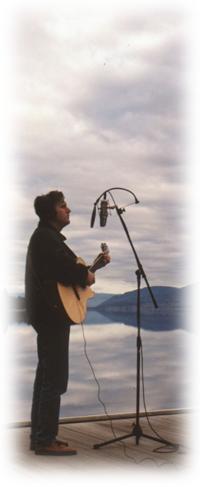
Over Scotland

I love poetry. I used to write much more poetry than I presently do. I feel bad about that. Consider this part one in rectifying this. This poem was written gazing out from an airplane window while flying over Scotland in 1989. It was finished in 1991, the next time I was in Scotland.

High flying, window glass reveals tattered floor-

Pristine heaven greets eyes open to curving planet yonder

Stretching, reaching, sky-borne, we soar.

Place of kings bringing wonder to hearts that wonder.

Stipple green, ground richly steeped in lush, purple hue-

Woven pattern of road-cut scenes moves closer,

Sky meets peripheral sky, horizon’s hazy blue.

Shadows run as daylight comes.

Well-fermented scenes from ancient dreams-

Walls of stone, hearts of flesh, eyes of steel,

Pageantry in motion, all is as it seems.

Like God in man, surreal kisses real.

Robert Rife © 1991