I believe this more every day. If I have all the best, most exotic spiritual practice, but am not prepared to die for another, then spirituality is only a hobby.
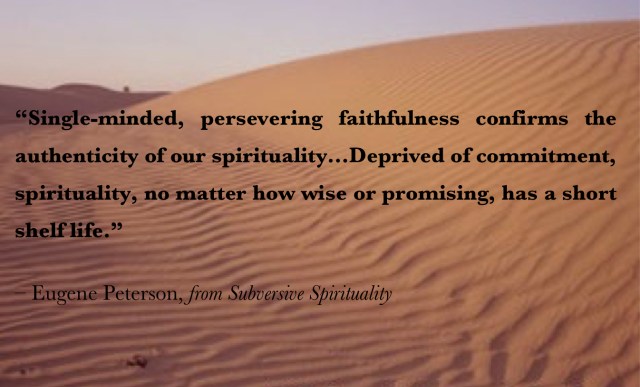

I believe this more every day. If I have all the best, most exotic spiritual practice, but am not prepared to die for another, then spirituality is only a hobby.
As a church music director I occasionally get opportunities to preach sermons. That should cause some of you to rejoice that the artsies have a pulpit voice, too. The rest of you will shudder at the idea that we’re allowed anywhere near one.
Ah well, what follows is my sermon from this morning, Sunday, August 5th. It’s been amended a bit to this audience who would tend not to react as negatively to more “spicy” language and approach.
I hope it lodges somewhere good, or at least, hungry.
Mark 6:1-13
6He left that place and came to his home town, and his disciples followed him. 2On the sabbath he began to teach in the synagogue, and many who heard him were astounded. They said, ‘Where did this man get all this? What is this wisdom that has been given to him? What deeds of power are being done by his hands! 3Is not this the carpenter, the son of Mary and brother of James and Joses and Judas and Simon, and are not his sisters here with us?’ And they took offence at him. 4Then Jesus said to them, ‘Prophets are not without honour, except in their home town, and among their own kin, and in their own house.’ 5And he could do no deed of power there, except that he laid his hands on a few sick people and cured them. 6And he was amazed at their unbelief.
Then he went about among the villages teaching. 7He called the twelve and began to send them out two by two and gave them authority over the unclean spirits. 8He ordered them to take nothing for their journey except a staff; no bread, no bag, no money in their belts; 9but to wear sandals and not to put on two tunics. 10He said to them, ‘Wherever you enter a house, stay there until you leave the place. 11If any place will not welcome you and they refuse to hear you, as you leave, shake off the dust that is on your feet as a testimony against them.’ 12So they went out and proclaimed that all should repent. 13They cast out many demons and anointed with oil many who were sick and cured them.
Even a cursory jaunt through the Gospel of Mark gives us a picture of Jesus who doesn’t fit well into pre-existing categories. He is different than the conventional and, as such, is often viewed suspiciously, or as we shall see, even contemptuously.
This sermon takes place among a series entitled “Defiance – Challenging the Norm.” ‘Defiance’ here is intended as a general term meant to convey the prophetic, counter-cultural way in which Jesus lived, taught and related to others. He defied easy categorization.
He was then and shall ever be, a glorious enigma.
Jesus has begun a ministry of healing and teaching, confronting people with a new way of thinking, of being in the world. He’s been busy making waves, making sick people well, hopeless people hopeful, lost people found, demonized people free, the government nervous, and religious people pissed off.
So, with all that success and street cred in tow, Jesus comes now to his hometown. But he comes not on a social call. He arrives bringing with him the kingdom message and is prepared to fulfill the exact same purpose for which he has come. He returns to Nazareth to reveal this new way of looking at God.
And how does he go about doing such a thing? Exactly. He teaches in the synagogue to those who already “know God” (by the way, in the same way doctors make terrible patients, we religious folks can make the worst disciples!). He’s met quickly with disdain and rejection.
“Wait a minute. We know this guy. That’s a lotta book learnin’ coming from that weird kid who grew up down the street from Bob and Lydia’s place. Who the hell does he think he is?!”
In fact, this was what they said, “Where did this man get all this?” They can’t be bothered to use his name! “Is not this the carpenter, the son of Mary…?” They basically remind him of his status as an illegitimate bastard by referring to him as “the son of Mary.”
Jesus had likely dealt with whispers and sneers his whole life. The self-righteous do-goodery of small town gossips has ripened well. And old grudges die hard.
Their assumptions about Jesus and, by extension what a prophet is “supposed to be” have been challenged. “This is no prophet, this is that snot-nosed carpenter’s kid. And, certainly no Messiah, either.” They make themselves unreceptive to the saving power of grace.
How many of us, having gone out into the world and made something of ourselves have returned to our places of origin only to be met with suspicion, or even derision? This kind of thing happens all the time. There’s something about challenging the status quo that makes people uncomfortable.
Jesus, the small-town lad, returns home. But no longer is he Joseph’s boy who spent many an afternoon fashioning cedar china cabinets and coffee tables. He returns home to Nazareth, a Palestinian redneck town, flashing the equivalent of a Ph.D. and a big city car. And they don’t take kindly to him shoving all this in their faces.
There is an acceptable, well-established role for anyone calling themselves prophet. Do not move outside those lines. In their eyes, miracles of healing, however impressive, may well have been reduced to cheap parlour tricks from someone just showing off. And a salvation message, however profound, met with stony ears unprepared for it.
Love gets shackled by unbelief.
To call him a prophet would have called into question all the ways they already saw the world and their place in it. It would have been to question their own hearts. And come on, that’s hard for most of us, isn’t it?
Poet John Donne once penned these words:
No man is an island,
Entire of itself,
Every man is a piece of the continent,
A part of the main.
We all have a collective grid of preconceptions, shared expectations, and accepted protocols through which we see out to the world and through which the world comes to us. If you don’t believe me, just try changing the rules to a game played for decades at the local social club. I dare you.
Because we have constructs for everything, we will have difficulty seeing Jesus when he challenges our comfortable assumptions. Jesus looks too much like us. We’ve coopted him, repackaged him, made him comfortable, usable, for us. Then, we lose the ability to see him in our daily activities, hear him speaking to us.
Theologian John Dominic Crossan once said, “beware of finding a Jesus entirely congenial to you.” We don’t want a Saviour who is constantly poking around at our idolatries. Our bigotries. How annoying! And to reject the Jesus who welcomes others, is automatically to reject God.
Let’s be honest, sometimes we’re either afraid or ashamed to be challenged because it’s just easier to rest in a Gospel re-envisioned to suit us. No outsiders allowed. Gather with those who look and think like us because it’s safer and more controllable.
This is something hard to see because those we think of as “other” are unique to every time and place. And, whenever we corral some particular group into the “unwanted” or “sinful” category, that’s precisely the place we will find Jesus.
We see this writ large in the ridiculous debacle of contemporary American politics. With ample posing, bluster, and incompetence enough for everyone with leftovers, we’ve decided it a great idea to crystalize our fears by bowing down to a self-proclaimed White House king. We say we want Jesus but really, we want Barabbas. And he means to neanderthalize what once was a cultural mecca for progressive (small ‘p’) values and diversity. Rather than seek to understand one another and enjoy the delightful surprises of acceptance, we vilify and demonize and divide. Indeed, our wrath spilleth over.
Who here remembers Isaac Asimov? He was a professor of biochemistry at Boston University and a prolific author. He once said, “your assumptions are your window on the world. Scrub them off sometimes or the light won’t come in.”
Jesus is not in the business of satisfying what we already believe to be true. Jesus wants us to follow him who IS true.
You want to find Jesus? Don’t look for him on the courthouse lawn. Find him in the prisons.
Don’t look for him in the backyard suburbia. Find him in tent villages under bridges.
Don’t look for him in the Constitution. Find him in between the lines of graffiti or suicide notes.
Don’t look for him in the hallways of power and priviledge. Find him in the faces of caged children and in the mentally challenged.
See his face staring back through the black eyes and broken nose of the abused housewife.
Find him in the cyber-bullied student or pregnant teen.
See him looking back at you in the eyes of your Republican neighbour, your Democrat sister, your drug-addict brother, your senile grandma.
See him in your enemy.
It is as true now as it was then, Jesus is often the least welcome among those who claim to know him best. We can be slow to accept anything that challenges our deeply embedded assumptions. Over familiarity with what we’re convinced is true about Jesus can keep us on the outside of experiencing the love he offers.
And, at the very heart of the Gospel is love. It is God intruding into our lives, shattering our pre-existing ideas about everything. Not to be a bully. But to help us clean off our windows enough to let in some light.
Let us not be those whose cast iron opinions (of which, obviously, I’m equally guilty) disallow the in-breaking of God’s love into our lives. Let us instead be those who are always willing to be surprised by Jesus. Let us not allow our knowledge about Jesus stand in the way of our love for him.
Who knows, perhaps he’ll be welcome enough in our hearts to perform mighty deeds of power? Lord, in your mercy, may it be so. Amen.
In their better moments, I dare say many folks would likely extend a more welcoming hand to our LGBTQ brothers and sisters. But our mob mentality, especially prevalent in the institutional church, often disallows as much. The reasons for this are often touted as theological. However, I’d venture a guess that it is often much more likely to be a projection of misdirected self-loathing and fear at the easiest target du jour. Further, it is given credibility through bad, or at least popular, biblical hermeneutics (the paradigm and practices by which we understand something). Then, all is rubber-stamped by those who prescribe and hallow that same fear.
Many of the most vocal critics of alternate sexualities claim to know a gay person. I’d like to suggest that, given their predisposition toward raised-brow shock or squinty-eyed judgement of the same, this is highly unlikely. Sadly, the high degree of verbal and/or physical violence against these folks by such critics, renders them not particularly forthcoming with personal details that merely paint targets on their chests.
Therefore, the self-proclaimed prophets of righteousness toddle off into the fray, cherry-picked, ill-understood bible verses in hand, and “take a stand for Jesus.” All this while their gay “friends” are sidelined from the very same faith that calls them as does their accusers.
I’ll stop there because, when in doubt, ask someone who’s truly been there to better explain. Fellow Jesus-follower and blogger, Laura Jean Truman, recently posted this to her blog. The title alone gave me pause to consider.
Read, pray, love. Then, let’s talk…

Once again, thanks to Mícheál Eóin Mac Fhiodhbhuide for photo permission.
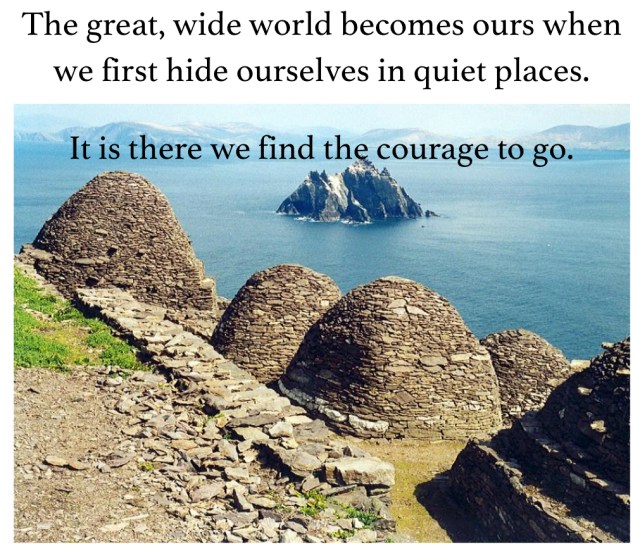 Once again, thanks to Mícheál Eóin Mac Fhiodhbhuide for photo permission.
Generally, a pretty good approach to life I should think!
 Special thanks to Mícheál Eóin Mac Fhiodhbhuide for photo permission!
USC Thornton Chamber Singers singing “Gaudeamus Omnes” by Marek Raczyński
 Another Sunday opens her eyes, damp from night sweat, or the river of dreams. Sunrise, like incandescent eyelashes blinks away the previous day and lets dawn stretch her legs. The miniature Big Ben mantle clock I inherited from my Dad ticks stoically, chipping away the seconds that have become, inexplicably, piles of years; a woodpile of time-chopped memories too easily fuel for the fire. And ashes are but the monochrome of memory – something once hot, bright, robust.
I suppose writing is to throw another log on the fire. The words crackle and spit themselves out as the heat rises. Those are the welcome fires of tin-foil wrapped delicacies, roasted and rich, softer by the second.
Now, this day, here in my writing chair, I can serve up a few morsels, ready to taste. Two. Years. Two full years since an adventure got tucked away, folded inward to await the fires of remembrance. And, in that time, the process, not of decay, but of marination has occurred. Like a good chili, always better the next day.
And I’m starving!

Facebook memory pop-ups are a blessing and a curse. They can bring a happy smile of recognition; reminders of good times past with good people. A “curse” inasmuch as those reminders pinch the inner optic nerve with the liminal colour of what is no longer now, but then – sweet, savoury, overpowering.
Never is “a picture is worth a thousand words” truer than when reviewing pictures of magical moments, inaccessible by the senses; only through memory. The existential replaces the experiential and a tear is born.
Two years.
Just seeing those words side by side is unnerving. This time, two years ago, Rae and I had just returned from galavanting around the U.K., filling our boots with shenanigans of every sort. It was our fourth such journey. 1989. 1991. 2004.
Then, a 2016 whirlwind whack-a-mole through salad-bowl Welsh valleys, pulsating London streets, book-studded villages, swarthy Scottish Highlands, tidy bed ‘n breakfast cottages, seaside adventures, writing (always lots of writing); family and friends both old and new. I think my legs still hurt from trudging downtown London and rural Skye, lost much of the time (of course).
Time heals all wounds.
Only time will tell.
Just give it time.
It’s about time.
Time-out.
All in good time.
Running out of time.
We had a great time.
Time gets a lot of press, both good and bad. Likely because of its annoying persistence, an impatient ubiquity. It tick-tocks us into corners or shows up as an ally, all in the same day. We even honour it with a face and hands, and then entrust to it lists about which it cares little. And, just when we think we’ve earned its respect, it barfs in our lap the other side of the page we didn’t see coming.
To attend to these memories respective to our journey to the UK is to approach the unapproachable. I don’t believe rose-coloured glasses are involved here. Nor do I think it a distance-makes-the-heart-grow-fonder kind of thing. It’s much more than that.
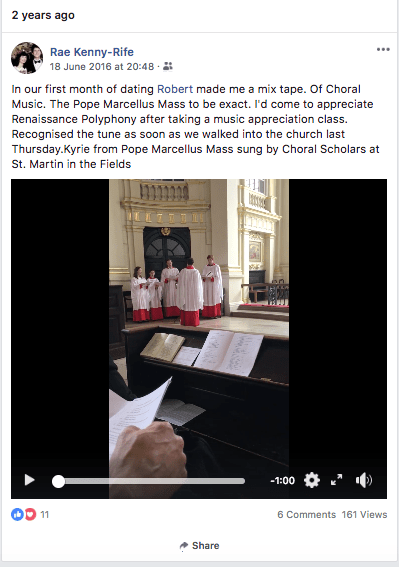
I think the greatest impact of our time there wasn’t the allure of tourist traps or the necessary bling that accompanies them. It was, on one level, a homecoming. For Rae it was genuinely geographic. She was born there after all. Wales to be exact. For me? Existential.
As I’ve recently discovered, my very DNA hearkens from Scotland/Ireland. Ancestry and companies like it parade around biological allurements to family origin hungry types like me. I fell prey. In doing so, I discovered my patrimony, a host of living relatives, and the certainty of my own personal ancestry rooted deep in Celtic soil.

Given all that I’ve written, spoken, and warily discerned on the subject – a holy hunch, if you will – I was more surprised than I should have been. Apparently, it is one thing to guess at one’s place in the world. It is quite another to actually discover as much. Like the dog who catches the cat. So, what now?
More on that ride soon.
Reminiscing can take more than one form. Time is friend to one, foe to another. When we’re younger it’s common for us to remember everything in vivid detail and easily recount as much. Time is our friend.
But, as I grow older (along with everyone else), time grows restless. Not yet foe, but starting to act a little shifty – less trustworthy. And, like hair, teeth, balance and bladder control, memories disappear. They thin. Those garnishing details, enhancements, indispensable at the time, begin to drop away.
 Once it begins, the connections between head and heart grow more tenuous. Colours fade to pastels, then to black and white, finally to retreat into a palette of grey ooze. Faces slip further back from the front of pictures until they disappear altogether and, soon, they become just another “somebody that I used to know” (thank you, Gotye).

That is why I write. It is especially why I memoir. When memory ceases to recall details, setting, faces, connections, passions, tears, laughter, even rationale, there will be on paper at least one thread of a life lived. That life had adventure and discovery, not just existence. Proof of significance, a justifiable place in the world. A reminder not just to me, but to everyone that I was here. I had something to say. I had people I loved, who loved me back.
A journey, two years hence. I remember. One day I may not. That is why I write – to remember not to forget that one day I won’t remember.
What follows is a “bloggified” version of my sermon from last Sunday, June 3rd.
* * * * *
Today we begin our summer sermon series entitled “Defiance: Challenging the Norm.” We will focus on Jesus’ radical, counter-cultural life and the ways he defied social norms, religious traditions, and theological expectations. We’ll be using for this exploration the gospel of Mark.
Mark will reveal to us a Jesus offering hope for the abundant life, convincing people that he was the promised Messiah, spending time with disreputable people, challenging the social conventions of his day, healing, teaching, eating and drinking, praying, and teaching his disciples to do the same.
So, when we hear the word “defiance,” what comes to mind?
The stubborn two-year-old who sits pouting, arms folded, at the kitchen table because he didn’t get his way?
The angry teenager who shouts, “I hate you!” just before slamming shut her bedroom door?
That guy who insists on his right to walk through the shopping mall, teaming with families, with an open carry pistol?
Or, conversely, the PC police, social justice warrior who shouts down a speaker at a university campus because she disagrees with the message?
All of the above? None of the above?
Maybe this is what we think? People rising up against their oppressors. Jesus did that, although in subtle, subversive ways. And, he starts from the inside out. His weapons of choice? Love and his own life.
Or perhaps this? Pealing back lies to reveal truth. Jesus did that. “You have heard it said, but I tell you…” “I Am the way, the truth, and the life…”
Or maybe this? Alone, or together, having the courage to speak truth to power? Jesus did that, too. “Woe to you blind guides…” “You brood of vipers…” You know, the kind of things you say to your grandparents at family dinner.
How about this?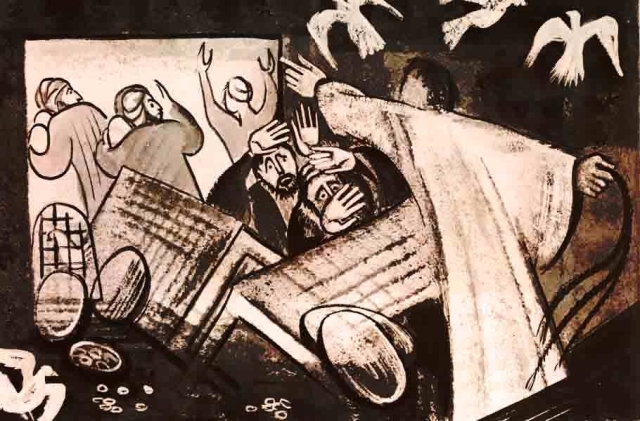 Here we see Jesus turning over the tables of the money-changers. This is Jesus, in defiance of the business of faith: T-shirt, bumper-sticker religion.
The image we decided on for at least the first part of the series is this one. A little girl stands courageously against a raging bull. We see here the weak against the strong. The vulnerable against the bull-y (no extra charge for that one).
The dictionary defines “defiance” as follows: Let’s explore how this might apply to Jesus.
All four Gospels are unique. They are four unique authors speaking from unique perspectives saying unique things about the unique, but complex person of Jesus.
Matthew wrote primarily to the Jews. Matthew’s Jesus is the fulfillment of God’s covenant promise to Abraham and of all the Law and Prophets.
Luke, a doctor, presents us with Jesus, the son of Man, lover of the poor and downtrodden, the hated prodigals now welcomed into the presence of God through him.
John was the mystic. He was the closest friend of Jesus and had heard his very heartbeat. It has this scent of tender familiarity. John’s Jesus takes us deep into the loving heart of God.
And then there’s Mark.
In the space of fifteen verses we get:
Mark’s gospel reads like a Hollywood blockbuster that opens with a car chase. It’s the biblical equivalent of the Fast and Furious! He’s so excited to tell us about Jesus that he spares no time. He. Is. Focused. Let’s just git ‘r done!
My wife and I are both lit-geeks. But Rae is really more the story-teller. She says that, in any study of story, the question of pacing is incredibly important. Too fast and it can lack the heart, depth, and staying power of great storytelling. T o o s l o w and y o u r i s k l o s i n g y o u r audience.
Hence, even Mark’s very pacing teaches us. Something has happened that radically changes the way we look at and experience the world, and he can’t wait to tell us about it. There is no more waiting. It’s happening right here, right now, in real time. It is decisive, dramatic and begs a response.
But how does Mark’s Jesus illustrate defiance?
We can do that in a single verse. Mark 1:1 says,
“The beginning of the good news of Jesus Christ, the Son of God.”
How is this defiant, exactly? Well, this is a significant statement for many reasons.
What do we know of ancient Rome? It was a military occupation possessing a particular skill in “crowd control.” It was marked by its efficiency, technology, discipline, and finely-honed bureaucracy.
Rome was intimidating and ruled by means of the well-known adage – “the beatings shall continue until morale improves.” The Jews were all huddled up under the great shadow of Rome, longing for the promised Messiah to come and kick some Roman ass.
But what kind of Messiah did they get? Mark’s point is to convince them that Jesus is indeed the Messiah, just not in the sense they wanted him to be.
Let’s read that statement again:
“The beginning of the good news of Jesus Christ, the Son of God.”
You may recall that Herod considered Jesus such a threat that he slaughtered an entire generation of Hebrew children. What was he so afraid of?
A child, rumoured to be king of the Jews, would have posed no small threat to a bumbling narcissist like Herod (sound familiar?).
Many Roman Caesars believed themselves to be God incarnate, a notion they were only too happy to enforce. For anyone other than Caesar to make such a claim would have been foolhardy in the extreme. To the Romans, for Jesus to be described as “the Son of God” was not a theological matter. It was a political threat.
And, guess what form of death was designed specifically for political dissidents?
Crucifixion.
Mark’s opening statement therefore is already a dangerously defiant one!
This Messiah does not set out to conquer. He sets out to suffer that the notion of conquering might come to an end. He doesn’t conquer Rome. He conquers death at Rome’s hands, forgiving them the whole time.
A defiant bait ‘n switch if ever there was one! His non-violent love defied – said ‘no’ – to blind hate and aggression and, through death, led ultimately to the freedom of all.
Jesus defied hatred with love.
He defied exclusion with invitation.
He defied the misguided hope for military salvation (take note America) and brought instead, freedom from sin and death.
He defied the kingdom of Caesar with the kingdom of God.
He defied everyone’s expectations, trading pride for humility.
Jesus should have baptized others. Instead, he allowed John to baptize him.
Jesus, Lord of the wilderness is, himself, driven there to starve and face down the archetypal temptations we all face. Why? That he might truly be one of us, in every way.
Jesus could have ruled a heavenly army. Instead, he says “the time is fulfilled, and the kingdom of God has come near; repent, and believe in the good news.”
Let’s ask Mark to take us on a journey, shall we? A journey into the heart of God, a God who does not look like what we’d expect.
He looks like Good News.
Amen.
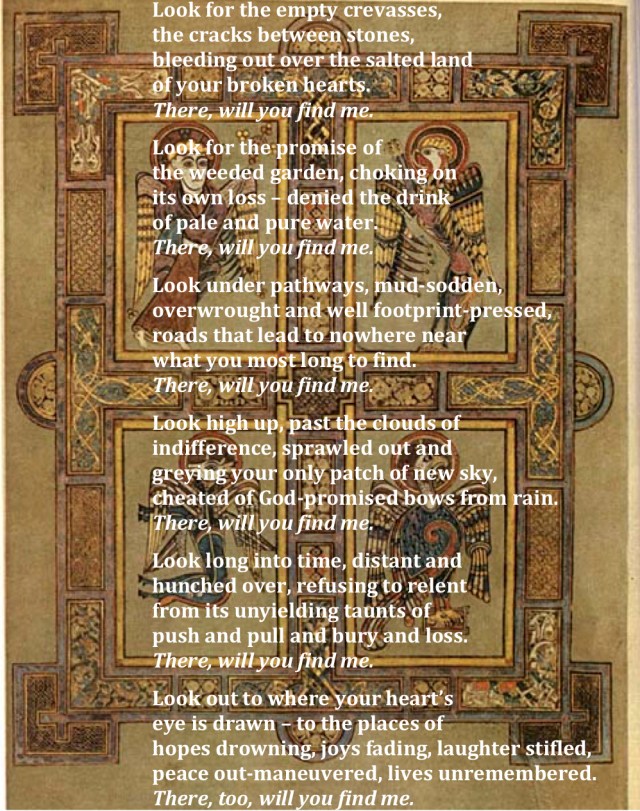
Watermark is from The Book of Kells
If we are made in God’s image and God sings, then we should be singing, too.
Ancient Wisdom for Modern Seekers
Spiritual Direction for Integrated Living
From liquid courage to Sober Courage
an anamcara exploring those close encounters of the liminal kind
Collaborating with the Muses to inspire, create, and illuminate
...in such kind ways...
"That I may publish with the voice of thanksgiving, and tell of all thy wondrous works." Psalm 26:7
Blog for poet and singer-songwriter Malcolm Guite
…in the thick of things
REFLECTIONS & REVIEWS
Seeking that which is life giving.
… hope is oxygen
Homepage of Seymour Jacklin: Writer - Narrator - Facilitator
If we are made in God’s image and God sings, then we should be singing, too.
Ancient Wisdom for Modern Seekers
Spiritual Direction for Integrated Living
From liquid courage to Sober Courage
an anamcara exploring those close encounters of the liminal kind
Collaborating with the Muses to inspire, create, and illuminate
...in such kind ways...
"That I may publish with the voice of thanksgiving, and tell of all thy wondrous works." Psalm 26:7
Blog for poet and singer-songwriter Malcolm Guite
…in the thick of things
REFLECTIONS & REVIEWS
Seeking that which is life giving.
… hope is oxygen
Homepage of Seymour Jacklin: Writer - Narrator - Facilitator
 innerwoven