
George Herbert (1593 – 1633) was a Welsh-born poet, orator, and priest of the Church of England. He hailed from a wealthy family and his poetry is recognised as some of the greatest in the Christian devotional canon.


George Herbert (1593 – 1633) was a Welsh-born poet, orator, and priest of the Church of England. He hailed from a wealthy family and his poetry is recognised as some of the greatest in the Christian devotional canon.

Adventia, day 13. The poem is “Incarnation.” The poet is Irene Zimmerman. This poem originally appeared in Incarnation: New and Selected Poems for Spiritual Reflection, © 2004 Irene Zimmerman. Sister Irene Zimmerman, OSF, is a Franciscan nun living in Milwaukee, Wisconsin.
Incarnation
In careful hands
God held the molten world –
fragile filigree
of unfinished blown glass.
Then Mary’s word: Yes!
rose like a pillar of fire,
and Breath blew creation
into Christed crystal.

For our offering today, I’ve decided to stretch outside the safe, sanitized confines of “respectable” or “easy” poetry. Instead, I choose this remarkably incisive and prophetic piece by poet, Dan Anderson.
For God’s Elect in Shopping Malls
Dan Anderson
For those who would not choose to grow old before the Son of Man comes.
A woman with eyes painted on her boobs.
Another reading ‘dodgy’, another inscrutable.
Unfailingly matched to personal genre.
Thematised Personalities of the latter Capitalism.
World writ on the chests of post-Christmas shoppers.
On their post-Christmas T-Shirts. Taunt as these turgid surplus days.
Or sagging with remorse, various colours of remorse.
Buyers. Gifted – those who grieve their gifts. For whatever reason.
Returning shirts. Those soft packages, small bombs of disappointment
That mined the carpet round the Christmas tree.
Sale shirts. Unwanted gifts never sold. A surplus of disappointment.
This excess week, just enough to reconcile the wrong gifts of the old year.
What cancer lives in the soul of a people who exchange gifts?
Gifts that were never thought precious to begin with. But were.
Gifts that were cheap because the panting labour of creation was stolen.
Groaning. Tired hands and aching backs that sutured them cheap.
T-shirts that were hated by their makers, and a disappointment to those who received them.
Who will never be worn. Passed from hand to hand but never worn.
Raped from the earth. Cotton-farms, Great scratches across her face. Unswabbed.
Made poisonous by hatred and other chemicals. Buried.
Done again. And again. Until there is nothing left to take and no where left to hide.
When the Son of Man comes, and all his Holy Angels with him,
Will he need to do more than open our landfills, speak to the T-Shirts,
Give them words to tell their stories, the testimony of fibres. To pronounce?
What was whispered in workshops will be shouted from the rooftops.
And the judgement written across our chests, graphically, designedly.
Stern Son, I would have no hope of your judgement.
If you had not worn such a shirt. Clothed yourself in flesh.
Hung upon, cared and washed, worn out. Worn still.
Been surplus. Been a disappointment. Been laid with the fodder.
Been unspeakably precious. Been the joy of groaning history.
Been unrecognised. Been bloodied. Been hung out to dry.
Laundering Son, how I long to be clothed by you.

The radically counter-cultural nature of the Advent narrative demands poetry of equal heft and teeth. Few are better positioned to contribute such as Óscar Arnulfo Romero y Galdámez (15 August 1917 – 24 March 1980). Catholic prelate and later Bishop of El Salvador became a martyr in his outcries against the social injustice and violence amid the escalating conflict in his homeland. He perished by gunshot while serving Mass. His spirit is the very spirit of Advent itself: love invading hate, light invading darkness, righteousness invading chaos.
For Adventia, day 10, I give you…


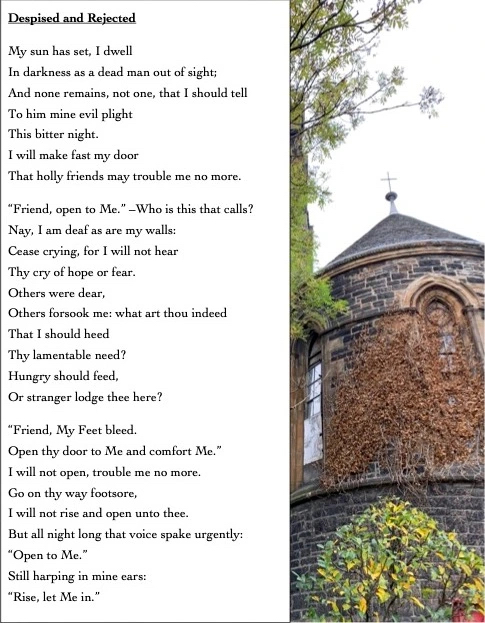
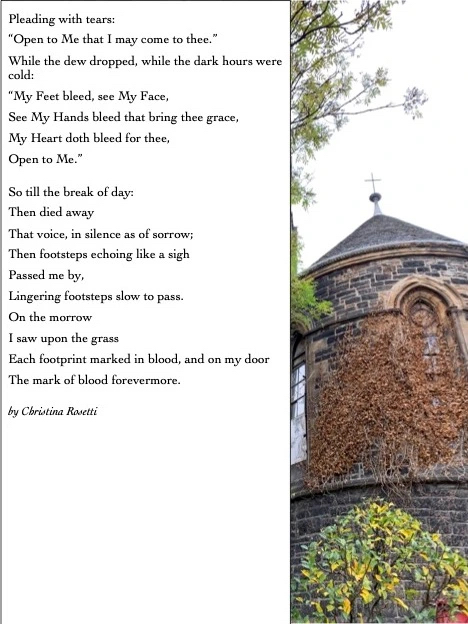
Christina Georgina Rossetti (1830 –1894), born in London, was an English writer of romantic, devotional, and children’s poetry. She is also famous for having written the texts of two well-known Christmas carols: “In the Bleak Midwinter” and “Love Came Down at Christmas.”
This poem combines Advent and Lenten themes; the sacrificial Christ pursuing the hospitality and kindness represented by the inn where there was no room for the holy family. The question ever asked of us, “is there room for the Christ within?”
Don’t forget to pop over and visit Real Poets Daily. They’re a wealth of inspiring poetry!

No, the above is not meant as some cheap attempt at a New Joizy accent with the word adventure. Let’s just call it the purposeful amalgamation of Advent and Fragmentia. Let it be a place where the illumination of God’s in-breaking into our world found in the Advent narratives unites with the fragments of literature and faith and life seeking to bring us to deeper understanding of it all.
Advent is upon us once more. With it comes a barrage of books and practices all aimed at helping us get the most from the experience. Last year I chose to post a daily poetic reflection on my poetry website. This year I’d like to do something similar here on innerwoven. It gives me opportunity to dive deep into some of the best words about the best time of the year; the beginning of the church’s calendar at Advent. These poems are both old and new and are found in various places.
For Advent, day 1 we begin with a gorgeous piece by Sally Thomas, which I saw first on a favourite Instagram channel, #realpoetsdaily
Here is “First Sunday” by Sally Thomas ( @sallytnnc )

I’ve been quite open about my struggle with alcoholism and subsequent recovery. Perhaps it is because, through my association with the program and community of A.A. I’ve rediscovered the loving, trustworthy God I once knew. That God somehow got lost along the way, despite my practices of faith, my role as a “professional Christian,” and a radical conversion experience at eighteen.
These days, my faith is simpler. It is not so cliché-ridden, expectation-laden, preconceived notions-driven. It is one of basics: learning humility, self-love, and the practices necessary to maintain and nourish the same. Along the way, I read everything I can get my hands on to assist in that journey. This is a short excerpt from my Seeds of Grace: A Nun’s Reflections on the Spirituality of Alcoholics Anonymous by Sister Molly Monahan (pseudonym).

Our Europe Team for Serve Globally, the mission organization we serve through our denomination (Evangelical Covenant Church), recently met for our annual retreat (two and a half year COVID delay notwithstanding) at Le Lazaret in Sète, France. For my wife and I, it was only our second such experience. Our first was in October, 2019 and acted as a kind of “reconnaissance mission” as we explored God’s call.
This beloved team is a collective of singular passion, unwavering commitment to justice and reconciliation, enviable humour, rich fellowship, boundless creativity, and endless capacity for joy. We would take a bullet for any one of them.
Our speaker and guide for the retreat was none other than Al Tizon, former Executive Minister for Serve Globally, missiologist, teacher, writer, prophet, and friend. His upcoming book, Christ Among the Classes, shaped our discussions.
By way of understatement, these were not easy conversations! We engaged in matters best left alone unless one wants to face the convicting issues of wealth, the Gospel to and among the poor, our complicity, knowing or unknowing, in perpetuating systems of greed and disenfranchisement and how all of that intersects with the gospel of Jesus Christ.

It can be equally stirring and unnerving to discuss one’s place in a world given to championing the rich and powerful at the expense of the poor, while not demonizing the rich. What does that even look like? Is such socio-economic righteousness even an attainable goal? When does it cross the line from kingdom equality to political radicalism? Is there a difference? If so, what?
The questions arising from such discussions are as dizzyingly complex as are the issues from which they derive. But, it is our calling as followers of Jesus, himself a friend of the poor, and sinners, and children. We, by association, are to befriend the outcast, emancipate the leper du jours; even love our enemies. This includes those we are most quick to either dismiss or demonize.
Al (he’s not one for the fineries of title!) painted a picture of the transformation of heart toward equanimity by way of downward mobility, an increasing identification with the poor. This starts first with an awakening to our own relative privilege and wealth. To be “born again” is to see anew, or perhaps for the very first time, our place in the broader world; our individual and collective sin and how it has affected us and those around us.
We journeyed through a series of steps along the way toward the ultimate goal of befriending and advocating for the poor. The rich are not of the devil. Nor are they to be eschewed, pooh-pooh’d, or railroaded out of access to grace. But, Jesus makes clear that they will have a much more difficult time when it comes to the attitude of mind and heart necessary to befriend those who, by definition, require something from them, whether that is as benign as their time or as challenging as their resources.
I like to keep things simple. I take my cue from Wendell Berry who recognized the need for every song we compose to be fully accessible to all. If not, we still have work to do…

If we are made in God’s image and God sings, then we should be singing, too.
Ancient Wisdom for Modern Seekers
Spiritual Direction for Integrated Living
From liquid courage to Sober Courage
an anamcara exploring those close encounters of the liminal kind
Collaborating with the Muses to inspire, create, and illuminate
...in such kind ways...
"That I may publish with the voice of thanksgiving, and tell of all thy wondrous works." Psalm 26:7
Blog for poet and singer-songwriter Malcolm Guite
…in the thick of things
REFLECTIONS & REVIEWS
Seeking that which is life giving.
… hope is oxygen
Homepage of Seymour Jacklin: Writer - Narrator - Facilitator
If we are made in God’s image and God sings, then we should be singing, too.
Ancient Wisdom for Modern Seekers
Spiritual Direction for Integrated Living
From liquid courage to Sober Courage
an anamcara exploring those close encounters of the liminal kind
Collaborating with the Muses to inspire, create, and illuminate
...in such kind ways...
"That I may publish with the voice of thanksgiving, and tell of all thy wondrous works." Psalm 26:7
Blog for poet and singer-songwriter Malcolm Guite
…in the thick of things
REFLECTIONS & REVIEWS
Seeking that which is life giving.
… hope is oxygen
Homepage of Seymour Jacklin: Writer - Narrator - Facilitator


 innerwoven