Hogmanay Hopefulness

It’s the last day of the year. ‘Finally’, say some. ‘Big deal’, say others. We seem to really love these arbitrary chronologies; new leaf-page turns, as it were. Any opportunity, either actual or manufactured by which to measure ourselves against the cosmic yardstick of success. “Let’s see how we did,” we tell ourselves, “with the three hundred and sixty five chances we were just given.”

Were we good enough? Did our decisions prove correct enough, or at least useful enough? Are we “better off” now than we were when last we stood at this threshold? Aren’t these the same questions we asked this time last year.

Well, s**t.

Whatever one believes about New Year celebrations and the random significance we may or may not foist upon them, allow me to share a few clear reliables.

  1. However one may feel about one’s place in the world comparative to last year, our belovedness remains unchanged. God, apparently (and sometimes, on our off days, with little reason), is rather fond of us. Each one is deeply loved and cherished. As much now as last year. Have hope.
  2. Whatever chaos, cares, or calamities we faced in 2024, with the coming year there are still the kernels of hope planted deep in the soil of grace. God’s abiding presence with all of us does not change on the altar of a Roman calendar. It is always total, unchanging, and calendarless. Have hope.
  3. Whatever plans we made, course we charted, intentions we implemented (or not) that came to naught, our worth is determined by things much less measurable than platitudes, promises, plans, or productivity. We are forever children of God, loved unreasonably well and with unseasonable consistency. Have hope.
  4. Similarly, as one well-versed in shoulding all over myself on a pile of ripe could-would, whatever resolutions I make for the coming year may, no, will reflect the light of Christ in me, not some perceived darkness into which I may trudge, knowingly or unknowingly, willingly or not. We are all so much more than resolutions made or broken, promises made and kept (or not), hopes realized or dashed. Have hope.

So then, having just finished my final cappuccino of 2024, I sit before my journal not with the pen of guilt, embarrassment, or self-abasement but with joy, gratitude, and expectation happily swimming in the blessing and presence of God. That is the spirit in which I choose to bid adieu to this year.

I crane my neck and shove my not-so-inconspicuous nose forward into whatever 2025 smells like. And, whatever it is I smell is not for me to say. Instead, it is for me – for us, simply to breathe in, greeting it all with gratitude and a whispered prayer for those who will never have opportunity to do the same.

Here’s to Hogmanay hopefulness and a happy, and honest, 2025.

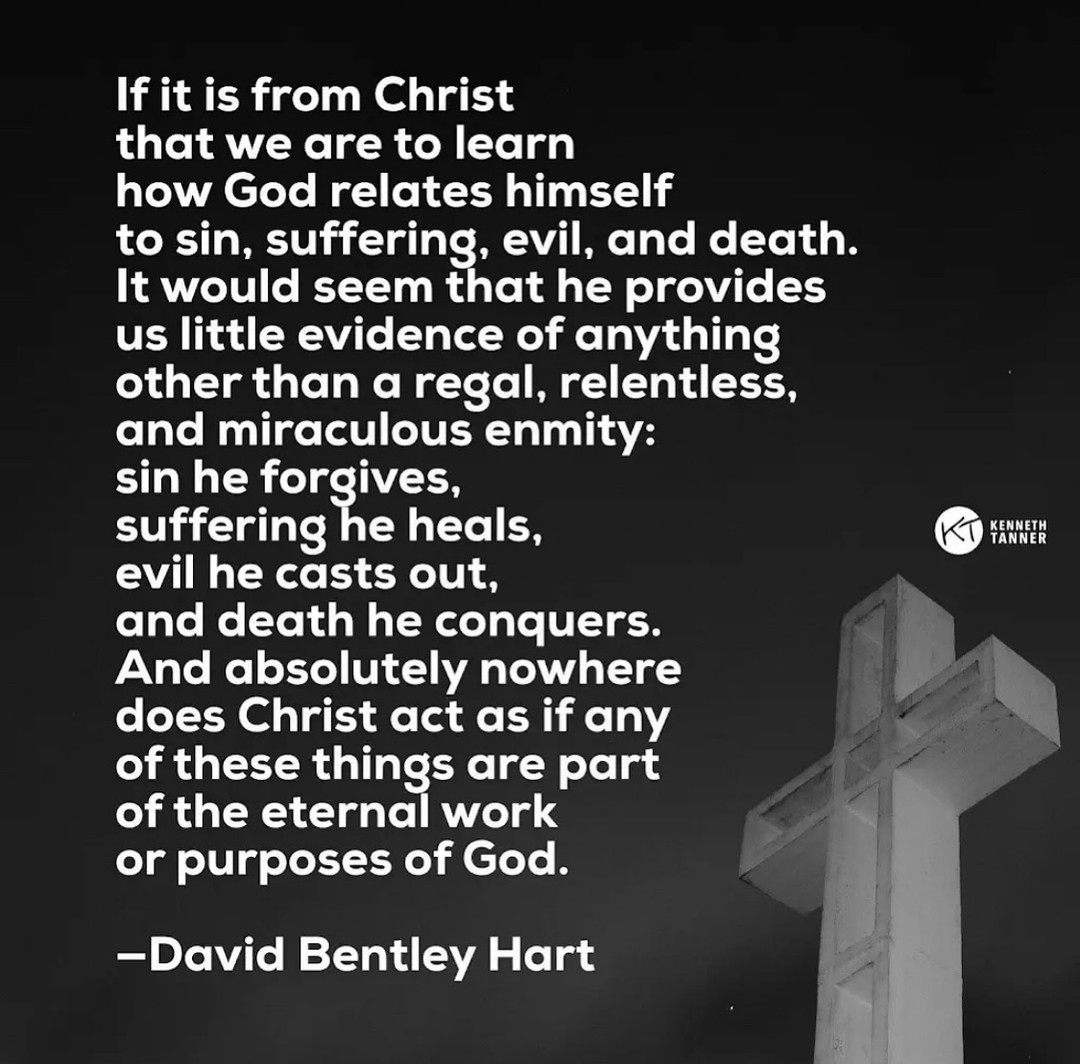
“If it is from Christ…”

Thanks again, Fr. Kent Tanner, for providing us with timely quotes from discerning and wise voices. This one is from David Bentley Hart.
Words from Clive…

Another favourite voice, one that has kept me fascinated and seeking for many years, is C. S. Lewis. Clive Staples Lewis is one of those endlessly poetic, thoughtful Irishmen who have changed the world – and continue to do so.

Enjoy.

Thanks to Father Ken for the wonderful mime!

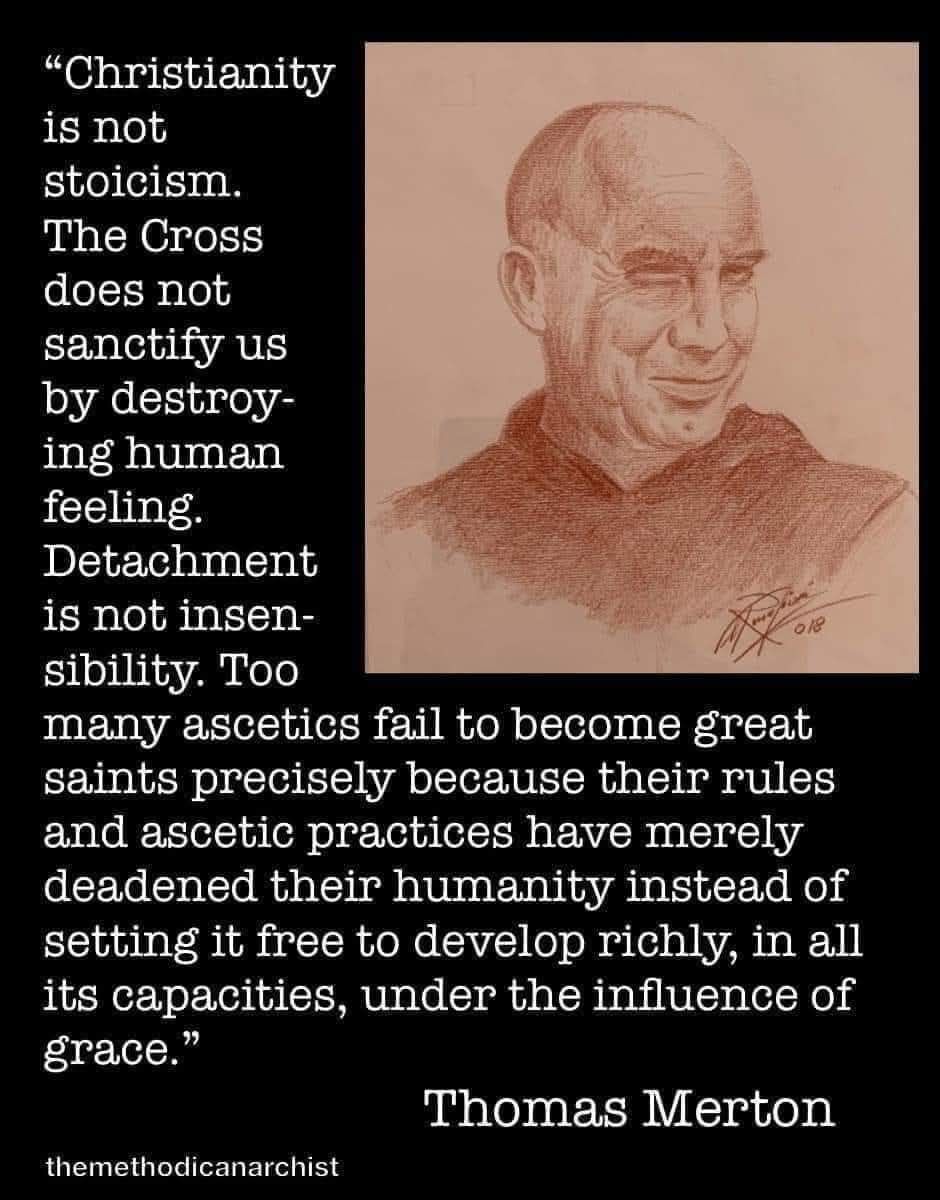
A thought from Thomas Merton

Thomas Merton is one of my Christian “heroes”. An artist and writer, an intellectual and activist, a tortured soul full of mystifying, beautiful chaos. A teacher, monk, friend to many, and a man way ahead of his time. And, to my delight, a fellow Enneagram 4! His Christian faith was enriched through many conversations with many others equally unique but very different from him. I dare say we too would benefit from such diverse interactions.

Enjoy these thoughts I stole from a similar spiritual savant (and fellow Canadian) I admire, Justin Coutts over at his website: www.newedenministry.com.

The Creative Recovery Initiative, Episode 1

Doorkeepers of a better kind

There are those among us upon whose shoulders we stand when looking for ways out of the claws of darkness. Women and men who have peace and glory in equal measure tattooed upon their souls, waiting to help others across the finish line of pain to peace, chaos to glory. They are often unassuming and hard to spot in a crowd, their humility hiding their heroism. Bill W. (William Wilson (1895 – 1971), Dr. Bob (Robert Holbrook Smith 1879 – 1950), and Rev. Samuel Moor Shoemaker III (1893 – 1963), collectively, the architects of Alcoholics Anonymous. Says Bill of Rev. Shoemaker, “early AA got its ideas of self-examination, acknowledgement of character defects, restitution for harm done, and working with others straight from the Oxford Group and directly from Sam Shoemaker.”*

I Stand at the Door
by Rev. Sam Shoemaker of The Oxford Group

I stand by the door.
I neither go to far in, nor stay to far out.
The door is the most important door in the world –
It is the door through which men walk when they find God.
There is no use my going way inside and staying there,
When so many are still outside and they, as much as I,
Crave to know where the door is.
And all that so many ever find
Is only the wall where the door ought to be.
They creep along the wall like blind men,
With outstretched, groping hands,
Feeling for a door, knowing there must be a door,
Yet they never find it.
So I stand by the door.

The most tremendous thing in the world
Is for men to find that door – the door to God.
The most important thing that any man can do
Is to take hold of one of those blind, groping hands
And put it on the latch – the latch that only clicks
And opens to the man’s own touch.

Men die outside the door, as starving beggars die
On cold nights in cruel cities in the dead of winter.
Die for want of what is within their grasp.
They live on the other side of it – live because they have not found it.

Nothing else matters compared to helping them find it,
And open it, and walk in, and find Him.
So I stand by the door.

Go in great saints; go all the way in –
Go way down into the cavernous cellars,
And way up into the spacious attics.
It is a vast, roomy house, this house where God is.
Go into the deepest of hidden casements,
Of withdrawal, of silence, of sainthood.
Some must inhabit those inner rooms
And know the depths and heights of God,
And call outside to the rest of us how wonderful it is.
Sometimes I take a deeper look in.
Sometimes venture in a little farther,
But my place seems closer to the opening.
So I stand by the door.

There is another reason why I stand there.
Some people get part way in and become afraid
Lest God and the zeal of His house devour them;
For God is so very great and asks all of us.
And these people feel a cosmic claustrophobia
And want to get out. ‘Let me out!’ they cry.
And the people way inside only terrify them more.
Somebody must be by the door to tell them that they are spoiled.
For the old life, they have seen too much:
One taste of God and nothing but God will do any more.
Somebody must be watching for the frightened
Who seek to sneak out just where they came in,
To tell them how much better it is inside.
The people too far in do not see how near these are
To leaving – preoccupied with the wonder of it all.
Somebody must watch for those who have entered the door
But would like to run away. So for them too,
I stand by the door.

I admire the people who go way in.
But I wish they would not forget how it was
Before they got in. Then they would be able to help
The people who have not yet even found the door.
Or the people who want to run away again from God.
You can go in too deeply and stay in too long
And forget the people outside the door.
As for me, I shall take my old accustomed place,
Near enough to God to hear Him and know He is there,
But not so far from men as not to hear them,
And remember they are there too.

Where? Outside the door –
Thousands of them. Millions of them.
But – more important for me –
One of them, two of them, ten of them.
Whose hands I am intended to put on the latch.
So I shall stand by the door and wait
For those who seek it.

‘I had rather be a door-keeper
So I stand by the door.

So then, Mr. Wilson, Dr. Bob, and Rev. Sam, this recovering alcoholic thanks you.


See Wikipedia

“It’s a Beautiful Day”

Tuesday. 4th of July, 2023. American Independence Day. Three days after Canada Day. The day before tomorrow, also known as, today. Always a good place to start I figure.

My itinerary:

Pages of Bono’s “we-moir”, Surrender. He is perhaps the most compelling artist-writer of a generation or two.

A cafetière of the good stuff to settle accounts with the day.

Black ink on blank pages to begin my regular process of over-thinking my under-living.

Perhaps a few quiet moments presenting myself to myself, huddled up, tucked in, and rolled up in the bosom of Jesus.

Then, another slow journey to and through my weekly practice of Sabbath – my Tuesday hunt for shalom.

Today is North Berwick – Scotland’s version of tea ‘n tidy posh b’ gosh along her sniffling east coast. The North Sea is never satisfied to sit still but insists upon itself in childish guffaws, jumping around in an effort to stretch her restless legs.

My mind, gradually calling itself back to ground zero, is settled on few things these days. If age reveals anything at all (if you’re open to its ranting) it is that wisdom is about the law of misdirection, of diminishing returns. The longer we live, the less we have left to live. The older we get, the younger we wish we were. The more we know, the less we truly know. The more we pursue it, the farther away it appears. The wider we open our eyes to see, the more blinded are we by the light of all there is to see. Says Bono, “Wisdom is the recovery of innocence at the far end of experience” (Surrender, pg. 527).

I am under no false illusions that these days of reflection, reading, writing, pretentious decaf oat lattés in pretentious places, and mental gymnastics are making me smarter, let alone wiser, let alone better. But they do, in a sense, grease the skids for what might inevitably do so. Usually it shows up as failure, naïveté wrapped in narcissism, or just willful blindness. I take ordinary days for ordinary things so that, somewhere along the road, befuddled and betwixt and bemused as it may be, I might transform into something marginally better than I am right here, right now. God’s alchemy of extraordinary from ordinary. Divinity from detritus.

And, I’m good with that. I guess I’ll have to be since it appears God is seldom in the mood to reveal trade secrets. She loves to stay at the center of things but play in our peripheral vision. That way, we’re never caught like a deer in the headlights of God’s withering gaze. Instead, our head is pressed up tight to Her bosom, listening to that cosmic heart of perfect love.

I come to North Berwick often. Set upon gently sloping shoulders bared to the North Sea, it boasts a braggadocious profile in a golf swing swagger. A country club smile with tea cozy sensibilities. It is, in a word, sublime. Better still, it is pouring. Only my fellow petrichorians understand why this is so delightful.

The sea and I have an understanding. It needs to do nothing other than slosh about in its normal routine, twerking her waves at me while I lollygag at its shores sufficiently attentive to the needs of my soul. Rough ‘n tumble or quaint ‘n quiet, I’ll take it how it comes. I didn’t grow up near the ocean (the sea here in Scotland), having instead the daily reminder of my ineptitude as either a cowboy, oil roughneck, geologist, or economist, the generals in Calgary, Alberta’s army. That only made my lifelong yearning for ocean that much hotter, more insistent.

On these days of Sabbath, my thoughts inevitably drift to matters of faith and fury. My bugaboos bashing at heaven’s door in search of understanding. I reflect, usually with book and journal in hand, upon the life I’ve been given; the one I’m living, the places from which I’ve come, those toward which I’m heading, and the life to which I’m called in my best moments. Increasingly, I see them all as one. We are always living the life to which we are called. Our holiest moments are the same as our most mundane. When everything is holy, nothing is wasted, everything belongs (thank you Richard Rohr), and we can live in constant gratitude.

I end these brief recollections with Bono’s words:

“…faith is…more like a daily discipline, a daily surrender and rebirth. It’s more likely that church is not a place but a practice, and the practice becomes the place. There is no promised land. Only the promised journey, the pilgrimage. We search through the noise for signal, and we learn to ask better questions of ourselves and each other.

   I call the signal “God” and search my life for clues that betray the location of the eternal presence. For starters we look to who is standing beside us or down the road, the ones whose roof we share or the ones around the corner who have no roof. The mystics tell us God is present in the present, what Dr. King described as “the fierce urgency of now.”

   God is present in the love between us…In the way we meet the world.”

This has been an extraordinarily ordinary day. I’ll take it.

The Celts…again

I read. Like, a lot. Mostly narrative (novels), poetry, and spirituality. But also loads of practical, pastoral fare; the expected manuals of those like me in the craft of soul-shaping. As one who still stands uncomfortably close to the edges of evangelicalism, it is generally expected that I be of the ‘soul-winning’ trade. It’s not as though I’m uninterested as much as I’m…uninspired. The language is so quaint and banal by comparison. Hardly the kind of thing to draw anyone into the kaleidoscopic mystery of the Trinity.

For that, I turn to the Celts. Their muskiness and John the Baptisty daring-do has an almost Homeric quality about it. I revel in their disinterest in the urban diaconates of Rome in favour of the murky oak groves more suited to the thicker material of Desert Fathers-inspired mysticism.

Trust me, I am no expert in any of this. But I can say, without embarrassment, I’m an enthusiast. Living in Edinburgh now since October of 2021 has helped this thirst. My proximity to the mythic environs in which Celtic monasticism was born and from which it traversed the globe is delirious at times.

So, where was I? Oh yes. I read. Like, a lot. A lot of Celtic-related material. Some of it fictional, (as in my first ever Waverley novel of Sir Walter Scott. Highly recommended by the way, although not without copious cheat notes to help guide your way through narrative literally dripping in self-importance and fourth-wall breaks). But, I also love history as well, which is what I’m currently reading.

A more thorough review may well be forthcoming. But, for now, here’s a taste of writing so good it makes me cry, both with the joy of its beauty and in the discouragement that I possess a skill rather quaint and elementary by comparison. Sigh.

For now, just listen to these rigorous but calming waves of literary water lapping on the shores of your imagination.

“The monks who took their curraghs to the Hebrides knew that they sailed along the edge of the world and perhaps they also believed that they were moving along the edge of Heaven.

Seen from the Atlantic shore, silhouetted by the westering sun slowly enveloped in the still, soft air of the gloaming, the Hebrides become metaphors. Beyond these islands of the evening lay the vast wastes of the ocean, and beyond that, the end of the day, the dying of the light, the darkness. But beyond even that, there was hope, the eternal light of Heaven, where the sun warmed the fields and all those who had been saved, and where God smiled and stretched out His hand to bless those who had sailed to the islands in their curraghs and given their lives to Him.”

Good, right?

So then, back to reading and the dream of the world the Celts envisioned, and maybe just…be a part of creating it.

Viral Virulence

Today marks twelve years since I started this blog. Twelve years. Let me say that one more time, since it sounds so strange: TWELVE YEARS! How grateful I am to have just a tiny corner of the blogosphere in which to engage you lovely co-sojourner pilgrims. You’ve faithfully followed and read, subscribed, liked, commented, and shared posts. It has meant the world to me. A little community, a global one, intent on learning more about the movements of the human soul under the watchful eye of a loving God (no, this is not Handmaid’s Tale “under his eye” material!).

To honour twelve years I am posting a hard-hitting piece by someone else I admire and follow, Dr. Kevin Young. You can follow him on Facebook and Twitter.

First, as an ordained pastor in the Evangelical Covenant Church serving as a global worker with our missions arm, Serve Globally, in Edinburgh, Scotland, this piece really stuck with me.

Second, since my job puts me in direct contact with people of all races and colours all wanting space at God’s banquet table, this piece really stuck with me.

Third, as one deeply entrenched in the world of scripture: lectio divina, exegesis, homiletics and more, this piece really stuck with me.

I hope you will log onto Dr. Kevin’s blog, support as you’re able, and interact with his excellent material. It is well worth your time. It certainly has been for me.

* * * * *

The Uneasy Business of Being Viral

How one viral post changed the trajectory of my life

It was June 2020, and I was pastoring an overwhelmingly white, justice-minded congregation with a lot of money and snowbirds to match in South Florida.

I was comfortable, and so were they…. until George Floyd.

“Speak up, speak out, get in the way. Get in good trouble, necessary trouble, and help redeem the soul of America.”
— John Lewis

Watching the callous murder of George Floyd wrecked me.

I was angry—so very angry—but pastors have limited options for managing volatile emotions. People tend to want a pastor who will work through words at the pulpit rather than throw a punch.

But I wanted to punch something, hard. And transparently, I was most angry with myself. I had ignored decades of cries from people of color in my life. They were right, and I had been ignoring the deep racism around me.

My eyes were open, but filled with tears.

With blurred vision, I turned to social media and channeled my emotions into words and pictures, and one of those went viral.

I’ve made literally thousands (perhaps hundreds of thousands) of social media posts over the years on Twitter, Instagram, websites, blogs, myspace, and many others… but none of them had ever gone viral… until this post on Facebook on a Monday evening.

I had run across a set of photographs from James C. Lewis, a photographer in Atlanta who had released a series of Bible character portraits a few years earlier. His goal was to depict the heroes and heroines of the Bible as people of African and Middle Eastern origins, and it featured models who identify as Asian, Native American, Hispanic, African, Middle Eastern, Black American. and West Indian.

At the time, he said:  “I think it is very important to see one’s self in the scripture so that it may become real in our eyes. The whitewashing of the Bible has always bothered me.”

I stumbled across the photos quite by accident, but they moved me in ways I couldn’t fully form words around. So I selected several of my favorites from the series and posted them on my wall with this question: “Take a moment to picture the Bible characters you have heard and seen over the years. What race are they?”

Despite the fact that these characters are predominately of Semitic and African origin (i.e. people of color), since the Renaissance they have been mostly depicted as white. Just like the photographer, I grew up with a Bible that was “whitewashed.” All of the characters were white, all of the nativities were white, and all of the pictures of Jesus in our homes and surrounding churches were white.

So when I saw these images, something inside of me broke open. I couldn’t stop staring at them. They were somehow, real, in a way I couldn’t explain. They were beautiful, haunting, and somehow holy.

And, if I am honest, they were convicting.

When we become convicted by something, one of two things happens: Either we change as a result of the conviction, or we seek to mitigate the conviction by pushing hard against it and seeking instead to change the thing that is causing the discomfort.

So I assuaged my discomfort by pushing Post and going to bed.

It would be the last decent night of sleep I’d get for the rest of the week.

I woke up to almost 100 shares, and by dinner the next day it was up 300 shares… and climbing, quickly. I slept about two hours that night because the West Coast was liking, commenting, and sharing like crazy, trading off with the East Coast early to keep the snowball rolling. It’s popularity kept growing, and it was picking up speed.

I’d never had a post grow after 24 hours. I had no idea what to do or what I was in for.

My Facebook notifications were literally scrolling on my phone day and night. Every second, dozens more would show up. Great Britain, Ireland, Egypt, and Ethiopia. Turkey, Jordan, South Africa, Russia, India, and Japan.

The diversity of comments felt a bit like the Revelation image of the Throne Room of God where John saw “a vast crowd, too great to count, from every nation and tribe and people and language, standing in front of the throne and before the Lamb.” [REV. 7:9]

It was beautiful. And I had never experienced anything like it.

94,000 people shared it. 38,000 like it. Millions of people saw it.

It was incredible. People from around the world were conversing in real-time, on my wall, about the Bible, culture, and race.

They were talking… Together!!

People were laughing about some of the outfits that had creases, “Weren’t there irons back then?” Others pointed out that there wasn’t an ugly person among the bunch (these were some of the most beautiful people I had ever seen). Many said they had never considered “color” beautiful, but these photos had changed their minds… and more importantly, their hearts.

Many were talking about the issue of race and how they had grown up never realizing the biblical characters were people of color. They couldn’t believe that they had never thought about it. Some expressed gratitude that they, for the first time, realized that they had been a bit of a racist.

For a moment people came together to share love and deep regrets.

But then, things began to take a dire turn, and they turned quickly!

What had once been hopeful and uniting quickly devolved into an online version of the Lord of the Flies. I half expected to see a pig’s head scroll up in the comments.

“This biblical character’s skin tone is too light,” one said. For another, “Far too dark.” This one’s hair was too short, another’s too long. Too young; too old. Too pretty; too ugly. Too tall; too short.

Gripe, gripe, gripe.

But the complaints I could have handled. I’m a Pastor, you know.

It was what came next that blew my mind.

Pure Hate.

People began to inject hate into the comments. It caught me off guard. I thought it was a joke at first. But then I started looking at the walls of those who were posting the hate, and, “Nope… This is who they are IRL.” Unhinged, hateful people who were saying horrific things. I simply couldn’t believe it.

I wanted to grab them by the shoulders, shake them, and shout:

“Your Momma didn’t raise you to be like this! Your dad didn’t teach you to act this way!

“Knock it off, already!  Your family would be embarrassed (your family IS embarrassed) by this.”

“Grow up.  LOL. Wow!”

A post that was designed to help us understand the beautiful rainbow of colors in the Bible was being hijacked by hate… by people filled with hate.

So I said something to myself that I’ve said many times over the years…

Not. On. My. Watch.

“Do not let any unwholesome talk come out of your mouths, but only what is helpful for building others up, according to their needs, that it may benefit those who listen.”
— Ephesians 4:29

WORDS CREATE WORLDS.

So many of our families, our homes, our workplaces have been decimated by our mouths. Our words have created war zones in our worlds.

As I scrolled through this terrible content and hate that was multiplying across my page, I knew that there was no way that I could be a part of creating the situation where a person of color had to see those kinds of words written about them, ever.

I could pull the post, or I could scrub the comments.

I feverishly started deleting comments, hiding posts, and blocking individuals who crossed the line. I stayed up late into the night and was back up early in the morning managing the hate. I don’t think my phone left my hand for days. I spent about 20 hours each day actively managing the comments.

But I just couldn’t keep up with the hate.

The post log shows 9,700 comments, but the reality is a total number about 2 to 3 times that.

I was amazed at the things that people were willing to say and post.

And many of these individuals self-identified as Christians!

I mean, come on. Really?!

I learned a long time ago as a Pastor: HURTING PEOPLE HURT PEOPLE.

How many times had I seen this play out in relationships, in workplaces, in congregations, but especially in families!? Fathers, mothers, sons, and daughters who were struggling with one thing or another would use words to harm those they love. Instead of dealing with the root of their problem, they chose instead to project their pain on others. It’s a recipe for disaster.

It is easy for all of us, I suppose, to take the pain and evil that we have experienced, internalize it, and then return that pain to someone else. That was certainly happening in my comment section.

The Bible flat-out calls that evil.  

“Don’t repay evil for evil. Don’t retaliate with insults when people insult you. Instead, pay them back with a blessing. That is what God has called you to do.”
— 1 Peter 3:9

For what it’s worth, that’s pretty good advice.

Don’t argue with people on social media (unless they are dreadfully wrong about something really important), and for the love of God: Don’t attack people.

Give people blessings instead of insults.

That’s not easy to do.

I began to wonder how I might live this out online in the midst of so much drama and trauma. I decided I couldn’t help everyone, but maybe I could do something for a few.

Maybe I could bless some of those who had been cursed by far too many white people.

For instance, one of the bigots had been particularly brutal to a black lady who had lamented the whitewashing of the Bible. She expressed that she’d like to have a color-correct Bible for her son. So I bought her one.

I worked to help others find local congregations that were more diverse than the ones they currently attended.

I listened and apologized A LOT.

I did what I could, but eventually the fatigue caught up with me. Sometime on Friday, five days later, I threw my hands up in the air and said:

“I give up!”

I was done. I was physically exhausted, emotionally spent, and couldn’t deal with the stress of other people’s opinions anymore.

I prayed a short prayer thanking God for allowing my words and James’ pictures to travel the world, creating a dialogue about faith and race.

I closed the prayer by telling God that I hoped it never happened again.

I wasn’t cut out for this.

I don’t have the time for this.

I don’t have the mental health for this.

I knew I needed to BE FULLY PRESENT in the place where I could effect the most change: my family.

“Direct your children onto the right path, and when they are older, they will not leave it.”
—Proverbs 22:6

At that moment, it dawned on me that a large number of those comments likely came from adults whose parents had failed them.

As people commented—some with beautiful and healing words, others with hateful and abusive words—I wondered how much of that was planted in them in their early years.

I know that I said that “their momma didn’t raise them to be that way” and “their father didn’t teach them to act like that”… but now I wasn’t quite so certain. I’ve known many people who weaponized their kids, passing along their partisanship, anger, racism, and hostility. You know, that whole Hebrew Scripture idea that “The sins of the fathers and mothers shall be passed down through the generations.”

Not everyone repeats the sins of their parents’ prejudices, but many do.

I needed to ensure that my four children didn’t grow up to be the type of people who needed to have their comments deleted or hidden by a pastor to protect others.

That simple Facebook post that crisscrossed the globe made me a better dad in the end, but it also was the beginning of the end of my role as pastor in that congregation.

My newfound passion for the oppressed, for justice, and for Micah 6:8 mercy for the marginalized was too difficult for them to stomach.

It would be years before I would have another viral post or platform with any influence beyond a local congregation, but the commitment to be a prophetic voice of uncomfortable honesty was born during that warm week in June 2020.

I had spent too many years being silent and enabling an Evangelicalism that sought to silence dissenting voices.

On things that mattered to God—and now to me—I would speak up.

Even should I lose my pulpit, I had found my voice.

For such a time as this.

* * * * *

Don’t forget to head over to Dr. Young’s page. Join the conversations. Support his ministry. Invite others.

God’s first language