Glimpses, part II – the spirituality of place.

Where a person is can be as important to one’s spiritual development as what they believe. Long have spiritual masters proclaimed the benefits of sacred places. The Hebrew scriptures are replete with God’s directions to Israel to mark out territories prescribed by God that would both demonstrate God’s faithfulness and Israel’s special role in God’s redemptive economy. From the irrigated, verdant hills dotting the landscape around his hometown of Galilee, Jesus would spend countless hours with his Father. From such wilderness haunts he would find nurture, tenacity, strength, succor, and, frankly…answers.

So much of who we are and what we are becoming is directly attributable to the places that have graced us (rhyme subliminal but entirely intentional). In the comparative spiritual laissez faire of Constantine’s newly Christianized Rome, Abba Antony of Egypt started a mass exodus into the deserts of Egypt, those who would become known as the Desert Fathers and Mothers. The barrenness and desperation of the desert mimicked a similar cry deep within the hearts of these enigmatic souls. What is the obvious lesson? When there isn’t anything to titillate the senses, one might as well deal with the soul!

As a result of their foray into geographical nothingness, they became everything. They became the fullness that lies beneath the surface of what one misses when only seeing the desert sand.

The Celts, well known for their keen kinship with their environment, made much of this desire. Not unlike the Native populations of the US and Canada, not a feather of wing-ed bird, nor bark of tree, nor single trickle of rainwater escaped their notice. All carried within it some morsel of meaning for them.  Because everything received notice, nothing got wasted and this outer kinship found expression through inner resolve and great spiritual creativity.

My own holy places, the cairns of my wanderings, are generally old, rather solid, often drafty and poorly insulated, but full of the memory of stones that have long cried out to their Maker. Long have I had an historical and spiritual affinity for those stuffy, rarely air-conditioned chapels that never cease to draw me elsewhere…to the great Other. Let me share just a few.

St. Saviour’s Anglican Church sanctuary in Nelson, British Columbia where for a number of years I taught at a Highland Bagpiping School (a place where other strange souls like myself learn to tame a five-legged creature designed to rouse neighbors and destined to arouse suspicions). Connections in the community opened the door figuratively and, in this case, literally, to spend as much time as I wanted in the church sanctuary after everyone else had gone home. I was given a key and carte blanche run of the place.

Most evenings after a long day of bagpipe students, some whiny, some lazy, all of them noisy, I would retire to the sanctuary with my pipes. For an hour or so I would simply play, enjoying the epic reverberance of the sound bouncing off the hard stone walls, and finding no sonic respite from the hardwood floor. It was, for me, the closest I had yet been to what I might have then described as heaven. At times it was 2:00 am before finally getting back to my room.

The hospital chapel in the same city was another such place. I was falling apart after a recent break-up with a girl to whom I had been engaged. My shattered interior was gradually reintegrated in that little chapel where I would weep and pray for hours, listening to John Michael Talbot, or the Monks of the Weston Priory sing beautifully doleful refrains. It was for me, through gallons of heart-crushing tears, the perfect requiem to my stubbornly elusive peace of mind. It would become the Introit to a new place of healing and restoration, albeit gradually.

Tintern Abbey in Wales, the place I believe could be boasted by angels as heaven’s waiting room, the lobby to eternity. My first experience of this roofless wreck of holiness was following a six month sojourn as a missionary to youth in Edinburgh’s rough Pilton district with my new wife of a year. We were tired and needed time to traipse about the land of our ancestors (and her relatives) before returning to Canada, unsure of what awaited us there. The warm, lazy day infused with the angular light of Fall caressed the ancient stone walls easily visible from almost anywhere. The pointed gables of apse and nave bespoke a darker but simpler time. All we could do was sit and pray.
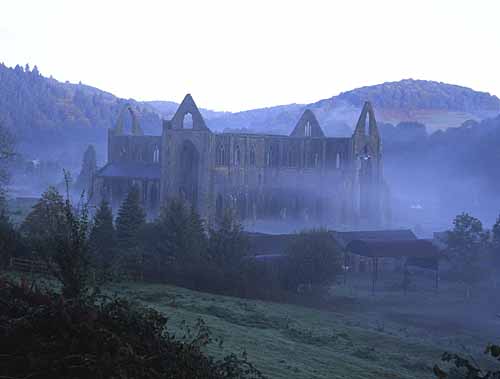
Less than two years later a picture of Tintern Abbey would help pull her through a terrible first pregnancy with our son, Calum. The same photo performed this function five years later as our second son, Graeme, reluctantly succumbed to womb-ed pressure and left his humble abode to make his premier. However, it is difficult to compete with William Wordsworth whose words best complete this picture:

While with an eye made quiet by the power

Of harmony, and the deep power of joy,

We see into the life of things…

And somewhat of a sad perplexity,

The picture of the mind revives again:

While here I stand, not only with the sense

Of present pleasure, but with pleasing thoughts

That in this moment there is life and food

For future years. And so I dare to hope…(Wordsworth on Tintern, 1798)

Everyone can point to at least one place where something important, even seminal occurred and they sense something is different. There it is that our life has been forever changed, perhaps only incrementally, but transformed just the same.

I believe it is God’s way of playing spatial peek-a-boo.

Think deeply of a place or two that have been places of rest and reconstruction. Picture that place in your mind. Now let that picture juggle your heart.

As you do so, re-member the pieces of you that may have been broken or lost in that place. Quietly give thanks to the God who loves to find us where we’re least looking or at least looking the other way.

Glimpses, part I: awakening to the indescribable

I want to take a stab at describing what cannot adequately be described. As a contemplative and a musician, I have met, from time to time, with mystical experiences that beggar explanation. I do not have anything close to adequate categories or temporal understanding for such things. In seeking them out, I must simply share and hope for the best.

I will be doing so in a short series of posts under the general heading, “Glimpses.” A little unoriginal I admit. However, I trust that my faltering attempts at self-revelation will prompt your own journeys of inner discovery and that, together, we may find God’s deep reservoir of grace.

At the foundation of Christian spirituality (and others) is the very basic principle of awakening or awareness. It comes in many different packages, under numerous ideologies, representative of a host of approaches, all with practices that lend themselves to one’s emerging spiritual life.

To become aware is to wake from some form of slumber, sleep or sloth. One of the mysteries of spiritual awareness is that one does not awaken naturally. We are prodded awake by the loving work of God upon the sleeping soul. It requires this nudge from God upon our shoulder before any meaningful process of receptivity and relationship can occur. In order for us to embrace this work, basically to ‘awake to our awakening’, we must intuit God’s whisper, speaking grace into the spiritual ear of our understanding.

I do not speak so much of the prophetic proclamation to “arise, shine; for your light has come.” No, before we can be so attuned to the prophet’s voice calling us to faithfulness and righteousness, we must first hear the voice of the Lover calling us to succumb to this wooing for which our only response can be, “I am my beloved’s and my beloved is mine.”

As comforting and romantic as that sounds, however, upon awakening to the first primal strains of the song of God, there comes a dissonance amidst the lilting notes. We awaken to beauty and begin to see that for which we have always yearned but of which we were unaware; blind. This, however, can often be a fearful and groggy experience. Cobwebs invade our minds unaccustomed to such sharpness of color. Ears that have been plugged up suddenly pop as our inner altitude changes. It is as disorienting as it is invigorating.

I remember places, glimpses into…something; an awareness that hints at a proximity to the indefinable, numinous presence of God. These are never easy things to describe, but there is a delight in the attempt for, in so doing, I am taken back to some of those places. For me, it was often some old, stone church or monastery; most often at night, alone.

Yet, not alone.

As I have since come to believe, they were, as the Celts called them, thin places where a barely perceptible sheath surrounds the holy otherness of God and where comes a mystical awareness of God so immanent that one feels she can literally smell God’s breath, touch God’s skin. These experiences have often made the hair on the back of my neck stand up.

Ironically, they used to happen often when I was a boy, long before I had any faith lexicon or tidy systematic theology with which to scrub them up and describe them away. I recall one particular time as I lay on our living room floor. I was probably eight or nine years old and, as I did every year, was watching the first snowfall of winter. Enormous frozen flakes dove in random, disciplined lines, dancing past the streetlight that stood outside our home. The glistening goodness provided a panacea against which the world was complete and all was one, if only for a time. In those moments, gilded and encased in childhood wonder, I became curiously aware of a haunting peace that arrested my sensibilities and held me spellbound in what I can only describe as ‘rightness.’ The cosmos and I were one. God, as I now understand God, was lying beside me on the living room floor that night, whispering wordless words to me, convincing me of my place in it all, be it ever so miniscule.

This is a story best left unfinished…

This week, consider quietly and prayerfully, the ways in which you may have heard these awakening whispers of God.

Journal them. How did they occur? Under what circumstances? What, if anything, changed in you as a result?

What are ways you may be invited by God to enter even more deeply into these places of awakening and transformation? Agree, humbly and with resolve, to enter into them with the God of grace to guide you.

Feel free to share what you and God have been up to in your journey together.

Jars of Clay – A Prayer

Lord, you have exalted your name above the heavens.

Your name means grace and peace and wonder to all who speak it in faith and love.  You have chosen to use weak and broken vessels to be your eyes and hands and feet in this world.  It seems, Lord, that you love to pour out your glory through

the ordinary, the fragile, the imperfect.

In this, Lord, we are honored – but humbled.

You ask us to mirror grace, love and faithfulness to the world – the very grace, love and faithfulness so eloquently portrayed in Jesus Christ.  Through him, you promise to give us all we need to live rich and holy lives in our communities, our families and in this world.

Mysterious God, so great a salvation!

We sinned, you forgave.

We turned away, you gave chase.

We rebelled, you paid for it.

We forgot, you remembered.

We are often faithless, you are ever faithful.

We complain, you are patient!

Lord, do not allow us to make excuses for ourselves, hiding as we do in the limits of our humanness.  Although we are perfectly aware of how inadequate we are to the task, help us to see ourselves as you do, as reconcilers, as peacemakers, as redeemed kingdom builders.  If we are dull, make us shine.

Lord, take these imperfect jars of clay and make them holy cups of pure grace, forged in your desires for us.

May it be so, Lord.

May it be so.

…and he said to him, “follow me”: a Litany

This litany grew out of a class I took as part of my master’s program….


How good it is whenever we leave all false agendas, desires, plans, schemes, thoughts – selves behind and obediently follow the Master without hesitation.

…and he said to him, “Follow me.”

How good to imagine a world where those without hope are given hope because the community of Jesus follow the leading of their Master and Teacher and bring this hope in all they say and do.

…and he said to him, “Follow me.”

How good, to host the Presence keeping company with sinners, tax collectors, lepers and the outcasts of society.

…and he said to him, “Follow me.”

How good to ever have ears to hear the voice of Jesus calling to us, urging us to follow him wherever he goes participating with him in bringing the new wine of God’s kingdom to light around us.

…and he said to him, “Follow me.”

How good to live before God every moment with godly sorrow for our sin, fully embracing our many and varied brokenness in honesty and authenticity.

…and he said to him, “Follow me.”

How good to celebrate with all whose repentance brings new life and an accompanying deep life change even when such celebration causes raised eyebrows.

…and he said to him, “Follow me.”

How good never to allow ourselves to succumb to religious peer pressure that traps one in the smothering flames of imposed, ungodly parameters of faith life and thereby lessen the gospel message in compliance with it.

…and he said to him, “Follow me.”

How good never to succumb to the same judgmental spirit which produces and perpetuates religious peer pressure. “Father forgive them, for they know not what they do.”

…and he said to him, “Follow me.”

How good to taste the old, complexly rich and fragrant wine of our forebears while working in the vineyard alongside our Master Winemaker.

…and he said to him, “Follow me.”

How good, to “stand in the place where you work” looking left and right to find those of ill repute and the despised with whom to drink new wine.

…and he said to him, “Follow me.”

How good to stand in the place where others are, be the voice of Jesus calling to them, saying “follow me” and teach them how to catch others in the net of grace.

…and he said to him, “Follow me.”

How good to be those who hold the redemptive instruments of grace at the bedsides of the broken together with our great Physician.

…and he said to him, “Follow me.”

How good to bring encouragement to all whose “bridegroom” has been taken from them either by sickness, death or malfeasance.

…and he said to him, “Follow me.”

How good…

How good, indeed.

Praise be to the Lord of all lepers, losers, limpers and lovers!

…and he says to us, “Follow me.”

a contemporary psalm of lament

Lord, a heart lies in anguish’d ruins,

haunt of those whose boots are stuffed full

of the detritus found only on lonely hillsides

and mucky marshes.


There is no comfort in comfort;

comfort itself is a mockery, a shadow.

My soul is o’er grown with the sadness of sin,

untimely and magnetic North to this sorry South.


Finding is, to me, just another losing

of what was never found, nor seen;

the secondary reality of a desert’s shimmering heat

rising above an already parched, dead land.


Beasts of memory and regret feed

on the bowels of my discontent,

and I am emptied, disavowed of what might

otherwise provide hints of hope, of life.


The heartsickness of a harrowed soul

is its own reward to the one who is lost;

wretched reminder of yesterday’s loss by

the infected, troubled mind.


Is there to be yet a darker dark

in this once proud cave,

suspended from the slippery ceiling

of this crowded, empty space?


How long?

How long, O hidden one,

must I only think I see what troubled images

broken mirrors bring of half a man?


Does your heart still break for the broken and breaking brood

of souls, unwhole, and garden walls, both shattered and unsure?

Do your light and lilting footsteps no longer fall

upon once green grasses; once ripe gardens?


I can’t remember your name.

Do you remember mine?

If this be my last will and testament,

so be it, if only others may not find me thus.


If your face be turned away,

may it be for the sake of a clearing breath,

a yearning sigh, a readying glance,

that in returning…


sees me again.

Laundry day Jesus

There are curious profundities in insignificant things. We Presbyterians are especially proud of our strong, unassailable logic in all things theological, as if God was easily codified into neatly established linear categories. More often than not, we are working out our salvation with coffee and donuts as much as fear and trembling. Our responses to sermons regularly find their way into coffee pot conversations. They just don’t sound so fancy pants.

For all our strengths, those of the Reformed persuasion too often miss the point in a mad dash to convince everyone of big boy doctrines like the virgin birth or the divinity of Jesus. It seems that it will remain an impossibility to perfectly describe the indescribable. I often wonder if we would do his divinity a big favor by paying more attention to his humanity; the way he did.

Jesus never shied away from recognitions of or statements about his place in the Godhead. It just wasn’t his primary focus. Instead, he spoke endlessly about wheat and lilies, goats and sheep, wine and bread, coins and widows and sand and sea and doubts; the kind of stuff we talk about in our unguarded moments together. Jesus didn’t want to raise our level of conversation with polysyllabic words fit for Scrabble champions. Nor did he really care whether or not we came out of this with a shiny box set of matching, picture perfect doctrines fit for wrapping and placing under the Christmas tree.

He wanted to find himself with us caught up in the load of laundry that contained a red crayon or the fifty-dollar bill Dad had been desperately looking for last week. He desires to find his way into our thoughts when we’re changing the oil in our car or swapping out a toilet in the master bathroom. Will our most private, reckless moments contain bits of light, truth even? Would we speak from the pulpit what we just spoke to our swollen finger, freshly hammer-smashed? Does the name of God find its way to our thoughts as often or as vividly as does the business page of the paper or the latest political wrangling?

These considerations are not to add to our already bursting guilt quotient. But maybe they can help us find our way out of the morass of conversations thick and heavy with theological brain goop in favor of the spiritual tarpaper of mutual sojourn with the Jesus who knows how we do our laundry. Our theology should lead us to the laundry room as readily as the church library.

He knows that we’re often more delicate than the stuff presently in the dryer.

What are some of the out of the way places Jesus might find you today?

If you were to converse with Jesus in the most mundane moments of your day, what would you say? What might he say to you?

Think of the most boring thing asked of you this week. Try picturing Jesus there with you. Remember, Jesus did grunt work, too!

Jet fuel, candle wax, Bilbo Baggins and Pentecost

I posted this originally on the Spring Arbor University MSFL micro-site. I also wanted to share it here. Join me in either place and we’ll talk Tolkien among other stuff…

In a conversation with Gandalf the Grey, Bilbo Baggins, elder statesman of Bag-end in Hobbiton, anxiously complains that he is feeling “thin, like butter spread over too much bread.” Uncharacteristically, Bilbo had been the first hobbit ever to venture outside the safe, recognizable confines of the Shire. There, life was well planned, neatly cropped and decently fitted to those more inclined to an afternoon of tea and scones than giants, goblins and dragons. How distasteful.

“Butter spread over too much bread”, I quite relish cryptic statements like this. There are any number of ways to parse his meaning. Bilbo might just have easily said that he needed less bread upon which to spread his limited butter. It means basically the same thing, doesn’t it?

Maybe.

His original statement suggests that there isn’t enough of Bilbo to accommodate all that life throws at him. He was verbalizing the fact that, under any circumstances, he was always the same person; a hobbit of limited emotional and physical resources (the latter being especially true of Shire folk). For hobbits, adventures are unsightly, unnecessary inconveniences. What had changed were the additional demands his world imposed upon those limitations. Sound familiar?

As we consider Pentecost, this should invite the question, “is the Spirit-empowered life intended to prep us for a world that makes no allowances for the spiritual needs of its inhabitants? In other words, do we, by God’s strength, bend to suit the frenetic nature of the world around us? Conversely, is the Christian life designed to provide us with the tools necessary for us to discern such demands and, in response, live counter-culturally? That is, do we, by that same grace and power, embrace a just-say-no policy to insane living?

Mindy Caliguire, founder of Soul Care, a spiritual formation ministry, (and committed non-hobbit) places we Pentecost people into two broad categories: jet-fuel drinkers and candle lighters. At first glance, I envision those type-A, scale the world with bare hands types to be drawn to the former option. They already tend toward a win-through-perseverance philosophy in most things. Thus, they might be more inclined toward the more is better motif – praying, believing and living in ways that hint at the deeper well from which the Christian may draw. Pentecost to them means that we are given more than adequate resources to meet the challenges imposed by a frenetic culture. More butter to meet the demands of much bread.

The second scenario might be considered more the domain of the candle lighters. They are those who see the inherent dangers to an integrated wholeness within the prevailing culture and risk either apathy or antipathy in their subversive, counter-cultural response to that same milieu. They seek freedom from the imposed insanities rather than power over them. In this ideology, Pentecost provides the inner sensitivity that allows for careful discernment of our crazy predicament. Less bread given our limited butter.

What then is the biblical alternative for he or she who seeks to live as a faithful disciple of Jesus Christ? As I read the scriptures I am forced to concede that the best answer is…both. From the Bible’s earliest pages, one discovers jet-fuel drinkers and candle lighters dwelling together in a veritable stew of divergent sojourners.

Matthew, the greedy, upwardly mobile corporate yes-man intent on being all he needs to be to dominate the system: jet-fuel drinker.

Intimately acquainted with the rhythmic beating of the Savior’s heart and writer of the most mystical Gospel, John: candle lighter.

Gideon, the mealy-mouthed Mama’s boy who ultimately becomes a savage warrior: jet-fuel drinker.

Samson, more aptly named Testicles, a small-minded man whose thoughts are more guided by testosterone than thought: jet-fuel drinker.

Mary, the simple (Martha might suggest, lazy), young lass intent on soaking up the warmth of Jesus’ intoxicating presence without thought of consequence: candle lighter.

Peter, run-at-the-mouth-foot-in-the-mouth-has-a-big-mouth, and yet ever repentant, never enervated follower of Jesus: jet-fuel drinker.

Elijah, self-pitying purveyor of God’s power over pagan parlor tricks: candle lighter in a jet-fuel drinker’s body.

So, what does all of this have to do with Pentecost? My original query was whether or not the promised Spirit sent to those expectant, wondering disciples was primarily for the purpose of preparing ill-equipped weaklings to become stronger than their environments. Or, is the Spirit’s primary purpose to help discerning disciples say no to the soul-killing environment in the first place and build the new society of love envisioned by Jesus?

Jesus enjoyed company with all manner of strangely broken, frustratingly naïve individuals. The hand of God extends to all who are found clinging to the hem of the Savior’s garment. The chill-out, be happy, hippy version of faith together with the git-er-done, live like ya mean it suit ‘n’ tie types.

How does Jesus’ example help us interpret Bilbo’s complaint? Does Jesus, by the Spirit, primarily present the victorious life of the jet-fuel drinker, thereby modeling the ideal spiritual life as the power-to-rise-above? Conversely, is Jesus, by that same Spirit, to be viewed more as the perfect version of Martha’s whimsical sister, whose strength for service came at the feet of her Savior and friend, the candle lighter? Was Jesus drinking jet fuel or hot wax?

Yes. Any questions?

To follow the Pentecost road with Jesus is to live rightly and well. It guarantees that our butter will last and that the constant stream of toast demanding our butter will never be more than our butter can manage. Let us rise to thank Bilbo Baggins for his good, but unintended, spiritual counsel.

I need a sandwich.

An Easter people in a Good Friday world…

This past Sunday, with the coming of the Holy Spirit at Pentecost, we “officially” mark the end of the Lenten-Easter journey. Unofficially however it is only the beginning. With hearts freshly cleansed, minds renewed, paths made straight, souls united to God and eyes made clear, we are now given charge to be the bridge upon which people may walk to find peace…to find God. We become Easter people in a Good Friday world. The following is our manifesto:

An Easter people in a Good Friday world:


Live life when death seems to be winning,

Seek hope when despair seems bigger,

Laugh out loud when to be sullen seems better,

Cry for justice when the weight of wrong smothers,

Call out for peace, when the shrapnel of war still smolders,

Find good where goodness should not be found,

Stand still when chaos and panic seem to rule,

Take the long road of grace instead of the short road of law,

Pursue righteousness, even when unrighteousness is easier,

Sing the praises of God even as darkness appears most ominous,

See Christ in the face of friend, enemy, immigrant and stranger,

Proclaim an empty tomb when the heart of darkness yet gloats…


“He is not here…just as he said.”

Commissioning prayer

I moved with my family from Kelowna, British Columbia to McMinnville, Oregon a month before the infamous events of 9/11. I’m not generally known for great timing! The move was for the purpose of assuming my role as Minister of Worship and Music at First Baptist Church. My short, 3 year tenure there was challenging and exciting and growing for me. A congregant, Densley Palmer, was a wonderful hymn text writer and poet. The following is a commissioning prayer he composed for the occasion of my coming to FBC.

Commissioning

Densley and Joyce Palmer ©October, 2001

For the commissioning of Robert Rife as Minister of Worship and Music

First Baptist Church, McMinnville, Oregon, October 14, 2001


Let all earth dance and sing in the presence of the eternal God.

Let us blend distinct voice and individual song in praise and thanksgiving

to God who makes all things one.

Let us worship God with our voices,

on the organ, and on the pipe and drum.

Be still, and await God’s voice in the pregnant moments of silence.

Calm the erratic cadence of daily life and move to the rhythm of the eternal.

Through worship, glimpse God’s infinite breadth, eternal length,

and encounter the intimate presence of the holy.

Wherever we worship God, let it be with a sense of awe and expectation,

a spirit of joy, and an awareness that,

through worship, we encounter the sacred

and stand barefoot on holy ground.


Let all earth dance and sing in the presence of the living God.


As Family

Lord of all things new,

we come to you in prayer this morning as family.

We are many and we are different.

But those things that make us happy or confused or sad are similar.


Lord, this is the prayer

…of the man, recently laid off from work,

whose job has provided his identity for decades;

…of the lonely housewife aching for adult conversation

at the end of long, arduous days of laundry, diapers,

fighting children and a barrage of thankless tasks;

…of the college student who recently discovered

she is pregnant six months before graduation;

…of the teen-age boy whose unchosen sexuality promises renewed bruising

and rejection from his father.

…of the businessman who sees his many years of hard work

building a business crumble and disintegrate

in the hands of greedy men who care little

for his sacrifice of time, sweat and pain;

…of the teenage runaway, whose only remaining options for survival involve

things too shameful to mention.

…of the young boy or girl forced to live in isolation,

fear and chaos because of abuse;

…of the elderly man or woman who faces the increased pain and frustration

of watching their spouse descend into the dark abyss of dimentia;

…of the forgotten senior who can’t possibly face another day

without companionship;

…of the family faced with the prospect that Daddy may not survive

his heart surgery or that Mommy’s cancer may not go away;

…of the family torn apart by bitter divorce;

…of the person who, for any reason, is furious with you

for not coming to rescue and making the pain stop.


Lord of hope,

we come to you in prayer this morning


as family.