How good it is whenever we leave all false agendas, desires, plans, schemes, thoughts – selves behind and obediently follow the Rabbi without hesitation.
…and he said to him, “Follow me.”
How good to imagine a world where those without hope are given hope because the community of Jesus follow the leading of their Master and Teacher and bring this hope in all they say and do.
…and he said to him, “Follow me.”
How good to be hosts of Presence keeping company with sinners, tax collectors, lepers and the outcasts of society.
…and he said to him, “Follow me.”
How good to have ears that hear the voice of Jesus calling to us, urging us to follow him wherever he goes participating with him in bringing the new wine of God’s kingdom to light around us.
…and he said to him, “Follow me.”
How good to live before God every moment with godly sorrow for our sin, fully embracing our brokennesses in honesty and authenticity.
…and he said to him, “Follow me.”
How good to celebrate with all whose repentance brings new life and an accompanying deep life change even when such celebration causes raised eyebrows.
…and he said to him, “Follow me.”
How good never to allow ourselves to succumb to religious peer pressure that traps one in the smothering flames of imposed, ungodly parameters of faith life, ways of living that lessen the Gospel in us.
…and he said to him, “Follow me.”
How good never to succumb to the same judgmental spirit which produces and perpetuates religious peer pressure. “Father forgive them, for they know not what they do.”
…and he said to him, “Follow me.”
How good to taste the old, complexly rich and fragrant wine of our forebears while working in the vineyard alongside the Master Winemaker.
…and he said to him, “Follow me.”
How good to stand in the middle of our lives, looking left and right, to find those of ill repute and the despised with whom to drink new wine.
…and he said to him, “Follow me.”
How good to stand in the place where others are, be the voice of Jesus calling to them, saying “follow me” and teach them how to catch others in the net of grace.
…and he said to him, “Follow me.”
How good to be those who hold the redemptive instruments of grace at the bedsides of the broken together with our great Physician.
…and he said to him, “Follow me.”
How good to bring encouragement to all whose “bridegroom” has been taken from them either by sickness, death or malfeasance.
…and he said to him, “Follow me.”
How good…
How good, indeed.
Praise be to the Lord of all lepers, losers, limpers and lovers!
When it comes to the spiritual enterprise, I’ve always found delight in the iconic metaphor of wandering. My best guess is that it most capably represents my propensity for being lost in places even blind people navigate with ease – a hallway to the bathroom, the distance from upright to nosedive, or retracing my steps from mall to parking lot.
There are innumerable metaphors employed by the writer’s pen to describe transition, or passaging, as I like to call it. We “turn over a new leaf” or perhaps move from “night into day,” “turn on a light” or some such thing. Such metaphors reach for the deeper comparisons within us between what was, what is, and what is yet to come.
But this is different. Wandering isn’t the right metaphor here. This feels less like seeking something out than coming to terms with what is; a new normal. In that way, it is more the turning of a page in a book with more chapters read than yet to read.
I begin with a few words I wrote upon turning 50 a couple years ago:
“Our lives are a series of passages. One tributary leads to another, which in turn yields to something else on its way to waterfall or harbor, estuary or eddy. At times we are stuck, unmoving. Or so it seems. To be stuck can actually be a decision not to decide something. Perhaps it’s a slow, deep spot before being sucked back out into the rapids where we easily lose our sense of direction and the not unreasonable expectation that we’ll fly ass over tea kettle into the frothy spray. There are even times when our boat slows almost to a crawl and we find ourselves in the enchantments of a Pirates of the Caribbean style rendezvous with delight.”
In the chapter that is my work at Yakima Covenant Church, specifically with friend and colleague Duncan A. MacLeod, a page has turned. A new estuary has emerged requiring caution and intentionality, things I am not always known for. Like me, he too is passaging, seeking to ford new streams of possibility with their own risk and reward. He is writing a new chapter in a book yet unfolding (and a rather smelly, farm-y type one at that!).
“Whatever the case may be it should be our goal to passage well. That is, when faced with life’s bone-chilling decisions, we learn to listen for the most gracious, compassionate means by which to navigate such. Bad transitions lead to less than adequate skills needed for the yet more difficult passages to come. They also create a sinkhole of insecurity since we’ll just have to face similar rapids again later but with one more failure to our credit….I want to say goodbye well, with class, grace and compassion. A goodbye that puts a Gospel period at the end of a glorious sentence.”
Learning to passage well has many rewards. Fewer regrets I suppose might be one. But, more than that, in the ever-expanding journal of our meandering lives, a clarity of chapter markings brings a satisfaction to the sojourner of adequate closure before moving on to another part of their story. It expresses a sense of poise and, ultimately, denouement to our lives that those whose eyes watch us for signs of the Divine are longing to see. More than anything else, how we transition through the passages of our lives reveals the level of our trust in the unseen God making Godself seen – through us. Through you. Through me.
So, then, with the same trembling, inadequate faith with which I’ve typically faced these passages, I do so now once more. Who knows, perhaps this time I’ll have matured enough, even sub-atomically, to the point where I can help lead others in the same challenges?
But, then again, that would be faith in faith, not in God.
I figured St. David’s Day was a good reason to reblog part 1 of a 6-part series I wrote last year on the Welsh-Celtic idea of “hiraeth.” Come, join me for the journey!
“The human heart is a theater of longing” -John O’Donohue (Eternal Echoes)
The Celts have a concept, Hiraeth (here-eyeth). It is a Welsh word, about as difficult to define as it is to pronounce.
Let’s try.
It might be defined as a longing, a homesickness for a home to which one can never return. It is the unrequited hope that produces ever more unanswered longing. It is a grieving for the lost places and moments of one’s past – a sense of loss for loving moments and places, fondly remembered. It sits in the dream world where longing, belonging, home, and wanderlust meet.
I’ve lived my entire life in this terrible, wonderful, aching place, rarely able to make sense of it but never able to escape it. I like to think I’m a complex mystic. Others I’m sure simply dismiss it as the cross-eyed musings of a artsy moron. But…
Valentine’s Day, although a convenient Hallmark construct, is still a good day to tell special ones you love them. I wrote this a couple years ago in celebration of our 25th wedding anniversary. It all holds just as true today. Love you, babe.
When I look at her I see a few extra pounds, a slight sag on one side of her face, the residual effects of a Bell’s Palsy and a few extra facial lines every year. I see someone whose love for life is second only to her love for risky adventure. Most likely, one has fed the other. I see an olive-skinned, brown-eyed, Welsh-born, Canadian-raised girl whose voluptuous curves still captivate and tantalize me. I see a face wiser from pain, hands tougher from hard work, a smile gentler and more thoughtful from raising two complicated, wonderful sons and a brow somehow more relaxed from having weathered innumerable storms, many of them my sorry gift to her.
There is a bite to her wit, at once caustic but ultimately harmless. There is a joy in her step even if that means tripping more than is generally possible for the average…
I just returned from a denominational conference in Chicago.
That in itself is nothing particularly unique or special. But it has provided ample opportunity for observing, listening, and to a lesser extent participating, in the strange soup that is contemporary evangelicalism.
I love my newly adopted denomination of the Evangelical Covenant Church.
Among Protestant, evangelical denominations it’s at the top of the list for what I expect and/or prefer in a faith family with whom I sojourn. A big front door, a big living room, a big heart, big ideas, and a small theology ledger.
A non-creedal body by history and by choice, there is no dotted line awaiting my subservient signature to enter and serve. As such, the ECC provides a place in which to actually practice the work of theology on the ground – you know, where Jesus did before leaving to get his doctorate.
Typically, our post-Enlightenment milieu seeks to train up preachers like God scientists. Sideline the complexities of self and soul and stuff young heads like Christmas turkeys with doughy abstractions and crunchy data, then send them out as over-confident, naked children to fight lions with noodles.
I’ve written much about my twenty-year journey out of evangelicalism into a much broader ocean tinged in the light of a more mystical, pre-Reformation, eastern Christianity. For me to even consider climbing back aboard this ship required a pretty convincing package.
So far, the ECC seems to be that package.
In brief, the ECC is comprised of a complicated mix of Swedish Lutheranism distilled through North American Pietism. It has found its way forward, stumbling together through all manner of daunting issues, learning itself by means of diverse community, water-cooler (pub, more likely) conversation, congregational government, word and sacrament, occasional passive-aggression, all over micro-brew and cigars.
It’s enough to make C.S. Lewis and G.K. Chesterton downright giggly.
An old world Lutheranism offers the richness of liturgical worship and sacramentalism while its new world Pietism places it in the hinterland where the ‘other’ lives. On the backroads, the rank and file are too busy surviving to worry whether or not all the right words are in all the right places.
It prefers connectivity over credibility, presence over power, and communal acquiescence over conversant apologetics. It may be the last bastion of evangelicalism where any hint of spiritual orthopraxy is wed, albeit tangentially, to theological orthodoxy. It’s tea cozies for some, bad whiskey in dirty cups for others. My kinda place.
This blog from the beginning has existed to give voice to the centrality of spiritual formation in all I do, think, say, believe, adore….How gratifying to know that this denomination has an entire wing dedicated to the promotion of the same. There is more than lip service paid to the idea of souls being satiated in the numinous realities of the ineffable God.
As one tasked with drawing a local congregation into the worship of God, this has given me a good place to explore. I can continue my journey into post-modern, eclectic liturgy rooted in a more robust sacramentalism.
A few of my music peeps out on the town in Chicago
But I can also do so with a view to reimagining the church’s ancient past for a very complex present. In this endeavor I am finding friends, co-laborers in the liturgical arts game with whom I can toss around the stuff of our trade. They are beautiful souls and have almost as many questions as I when it comes to how best to ply our trade in the murky complexities of local church ministry.
The ECC is not perfect. We still succumb to the temptation of hipster idolatry and the cult of relevance. We are still a bit too easily enamored of evangelicalism’s how-to mentality where every conceivable question has an airtight answer. The subtle presence of American pragmatism can be seen sniffing around the corners and we’re a bit too close to Christian industry-speak for my taste. Finally, we find ourselves mired in a safety-zone mentality on matters of human sexuality.
But in spite of this, it is a very healthy alternative to almost anything else I’ve seen within the vast dysfunction of the growing-by-division evangelical family. It’s been a good place to be found of God.
It is the garden in which I am presently planted.
And I am glad to be here.
My new Covenant partners in ministry
Photos by Jessica Perez and someone else with a very daunting selfie stick
A New York City subway train holds 1,200 people. This blog was viewed about 6,900 times in 2015. If it were a NYC subway train, it would take about 6 trips to carry that many people.
Christmas Day. My eyes are like twin harvest moons of bloodshot fatigue. There’s a roller derby taking place in my head. My church music ministry gig ramps up something fierce this time of year leaving me satisfied and happy, but a shivering hump of quasi-humanity. The solution? I sent my wife, Rae, out to find anything resembling coffee, if only for a most yummy and effective remedy for my pounding head. God bless her!
A rather poorly decorated poor excuse for a Christmas tree tries unsuccessfully to stand guard over the precious few gifts tucked under her skirt. A single strand of multicolor lights graces her awkward presence in our living room. Perhaps fewer than a dozen ornaments hang suspended, lifelessly, from these poor, little green arms – flimsy and weak.
I speak of symbols, those tried and true geiger counters of the meaning and truth they represent. Many…
In a recent post I began to meditate a bit on what the Psalmist may have been on about in 37:4 when he adjures us to “Take delight in the Lord, and he will give you the desires of your heart.”
To press into the paradox of these words is to discover two interrelated things. In pursuing those things, ideas, persons we believe to be most satisfying to our egos, the shallow water before getting to the sea of soul, we suffer the law of diminishing returns. We attain, receive, pursue, and sometimes steal in order to buttress an icy happiness that laughs at us mere moments after the fact.
We held in our hands what is now farther away.
The result? Turn up the heat of our pursuit and call it “dedication” or “hard work” or “sacrifice.” The process begins again in earnest, to a fool’s detriment.
Conversely, it means something much odder still. To walk away from delight itself and toward the God of all delight is to forego the very need of desires for which we were previously straining. It is God’s cheeky bait ‘n switch.
To one drowning in desire, grasping hold of the first thing to bear us up is a natural action. But that desire blinds us to the life boat yards away in favor of a shark’s fin inches away. We are saved, but only until it becomes clear the price we pay.
In this season of competing allegiances and dueling narratives, all sparring for our attention, let us journey together on the longer road, bringing an end to all lesser desire, and follow after he whose self-denial gifts us with what we never thought was lost.
Let us risk the farther star; the gift which requires us to keep our heads up lest we trip on our own pursuing feet.
“Take delight in the Lord,” says the Psalmist, “and he will give you the desires of your heart.”
This is a deceptively easy passage. The fog of western, individualist consumerism however urges us to read this as God simply handing us whatever we want, regardless of its origin, intent, or wisdom in the attainment thereof.
Indeed, God does give us what our hearts desire. But, the beauty and deft insight of this verse is that the heart changes in accordance to what brings delight. As it becomes more centered in the Divine, it leans more readily toward the faces who line the hallways of our lives.
We soften toward their plight, and glow with pride in the accomplishments of others. It begins to shatter for the things that shatter the heart of God, in whom we delight.
And even suffering begins to make some small sense as it becomes contextualized against the larger picture of God’s redemptive enterprise, an enterprise into which we are invited, baptized, and transformed. It is out of that transformation which come the heart’s deepest desires, doubts, despair, dreams, and destiny.
The next time we quote this marvelous gem, especially during this holiday season, let us attend to its more ultimate direction. Let us lean into the God who, in Christ, becomes all our desire and through whom our deepest desires, plunged into the raging love of God’s heart, are fully satisfied.
Precious little of our lives in Yakima reminds me of life in Calgary. Not that it should. I’m just a comparison kinda guy.
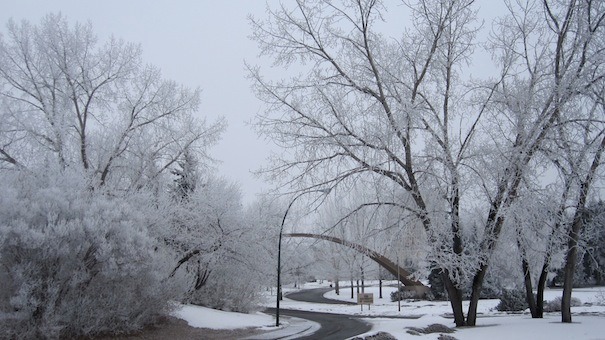
Calgary in winter
In Calgary, we’ve had snow every month of the calendar year. Even August. Here, we’re lucky to get snow at all. When we do however, life becomes unlivable. Not the kind of unlivable that has one kicking the dog or hoarding the Communion wine. It’s more a slush-ridden slide of faith down valley hills on tires never sufficient to the task. The dampness of Pacific Northwest snow makes it heavier than the objects upon which it falls. Plants cower under the weight, almost like Atlas bending under a muscle-twitching burden. Roofs have been known to collapse. More people own snow blowers than shovels in this valley, since even body-builder knees buckle shoveling this snow.
Photo by Mike Sauer
In spite of endless sunshine, most often appreciated by lizards and sun worshipers, I’m most miserable during the Yakima summer. My Canadian blood, trained by a temperate climate promises a hazy kind of heat-induced droopiness that drags on endlessly when parts of you are sweating that never did before. I suppose it’s the opposite of S.A.D. (Seasonal Affective Disorder). While most Yakimites keep a loaded revolver in the glove box just in case winter’s grey leaves them overwrought, I whine like a banshee without enough rain and grey skies. I should probably have that checked out.
A Calgary heat wave usually meant a few days of low to mid 90s that promised bitchy parents. Drivers and pedestrians alike grew more aggressive than usual, and tempers got shorter than the summers themselves. As kids growing up in the not-so-balmy regions of Alberta’s grasslands, such unreasonable temperatures meant longer days for exploring and defining ourselves against the shenanigans of our troublesome friends.
Make it through the super-heated Yakima summer however and flaunted lavishly before us is a superlative fall, beautiful to the point of garish. Leaves change more slowly here. The sage green and spittle browns of summer are swapped out for yellow, auburn, orange, and other colors I can’t even begin to name.
The historic Barge-Chestnut neighborhood in the Fall.
A Calgary Fall came quickly and with a vengeance. The colors were there one day, gone the next. Winter was the only decisive time of year. Calgary’s favorite color is the peaty-brown grass that climbs its gentle slopes and clings to her Rocky Mountain-shadowed foothills. Stands of poplars, deciduous minority brothers in the more ubiquitous pine forests further west into the mountains, groped for sunshine, teasing each other beside the Bow and Elbow Rivers.
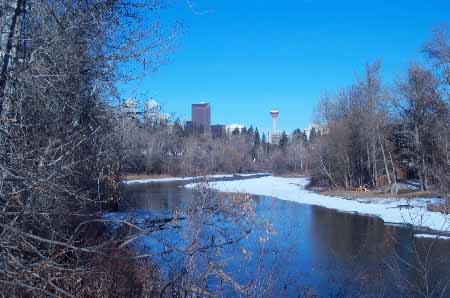
Elbow River, Calgary
From there, the Rainbow Trout, Steelhead, Sturgeon, and ample Pike taunted many a fly-fishing line and studied the undersides of canoe and kayak meandering their way down her rippling spine. Besides, if the fish weren’t biting, the mosquitoes most certainly were.
Bishop Grandin Catholic High School, one block from my street
Life in the Calgary of the sixties and seventies was decidedly more pasty and wan than it is now in a sprawling cosmopolitan soup of oil-nouveau-rich yuppies. Before Bishop Grandin High School was built in the early seventies, we could look out our kitchen window and see the animals frittering about on Harry Hays’ farm a block away. In fact, our street was almost the southern most boundary of the city proper. For my parents to drive me for bagpipe lessons in Midnapore, then a separate town, now one of many annexed communities, required high beams and good suspension on dark, bumpy back roads.
A Calgary winter could be the most indecipherable mess of meteorological phenomena. Her geography has her cupped in the palm of a significant mountain range but with her head tucked in the nape of the foothills that ridge her neck. Some have compared it to Denver in this regard. It was not uncommon to scrape our windshields one day, after twenty minutes of pre-warming the car in -30 degree weather only to ditch our down jackets for windbreakers the next day as Chinook winds brought temperatures even into the 50s (10+ degrees Celsius of course). It was the meteorological equivalent of multiple personality disorder – about as complicated, but less fun.
A favorite part of Calgary life for me was the continuous rivalry between Calgary and Alberta’s capital city of Edmonton, a couple hundred miles north. CFL (Canadian Football League) teams, the Calgary Stampeders vied for supremacy against the Edmonton Eskimos (Canadians are allowed to use this word because I think we invented it) in clashes a lot less polite than is typically attributed to the Canadian demeanor. Betting was fierce. Petty, verbal jabs even more so. Broken ribs and missing teeth most common of all.
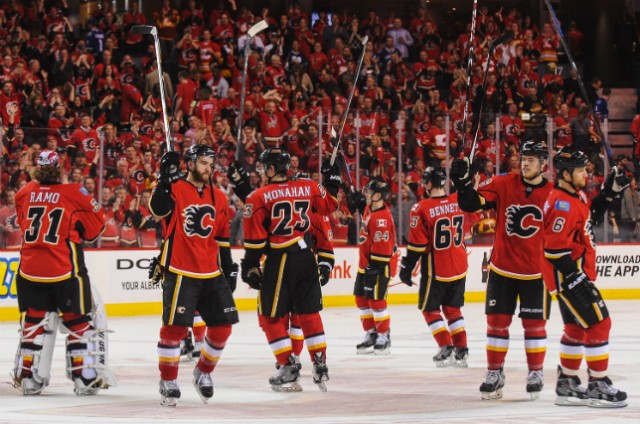
The Calgary Flames
What did I care? I loved hockey, a sport as definitive of Canadian citizenship as God Bless the Troops bumper stickers in the States. Even before the Atlanta Flames became the Calgary Flames in 1980, I knew every player on every team. I even knew first round draft picks and the names of a few general managers. Ask me the most obvious question about anything football and the blank stare will tell you what you suspected all along.
The far too many uprootings in my family wake has made me grateful for the stability we’ve known here in Yakima. It’s surprising how God’s vitals become more pronounced when one isn’t always out of breath and one’s heart isn’t pounding in the ears. It makes inner silence and listening so much easier.
God has found me here. I may not always feel the same sense of DNA-level familiarity with my environment, I may be living in the U.S. but Canadian as the day is long, I may not appreciate all the cultural inside jokes or regional quirks, but I’ve heard God’s heart beating. It’s quite soothing. There has certainly been life in the drifts, but there’s more life in the ground, buried and out of sight, that nourishes and stirs dead things to life.
I’ll still whine from time to time about ‘home’ (whatever that is). I’ll still cringe whenever I see the Trumpster or the Palin-doll in “the news.” I will never understand the correlation between guns and “freedom.” I may not feel as connected or authentic when stumbling through the American national anthem. My friendships may barely exceed a decade. But God has planted me in a distant soil to bring me and mine closer to the deepest harvest, that of the heart.
Until then, I’ll keep bitching all through Yakima summers in the knowledge that seasons change. Like all of us.
I know, it’s annoying, but I kinda like it that way.

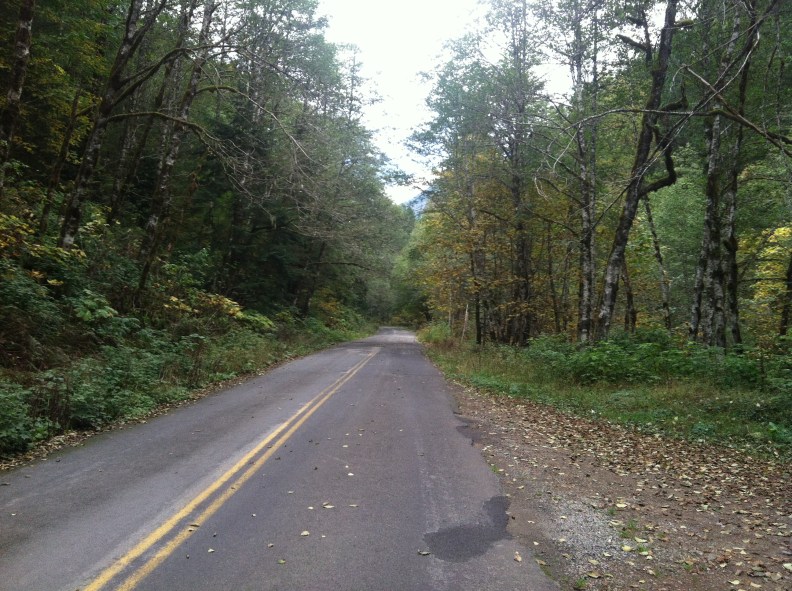
 When it comes to the spiritual enterprise, I’ve always found delight in the iconic metaphor of wandering. My best guess is that it most capably represents my propensity for being lost in places even blind people navigate with ease – a hallway to the bathroom, the distance from upright to nosedive, or retracing my steps from mall to parking lot.



 Painting by James Tissot, found
  This is a deceptively easy passage. The fog of western, individualist consumerism however urges us to read this as God simply handing us whatever we want, regardless of its origin, intent, or wisdom in the attainment thereof.



 innerwoven