“Trip to Bountiful” – part 7

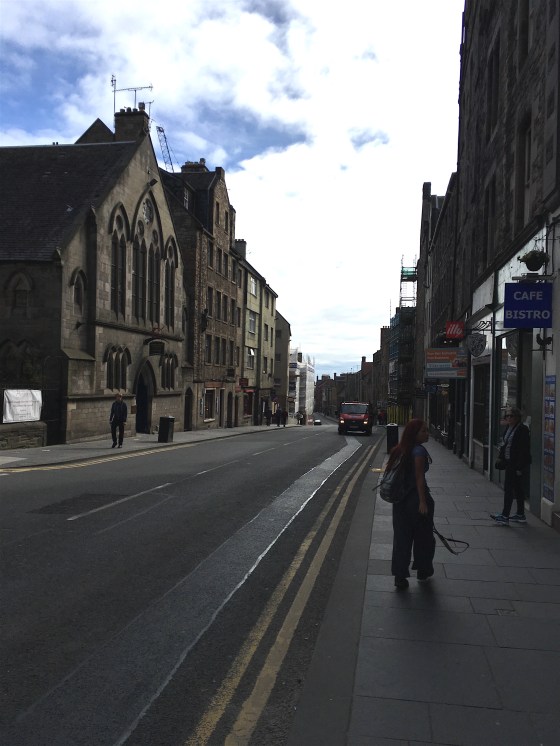
Edinburgh writing haunt.jpg
Downtown Edinburgh, from whence I wrote this piece

Block after block of grey, stoic flats flit past to converge with still others in a parade past my train window. An aging reflection gazes back reminding me I need a haircut. The broom-covered, volcanic hills stand guard against a broadening horizon of uncommonly blue Edinburgh sky, and I am pensive.

My wife, as I have described her at least, is a tempest in a teacup. Actually, human hurricane was the term as I recall.

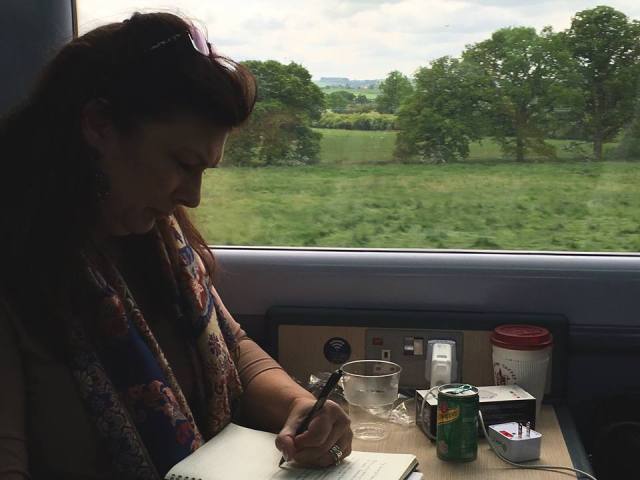
Rae writing on the train to Wales.jpg
My wife and fellow partner in words, curiously quiet

She is the poster child for extraverts, an off-the-charts go getter with a zest for life and love for adventure. It’s fun but rather exhausting! I accompany her downtown from Brunstane to Waverly Station where she caught the morning train to a writer’s retreat near Bath.

After seeing her off, I indulge in another quick jaunt up Princes Street. I trip into a trendy Edinburgh café (there are gazillions) for a third, perhaps fourth, coffee and obligatory Facebook check-in. James Blunt sings to me through café speakers, “how I wish I could walk through the doors of my mind; hold memory close at hand, help me understand the years.”

We’re well past halfway in our 2016 “Trip to Bountiful.” A journal and a full heart loudly pester me for a few reflections. At a reunion party last evening, my wife and I were reminded how central relationships are in our lives. Many photo albums and now an iCloud full of photos give evidence of a full life, lived fully.

But, although places and experiences fill much of our memory hard drive, it is the faces of those whose voices still sing loudly in us that best help us to “hold memory close at hand.” It is they who can most capably help us “understand the years.” 

In another post, I share some thoughts from the tale end of our time spent among the good people at Granton Baptist Church, Edinburgh.Granton Baptist.jpg

Scarcliffes.jpg
Pastor Andy, Moira, and Adam Scarcliffe
Grant Cunningham
Grant Cunningham
Fiona Aitken.jpg
Fiona Aitken
Joan Cunningham.jpg
Joan Cunningham

There is much I could say about the few months spent among these dear souls. To do so would require some fierce self-editing. First, because our memories are many and detailed. But, secondly, because we weren’t always the best influence despite our lily-white, suburban-Canadian, preppie exteriors.

Life is handed to us often in haphazard basketfuls of beauty and complexity and chaos. The best bits are those we live by accident, the unplanned moments of grace which splash upon us, baptizing us in their freshness. We can no more execute them than plan for them. They simply show up and we do the best we can with what we’ve got.

Stephen Scarcliffe and Angela.jpg
Stephen Scarcliffe and his girlfriend, Angela Murray (oh, and Nookie!)

Like the time my boys’ group talked me out of Sunday School in favor of a football game (soccer to North Americans) at the park. It was an effort requiring a lad or two to be stuffed unceremoniously in the boot (trunk) of the car for the journey.

Perhaps the time my wife and her coworker decided a girls’ sleepover the perfect time to discuss procreational geometry to middle school girls with the aid of balloon phallic symbols? Perhaps the seaside games night in which my wife and I, so exasperated with each other, shouted “fuck you” in the presence of innocent, Baptist kids? The rest had long before given up and were shoving each other into the sea. Perhaps the time we danced at a church-wide ceilidh (party) and a young boy affixed himself to my leg all evening and wee Calum became the namesake for our eldest son, now 25.

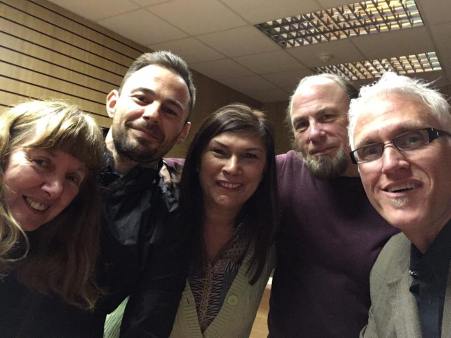
Yes, all these and many more besides provide the yellowing pages of our memories. These folks have shaped our lives, glutted our hearts, and colored our memories. And so we find ourselves back here in Edinburgh at a café get together arranged for the purpose.

We may have been the ones to uproot and replant for a time at 73 Inverleith Row in the land of bagpipes, blood pudding, and pasty skin, but it is they who have walked us through the doors of our mind, holding memories close at hand.

And, yes Mr. Blunt, most definitely have they helped us understand our years. More than they will ever know.


“Trip to Bountiful” – part 5


My writing perch Ambleside.jpg
My writing perch this morning, Ambleside

August, 1989. My wife and I were the grateful recipients of Scottish largesse and enjoying a robust, five-course meal at Edinburgh’s George Hotel. The meal was spectacular. The entertainment? Lounge cheese. Nevertheless, down went venison, roast vegetables, fresh salads of varying kinds, nips ‘n tatties, roast beef and, of course, haggis. We were by far the youngest at our table, mere months after celebrating our first anniversary on Culloden Moor. It was pure magic.

I suppose this added a bit to our sense of naïveté and childlike wonder. We had just completed our time at Granton Baptist Church, Edinburgh as youth ministry “missionaries” and were spending some ramble time in the Highlands and England. We were, as a result, the wrong people to hear the travesty of screw-the-world chest-puffing comments that followed.

Seated across the table from us were two of the most arrogant ass holes the world ever produced. God was in the toilet when these two popped up whole out of the ground somewhere. The husband made the ass-tute observation, “aaah, ya see one cathedral, ya’ve seen ‘em all.” Delightful. She went on to add, “good Lord, what a California developer could do in the Highlands. Glencoe absolutely needs condos.”

As I suspected, your reaction was the same as mine.

The Lake District 11 copy.jpg

Lake District 6 copy.jpg
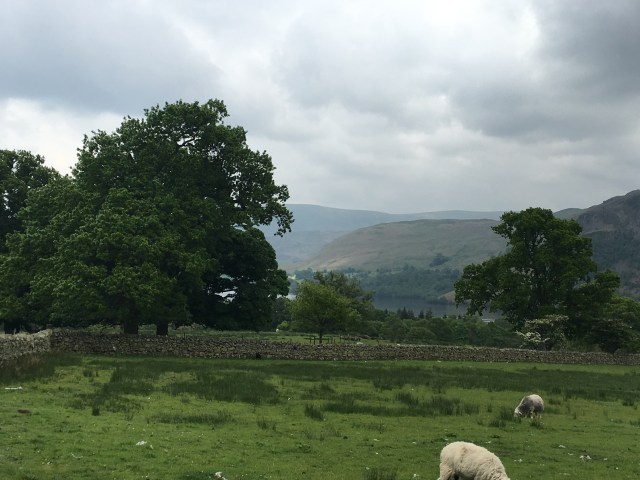
Grasmere, in the Lake District

I breathed in deeply trying not to portray my disgust, wondering to myself why it’s necessary for some people to reproduce when this is the best we can get. I consoled myself with the fact that they’d die before their time. Okay, so maybe I only thought it. I repented (kinda) and moved on.

In the lifelong pursuit of all that I’d call ‘home’, deep in the stone guts of a thousand-year-old cathedral or castle somewhere in Britain is as close as it gets. Even as a young boy my predilection toward all things old and musty presented itself regularly. This was constantly disappointed growing up in Canada. As deeply Canadian as I am, it was still never old enough to satisfy my longing for anything older still.

As I write I do so in a corner window overlooking the high street in Ambleside, one of many perfect Lake District towns. It is made to order for writers. It’s not much of a stretch to imagine why that has been the case for so many writers (real ones, that is): Beatrix Potter, William Wordsworth, Samuel Taylor Coleridge. It has inspired countless others since then, Shelley, Keats, and Robert Burns, to name but a few.

Ambleside 11.jpg
Near Ambleside

My point is, to find the deepest reserves of one’s creative and spiritual taproot, one must be willing to explore and discern what that actually means. The whole point of the spiritual enterprise is to be ‘home’ everywhere. It is to be completely comfortable in all places at all times under all circumstances. Says St. Paul, “I have learned to be content in all circumstances.”

My wife and I have come to Britain for a host of reasons. Hers are similar but different to my own. I am here to reconnect with my spiritual DNA. My helix is uniquely interwoven with that of the ancient, storied hills of Scotland. The latter part of our journey allows me some alone time, with the rental car, in the Highlands and then to Skye. I shall suffer this unbearable burden with God’s abiding strength (stupid emoticon here). I shall also offer more pontifications then.

Until then, I pray you never suffer the indignity of meeting the toilet-water-buffoons with whom we shared a table in Edinburgh.

“Trip to Bountiful” – part 4

The view to end all views.jpg
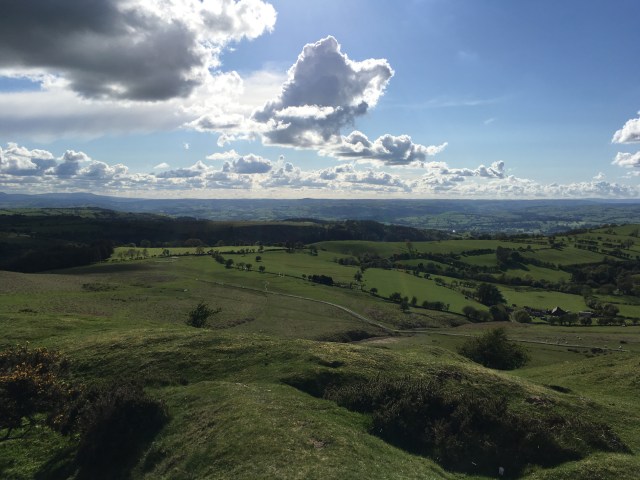
Hay, Monmouthshire – the view I’ve been waiting for

I have, for the first time, truly experienced the devastating wonder that is Wales. It is as though God made Britain first and then, everything else from spare parts (not that I can speak from context, or experience, or knowledge of any kind really). From the broad-shouldered Brecon Beacons, to the literary orgasm that is Hay-on-Wye, the city of bookshops.

Hay-on-Wye bookstore:cafe.jpg
A bookshop. A café. In Hay-on-Wye. What’s not to love?

From the Cistercian monastery ruins at Tintern Abbey to equally haunting and beautiful Llanthony Priory. From the seaside riches of Harlech and Llanbedr to the rough ‘n tumble Dolgellau.
From a fifteenth century teahouse in Ty Hwnt I’r Bont near Llanwrst to Snowdonia National Park in Beddgelert, Wales is a place of countless treasures. 

I’ve been here before, but not this close to the bone. I’ve learned what it means not just to drive a car but navigate it like a big ship through a tiny canal. I’ve heard horror stories of those possessing significantly superior driving skills to myself pissing themselves from stress on the very Welsh “highways” I’ve just driven. Now, to be fair, I changed before writing this and how would you know anyway?

More Welsh countryside copy.jpg
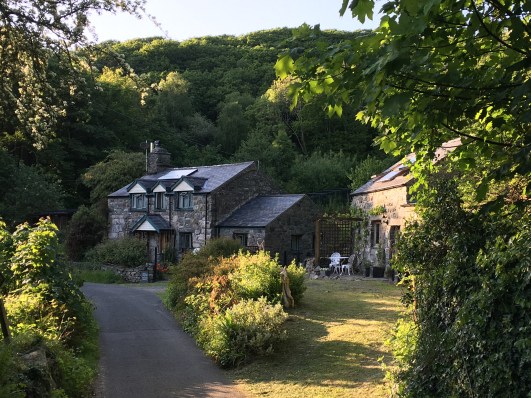
Beudy Bach, our perfect stay in Llanbedr, near Harlech

In addition, to drive a car in a place so utterly complex is to forego any certainty of directions, ETAs, the logical movement of traffic, expectation of driver largesse, and frequency of toilets. Throughout the UK, the puritan American spirit must learn to contend with the lack of excretory euphemisms.


Llanthony Priory 18.jpg
Llanthony Priory


A tiny thumbnail of a country it boasts as long a history as anywhere in Europe. Today, we said goodbye to Wales, and find ourselves in another enchanting part of Britain – Ambleside, in the Lake District. We stop here to catch our breath, drink a ton of coffee and write.

In the days that follow, our travels will take us east and north to Dunbar and Edinburgh. The deep connection I have to Scotland will require a host of other blog posts. Hence, for now, with Wales in our rearview mirror, I think poetry is the only song that will work. I hope you enjoy, and thanks for joining us on this ride.

Down in the throat of Wales

In the throat of Wales,

where light is sparse, then it is best.

This land of green trousers with grey hat,

hair coiffed in bluebells, tulips,

and yellow daffodils.

She is held in frames of arbour, where bristle-faced hills

are bred for poetry – Coleridge, Thomas, Wordsworth.

Down in the throat of Wales.


In the throat of Wales,

we pass the standing stones, God’s elder brothers,

and their eyes follow us.

Rain falls like sweat from the coal miner’s brow

while praying hands of hedgerow herald peace on every side.

A bleating sheep choir beckons eyes up to the watching hills.

Down in the throat of Wales.


In the throat of Wales,

down, down the Brecon Beacons beckon, swallowed down

where the green things live – down in the throat of Wales.

At the Blue Boar Pub, regulars and weekend

intellectuals hold out town secrets.

Practiced tongues wag in dark corners, breathing out suds

and gossip and recycled stories with fresh laughter.

Down in the throat of Wales.


In the throat of Wales,

at Hay-on-Wye – these streets are full of pages,

ten thousand dog-eared voices

tucked away on shelves and tables,

under arms and coat pockets.

American streetlights bow to clock towers, cheery pubs,

and weary stones. Long-drawn lines of primogeniture sing

the songs everyone still knows. And, the many-throated

happy-hour jubilee of a thousand years gone by

still steeps in the glow of candles,

wine-bright eyes, and cell phones.

Down in the throat of Wales.


In the throat of Wales,

the hills stand guard, where stone and memory bleed

the colours of the ancestors,

drawing their long and bloody shadows over Beddgelert.

The River Colwyn, host to muddy boots and hooves and paws –

I pause to imprint her banks of sleep.

Down in the throat of Wales.


In the throat of Wales,

Harlech’s stiff-shouldered castle juts out a jarring face

into Cardigan Bay, catching salt kisses

blown from the cold, grey sea.

Oh, where to wander in this wild and brooding land,

where friend is stranger – stranger, friend –

and all that ever wrung true hangs tightly

to the soft skeleton of a land made

from the stoutest stone, the strongest sheep, the swollen stories

of hearts that glow brighter than the smiles of children?

Down in the throat of Wales.


In the throat of Wales,

I place my ear next to her breast

to hear the consonantal tongue

make love to songs as old and wise as she –

where still, of all sad souls,

the blind man is poorest.


Down in the throat of Wales.


“Trip to Bountiful” – part 3


13238898_10208106960346130_397416527787693528_n.jpg
Rae and I on the train to Wales

Here, in the lavish, lazy valleys of South Wales one can smell the old, taste the green. To the mystic’s palette it is chateau briand for the soul. The harmonious voices of stocky, Welsh coalminers blend with the buoyant tongue of an ancient language to stoke the most experienced fires.

Too bad they drive like shit. Well, one can’t have everything.

Our brief foray in the UK takes a turn from the sleek, overly preened mien of London to the clumpy, sodden town of Newport, Gwent, South Wales. It is a place as equally devoid of panache as it is pretention. The people are as unremarkable as they are genuine. Note to self: read that line again later.

River Usk.jpg
The muddy banks of the Usk

The River Usk upon which this town is built looks like one long bowel movement running through the center of town. To hear them speak with pride for something so utterly un-notable is in equal measure quaint and unnerving. The last time we were here a few years ago, I joked with my wife, for whom this is her birthplace, that Newport was the only ugly place in all of Wales.

Beyond the obvious revitalization enjoyed by this city, I repent of such ignorant, North American bluster. Besides, the passing years have replaced my previous eyes with new ones. I see now something quite different. The grey, spongy demeanor of the place is easily eclipsed by a deep and knowing spirit – a kind of relaxed ennui, without a hint of self-pity.

I must learn from this.

When the soul moves past its incessant need for the spiritual X-factor, it then can see the better coal beneath the monochromatic surface of its own shallow intentions. The beauty of Newport isn’t found in its breathless joie-de-vivre, the jaunty rollercoaster of soulish affixations we often call spirituality. It is somewhere down under. It lies beneath all of that, in the bedrock of older soil breeding nourishment over luxuriance.

In exploring here, I am struck by how difficult it is to amuse the over-stimulated American psyche. By contrast, the British are delighted by small pleasures. The sheer joy of a few hours before the fire with a stiff cup of tea, a biscuit and conversation is all they require to feel human and whole. As our spirits chase after ever more lusty extravagances, Newport reminds me that the best things come in the unbidden grace of simple, genteel moments.

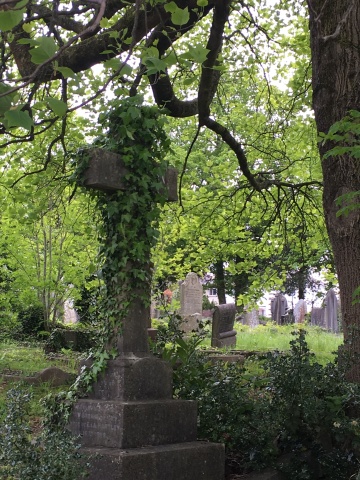
Cemetery 3
A visit to the St. Woollos Cemetery

Today, I am a tourist in the most non-tourist town I’ve yet seen. Better still, I’m a pilgrim where once I was a tourist.

And, I am seeing the beauty that lies beneath.


“Trip to Bountiful” – part 1

mobile_h_photo.jpg

The words I’m about to write are the first I’ve written about this. Not because I am ashamed of it. Nor am I trying to hide anything. Quite simply, I’m still trying to understand it all.

I had an emotional breakdown early in the new year. I hit a wall that would have intimidated Goliath. I was wiped out, gutted; truly at the end of my emotional capital. I laid curled up in a ball, weeping uncontrollably on a hotel room floor, a tsunami of thoughts raging in my skull. My soul was in a vice, and my interior life was squeezed beyond recognition.

Quite simply, I had nothing left.

In the middle of that I received a text from a close friend and colleague. Rather cryptically (and not without humor), it said, “what the f**k is up with you? I keep getting woken up to pray for you.”

Okay God, you have my attention.

In the space of an hour, I went from despair to utter calm. The room remained dark and cheerless. My soul however felt swept somehow. Not elated. Not blissful per se. Just quiet and pensive. I was for the first time in distant memory, without anxiety. It was a state I would enjoy for about twelve days.

And, although the anxiety would return, in the window of time gifted to me I made numerous life decisions that have offered great riches ever since. What I discovered in that time was remarkable. When anxiety is removed one becomes surprising lucid, focused, confident, and decisive. 

I put my ordination process on hold. Ordination is the right decision. It’s just the wrong time. I removed myself from a number of writing projects, if only for a time. I gave up my music students (shamefully, I only teach for the money anyway). I felt a desire to perform more often and to dig into gardening (the pun is easier than the gardening). I had an overwhelming desire to turn my sights toward fixing things around our home. I saw more clearly the necessity of relationships and the blessing of stability (thank you, St. Benedict).

Most importantly, it became clear to me that I must join my wife on what was originally her, not our, vacation. 

By God’s grace and if the creek don’ rise, my wife and I board an aircraft for Britain on Saturday evening. It’s been twelve years since we last stood on this sacred ground. The archaeology of our lives readily reveals itself at these moments; moments ripe with joyful anticipation, with curiosity, small misgivings of varying kinds, and simple impatience.

2016-03-26 16.32.40.jpg
Rae and I

We are grateful in such deep ways. We are aware that as we depart, we do so with people and responsibilities we leave behind. In God’s loving hands they are held. But, as everyone knows, the best thing to fix a computer is usually a simple restart. Although we go for different reasons, my requirements are 1) to flush my mental hard drive, 2) to restart my emotional computer, 3) upload fresh life experiences to enhance my spiritual monitor, and 4) set foot again on holy ground.

Ultimately, I am unsure what all of this will mean to me, to us. But, I am a man squarely in a mode of rebuilding my mental-emotional infrastructure. May God have mercy. And, may God go before us on this, our trip to bountiful.

Pix found here and my iPhone!


Going Home, and the Way There

It was 1989. My wife, Rae, and I had just completed a call of duty as mission workers to youth at Granton Baptist Church, Edinburgh. We enjoyed our first anniversary on Culloden Moor, near Inverness and were now enjoying a few weeks to just explore. I recall quite fondly the first time we stood together within the ruins of Tintern Abbey, not far from her birthplace in Wales. The mystery of belonging, and the sheer weight of home was overwhelming.

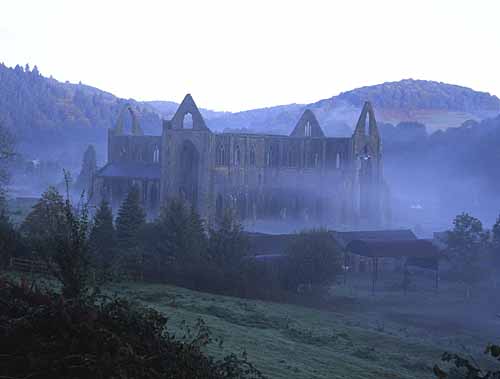
Tintern Abbey, Wales

A Celt at heart, I think and write a great deal about the spirituality of ‘home‘ and the ache it engenders. The human heart is uniquely designed to yearn. It knows what it wants and diligently seeks it out – sometimes in unsavory, even desperate, ways. Our sacred procurements can quickly become what derails us from procurement of the sacred. But God knows our heart and the passions to which it is given, both good and bad.

What do you think of when you think of ‘home?’ A family room, lavishly bedecked with Christmas finery? A dining room table around which sit the people who grace your life? A certain place to which you return for solace when life goes south? For Rae, my wife of twenty-seven years, it is Britain. We both grew up in Calgary, Alberta on the uneven foothills that slowly crawl their way up the eastern slope of the Rocky Mountains. But the ancient Celtic hillsides, grey and mournful skies, and songful souls of Wales are for her, home.

Calgary, Alberta
Calgary, Alberta

We met while in mutual mourning. I had just lost my father to cancer a few months earlier. She was a girl in the throes of anguish, watching her mother waste away with the same plight. Rae is an only child, not because that was the desire of her parents, but because she was the only one to survive of numerous pregnancies. A survivor she remains to this day.

Only-children learn to be self-sustaining, imaginative, and scrappy in order to live their lives outside the interdependency of other kids in the family. With the lack of siblings, they often grow deeply independent, and extremely close to their parents, taking on signs of maturity well before others. All this is true of Rae. 

She lost her mom in August of 1986, almost a year after I lost my dad. She and her dad, now alone, forged a new life together on their own. In a sense, Rae took over many of the aspects of care and mutual friendship that previously existed between her parents. They often spent evenings simply crying together. Her father was lost without his partner, and the many tendernesses known only to lovers. His habitual journey from kitchen to bedroom every morning with tea and toast for his wife was now enjoyed by Rae. In honor of this tradition, I bring her coffee every morning. These little things help keep the big things in place.

The friendship born of the mutual bond of grief has lasted to this day. Since losing her parents, any family of origin are gone. In a sense, she is alone on this continent. To help her contextualize this and many other competing voices within her, she started writing a novel a little over three years ago. It is, of course, based in the UK.

Rae, my writer, wifey pal

Because I so keenly identify with her longing for home, and because, as a writer myself, I am her biggest fan, it has been my desire to help her return. I have developed a Giveforward crowd-based fundraising campaign to assist in getting her back to Britain where she may visit her remaining relatives, and finish research for her book.

If you feel as pulled toward home as we do, please consider making a donation, however small, to help her feet once again touch her own hallowed ground. You may do so here.

Diolch yn fawr iawn (thank you very much in Welsh)

Picture of Calgary found here

Hiraeth – making peace with our longing, conclusion

contemplation

“Our longing is an echo of the divine longing for us. Our longing is the living imprint of divine desire. This desire lives in each of us in that ineffable space in the heart where nothing else can satisfy or still us” -John O’Donohue, Eternal Echoes

Throughout our series I’ve sought to define the Celtic concept of hiraeth in the following way: “a longing, a homesickness for a home to which one can never return. It is the unrequited hope that produces ever more unanswered longing. It is a grieving for the lost places and moments of one’s past – a sense of loss for loving moments and places, fondly remembered. It sits in the dream world where longing, belonging, home, and wanderlust meet.” 

We’ve looked at the necessity of metaphor in our efforts to understand this, or any, spiritual concept. I’ve invited people into my own personal salve, applied generously on my own longing – writing. We’ve discussed how the spirit of childhood and its built-in mysticism (Jesus called this childlikeness or, humility) is our truest home and the perfect allegory for our own longing – the return to that elemental time of wonder and chaotic delight; to mystery. Finally, we’ve adopted Ronald Rolheiser’s idea that our spirituality is what we do with our longing, the end of which can lead us to God’s greatest gift: self-knowledge.

Longing, as rooted in hiraeth, is a double-edged sword. It pricks us with the sting of yearning while simultaneously acting as a reminder of our finitude. We long for what we most want but which we so often least require. In this way, Hiraeth can be a longing for longing itself. Except, when we return, we discover WE have changed. Capturing even the essence of something is then an impatient storming of the gates of the reality itself. We chase a shadow as though it were the substance of the shadow.

Shadows

So, where does this leave us? This enigmatic Welsh word seeks to describe an idea without clear English equivalent. But it’s a start. It gets us somewhere. It has helped me grapple with an incessant gnawing thirst within me, never completely satisfied. And, as is the case with so many of our bugaboos, healing often comes with the process of articulation.

There is still a deeper level to which I am drawn as an apprentice of Jesus, for if anyone understood the exile of hiraeth it was the Son of God. It is here that I diverge from hiraeth in order to turn my attention to longing as understood and experienced in the harbor of Christ. 

All our discontinuities, our divestments, and disenfranchisement are subsumed into Christ Jesus, the exiled One. In the contemporary evangelical mind at least Jesus belonged anywhere but where he willingly chose to come. His truest “home” was within the eternal Trinity, that mystical scaffolding for all human relationships. If indeed one believes Jesus to be the image of the Divine Essence we call God, then his enfleshment becomes that much more jaw-dropping.

Prior to the Incarnation of God in Christ, the archetypal longing in the human soul was crooned in the poetry of the Psalms:

“My soul is consumed with longing for your ordinances at all times” (Psalm 119:20). “My soul languishes for Your salvation; I hope in your word” (Psalm 119:81). “Whom have I in heaven but you? And there is nothing on earth that I desire other than you.” (Psalm 73:25). “My soul thirsts for God, for the living God. When shall I come and behold the face of God?” (Psalm 42:2). “O God, you are my God, I seek you, my soul thirsts for you; my flesh faints for you, as in a dry and weary land where there is no water” (Psalm 63:1). “I stretch out my hands to you; my soul thirsts for you like a parched land” (Psalms 143:6).

Biblically, it is an ubiquitous concept. And, with the coming of Jesus, who understood the exile of longing better than anyone, we’re introduced to the promise of a never-ending thirst that is always and never slaked. It is the fulfillment of what hiraeth begins. The richer vein from which we draw means that boring underneath the irascible sea of our lives is an Artesian Well of nourishment. Jesus spoke often of the possibility of satiation found in the existential oneness we experience with God in his name:

“Jesus answered and said to her, “Everyone who drinks of this water will thirst again; but whoever drinks of the water that I will give him shall never thirst; but the water that I will give him will become in him a well of water springing up to eternal life”” (John 4:13-14). “Jesus said to them, “I am the bread of life; he who comes to Me will not hunger, and he who believes in Me will never thirst”” (John 6:35). “Do not work for the food which perishes, but for the food which endures to eternal life, which the Son of Man will give to you, for on Him the Father, God, has set His seal” (John 6:27). “Now on the last day, the great day of the feast, Jesus stood and cried out, saying, “If anyone is thirsty, let him come to Me and drink”” (John 7:37).

From these sacred words we’re given a glimpse into what lies at the root of all our longing – the need to know and be known, to love and be loved; to be one with the One whose roots alone bring the nourishment from which we will capably thrive in our world fraught with the ache of hiraeth.

well-w-bucket

I anticipate much more thirst to come. But my life will never be without water.

Series image found here

Shadows image found here

Bucket and well image found here

Hiraeth – making peace with longing, part 5

contemplation

“The hunger to belong is at the heart of our nature” – John O’Donohue, Eternal Echoes

At the beginning of chapter one of The Holy Longing: The Search for a Christian Spirituality, Catholic theologian, Ronald Rolheiser‘s pivotal work, he implants the following poem by Johann Wolfgang von Goethe:

“The Holy Longing”

Tell a wise person, or else keep silent,

Because the massman will mock it right away.

I praise what is truly alive,

what longs to be burned to death.


In the calm water of the love-nights,

where you were begotten, where you have begotten,

a strange feeling comes over you

when you see the silent candle burning.


Now you are no longer caught

in the obsession with darkness,

and a desire for higher love-making

sweeps you upward.


Distance does not make you falter,

now, arriving in magic, flying,

and finally, insane for the light,

you are the butterfly and you are gone.


And so long as you haven’t experienced

this: to die and so to grow,

you are only a troubled guest

on the dark earth.

Goethe voices something Rolheiser explores very well in his book. It is what we’ve been examining these past weeks: longing. Rolheiser maintains that longing, or desire as he calls it, is our primary dis-ease. He submits that “there is within us a fundamental dis-ease, an unquenchable fire that renders us incapable, in this life, of ever coming to full peace” (p. 3). In fact, he believes desire to be stronger than the satisfaction for which it yearns. And everyone desires – longs – and our spirituality is what we do with that unrest.

Rolheiser goes on to say however that, although we all suffer deep longing, not everyone addresses it in the same way. He compares Janis Joplin’s longing, lived out in the erratic and scattered desires that ultimately led to her untimely death with the more focused and singular desire of Mother Teresa that allowed her a healthy integration and more restful existence. This of course recalls Kierkegaard’s definition of sainthood – someone who can will the one thing.

Stated another way, our spirituality is “about how we channel our eros…what we do with the spirit that is within us” (p. 11). This is for me the greatest challenge since I have so many competing and overpowering inner voices, all clamoring for supremacy. Indeed, willing the one thing first requires the monkeys to quit swinging in the mental tree (thank you Henri Nouwen!). It is also why desire and longing have, for me, been so intimately tied to identity: my is-ness.

I believe this concept is utilized best when determining the growth pattern of our inner lives, specifically our emotions. It does not deny the tiger claw tears in the fabric of our hearts that rich memories can bring. It invites us however to live there in a liminality of time and space, with one eye on the object of our longing, who in fact dwells comfortably where our elevator originates; Christ at our foundation.

And that is where our discussion will ultimately lead us. For now I want to explore longing as it pertains to the soul’s need for self-knowledge. And, at the root of self-knowledge is self-love that can find itself anywhere because it belongs everywhere. As an adoptee and one who has seldom truly felt “at home” anywhere, this can be a daunting, even depressing idea since it points to a (be)longing that, again, is never really be satisfied.

Numerous spiritual directors, almost all my friends, my therapist, and of course my wife, tell me I am my own worst enemy. I can talk myself out of anything. I will consistently deny the gifts apparent to others that elude me. I will be a willing martyr in order to delay or defuse conflict and, in my tireless efforts at ensuring my belonging in any crowd, will osmose into their particular zeitgeist like a chameleon in a tree. “Yup, I can fit here. Hmm, I can make this group work. Wow, this feels good. Now, who the hell am I?”

The result is that I have lived many lives, none of them my own. It makes me a blast at parties, a generally affable guy; the one you want to have sit at your table. It also means I am someone always willing to help change your tire, hear your story, or sing you a song of encouragement when you most need it.

But it can also have more sinister tones.

The loneliness and stress of living in the constant search for the “real me” often drives a relative blindness to boundaries as I push my way into everyone’s acceptance. It means the elaborate construct that has become my life lacks foundation and could all too easily topple into disarray, and often does. I wonder sometimes if it’s the adult version of the kid constantly tugging at the sleeve, “Mom, Mom, Mom, Mom, Mom…” Eeewww.

So, you see my dilemma. The hard path ahead is finding acceptance without expecting it, exercising self-love without bounding over other people’s personal space, and learning to live, contented, in tension when none of it works all the time as I think it should. For me as for others, the longing I experience is most likely the soul’s vocal cries to express the deepest, truest self; the self that is free even in prison, safe even in danger, content even in deep darkness.

We find the satisfaction to our longing once we know we belong. We belong in God’s ongoing cosmological project. We belong to the broader family of beings with whom we co-inhabit this spinning little ball of wonder. We belong wherever we presently are. It means everywhere can be home. It means we never truly have to live as exiles in our own domains.

We are most home when we come home to ourselves.

Hiraeth – Making peace with longing, part 4

contemplation

“Longing is the deepest and most ancient voice in the human soul” – John O’Donohue, Eternal Echoes

I’ve written much about longing; of home and exile and the mystical realities available to me as a child that seem these days so elusive. And I suppose I’m just Freudian enough to believe that it’s no coincidence. I write of these things because, in a very real way, I long for longing itself. And even C. S. Lewis would agree that often the sweetest longing of all is unrequited longing tinged in hope.

For me, to feel is to live. To live is to experience that life in magical, almost indescribable ways. A lofty goal considering the numerous inconsistencies, injustices and unpredictability of it all! In fact, I believe many of the issues that have troubled me in my adult years have been my unrelenting, but futile attempts to return to places I have been, or may have been, or perceived myself to have been.

Hiraeth.

When I was younger I never had to look far for the sheer magic of life to come to me. It just came, powerfully and often. I remember feeling exceptionally safe as a boy, smothered in the sun-drenched kindness the God of my understanding allowed into my young life. Although it is hard for me to determine the veracity of many of those experiences, given my penchant for romanticism, there are a few memories that return faithfully every time.

Staring out our front room window into a snow-pocked night sky, heavy flakes of snow floated effortlessly past the streetlights on our street performing dances of joy on their way down. I was transfixed. I cannot remember if I was alone or if my Dad was in the room, but it is a memory that has stubbornly stayed with me. Other instances include the simple joys of hunting for unique rocks in our back alley to add to my growing collection. Or, perhaps sitting on our living room floor playing with my dinosaurs, rockets, or reading my favorite “Book of Knowledge.”

The concept of hiraeth is one that has been part of my experience since I was a boy. I just didn’t know it at the time. It is inexplicable really but is most readily compared to that feeling of homesickness for a place to which one can no longer return. It’s not just physical space or actual friends. It is a state of being.

Finding the true home for my entire being has been difficult. Either my geography is wrong or I have the right address but my soul is off-center and the address is lost in an ardent cry that both will find each other. But thankfully, “Location, location, location,” for the mystic, means something decidedly broader.  The soul needs so much more than just a return address.

Think of a place and time when your life was particularly magical. Then, return there five years later. The place remains the same. Many of the same people may still be there, in similar capacities, even living in the same homes. But, as good as it can be, one’s experience can never be the same.

Growing up a mystic was challenging. First of all, I cannot properly define a mystic now, let alone that of my childhood. Oddly satisfying experiences of the eternal goodness of things would wash over me, leaving me almost breathless in their weight. For a few moments, all was remarkably well and as it “should” be. Nothing changed particularly, but what was normally benign and unremarkable, became perfectly “right” somehow. I saw the world as it was meant to be seen. Then, nothing.

It would vanish as inexplicably as it came. Sometimes I would cry afterward from the sheer beauty of it all and would wish for it to return.

Hiraeth.

With age comes the aspect of nostalgia. With chronology of course we gain the benefit of hindsight, experience and, hopefully, wisdom. More of our lives are behind us than ahead of us. We can become whimsical about the richness of past experiences, faces, places, etc. However, as good as it can be reliving them, the exact same experience will forever elude us because WE are different and are therefore incapable of perfectly replicating what we FIRST knew.

It is the “glory days” twenty-five year old still hanging out at high school parties. It is the “rose-colored glasses” mentality in which every memory, even of circumstances bad at the time, is a warm bath. It is the “everything was better when I was young” headspace, something empirically unverifiable but emotionally undeniable.

Hiraeth.

“Our bodies know that they belong; it is our minds that make our lives so homeless,” says O’Donohue. And, there it is, a key to those like me who experience some sense of ongoing dis-location. We are all much more “home” than we realize. Perhaps we stand at the edge of God’s great sea of promise, the shore of possibility, but do so with hands covering our eyes. Our mind has somehow convinced our eyes to remain tightly sealed against all that lives before us as we cry out for what we think is yet to appear.

After all, what really is longing if not the soul’s insatiable desire for communion and reunion with God, with others, with oneself? And, simply being awakened to its presence is the first step toward its fulfillment in real terms, and to joy. He concludes: “The sacred duty of being an individual is to gradually learn how to live so as to awaken the eternal within oneself.”

For now, that’s good enough.

Hiraeth – making peace with longing, part 3

contemplation

“The voice comes from your soul. It is the voice of the eternal longing within you, and it confirms you as a relentless pilgrim on the earth” -John O’ Donohue, Eternal Echoes

It can be like nailing jello to the wall to truly understand this elusive concept. Thankfully, it’s more like catching a butterfly in the net to uncover healing words, made available at the exact moment they are needed. For me, writing is the net that captures and strives to observe the flitting beauty that, if only briefly, bows to the effort. And longing is a subject ill-suited to casual conversation. It submits better to the broader pulchritude of artistic or literary narrative.

Hence, this series.

Indirectly, I owe these moments to my anam cara, John O’Donohue, no longer hiraeth-ing, but singing with the angels. “The human heart is a theater of longing,” he insists, “There is a divine restlessness in the human heart [but]…the heart is an eternal nomad. No circle of belonging can ever contain all the longings of the human heart” (John O’Donohue, Eternal Echoes).

Soooooo, in other words, don’t expect it to just fix itself or simply go away anytime soon.

O’Donohue, a Celtic mystic like myself, has uniquely and masterfully captured hiraeth. And longing may well be my greatest gift and most insistent Achilles Heel! Since it is an ubiquitous and stubborn ‘friend,’ the drunk uncle of the soul that never knows when to shut up, slurs a lot, and then disappears behind something, how does one learn to embrace and control it? Is such an effort possible? Is it even advisable? How do I make friends with something that so often feels like an enemy? Why does this seem never to touch so many others in the same way it does me?

Longing is a form of suffering. And every great spiritual writer would urge us to make peace with our sufferings; to come to terms with their eventuality, their persistence and complexity; their chaos. To those outside a conscious spiritual journey this can seem like madness, even masochism! It is especially baffling to those given over to the American gospel of therapeutic Deism with a generous helping of Jesus-my-boyfriend yumminess. Simply pursue your dreams in a can-do attitude and a good work ethic and let America do the rest.

The dreams mantra may claim to have answers, but they are for those with a clear sense of what their dreams actually are. My dream is to come out of sleep long enough to see with my own eyes what’s around me instead of drowning in an overly bloated Rob’s-little-dream-world. It’s how to deal with this ever-present yearning that sometimes just gets too heavy to hold.

In this sense, hiraeth can be unhelpful as it acts like a cloak of mourning over life’s common colds, the things we all must bear. Yearning without any hope of the substance of that yearning.

Instead, let me learn to see first so I can make sense of my dreams.

Photography by Laura Aldridge