I have spent the better part of my life as a professional musician. Primarily, that has meant the fun and challenging world of church music. Most recently, I have transitioned out of my role as worship and music director for Yakima Covenant Church, Yakima, Washington to global service in Edinburgh, Scotland. I'm a singer-songwriter, liturgist, poet, and writer. I love words. I love to read them. I love to write them. Most of all, I love the many intersections, like a sacramental tapestry, of life, liturgy, literature, the arts, and spiritual formation...oh, and I love haggis.
These are fun. I posted the same last year. I hope you enjoy.
Here’s an excerpt:
A New York City subway train holds 1,200 people. This blog was viewed about 4,200 times in 2014. If it were a NYC subway train, it would take about 4 trips to carry that many people.
In these busy-ness hangover days post-Advent/Christmas, I can finally undo my symbolic top button and let the layers of fatigue – built up over weeks of ridiculous work schedules – begin to flake away. It’s surprising just how exhausted one can become doing things one loves to do. It is equally alarming how many hours it is possible to clock in pursuit of what one believes to be satisfaction of job demands when the truth is far more complicated than that.
In my present fog of lassitude I at least have the presence of mind to bring a few considerations to the page since, in so doing, I am led to consider more deeply my calling to this anomalous gig.
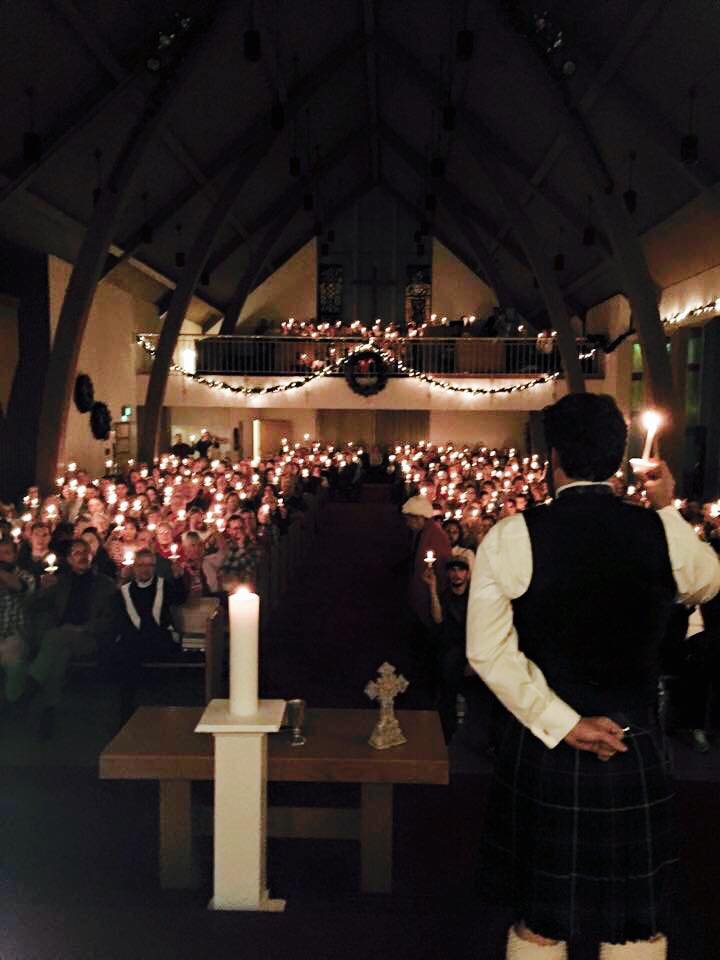
December. With nervous sighs and low-decibel groans I prepare for it every year. Advent candle-lighters, extra scripture readers, extra rehearsals for extra ensembles on extra days, Christmas concert with the accompanying P.R., advertising and follow-up, children’s and youth Christmas presentations, pre-school Christmas parties requiring musical and technical support, sick soloists, regular Sunday worship planning mindful of exhausted musicians, Christmas Eve candlelight and carols (2 Traditional, 1 Celtic) that required dozens of arrangements, sketching out post-Christmas services easily executable enough for a skeleton crew of volunteers not still on vacation where I will be once all of the above is neatly tied up. Oh, and a few scattered, but nervous moments spent nodding your head in the direction of those with whom you live and for whom you do all of the above.
For that rare reader not already painfully aware of the fact, I am a local church music director. It is a career I’ve pursued, faithfully for the most part, for much of my adult life. And, were it not for this job I do, I struggle to see any another scenario in which a complicated, non-risk-taking, overly worried, perfectionist, artsy-fartsy like me might even make a living, let alone a relatively stable one. The uneasy combination of squishy self-confidence issues with rabid artistic needs make for poor bedfellows. Translation: I’m not good at much else.
Christmas Eve Celtic candlelight service, 2014
Frustratingly, after all these years, I’ve never even come close to mastering the slippery skills generally considered normal, advisable even, for those in my craft: prioritization, time management, delegation, and especially unseen pitfalls prediction – viz a viz, troubleshooting. Make no mistake, when a local church comes looking for jaw-dropping artistic talent (that’s how we market ourselves) to bless the flock and fill the pews, they’re often after a glorified music secretary who happens to sing or play instruments. Make the music trains run on time and make sure my kids are getting free music lessons. One can be the best musician ever heard. But, forget too many clerical details too often and it becomes quickly apparent how “stable” the job really is. It’s the comfort of a well-oiled machine with better than average music that maintains a level of constituent satisfaction, and puts food on our table.
But alas, I wax cynical. It is the tiredness talking. I’ve asked frequently and loudly of God and those close to me, why is someone like me even called to work in a local church? I’ve almost always felt more comfortable anywhere but there. I’m rough around the edges at the best of times and can guarantee inopportunely-timed, off-color humor, and promise at least one offended person within half an hour of meeting me. My job is “Christian music” (whatever THAT is) and you couldn’t pay me enough to listen to it on the radio. I doubt I could name the top five Christian artists right now and haven’t darkened the door of *gasp* a “Christian bookstore” (again, unsure as to the meaning of that) for more years than I can count.
And yet, here I am. Any whining I do surrounding my detail heavy job is generally self-induced. Why? you ask.
An attempted explanation: Probably for good reason perfectionism gets a bad rap these days. Under church roofs it has led to lonely, broken, discouraged souls. People like me, in our rabid pursuit of the perfect performance of the carefully chosen song at the pristine moment in a stellar setting, have often left, burned out and bitter because of it. Those we sometimes ride like donkeys to help us provide the aforementioned often leave for similar reasons, blaming us on the way out (justifiable in most cases).
But, beside its potential for damage, it has also led to some of the world’s most stellar, awe-inspiring art. Those artists credited, directly or indirectly, with everyone else’s inspiration weren’t necessarily those who got the trophy just for showing up or sat in kumbaya drum circles (neither of which are problematic on their own!). Their music is great because it had to be. The inner compulsion, dare I say divine imperative, to produce the highest achievable work to present to the High and Lofty One, asks for nothing less. I can hardly imagine Bach having a lot of B-list instrumentalists in his sacred ensembles. His relentless pursuit of the perfect music for the perfect occasion probably made him many enemies.
But it also made him great.
I am now convinced that the very day I succumb to mastery in the lesser skills of prioritization, time management, leadership team coagulation, etc., will be the same day my muse will flee. My perfectionism has forced me down some dark hallways. It has left me bedraggled, barely able to stand at times. It has forced me to be tweaking song arrangements at 1:00 am…while on vacation. It has taken many hostages. It has kicked my ass, and others’ as well, in pursuit of some crazy ideal, held aloft in my own prideful head. But, in pursuit of the most beautiful art possible wrapped in the most transforming theology possible, that same pride disallows overly simplistic, soul-less, derivative, mass-producible pablum. Then, I’ll be only too happy to say, along with so many other dear souls, “with or without frappe?”
So then, I am tired primarily because I’ve been chasing whatever ideal my own perfectionism has placed before me. This aging treadmill donkey hasn’t quite nabbed his carrot, adangle before his hungry mouth and crossed eyes. If I ever do actually reach said carrot, it will be the day I am discovered, dead, in a pool of my own anxiety. And, after all is said and done, my choir still loves me.
And that alone is worth it.
One picture found here, the other is credited to Piper Renee-Richmond, who sings in my band and was in fact doing so at the time!
She was slightly chubby with a pinkish, round face, and dancing eyes that squinted a bit when she smiled. She had a way about her that was at once bracing and dangerous while at the same time hospitable and kind. She felt…comfortable. Our afternoons were often spent talking about all manner of shared interests: music, art, nature, beauty – often while lying side by side under our crabapple tree in the backyard gazing at the summer sky. It was heavenly. We held hands. We kissed. Often.
We were ten.
I was elated. It was summer. It was hot, and I was slicing through cool, choppy wake churned up by the boat behind which I was waterskiing – upright – for the first time in my life. My friend Darrin was driving, his dad beside him, and his younger brother watching me in case I came into difficulty. Silly, thought I. What could possibly go wrong? As is often the case with cocky, self-assured fourteen year olds, with over-confidence I over-compensated for over-reaching and found myself suddenly bouncing headlong over waves (surprisingly hard while cheese-grating along their ragged tops at forty miles an hour). By the time I finally pulled myself up from under the smug water, I was out of breath, bleeding from my side and completely naked.
It was exhilarating.
I saw my ever stoic and unyielding father cry only three times. Once during a heated exchange with my younger brother in which he loudly proclaimed that dad was an imposter (all three of us were adopted). Once, when my mother screamed at me so violently it made me cry out all manner of things I now wish I hadn’t. His hand, placed over mine at the kitchen table, is etched forever in the not-to-forget section of my memories. And once when he got back his biopsy results. I had driven him to Rockyview Hospital so that someone was with him should the news not be good. It wasn’t. At all. He came out of the room, face a pall of grey, and trembled out a few words in his roughneck Saskatchewan farm boy manner, “well, looks like I got a touch of the cancer.”
I miss him still.
I looked out the airplane window to a sight I’d waited seventeen years to see. The tightly woven, ancient and ragged hills of Scotland, huddled together in green beyond imagination danced a jig before me. If there’d been a seat on the wing, I’d have taken it in a heartbeat just to be that much closer to the land of my soul. Although Canadian born and raised, I have always been Celt to the core. My genes are kilted, my blood tartan, and my chromosomes play bagpipes proudly, up and down the hallways of my DNA. Best of all, I was there with my Welsh-Canadian wife of less than a year. Two Celts touched ground in Prestwick on a chill April day in 1989 and have never been the same.
“O flower of Scotland…”
The din was almost deafening. Bagpipes everywhere. It was August, 1991. Bellahouston Park in Glasgow. It was a “second first” related to this place. A bagpiper from the age of eight, I’d dreamed of making my way there to compete with the world’s finest since barely in double digits. Now, as head instructor for an up and coming junior pipe band, I was again on old country soil. This time, for the World Pipe Band Championships. To say it was dreamlike would be understatement akin to calling Mt. Everest a quaint, country bump. We were called up to the line. The pipe major barked his command, “by the right, quick march!” Two three-stroke rolls from the snare drums, drones, chanters, then – seven minutes of music, practiced and polished for two years.
These words of Emily Dickinson remind us that the longing for someone or something is often an experience even richer than the person or object of that longing. The college-age love affair forced to endure the insufferable distance of educational geography. The retired man or woman lost in a fog of non-identity yearns for earlier times when it was more clear who they were and why they were here.
My mom used to tell me that as kids we were “full of piss and vinegar” around Christmas time. Although the exact nature of this chemical mixture is unknown to me, I think I get her point. Those of us fortunate enough to have access to Christmas morning consumer delights may recall the unbearable pangs of waiting for it when that certain item we’ve been harping about might just be waiting to greet us.
Advent is the liturgical equivalent of communal yearning. It is a time when, together, we enter into the much deeper waiting experienced by our forebears in faith for the fulfillment of a promise; a promise made to those long dead and far removed from our present reality.
There really is no better time than Advent to talk about the mystery of waiting. If we are willing, our connection with the Divine throbs most insistently at such times. Waiting can be nothing more than a feat of drudgery, accompanying oneself on the frustrating journey of unsatisfied desire. Or, it can be the mist-heavy pond upon which float, blindly but lightly, our lilies of longing. One leads to fear, hatred, anger, destruction. The other to patience, quiet devotion to duty and persons, to the delicate wonders of the unremarkable that grace our days.
Advent acts as a centuries long foreplay to the main event through which sweet relief is found. In that long foreplay we learn to live, move and have our being while often blind-folded or lost altogether. In it we learn to trust our silent dance partner whose subtleties on the dance floor leave us breathless but a little baffled at times.
Advent forces a kind of slowness to things. As it becomes clear that immediate satisfaction is nowhere on the horizon, we learn the joys of nuanced living; of faith in a person rather than facts and plans and possible outcomes. We learn journey more than destination.
With the advent of Jesus we learn that God remains annoyingly carefree in his use of timelines. They belong to God alone. However, in that same advent we learn just how good it can be to wait with the intentionality of longing – spiritual foreplay – than pacing the floors of our constantly incomplete lives. For, to miss even the tiniest detail of all the manger meant is to miss everything else as well.