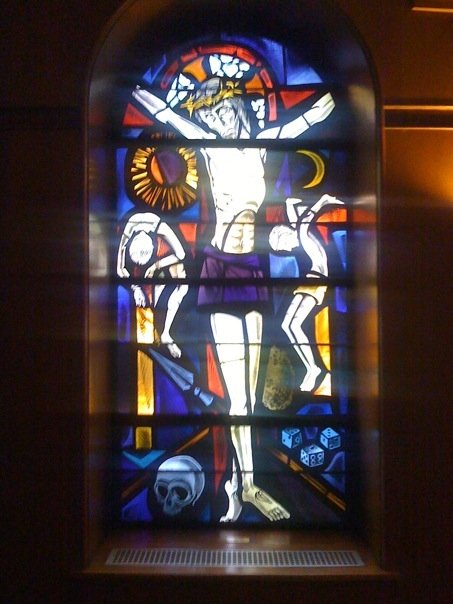
Unless…

The following poem grew out of a time of lectio divina from this passage in John’s gospel.


Unless a grain of wheat


Dry, fallen and fielded in freshness

of morning, asleep am I and…waiting;

stillness hopes for hoping still.


falls into the earth


Pungent and porous I become

as rain pools upon my sodden back bent.

And, soaked in effluent earth,

the rays of sun force cracks to appear in my skin


and dies,


and the weight of all goodness breaks

my back and bones, splintered

here and there, forsaking their unity

for roots and reach after raw and down and damp.

Silence overtakes silence overtaking me and I gasp out

a final breath, and dark removes

all light and nothingness replaces that which was.


it remains a single grain;


Is this the end? Has shadow, then, become

the defining characteristic of all things?

Am I forsaken, to be forgot and left rotting

in felch and fetid stench of this horrid, hollow hell?


but if it dies,


Heat, the warm and simple liquid light,

intrudes upon nihilo, introducing breath and branch

and with re-membered memory kills the dead,

and life cries out to see the new day.

I am not what was but am again.


it bears much fruit.


But wait, partners here in soft and strange

are bidding, too, this light-ward grasp.

Where once I was, now we are more;

where more was no more than less of one.

The rest is details

I’ve been thinking lately about what I may or may not have learned from a master’s degree in Spiritual Formation and Leadership I completed last year. Firstly, even upon writing that just now I am forced to admit that this is the kind of degree my parents warned me against. I can just hear them now, “spiritual formation! What the hell is that gonna get ya?” They would have strongly objected to something so…kumbaya and huggy (well, I did just blow out the candles after all). Perhaps time will tell what scraps there may have been in this sentiment. Secondly, who would ever, willingly and in good conscience, juxtapose the words “master” with “spiritual formation” anyway? A rather self-aggrandizing move, don’t you think? It is akin to proclaiming with assurance the attainment of humility. The assertion in itself denies the reality. Thirdly, the words “completed” and “spiritual formation” also do not belong together. How do I know this? I learned it in my degree. Well, actually, I kind of figured that one out all on my own, but…just sayin’.

Briefly, here are a few things I really did learn.

I cannot manage this earthly sojourn on my own. This truth is not self-evident, especially in our own machoistic, John Wayne individualism prevalent in America. The bulk of my degree was done online. Before you roll your eyes at the idea of either spiritual formation or community online, let me assure you that…it works. I, too, was skeptical. However, to this day I find myself pining for the nearness of the other dear souls who shared this journey with me. They are who I am becoming. I’m really happy about that because they are some of the most remarkable pilgrims I’ve ever met. The wobbly sensibility I sometimes sense in my daily insufficiency is ample reminder of their strengthening role in my life.

Spiritual formation is God’s gig. One might think this to be self-evident. The spiritual life has fascinated me for as long as I can remember. As a result, I’ve read all the right books, heard all the right voices, tried all the best disciplines, sat at all the right feet, and been to all the right conferences. After all that, I’ve come away with this single truth: spiritual formation is God’s gig. God is busy, not dormant; active, not passive. God is good, not evil. The math tells me then that God, who is both busy and good, plays a central role in who I am and am becoming. Phew.

Amazing grace, how sweet the sound. Related to the last one is this: no matter how “good” I think I get at this whole spiritual journey, Christ is, from first to last, the central figure in my formation. And Jesus shows one powerful, over-arching truth: God is love, expressed through grace. I enter poor and naked. I remain poor and naked, but loved and forgiven. This singular truth has radically altered my understanding about my “worth” in the tricky, and often dangerous, process of change. I will always come before God with a boat load of crap, both known and unknown. Therefore, since it’s about grace, and I’m not fooling God anyway, why not hang out with God all the same? I like that idea. Alot.

Faith is about mystery, not certainty. Since the Renaissance, and baptized at the Enlightenment, we have been on a self-congratulatory trajectory of humanism. The humanist manifesto: God is cool, but we’re pretty cool too and, with enough data, we can nail down this whole God thing (or perhaps scrap it altogether, whichever serves us better). Really. If that is so, why is it that we still hold to such desperately bad behavior as a species? Even our doctrine belies our self-love since it has been conveniently boiled down to a science; the data of God. Believe this stuff, sign on the dotted line and keep on being self-congratulatory fools. It’s working really well…right? I’m happier and more fulfilled in my life with God now that I’ve given up on the crazy idea that, the longer I walk with God, the more certain I will become about everything.

There are only beginners. Spiritual formation really is the epitome of the law of diminishing returns, at least as far as understanding is concerned. The deeper we go into Christ, the larger he becomes. The more one learns the less one knows. The more grace we need, the more grace we encounter. The more we love, the more we need to love. The more we have, the less we own…and so on. Catholic priest, psychologist and writer, Henri Nouwen tells us that, as we “progress” in the spiritual life, we enshrine an educated not knowing. Bummer. Beautiful.

It’s about the cross. Jesus on the cross portrays everything we need to know about the heart of God. God-with-us (Jesus) lived a life that always led to death, both metaphoric and real. Love and discipleship lead to sacrificial self-giving. Man, do we ever need that message in our culture! Richard Rohr insists that “Jesus is insistent that the way to God is the way of the cross. It’s not the prosperity Gospel of “the American Dream” with a little icing of Christ over the top.” Ouch and Amen.

The end of it all is…love.This should also be self-evident, right? However, the fundamentalists in our midst get particularly nervous when we use terms not easily “proven” or “quantifiable” as love. I mean, that messes with the whole idea of holiness and right understanding of the bible, right? Besides, it’s too easy to simply redefine love to mean something all mushy and squishy like them damn liberals! Perhaps. Hands up: how many of you know when you’re not loved? Yeah, me too. Again, I think we’re over-thinking something very simple and elemental. If it feels like hate…it probably is. To “believe” in Jesus is not just to say, “hey, I now have all the facts before me and, yes, I can buy into that.” To believe is to live as Jesus lived, come what may. It’s the whole package, mind, heart, soul, body…bowels as the King James would say.

That pretty much sums it up. The rest is details…


Distance makes the heart grow…distant

I’ve begun lately to feel a bit murky, like the water in the fish bowl a little too dirty to support healthy fish. There is something rather insidious that goes on in our deep down parts. It’s a kind of conspiracy that sets itself up to deny what we most need when we most need it. The old saying that distance makes the heart grow fonder makes sense in the youthful infatuations of long distance love. In matters of the soul however, distance mostly gives birth to more distance.

Since graduating last year with an MA in Spiritual Formation my prayer has been generally rich and full of gooey spiritual goodness. But the past few weeks have been excessively busy – death to the spiritual life, and I’ve fallen victim to the demands of self-imposed urgency. I choose to get to work just a little earlier to get more things accomplished. I cram in just one more phone call, send one more email, tweak the calendar a tiny bit more, and then look back to find that the wake of my boat moving through sacred waters is no longer distinguishable. I’ve inadvertently floated out to sea because I haven’t been paying attention to my surroundings. I’m untethered and afloat somewhere with no land in sight.

This is what happens when we pay more attention to the deck chairs than the proximity of the water. We’re happily lounging but in a context rather hostile to doing so long term!

If I could give one piece of advice, mostly to myself, but to others who also long for depth, breadth, quality and meaning in their prayer it would be this: pray. That’s it. I can offer nothing more profound than that. Allow nothing to steal what rightfully belongs to the soul’s longing for union with God.

Distance breeds distance, which in turn breeds the greatest conspiracy against the spiritual life: apathy. I don’t care to write anything more…

I’m off to pray.

With a little help from my friends

The older I get the less independent I become. Or so it seems. I suppose there is a certain calm “passivity” or lack of panic that comes with age. It can allow a kind of slow incubation of ideas and projects to hold at arm’s length. What I’m learning however is that, when it comes to matters of song and art and poetry – the stuff that floats my boat, I’m very dependent on others. I need their insights, their opinions (whether they hurt or not), their support, their better words to supplement my often insipid, verbose ones and their companionship in the way of beauty. I need their stories. Without the foamy headwaters of my life crashing in ways both large and small into someone else’s life, what remains are the equatorial doldrums of lack luster porridgy existence uninteresting even to myself.

But I keep finding interesting people to read. Or maybe I’m just becoming that middle aged guy who now finds interesting what once was a yawn. There are many other people like myself who seek to compose the scattered detritus of their own narrative into some artful shape that sings out in humor, frustration, pain or boredom. I consider my friends the many others who have been sucked into this vast bloggy neighborhood. They may not even know I’m here. But I value what they have to say. I pray that some form of meaningful reciprocity comes their way through my own meager gleanings. 

That’s it. That’s all I needed to say. Thank you, online word warriors, whoever you are. Keep the fire burnin’ as Kenny Loggins would say. And, as some other famous people once sang, “I’ll get by with a little help from my friends.” Most just happen to be virtual.

We are a little over halfway through National Poetry Month. What I should have done with this last submission was ask you to share some of your poetry specific to this particular time in the Christian calendar – that in between place of post-Easter-pre-Pentecost. Feel free to share your poetic thoughts as well!

robertalanrife's avatarRob's Lit-Bits

We are now post-Easter in what, historically, has been called “Eastertide.” With our post-resurrection eyes we have the benefit of hindsight and a big picture view of Easter week events. I should really reflect more on that and probably will. Instead, I share a bit more about the Saturday before the Easter event. If we can remove ourselves from what we now know and envision ourselves among those first disciples, we can perhaps grasp a little better the dramatic change from a Saturday despair to a Sunday hope.


Be – in – tween


It seems an eternity for what promised eternity

to wrest itself from dark and dank and deathly cell.

Yet hours have passed, not days and still can’t be

how you would show us life before death you fell.


Everything we gave and more to stand as one

in your reverie of newness, in time…

View original post 356 more words

I reblog merely to invite your thoughts and comments on how God may be leading you in this post-Easter-pre-Pentecost time of learning and living with Jesus.

robertalanrife's avatarinnerwoven

Eastertide. It’s tempting to think that, after the resurrection of Jesus, all was done that needed doing; all the loose ends neatly tied, the t’s crossed and i’s dotted. The whole Easter pie had only to cool on the window sill and hungry people could dig in to its holy goodness.

Nothing could be further from the truth.

In fact, it was only the beginning. The fifty day period that followed the empty tomb, celebrated at Pentecost (which means fifty weeks) and with it the coming of the Spirit, saw Jesus’ daily planner more packed than ever. Facing him were a veritable army of quaking, heart-broken, soul-sick, emotionally shattered disciples. Probably no one in history ever needed an encouraging word more than they!

So, while the religious leaders happily gloated over their perceived victory over this Nazarene upstart, Jesus was re-ligamenting (the same root from which we get religion) the…

View original post 611 more words

Be – in – tween

We are now post-Easter in what, historically, has been called “Eastertide.” With our post-resurrection eyes we have the benefit of hindsight and a big picture view of Easter week events. I should really reflect more on that and probably will. Instead, I share a bit more about the Saturday before the Easter event. If we can remove ourselves from what we now know and envision ourselves among those first disciples, we can perhaps grasp a little better the dramatic change from a Saturday despair to a Sunday hope.


Be – in – tween


It seems an eternity for what promised eternity

to wrest itself from dark and dank and deathly cell.

Yet hours have passed, not days and still can’t be

how you would show us life before death you fell.


Everything we gave and more to stand as one

in your reverie of newness, in time of all that comes

to quell and quiver and quash the forces of un-done

that hate and hold and hammer our daughters, our sons.


Our group was tall, like trees or hills, a truth to share

to all who hear or have not strength nor shame to hold

the weight of wait for that or this, the just or fair

awakened now but still shadow, pledge, a story told.


Why leave us in such mean estate of doubt, despair and dark

when but a word, a touch, a look all pain suspends,

and move, retool, redact the tepid toil our sorry ways embark

instead to choose what not you chose but placed in others hands depends?


But now what cryptic hint of empty rock-èd tomb bestirs

this rumored gossip that comes to taunt and tease, we rue

with quivered tongue and knees that buckle unsure

if this should be a joke, another tale to ruse, all hope undo?


Silly girls, you babble, burst and blubber forth what cannot be

the news of, what, we cannot say, except impossible to hear

and still remain in dark and desperate impossibility?

No longer face we fear of ending but ending of our fear?


If this be what I think I see then torn am I from all my knowing,

abandon now my shrinking soul and bursting out with heated heart

I clutch and grasp my tightened breast, my parch-ed throat, now stowing

what vestiges remain of sadness and remorse depart.


My brothers here and sisters, too, once shattered dreams reborn

as mist of doubt and pain of loss and waves of night congealed.

To satisfy, not mystify, was your intent. You shed the scorn

of those of them and us who turned from shame, our love concealed.


Severed from the death before, now living, path and joy to bring

you settle down to chat and dine and titillate with presence rare.

All that was then is not what now seems true or right to sing,

Still, in our time be-darked, be – in – tween, you trade your joy for our despair.

Hope in the in between

Eastertide. It’s tempting to think that, after the resurrection of Jesus, all was done that needed doing; all the loose ends neatly tied, the t’s crossed and i’s dotted. The whole Easter pie had only to cool on the window sill and hungry people could dig in to its holy goodness.

Nothing could be further from the truth.

In fact, it was only the beginning. The fifty day period that followed the empty tomb, celebrated at Pentecost (which means fifty weeks) and with it the coming of the Spirit, saw Jesus’ daily planner more packed than ever. Facing him were a veritable army of quaking, heart-broken, soul-sick, emotionally shattered disciples. Probably no one in history ever needed an encouraging word more than they!

So, while the religious leaders happily gloated over their perceived victory over this Nazarene upstart, Jesus was re-ligamenting (the same root from which we get religion) the faith of his broken followers. While they busily politicked with the ruling Roman elite, further positioning themselves for power, prestige and pull, Jesus was subversively showing himself to his startled friends and laying the foundation for what would help to crumble the false one upon which had been built such a vast religio-political empire. These humble souls, gradually enlivened and encouraged in the presence of the one to whom they had so completely surrendered but who had so unimpressively left them, would eventually go on to change the face of the known world. It would change our world. Indeed nothing would ever be the same again.

In and through the whole debacle that we’ve come to know as Easter there comes a promise like no other. In a way, never before seen in time or eternity, here heaven and earth kissed. God had stooped to embrace this damaged, sinful and light-starved cosmos in the most unexpected way. God slipped in the back door as a baby, with parents and jobs and bills. He became a man; a man with a story, a life, and that life was the light of all.

If we can learn anything from this time in the great salvation narrative it’s that there is always hope in the in between. Those periods when the book of our lives has been slammed shut and everything from which we drew hope and inner sustenance has been blotted out like a solar eclipse are only precursors for what we cannot yet see. Matthew’s gospel has the first words from Jesus’ post-resurrection lips as simply, “greetings.” With precious little fanfare for one they would come to understand as the King of kings, he gives them a simple, howdy! It is almost as though he was playing some twisted game of life and death peek-a-boo and he’d just been found out.

For all the complexities of our mortal lives, Jesus ever comes in the simplicity of everyday conversation. Before we can piece it all together and make sense of the tangled liminality of this-world living Jesus pokes his head in the shower door and catches us completely unaware and vulnerable. But, for the joy of seeing the one face we most needed to see, we forego any shock or dismay and welcome anew the place he once held in our lives.

The joy of lovers reunited is all the sweeter following the pain of separation. Eyes are never happier to see than when they’ve lost all hope of ever seeing again. The heart’s deep pain is quickly forgotten in the realization of that which once held it captive so effortlessly.

Let’s allow ourselves to dig deeper into the Easter story, letting it dig deeper into us and become our story. Having journeyed through the penitence and preparation of Lent, the strange irony of Palm Sunday, the tense calm of the Last Supper with its eerie undercurrents of betrayal, the black forgottenness and despair of Good Friday, the deathly silence of Holy Saturday, for those first disciples, that was where it ended. No triumph and fanfare. Just hopelessness.

But it didn’t end there. For those who place their trust in the Nazarene carpenter, it never is. Like those before us, we are continually being reintroduced to the forgotten Savior, the one who left us alone, but the one who returns. And he returns with goodies.

Before they could receive what was promised at Pentecost, when eyes were opened, tongues loosed, lives renewed, they waited. That’s what disciples do in the in between. They wait.

We wait.

We listen.

We prepare.

Then, at the right time…hope springs eternal and, like the Spring we are…

reborn.

Different Voices, Many Songs, One God

The great medieval feminist and Christian mystic, Hildegard von Bingen, composed a famous choral work, entitled “Ordo Virtutum.” It is really more of a musical narrative in which she weaves sublime choral and instrumental music punctiliously around ominous interjections of a sinister speaking voice, that of the devil, who utters hateful words towards the Almighty. As such she makes the metaphoric statement that all of God’s creatures were created to sing God’s praise.  However, only the enemy of God is denied the gift of song.  As God’s beloved creation, we are all a part of God’s redemption song in Jesus Christ.  Melody bespeaks our common humanity.  It defines our existence.  It narrates our story.  It proclaims God’s story.  It enshrines community and it is the food of glory.

Certainly, for many years choral music has played a central role in the worship life of the church.  It has been so in my own spiritual journey.  I credit Bach’s “Wedding Cantata”, his Brandenburg Concerto #2 and Anton Bruckner’s “Ave Maria” for creating the emotional backdrop for my own conversion.  As a young boy I enjoyed singing with the Children’s Choir of St. Andrew’s Presbyterian Church (the place I also learned to play the bagpipes – forgive them, they knew not what they were doing!).  I submit that a majority of folks on the faith journey would share similar sentiments regarding their own connection with music especially as it relates to worship.

I’m delighted to serve a rather odd Presbyterian church as music director; odd because we have determined not to divide ourselves up along preferential music lines based on consumerist ideology. Instead, for good or ill, we have journeyed together down the long and winding road of a single “convergence” worship service (I first heard this term used by Dr. Tom Long in his book, Beyond the Worship Wars). I actually prefer “eclectic” worship since “convergence” can feel a bit like someone hit the puree button on the music blender that spills out some indefinable ooze of congregational sludge.

We’ve sung everything from Bach to contemporary praise song arrangements to “Down to the River to Pray” from the movie, “Brother, Where Art Thou?”  We have sought to re-envision ourselves.  We have had many tough conversations together.  We have laughed and cried and prayed together in our quest to dwell under one roof, at one time, on one day, for one purpose: to bring honor to God by our common voice –  different voices, many songs, one God.

What this means is that we will never really be able to commit to the full on praise band since, to do so would immediately alienate those for whom such worship language would be far too big a challenge. It also means that our organist will always be under-utilized and over-anxious because she never gets to play as often as she would like and in ways that are most conducive to her own musical proclivities. Everyone sacrifices something to be together as a single family, albeit with a slightly higher baseline of discontent!

The joy and camaraderie of voices raised in harmonious praise is something that must be experienced for oneself. The shared sacrifice required to offer one another room for divergent but unique voices to be heard and appreciated is the true stuff of heaven. It is singularly Kingdom driven and really difficult to pull off. But it’s the best struggle I’ve been a part of thus far.

So, dear Hildegard, I’m inspired by your musical picture of God’s Kingdom. It is a Kingdom where everyone can sing together but where the enemies of God and God’s community are forced to bellow, grunt, wheeze and whine instead of joining that single, great choir called from every corner of the globe to worship this God. I leave you with these words from Hildegard: “Your Creator loves you exceedingly, for you are His creature, and He gives you the best of treasures.”

Music is just one of those.

Rimrock retreat – a day at Ghormley Meadows

The day after Holy Week. It is bittersweet. Bitter, because all that the week promises in its wealth of life-giving news and hints of transformation is gone for another year. Sweet, because such a grand narrative is never over. It is always just beginning.

For National Poetry Month and to honor a most delightful day at a local Christian camp, I offer the following:


Rimrock retreat – a day at Ghormley Meadows


Rimrock, rustic and real with space

to contain all that’s empty.

The rugged road cast before feet apace

where moon outshines the sun’s identity-

but loses out to one yet brighter.


Pillaged, austere and raw this one comes

bent and spent he went round

and there to see tomb unmanned, he’d won

what spillage, spewed, is spared, fixed and found.

I was blind but now have sight, or


is all that sees as blind or lost

as one whose eyes are just downcast?

For just to see is not to walk, wind-toss’d

and free from nature’s slighted past.

Between the stones of each one’s road


grow wild, still, evidences of strangely new

that mix with voices old to taunt

and vie for the once-free. But they, too

must retreat or be removed like mustard-mount

seeds of faith renewed, of hope, sowed


to keep and deepen the promised field

of unswept dreams and unkept pains;

detritus of lesser gods gives way to peals

of forest bells and words and Word unstain’d

This one’s tale of a Tale once and forever told.