Christmastide – Practicing Surprise

Much has been written about this period of the holy story the church has called Christmastide. We hear words like waiting, longing, anticipation, inbreaking, birthing, hoping, emmanuel, and sing of shepherds and sheep, angels, alleluias and announcements, mangers and mangy stables and , all in voices bright sing gloria in excelsis deo (glory to God in the highest).

Consumer culture rides its coattails toward a bloated bottom line. Corporate culture plays with its nuances to encourage warmth of feeling and brand vibes. Christian culture uses it to battle their annual “war on Christmas.” Cancel culture uses it to remedy the former. And, Hallmark culture uses it to sell Thomas Kinkade paintings (I have nothing against him, I promise!). Such a tangle of ideas and emotions, all running rampant…at Christmas.
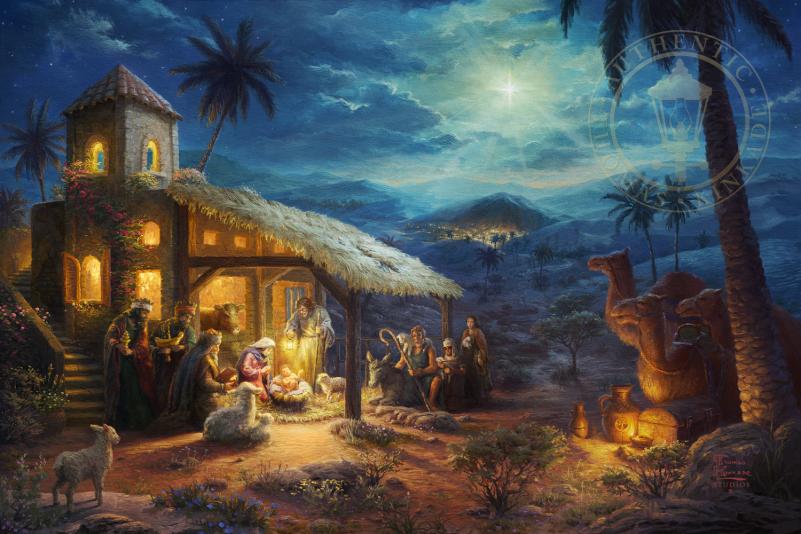
Thomas Kinkade, “The Nativity”

Even in an arguably post-Christian culture, it is challenging to share anything particularly new about a story this well known. For those of us tasked with its telling it can be especially difficult to reverse the potential for a familiarity-bred contempt, both in the church, and in the culture at large. But tell it we do. Every year.
The stultifying caprice of our COVIDays, coupled with unparalleled political farcity seems to have diminished our ability to see any hopeful horizons and consequently, ravage our capacity to dream. One wonders if one can ever again, wonder. As the writer of Proverbs once observed, “Hope deferred makes the heart sick, but a longing fulfilled is a tree of life” (13:12).

But, dare we think ourselves alone to be the hope-starved? Those to whom the heavenly babe first came were far more so.

Read appropriately, in its original context, the birth narrative of Jesus would have sounded incredulous. A questionable yarn akin to UFO talkies or gu’rmint conspiracy theories in the local version of Bethlehem’s National Enquirer. ‘Twould have been anything but a family-friendly, consumer-ready tale fit for animated movie screens and glittering holiday bling.

Instead, the Hebrew nation fixated on their lot as Roman-branded religious fanatics and kicked against the goads of military occupation. And, theirs was an occupation not just politically by the Romans, but theologically and morally by religious leaders pretending to follow Torah but largely interested in political safety and the biggest voice at the table (sound familiar?).
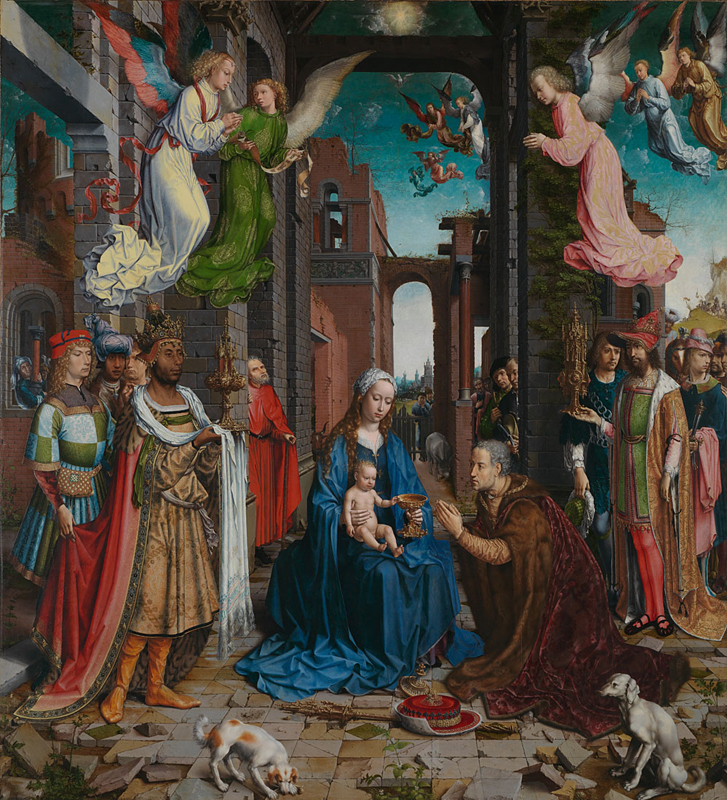
Jan Gossaert (Jean Gossart) (Flemish, d. 1532), “The Adoration of the Kings,” 1510–15. Oil on oak, 179.8 × 163.2 cm. National Gallery, London. https://www.nationalgallery.org.uk/paintings/NG2790

Long had they given up hope that anything would actually change. That their station might somehow improve. That, in great, great grandpa’s memory was something about messiah, the line of David, and covenant promises, among other fantastical things. They had done what almost every other conquered people has always done – settled into the long night of mediocrity and acceptance. Their survival mode button was stuck in the ‘on’ position.

Oh, there were outliers for sure. History is replete with them. There are always a remnant of stalwarts who refuse such resigned demeanour.

For example, Anna, whose long and lonely life had been given to prayerfulness and presence. Simeon, similarly, happy just to die having seen the fulfillment of a promise. Zechariah, whose priestly advocacy over Israel was well-known and whose doubts equalled his dedication. Elizabeth was giddy just to be pregnant in old age (God rather fancies such stunts), let alone with the New Testament’s resident off-the-grid hippy. And, of course, Mary. Aw, Mary – sweet but strong, young but wise, believing but thoughtful. Mary, perhaps more than anyone, understood the full importance and impact of what was told her by the angelic messenger. Apparently yes, she did know. ; )

“My mind is blown and my heart is full. Okay, so if I’m hearing you correctly, God’s finally doing something? Not just anything, but making the cosmic statement that the lesser is the more, the small leads the great, the poor rule over the rich. It’s all been upended, and you remembered everything that you’ve ever promised to me and my people? I’m in!”*

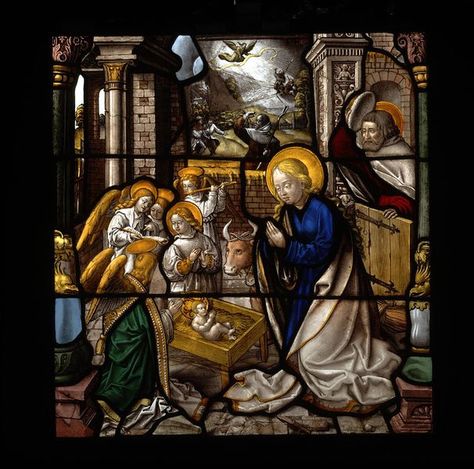
Danylo Movchan (Ukrainian, 1979–), “Nativity,” 2015. Tempera and gilding on board, 32 × 24 cm. Descending down into death. In icons, the cave of the nativity is meant to recall Christ’s tomb.

It is on the one hand a strength that such a story resides deep in our shared memory and finds revered place in our common consciousness. But, sometimes the familiarity of character, plot, and setting can sublimate the luminous mysteries at work under the surface. We kinda know the story but it doesn’t move us anymore. The aha! has been lost in the constant retelling that lacks reliving.

We can attribute much that is warm and good and beautiful to our affixation with the Christmas story. We still value the notion, however vague, that love lies at its heart, that forgiveness has at least something to do with all this, that family and community somehow matter, and that God doesn’t mind getting his hands (and diapered backside) dirty.

In our cynical moments, if nothing else, it keeps us looking for good deals at Walmart and happily arguing over Starbucks cups. And who doesn’t love that after fighting winter traffic for two hours?

But, upon reflection, guided by the Spirit who guided the star who guided the wise men who guides us still, we confess Christmastide to be a picture of heavenly surprise. To retell such a treasured tale should be of all things, an exercise in practicing surprise.

And everyone loves surprises.

A happy and surprising Christmastide to each and every one of you!

*Rob’s take on Luke 1:46-55, often called “The Magnificat” or simply “Mary’s Song of Praise.”

Soon, but not yet.

As you have seen, I am a fish on the shore right now, flipping and gasping for words to write. About anything. I’ve learned at these times to read until my eyes fall out. Others are not in this place. They’re producing page-turning material worthy of our consumption and consideration. 

One such soul is fellow blogger and faith-er, Laura Jean Truman. In a writer cop-out for which I seek neither escape nor make excuse, I share her better words here. Go, read in pride as I did, how Advent is a time uniquely prepared for both the prophet and the artist. For the artist-as-prophet.

They speak the same language. Maybe that’s why so much of the bible is poetry? Yup. I think that’s probably it.

Laura Jean, thank you. My readers will too, I believe.

2018 – Re-ligamenting

ligament [lig´ah-ment]
1. a band of fibrous tissue connecting bones or cartilages, serving to support and strengthen joints.

Already a few days in, we butt up against the tail-end of one year and make our way into another. A tail yet to wag. A tale yet to be written. This was a task best left until all the days of 2017 had been fully harvested and I could start bundling them into manageable piles.

For now, I am compelled to say that, in ways that matter most, I am grateful for 2017. On one level, I’m glad to escort its ass out the door, holding it open as it leaves (the door, that is!). However, it is gratitude that wins out over any other, lesser thing. And, as many have said so much better than I, to be grateful is to be always happy or, at least hopeful that happy will return soon enough.

This has been a year of returnings, of homecoming. I am drawn back to previous iterations of my self, albeit with the benefit of failure-bought wisdom. The overweening esotericism of the past few years is moving aside for a much more sensory guy. Less soul and more smell, feel, carry, see…hold.

I’m beginning to think our souls are much more rooted in our feet, hands, nostrils, eyes, and tastebuds than some airy-fairy nexus untouched and untouchable by we mortals. There is no division of labour. We don’t leave the world and our bodies behind in order to attend to our souls. Similarly, in a full-on, head-first dive into our world, waist-deep in shit and woe, we don’t have to leave our souls behind. They’ll get there first.

There is, simultaneously, a greater depth and immediacy to a life lived in one place at a time as a total and complete entity: body, soul, heart; sweat and spit. It buys back from the bleak, divided landscape of dualism, an holistic sense of peace and unity.

I reflected recently Jesus’ little visit to Sheol where he encouraged the prisoners, stuck in limbo, to look up for “their redemption draweth nigh.” A very physical Jesus went to the disembodied not to tell them that some ghostly, spiritual paradise awaited. The opposite actually. A great banquet with Jesus and friends in a great city was being prepared. Their souls would cough up new bodies, not the other way around.

Advent and its fruition at the Christ Mass says something utterly unique, a truth so utterly transfixing, that all the earliest characters in the drama found themselves winging it. Just a lot of gawking, and fear, and shivering with stuttered awe and wonder. In such circumstances, I dare say we would do the same.

The Christmas story says many things. But, at the front of the line is the simple idea that God is, more than anything else, profoundly physical, actual. Not just ideas to think. Right stuff to say or do. God is with us. God IS us. Conversely, it means we are like God.Foot.jpg

There are many out there who, like me, are constantly seeking to nurture something mystical and otherworldly within ourselves as though God were somehow uninterested in the messy little details of our tiny lives. This is not to suggest that we ignore “spiritual” matters in favour of “earthly” ones. It is the growing belief that those are not two sides of the same coin. They ARE the coin. God cares as much about my health, relationships, and the overall physicality of my existence as he does the height of my goosebumps when I pray.

In Jesus, God came not to save our souls. He came to save US. You and me. Body, soul, spirit. In Jesus, God came to realign our past, present, and future into one single unity. He religamented (re-ligion) the disembodied and as such disempowered parts of our humanity. Jesus came that we might become MORE human, not less. And, contrary to what contemporary evangelicalism might have us believe, he came not with some revivalist message of the sweet by ‘n by. 

He came to heal our bodies, our memories, our broken bits. To remind us of what we truly are: beloved but broken, loved but lost. Why?

Because we can’t feast at a table any other way.

Maybe this Christmas

Christmas Day. My eyes are like twin harvest moons of bloodshot fatigue. There’s a roller derby taking place in my head. My church music ministry gig ramps up something fierce this time of year leaving me satisfied and happy, but a shivering hump of quasi-humanity. The solution? I sent my wife, Rae, out to find anything resembling coffee, if only for a most yummy and effective remedy for my pounding head. God bless her!

A rather poorly decorated poor excuse for a Christmas tree tries unsuccessfully to stand guard over the precious few gifts tucked under her skirt. A single strand of multicolor lights graces her awkward presence in our living room. Perhaps fewer than a dozen ornaments hang suspended, lifelessly, from these poor, little green arms – flimsy and weak.

I speak of symbols, those tried and true geiger counters of the meaning and truth they represent. Many, many thoughtful souls have sought to unravel the ontological mysteries so delightfully pictured by this meager scene before me. As such, of that at least, I must forego.

For me, Christmas this year is a bittersweet remembrance. Every dangling bauble, twinkly light, fireplace pop and suspended sock boasting itself on our mantelpiece seems to me nothing more than sad reminiscences of loved ones gone before us; of friendship, once robust and real, now ruined; of bad things said and good things left unsaid.

Anyone who knows me knows all too well my utter loathing of all things Thomas Kincaid (sorry for the random, awkward segue). Oh, make no mistake, his practical gift at the canvas is indisputable. It’s of the vision, or lack thereof, to which I take issue. This “art” represents the shallowest of wishful thinking, whimsical, Pollyanna non-reality. It is resurrection without a crucifixion. It sets out to illustrate a fantasy world where evil has never existed; a place we all long for but which must be arrived at through God’s channel of self-forgetful love that dies an ignoble death to prove that love.

Back in my living room, my wife and I are writing in different parts of the house. I squeeze out these wandering thoughts while she continues editing her novel. Our eldest son spent the night at the home of dear friends one state away while our other son snores peacefully in his room. We don’t expect his angelic, trumpeted emergence anytime soon.

Every year that passes heaven claims more of those we love. Both of my wife’s parents are gone. My father died in 1985. Those whom we have called friend are strewn about the globe in a flower arrangement of well-memoried laughter and familiar faces. It aches.

This Christmas, all of the regular trappings have escaped me. Instead, it stands as glowing reminder of three things. Life is not as Thomas Kincaid or Barney would have us believe. If this little evergreen means anything it illustrates that our hope springs eternal and that life stubbornly wins out over death. Second, the imperfections which pervade our not-so-Christmasy living room are our own. In the heavenlies, whatever that means, all manner of thing shall be well. Sorrow and sighing trade places with gladness and rejoicing.

Finally, in the words of songwriter Ron Sexsmith, “maybe this Christmas will mean something more; maybe this year, love will appear deeper than ever before. And maybe forgiveness will ask us to call someone we love, someone we’ve lost for reasons we can’t quite recall. Maybe this Christmas.”

Indeed…maybe this Christmas.