Adventia, days 19 & 20

The following prophetic poetry has always been such a seismic piece that it deserves a couple days. For Adventia, days 19 and 20, I am posting one of the most remarkable, strangely comforting, but deeply subversive prophetic passages in the entire Scripture.

These words, from the mouth of a young, pregnant Mary are as powerful now as they ever were. For those who think the Gospel nothing more than one’s personal ticket to heaven with little social impact, the poem that would become known as “The Magnificat” easily challenges such quaintly dismissive, erroneous assumptions.

In two translations, the New Revised Standard Version and The Message, I give you –

Luke 1:46-55 – “The Magnificat” 

(NRSV)

And Mary said,
‘My soul magnifies the Lord,
47   and my spirit rejoices in God my Saviour,
48 for he has looked with favour on the lowliness of his servant.
   Surely, from now on all generations will call me blessed;
49 for the Mighty One has done great things for me,
   and holy is his name.
50 His mercy is for those who fear him
   from generation to generation.

51 He has shown strength with his arm;
   he has scattered the proud in the thoughts of their hearts.

52 He has brought down the powerful from their thrones,
   and lifted up the lowly;
53 he has filled the hungry with good things,
   and sent the rich away empty.
54 He has helped his servant Israel,
   in remembrance of his mercy,
55 according to the promise he made to our ancestors,
   to Abraham and to his descendants for ever.’

(The Message)

46-55 And Mary said,

I’m bursting with God-news;
    I’m dancing the song of my Savior God.
God took one good look at me, and look what happened—
    I’m the most fortunate woman on earth!
What God has done for me will never be forgotten,
    the God whose very name is holy, set apart from all others.
His mercy flows in wave after wave
    on those who are in awe before him.
He bared his arm and showed his strength,

    scattered the bluffing braggarts.
He knocked tyrants off their high horses,
    pulled victims out of the mud.
The starving poor sat down to a banquet;
    the callous rich were left out in the cold.
He embraced his chosen child, Israel;
    he remembered and piled on the mercies, piled them high.
It’s exactly what he promised,
    beginning with Abraham and right up to now.

Um, wow.

Adventia, day 10

The radically counter-cultural nature of the Advent narrative demands poetry of equal heft and teeth. Few are better positioned to contribute such as Óscar Arnulfo Romero y Galdámez (15 August 1917 – 24 March 1980). Catholic prelate and later Bishop of El Salvador became a martyr in his outcries against the social injustice and violence amid the escalating conflict in his homeland. He perished by gunshot while serving Mass. His spirit is the very spirit of Advent itself: love invading hate, light invading darkness, righteousness invading chaos.

For Adventia, day 10, I give you…

Adventia, day 4

For Adventia, day 4 I submit a poem I composed a few years ago. Rough around the edges perhaps, but I hope it scratches at the surface enough to help us find place in our Advent journey all the same. May the angst, ambivalence, austerity, and frustration of waiting be rewarded in our common longing for the coming Light.

We Wait

Too many moons after too many suns and still –

we wait.

To arise to yet another day with no sight of promised end –

we wait.

My great, great, great grandparents told this same tale. Still –

we wait.

My great, great, great grandchildren, will they tell this same tale?

We wait.

For once pliable, elastic, hope-filled words, spoken from that creepy prophet guy –

we wait.

In hopscotch rhymes, coffee table books, Sunday paper riddles –

we wait.

Faithless ones mock. Faithful ones pretend to believe. Seeking ones struggle to hope –

we wait.

Stuck. In stasis. Solitary, floating in an endless ocean of shark infested water –

we wait.

Nine-year-old boys sneak their umpteenth grab of dinner being prepared a year after lunch –

we wait.

We’ve long ago forgotten or even care about what we were waiting for –

we wait.

Will we even know when the waiting is over?

Still,

we wait…

Adventia, day 1

No, the above is not meant as some cheap attempt at a New Joizy accent with the word adventure. Let’s just call it the purposeful amalgamation of Advent and Fragmentia. Let it be a place where the illumination of God’s in-breaking into our world found in the Advent narratives unites with the fragments of literature and faith and life seeking to bring us to deeper understanding of it all.

Advent is upon us once more. With it comes a barrage of books and practices all aimed at helping us get the most from the experience. Last year I chose to post a daily poetic reflection on my poetry website. This year I’d like to do something similar here on innerwoven. It gives me opportunity to dive deep into some of the best words about the best time of the year; the beginning of the church’s calendar at Advent. These poems are both old and new and are found in various places.

For Advent, day 1 we begin with a gorgeous piece by Sally Thomas, which I saw first on a favourite Instagram channel, #realpoetsdaily 

Here is “First Sunday” by Sally Thomas ( @sallytnnc )

Seeds of Grace

I’ve been quite open about my struggle with alcoholism and subsequent recovery. Perhaps it is because, through my association with the program and community of A.A. I’ve rediscovered the loving, trustworthy God I once knew. That God somehow got lost along the way, despite my practices of faith, my role as a “professional Christian,” and a radical conversion experience at eighteen.

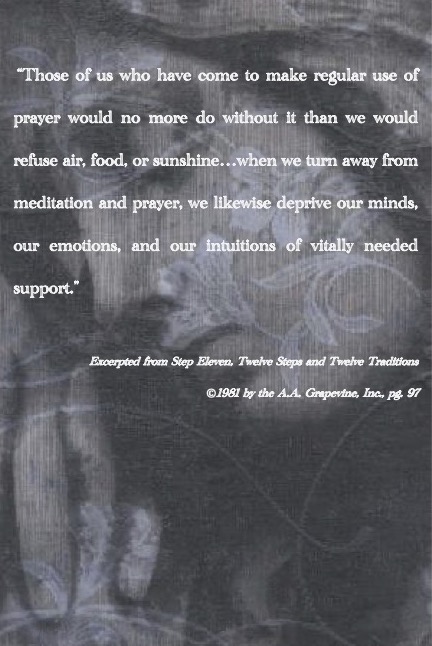
These days, my faith is simpler. It is not so cliché-ridden, expectation-laden, preconceived notions-driven. It is one of basics: learning humility, self-love, and the practices necessary to maintain and nourish the same. Along the way, I read everything I can get my hands on to assist in that journey. This is a short excerpt from my Seeds of Grace: A Nun’s Reflections on the Spirituality of Alcoholics Anonymous by Sister Molly Monahan (pseudonym).

Prayer Is Air

Saying farewell to a friend

This morning, we said farewell to a friend.

Jonathan (Tadhg) Gardiner

At 10:00am this morning, with aching throats, wet cheeks, and swollen eyes, we watched the livestream of his memorial service, held at Woking Crematorium in London. Tadhg, or “tiger without the er” as he would introduce himself, was laid to rest.

And, in those brief moments, our hearts shattered in pieces.

There are a handful of people for whom I could ascribe the following, “if I could be half the person…” Tadhg was one of those. Genuine, gentle-spirited, fun-loving, unassuming, unpretentious, kind-hearted, generous, and hospitable. There are many who are good to know. He was the one you needed to know, if only for a season. I can say honestly, and without embarrassment, that, to meet Tadhg was to meet Jesus. His life exuded grace and the easy friendship one might expect from the Friend of outcasts and sinners.

His Facebook page states his passion for walking alongside others in holy fellowship:

I am an Anamcara [gaelic for ‘soul friend’]. I consider myself to be a sociable guy, a latter-day celt, a professional and spiritual guy, who would dearly like to hear from you…I am also an independent (non-judgemental, inclusive) priest…and a ceremonialist.

We shared many similar passions including Celtic spirituality, Christian mysticism, theological conversation, a love for probing and formative liturgy, connections between Western and Eastern thought, and making sense of a world in love with itself. We wrote for each other’s blogs and spoke often (usually FB Messenger or email) about things that mattered to us. His perspective was rich, original, and refreshing. He was remarkably free of judgement or hatred of any kind toward anyone. Ever.

In the months before the summer of 2016 I was suffering from a profound emotional deprivation and spiritual ennui. My wife and I decided to take a sabbatical of sorts to the UK. The church for which I worked as Music and Worship Director kindly agreed to a five-week extended “Trip to Bountiful” as I called it.

We had the time but our budget was tight. Tadhg offered, eagerly and warmly, a stay at his tiny but comfortable flat in Fulham. Moreover, he’d be there to pick us up from the airport, having never actually met either of us in person!

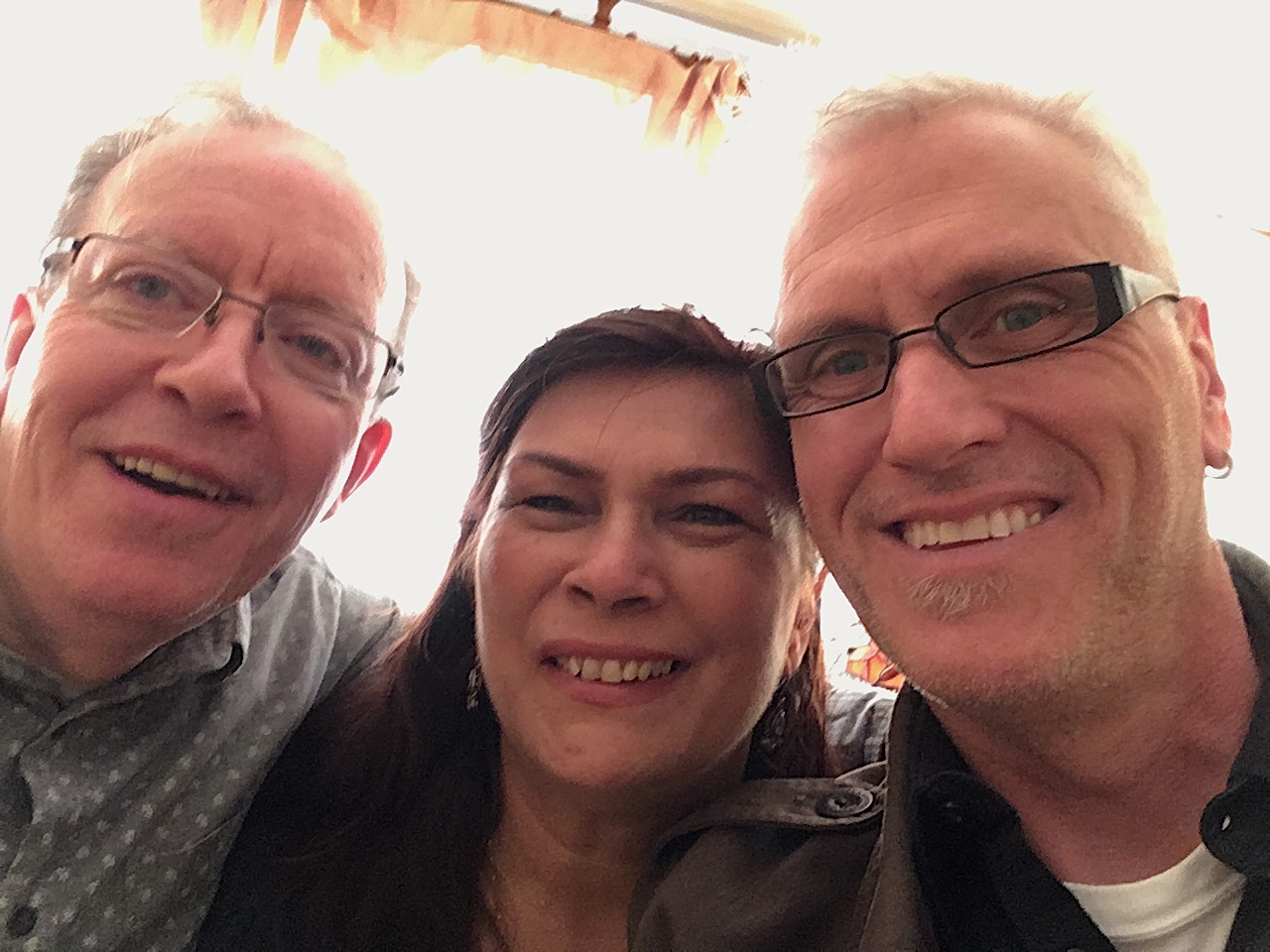
2016. Rae, myself, and our gracious host, Tadhg

Without expectation or guilt he allowed us to use “Hotel Tadhg” as our base of operations while we coddiwompled our way throughout Britain. He dealt with our embarrassingly North American-sized entitlements, returning them all with his beaming smile and dry humour. That journey so changed our lives that we now live in Edinburgh as global servants with our denomination’s mission wing.

God used Tadhg as a big piece of that cosmic puzzle.

When we returned to Britain in 2019 as part of our first encounter with the team of whom we are now a part, where did we stay in London? At Tadhg’s place, of course. For him, there was no question. He had stocked his fridge with all the various food and drink items he knew we liked from the last time we were there. Tadhg was the walking definition of holy hospitality.

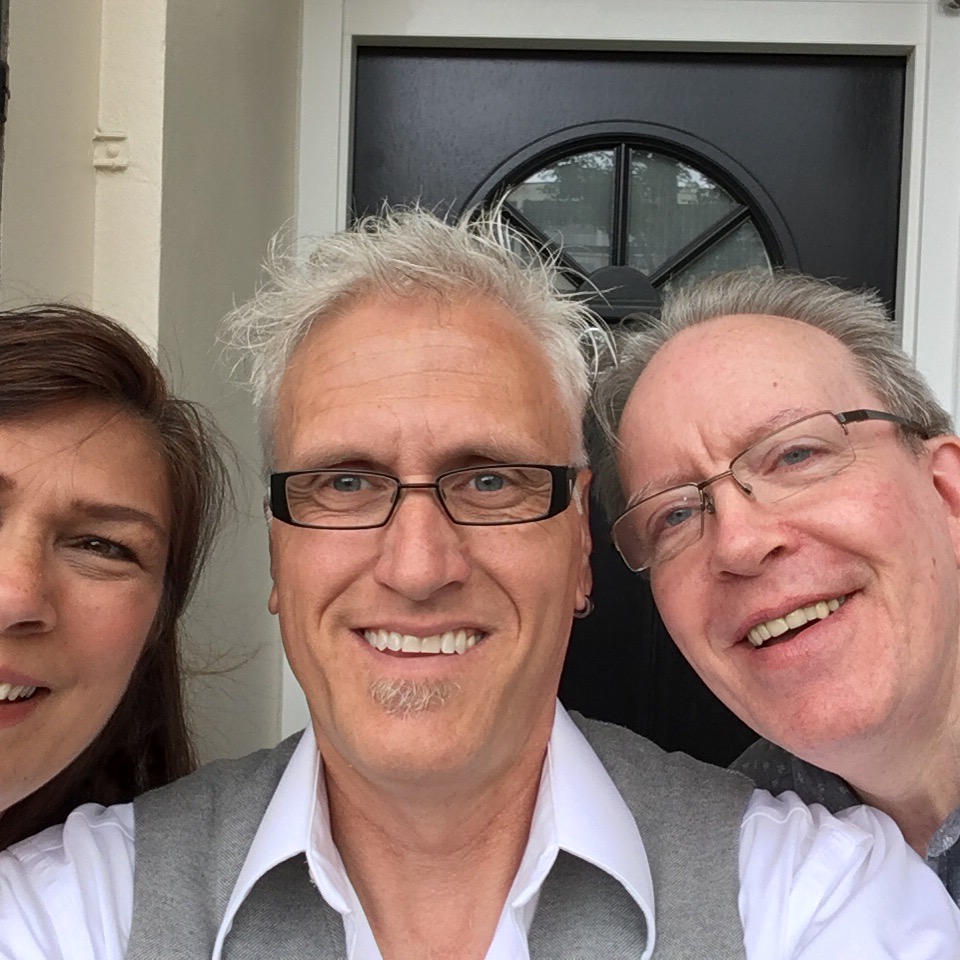
2019

In recent years, as Tadhg’s condition worsened, then stabilized, then ultimately took him from us, I felt a growing sense of panic. There were too many things left unsaid to my dear friend, too many conversations unopened, too many laughs unshared, so much more to learn from each other. To hear of his passing was to have one’s soul summarily torn from the body. A world full of ungrateful, spiteful, and unkind people and this is the one to be taken. God, I mean, really?

But, alas, such is the inexplicable nature of our existence. Tadhg, of all people, would chastise those like me who feel tempted to wallow in our pain. He would be the first to lift up our heads, and encourage us to look up to the running clouds, whose playful whimsy is ample reminder of God’s care over all created things.

Dear friend, I shall miss you. The world shall miss you, even if they don’t realize it. Perhaps you can put in a good word that God can help me to be more like you.

If only just a little.

Until my song comes here

Our Europe Team for Serve Globally, the mission organization we serve through our denomination (Evangelical Covenant Church), recently met for our annual retreat (two and a half year COVID delay notwithstanding) at Le Lazaret in Sète, France. For my wife and I, it was only our second such experience. Our first was in October, 2019 and acted as a kind of “reconnaissance mission” as we explored God’s call.

This beloved team is a collective of singular passion, unwavering commitment to justice and reconciliation, enviable humour, rich fellowship, boundless creativity, and endless capacity for joy. We would take a bullet for any one of them.

Our speaker and guide for the retreat was none other than Al Tizon, former Executive Minister for Serve Globally, missiologist, teacher, writer, prophet, and friend. His upcoming book, Christ Among the Classes, shaped our discussions.

By way of understatement, these were not easy conversations! We engaged in matters best left alone unless one wants to face the convicting issues of wealth, the Gospel to and among the poor, our complicity, knowing or unknowing, in perpetuating systems of greed and disenfranchisement and how all of that intersects with the gospel of Jesus Christ.

Dr. Al Tizon

It can be equally stirring and unnerving to discuss one’s place in a world given to championing the rich and powerful at the expense of the poor, while not demonizing the rich. What does that even look like? Is such socio-economic righteousness even an attainable goal? When does it cross the line from kingdom equality to political radicalism? Is there a difference? If so, what?

The questions arising from such discussions are as dizzyingly complex as are the issues from which they derive. But, it is our calling as followers of Jesus, himself a friend of the poor, and sinners, and children. We, by association, are to befriend the outcast, emancipate the leper du jours; even love our enemies. This includes those we are most quick to either dismiss or demonize.

Al (he’s not one for the fineries of title!) painted a picture of the transformation of heart toward equanimity by way of downward mobility, an increasing identification with the poor. This starts first with an awakening to our own relative privilege and wealth. To be “born again” is to see anew, or perhaps for the very first time, our place in the broader world; our individual and collective sin and how it has affected us and those around us.

We journeyed through a series of steps along the way toward the ultimate goal of befriending and advocating for the poor. The rich are not of the devil. Nor are they to be eschewed, pooh-pooh’d, or railroaded out of access to grace. But, Jesus makes clear that they will have a much more difficult time when it comes to the attitude of mind and heart necessary to befriend those who, by definition, require something from them, whether that is as benign as their time or as challenging as their resources.

I like to keep things simple. I take my cue from Wendell Berry who recognized the need for every song we compose to be fully accessible to all. If not, we still have work to do…

Doors

“A picture is worth a thousand words,” once proclaimed advertising executive, Fred R. Barnard.

Like so many of you, I love picture. Metaphor. Symbol. Illustrations as it were of the lives we lead that, themselves, mirror the confluence of flesh and fire, body and spirit, life and eternity. Occasionally, I post something that is a tip of the hat to such metaphors.

Door is a favourite such metaphor. They are something we must open ourselves but which, at times, are opened for us. Often, I open doors just for me, but most doors are communal, allowing others to go through with me, before me, instead of me, or even in spite of me. Once open, we’re faced with a decision: stand and gaze, or walk through and take an existential risk of faith mixed with trust. Once through, we gain the elation of having taken that risk and our view opens to be exponentially more expansive than it was before.

Speaking about prayer, Jesus made a remarkable promise to his disciples, “Knock, and the door will be opened for you.” He also said, “I am the door. If anyone enters through me, he will be saved, and will come in and go out, and find pasture.”

Such a profound, but mysterious, invitation!

Whatever the circumstance, in Christ, all such doors lead inward to friendship with God and outward to the riches of a universe being restored, renewed in God’s image. All of it an act of grace.

Come, let’s dare to walk through together.

The art of words, eleven years on

On January 31st, 2011, I posted my very first piece on this blog. After much consideration I chose the name innerwoven because it seemed to capture what I believe to be true about all of us – we are beloved creatures kneaded into the dough of earth and eternity by God. An often-nasty business requiring much punching and bending and mucking about that constantly shapes our raw material into something warm and nourishing to be served up to a world starving for its goodness. And, although true spirituality is a two-way street – impulses and experiences, ideas and trouble, ecstasy and environments – moving in and out of us, the work of God is largely an inner one. God, at the very center of us, pushing His/Her way out like radiating circles of magma to the mouth of our volcano, ready to burst out upon the world.

This blog then was originally designed to be a catch-all spiritual notepad upon which I could scribble a few ideas about the nature of the soul, the shape of my emerging life, and in so doing, build a little community. Writing about all that required poetry which is what happens when words make love. They impregnate the page with something remarkably sweet and real. Robslitbits became the creative writing arm of the blog which I later portioned into a separate entity. At first, however, it was all right here.

To celebrate eleven years, I repost one of my earliest blog entries. This one was originally early February, 2011, but it still says the kind of thing I’d typically say. Thanks to all of you for taking this journey of spirituality and literature with me. You make life fun, interesting, and just…better!

* * * * * * 

Gerard Manley Hopkins. John Donne. Wm. Shakespeare. Christina Rosetti. Emily Dickinson. Paul Simon. Bono. Since I was a very young lad growing up in Calgary, Canada, I’ve had a love affair with language; specifically the art of words. Words spoken. Words written. Words read and re-read, like ingesting food for the eyes that gets digested in the heart.

In the holistic sense of the term, words are sensual. They are meant for more than simply corralling ideas or channelling information. They can and should be beautiful for their own sake. Carefully chosen and meted out in gradual succession like adding the correct ingredients in proper order to the perfect meal, words are part of the whole and greater than the sum of their parts. They massage meaning into our spiritual skin, perking up our inner ears to hear what our unseen lover whispers in our unguarded moments.

The Christian life is more poetry than prose; more a wild garden than suburban lawn. To that end I share this brief poem:

Photo by R. A. Rife, Edinburgh, Scotland