The Price of Home

Published at innerwoven, given the literary nature of this one…

robertalanrife's avatarinnerwoven

I’ve been stung. Poisoned. Nothing flora or fauna. By a book. The Poisonwood Bible by Barbara Kingsolver. It’s got me thinking again about our notions of ‘home.’

Poisonwood Bible.jpg

Tuesday, December 26th. Boxing Day. It’s strange, just saying those words can produce such intense homesickness. A progressive, Canadian family living in a regressive, Trumpian America. Similarly, Nathan and Orleanda Price and their children, Rachael, Leah, Adah, and Ruth May – in equal measure, a family displaced; a little collective of courage and fear, lived in a world of nothing but frontier. Their only certainties were the uncertainties of daily survival in a world that cared little either way.

Their meager, not even daily, meals of eggs or mash, perhaps some chicken if someone took pity on them, removed any vestiges of the stolen or manufactured expectations as whites in a black world. They were equals among those who typically served their every…

View original post 799 more words

The Price of Home

I’ve been stung. Poisoned. Nothing flora or fauna. By a book. The Poisonwood Bible by Barbara Kingsolver. It’s got me thinking again about our notions of ‘home.’

Poisonwood Bible.jpg

Tuesday, December 26th. Boxing Day. It’s strange, just saying those words can produce such intense homesickness. A progressive, Canadian family living in a regressive, Trumpian America. Similarly, Nathan and Orleanda Price and their children, Rachael, Leah, Adah, and Ruth May – in equal measure, a family displaced; a little collective of courage and fear, lived in a world of nothing but frontier. Their only certainties were the uncertainties of daily survival in a world that cared little either way.

Their meager, not even daily, meals of eggs or mash, perhaps some chicken if someone took pity on them, removed any vestiges of the stolen or manufactured expectations as whites in a black world. They were equals among those who typically served their every whim, seen or unseen; an unexpected balance that would save them from their own extinction. Hmm, something to heed here I think.

Were they there because of some high calling of the gospel? Was it their great Christian frontier where, in their own stumbling way, they could add to the Roll Called Up Yonder? Or, was it something deeper, more primal? Were they there to befriend the enemy? To make peace with the devil? With their devils? With their gods? With God?

The complexities of their call beckon me to consider my own. Like the Prices, I am a man equally displaced, despite possessing a shared border and the lack of intermediary ocean. I have asked the question, precariously and ad nauseam, where do I fit? We all do at some point.

With no small shame, I spent an entire childhood fearing and hating this place, giant land of giants. America, the baffling. In my estimation, she never lived up to her own press. But she sure loved to talk about herself, unendingly, all with a suspicious eye on the unprepared listener’s awaited response of teary-eyed gratitude. Anything less was travesty or treason. For what exactly? Was I the lucky recipient of her gracious light or should I hide with the others in her long shadow cast over a pathetic world who, apparently, needs her?

Now, some seventeen years later – a generation, a lifetime, and I am faced with questions the answers to which would have been clearer back then. Frankly, I don’t know that I ever really knew the answers. Hell, I don’t think I remember the questions. And, even if I did, to have answers at all render such questions glib and facile.

Instead, I’m left trying to decide whether my “answers” are to be found in the questions themselves. Perhaps I am meant to find better questions? Like that one. Perhaps the answers to any question is the the readiness to ask anything at all? How thoroughly cliché. How unsatisfying.

Perhaps.

Like the Prices’ life in Kilanga, Congo, do we follow whatever calling, intuition, demons, indigestion, lead us to believe in anything beyond ourselves? How pure is anyone’s rationale in the final analysis? At times even the animals seem well beyond us. No complaining. No seeking, and therefore, no disappointments. Just Live. Survive. Reproduce. Die. Repeat.

Simpler, but rather bleak, don’t you think?

The Price’s, like everyone, made decisions birthed of the complex hubris of their psyches. The geography of soul can be most difficult to navigate at the best of times. They discovered this in as many ways as there are opportunities to offset obstacles. Their choices reflect the long, disjointed road that seems to lead nowhere. But, in the end, leads right back to who they are, who they became. Who they never were.

After the ignominious cross, Jesus even dwelt among the dead in Hades, not to gloat over their bad choices, but to boast of their good fortunes. To give a two-thumbs-up where one might not have expected as much. If it were a movie, it was that moment when the dungeon door flew open and a rescuer reaches out a hand, “come with me if you want to live.” Or something like that.

They were as much ‘home’ as all the lucky buggers still topside and playing cards. Their long, grey waiting room had more than old magazines to keep them company. It had their own journals in which had been written, “all is well, my good grace always wins over bad living.” What’s more inviting than that? Perhaps if we remain small enough, with hearts like sponge, minds like children, and souls in tattered need, Love will meet us even in our worst places?

The mystics, who swim here, would shit to hear me speak in such ways. I think I hear them whispering under their breath, “This is good. We ask these same questions every day. But, isn’t life that much richer for asking them in the first place? The gospel has shown us that everywhere is equally our home. We just don’t know it yet.”

In times past, my life here in the land of win-at-all-costs would have felt much more Poisonwood than promise. But, in the growing light of age and calmer spiritual water it is no longer an exile. It is merely my environment in which I internalize my experience. That alone is so much more than those among whom the Prices lived knew, where surviving and thriving meant the same thing.

Now, whenever I’m tempted to bemoan my sad disenfranchisement, I consider the ramifications of the gospel of freedom. The Price. We’re all in God’s living room, which is everywhere seen and unseen.

Price in Africa. Me, here.

The price of home.  


Let Us Once Upon a Time

The most foundational lessons common to us all come by means of story.

reading-77167.jpgStory and poetry and song and art and humour.
It seems almost counter-intuitive really, given the magnitude of the stuff we’re supposed to understand, the high stakes of living together in some form of harmony. I mean, who thought it a good idea to convince wayward souls of the need to love their neighbours as ourselves with those tricky parables? Why tell children nursery rhymes? Why not wait until they can read and just give them the case notes? More efficient I would imagine. As is the expectation of our logic-bound culture, shouldn’t these things be done in a classroom somewhere with textbook-tomes the size of small cars? Surely the importance of such a message should require all of us to ace a mid-term somewhere?

Looking out over the immensity of human history, replete with bardic tales of joy and woe, love and war, pillage and propriety, the answer would seem to be a resounding, NO.

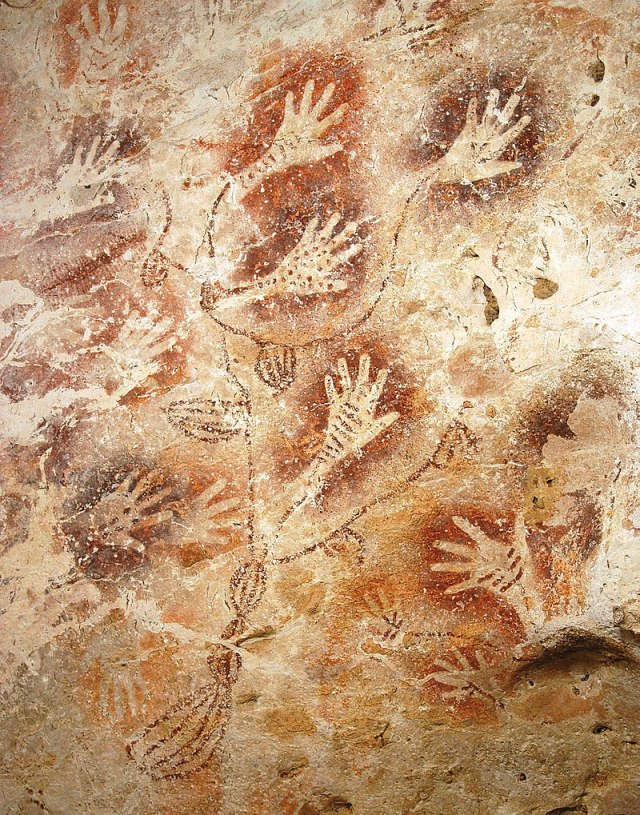
Instead, they painted pictures on cave walls. They built cathedrals of stone, marble, and gold. They painted canvases with colours too rich to mention. They wove seeking and curiosity into epic stories of sea journeys, fleeing oppressors, screwing other men’s wives, cutting strong men’s hair, or building floating shit-filled boats to avoid worldwide floods. They composed titanic symphonies with notes crashing like waves against each another, all of it tumbling together to cry out in singular voice – here we are!

Even the most agrarian of cultures, trapped as they were in the often bone-crushing cycles of poverty and loss, were inspired enough to tell their tales in ink, chalk, acrylic, wood and stone. Indeed, every culture that has ever existed has in some way spoken of its ebb and flow, triumphs and tragedies in these ways. From Ethiopia to Egypt, Peru to Palestine, Canaan to China, Ireland to Iceland. Gilgamesh, Homer, Chaucer, wilderness-wandering Israel – it’s always about journey framed in epic story.

800px-GuaTewet_tree_of_life-LHFage.jpg
Gua Tewet (Tree of Life), Borneo, Indonesia

Most of the Hebrew Scriptures, or the Christian Old Testament, is one great narrative. Stuff from no stuff (creation). Nation from nothing (Israel). A 40-year long desert hike (Israel’s wilderness wanderings). War, pillage, rape, judgement, restoration, repeat (the rest of it). Far and away the best-loved book of the Bible, is a collection of poetry and songs, both happy and sad (The Psalms).

Jesus is as well known for telling good stories as he is for his grudging  participation in the theological stew we’ve renamed ‘faith.’ We attribute to him not just a cross and a resurrection, but turning water to wine at some dude’s wedding reception. Creating feast from frantic in the loaves and fishes. A weird story about the wrong guy doing all the right stuff in the good Samaritan. Farmers sowing seeds in places both good and not so good, and fig-trees, and virgins, and tax collectors, and gardens, lilies, landowners, religious teachers, and the list goes on. 

With his questionable choice of teaching methods, it’s arguable whether he’d find a position as a substitute teacher in the rough part of town, let alone Saviour of the world. But, there it is. 

If the Bible tells us anything at all it is this – learn to love stories. Learn to love telling them, hearing them, remembering them, finding ourselves in them, retelling them. The sense of childlike wonder, the anticipation of what comes next, the page-turning expectation is so much better, so much more formative, than cracking open a textbook better used to sit on while hearing a story.

Something about arresting our senses in the beauty of which we’re capable points to Something/Someone beyond our under-the-sun existence. Only hushed awe and the reverence of a good story well told is sufficient to hold the sacredness of our lives.

We have one life. We have limited time.

Together then, let us once upon a time.


Fragmentia Sacra – Learn to Squint

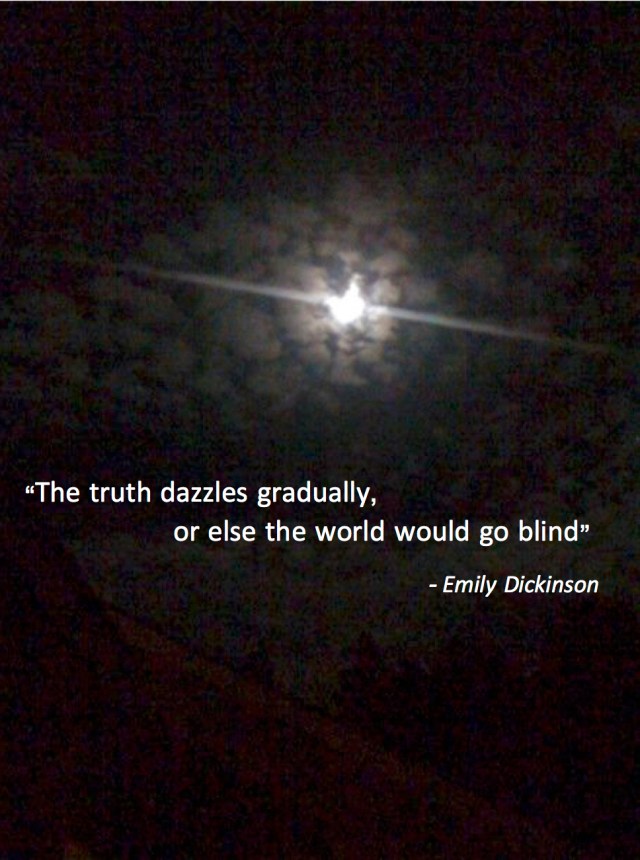
Always good for more than just sublime poetry, Emily Dickinson here suggests that, for our best understanding, which emerges slowly, we’d best learn to squint!

Fragmentia Sacra - Epiphany.jpg

A little more of less, please

Writing is a good life metaphor.

typewriter.jpgThese are interesting days. I approach my life much as I do the page, with contentment but with trepidation. The clumsy plasticine oozing from my pen leaves me a bit numb. A little bored, to be honest. A stultifying sameness guards the words from taking on a life of their own, of actually taking anyone on any kind of journey.

This is especially true of poetry. Ironically, I find my greatest enemy to be the stronger, more captivating work of previous years. It is the equivalent of creative shadow-boxing, a grasping after one’s own ghosts. It is to hide from the potential of my own gifts. The glory days, whether in life or art, can straight-jacket us right out of good days now.

Life is often this way. In creative-artistic terms, this is so commonplace as to be ridiculously cliché. This haunting of the present by an elusively successful past can choke the life out of bold, new ventures. Even the very desire to try is rendered impotent. A sterility can only be achieved by writing. Shit, but still writing. When acedia takes hold it keeps me from even getting that far. Writing poorly is still better than writing nothing at all. Bad sex is still better than no sex at all!

frustrated writer.jpg

Does this call into question my dedication to word-craft? Do I need to turn in my lit-card? Have I become less a writer and more of a word-ler (word burglar)? I suppose the creative struggle can be compared to dieting. One can lose weight through amelioration of already good habits-in-stasis while destroying bad ones. But, for it to “take,” a completely different way of living is required. Sure, lose thirty pounds, buy new clothes, take a thousand selfies on a new, air-brushed social media persona. Eat McDonald’s and chocolate cake for a week or two afterward and one’s previous successes merely mock present realities.

“Look how well I was doing,” we crow. “The effort really paid off,” we chirp. “It’s about bloody time,” screams our waistband. We gaze with fondness and well-earned satisfaction at our accomplishment only to groan with the recognition that that was then and this is now. Shit.

It can be genuinely depressing to read poetry or other bits and bobs of writing from even a few years ago when I had over-weening confidence in an under-developed, largely self-indulgent output. Now, possessing some measure of success, a proven track record in this whole letters enterprise, I find confidence a bit shaky to say the least.

Perhaps this is a case of art imitating life. Never have I been so content with so little. Not that I have little. I have in fact considerably more of everything than I could ever use. But my requirements are far fewer than ever. My writing is undergoing massive change right now, too. It’s not as clever-turn-of-phrase-y as it was, relying instead on that which, though simpler, might actually say something. I guess I’m losing my desire and, frankly, the need, to write for the academy – words for lovers of words. Insider talk.

Now, I write because it acts like a shower. My soul gets buffed up a bit more. My heart gets a jolly good brushing and I feel refreshed. And, I want to tell people about it. I want people to know who I am so they can meet me here. A welcome mat more than a Hadron Collider of complexity. There is a loneliness in creating something only a handful of erudites with too much industry-speak in their tool-belts can enjoy. And by “enjoy” I mean quietly compare to their own far superior material. Ha! Rightly so.

create.jpg

I guess to live better, we must learn to live on purpose. Correspondingly, to create better means to engage the process with trembling tenacity, even in the face of overwhelming self-doubt in one’s own ability.

I want to be the best writer, poet, musician – person, I can be. But it appears that what that means is a whole lot less words and a lot more conversation. Less erudition, more simplicity. Less academy, more living room. Less library, more kitchen table. Less bookstore, more backyard barbecue. Less thinking, more doing. Less of someone else, more of me.

Well, how about that. I just wrote myself out of my own funk. I rest my case.

We will remember them

The king of Vegas rockabilly, Elvis Presley, once sang this refrain, “we’ll have a blue, blue, blue, blue Christmas.” He was one of a number of artists to sing it. I mention it because it is a song of unrequited love, specifically at Christmas time.

If ever there were an emotionally heavy-handed time of year it is Christmas. As early as September we begin to see the familiar commodified images of sleek, effeminate reindeer, suspiciously rosy-cheeked Santas, Hallmark this ‘n that, and the tsunami of stuff we’re meant to buy to help us feel how we’re meant to feel.

It’s a construct and we know it. Well, at least the shiny baubles, taut packages ‘n bows part. But, lest I find myself on the receiving end of Scrooge-comments, let me say that I’ve loved this time of year my entire life, in spite of working outrageous hours as a church music director. I love the ambience. Sometimes I don’t even mind its rom-com, syrupy-saccarine motif falsely imaged and poured over us like a jolly-happy goo.

The whole thing smacks of an out of control Norman Rockwell painting, replete with the expectations that we all play along with the happy themes. We’re supposed to be joyful, full of gratitude and happy family times, with family-dog-stealing-roast-beef-off-the-counter type fun. Why wouldn’t we, right?

Quite often, it’s not that simple. For those who have lost a loved one, a parent, a friend, a pet, heaven forbid, a child – this can be an especially difficult time indeed. The ache of loss still fresh in their mind pinches their guts and narrows their emotional field of vision. It can almost feel like an insult. All these happy faces everywhere and not a hint of respite from their pain on the horizon.

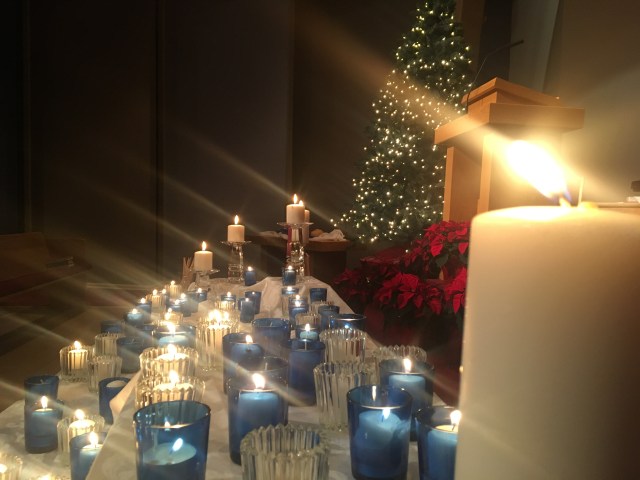
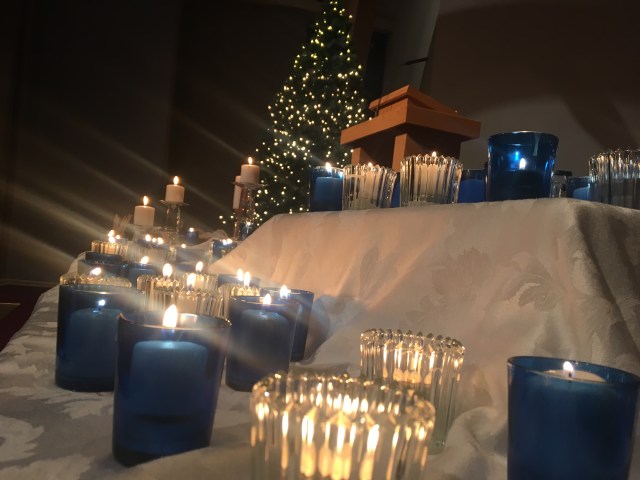
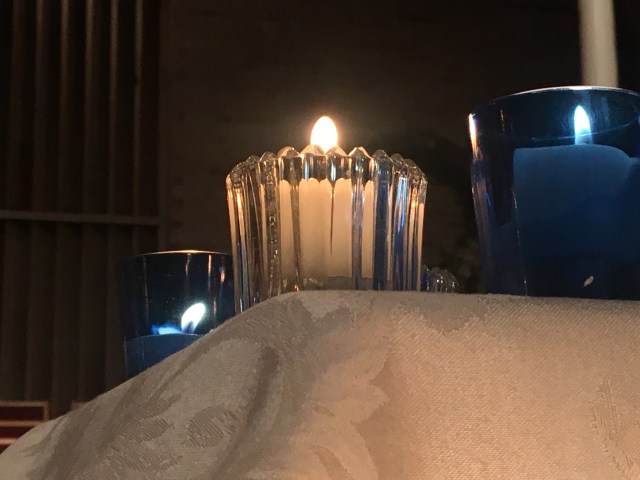
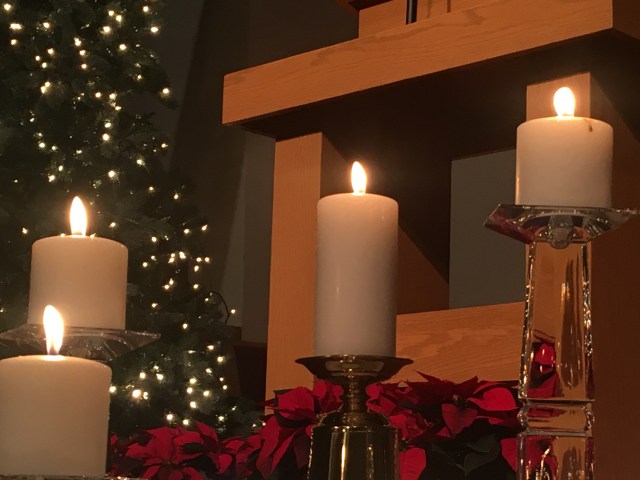
Tonight, our congregation chose to remember these people, to bring a light into dark places this Advent-Christmas. More metaphor than Elvis, we called it, quite simply, Blue Christmas.

Rather than barrel through the weekly lighting of Advent candles, special readings and prayers and favourite songs we thought it best to stop. Stop, to remember those faces no longer in our crowds. The missing pictures on our mantelpieces. Our family gathering a little less Rockwell and a little more Orwell. We spent silent time memorializing them, lighting a candle in their honour. Maybe crying just a little.

Wherever you are in your journey, maybe spend a few moments this season just quietly remembering those no longer there to taste your grandma’s apple pie or mom’s Yorkshire Pudding.

We will remember them.

Blue Christmas.jpg
A Tree of Gratitude

Blue Christmas 5.jpgBlue Christmas 4.jpgBlue Christmas 10.jpg

Blue Christmas 11.jpg